

In this guide
OVO Energy sells a wider range of household tariffs than most large suppliers: a standard variable rate, fixed deals, an EV charging add-on, a smart export tariff and, until recently, specialist products for heat pumps and home batteries. The company is now part of E.ON, following an acquisition announced in May 2026, with existing OVO tariffs to be honoured in full throughout the process1.
The tariff that most distinguishes OVO is Charge Anytime, an add-on rather than a standalone tariff, which sits on top of an eligible OVO electricity tariff and pays a credit for charging an electric vehicle in a controlled window2. One independent guide records the EV charging rate at 14p per kWh3. On the export side, OVO's SEG Beyond Exclusive tariff pays 12p per kWh to customers signed up for OVO Beyond with up to 30kW of installed capacity, against a typical OVO SEG rate of 4.0p4.
Two products have closed. Heat Pump Plus, a specialist electricity tariff for heat pump owners, was withdrawn for new customers from 1 February 20266. Battery Boost, an add-on for homes with a home battery, was discontinued in early 20267.
What OVO Energy tariffs are available
Ofgem groups household energy tariffs into three main types: fixed rate, standard variable tariff and multi-rate9. OVO's range covers all three, plus add-ons that change the rate paid for specific loads rather than replacing the tariff itself.
The standard variable rate is the default. OVO publishes a five-quarter price cap predictions table alongside it, last updated on 8 September 202610. Fixed tariffs sit alongside it, and the OVO SEG Tariff is itself a fixed product on a 12 month term5. Multi-rate products include the time-of-use structures used for EV charging and, historically, for heat pumps.
The add-ons are where OVO's range is broadest. Charge Anytime is described in the company's own terms as "an add-on product to OVO's eligible electricity tariffs"2. That distinction matters: a household does not switch to Charge Anytime, it adds Charge Anytime to whatever eligible tariff it already holds, whether fixed or standard variable3.
On the export side, OVO runs three SEG products at different rates and eligibility conditions, covered below. For a wider view of how supplier ranges compare, UK energy tariffs sets out the categories, and EV charging bolt-ons explains how add-on products differ from standalone EV tariffs.
| Product | Type | Headline rate | Status |
|---|---|---|---|
| Standard variable rate | Variable | Price cap linked10 | Open |
| Fixed tariffs | Fixed | Varies by deal | Open |
| Charge Anytime | EV add-on | 14p per kWh recorded3 | Open |
| SEG Beyond Exclusive | Export | 12p per kWh4 | Open |
| SEG Install Exclusive | Export | 20p or 15p per kWh4 | Open |
| OVO SEG Tariff | Export | 4.0p per kWh5 | Open |
| Heat Pump Plus | Heat pump import | 15p per kWh recorded11 | Closed to new customers6 |
| Battery Boost | Battery add-on | Not stated | Discontinued7 |
Fixed and variable: how OVO's tariff types differ
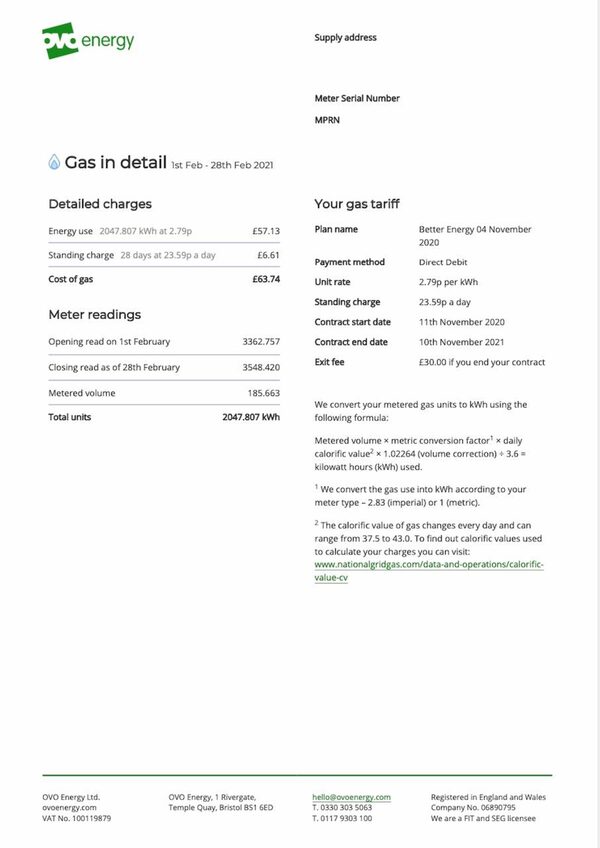
A fixed tariff holds its unit rates and standing charge for a set term. A variable tariff moves, and the guidance is that this usually happens every three months when Ofgem changes the energy price cap, though suppliers are free to change them at any time12. That is the practical difference for a household: a fixed deal converts price uncertainty into a known rate for its term, and a variable tariff tracks the cap.
What happens at the end of a fixed term is set out in OVO's own bill documentation. A sample bill shows the customer being "rolled onto the supplier's standard variable tariff after the tariff end date, which would probably cost them more"8. The same document records exit fees of £50 per fuel, so £100 across electricity and gas, for switching before the final 49 days of the contract, and confirms that from 49 days before the plan end date suppliers should not charge exit fees8. Exit fees and tariff contract terms covers the rules in more detail.
Online tariffs, which OVO sells, can be either fixed or variable, and dual fuel options are available13. Dual fuel means one supplier for both fuels and one bill, which simplifies administration but does not by itself change the unit rates. Dual fuel tariffs explains where that structure helps and where it does not.
For a household weighing independence, the fixed and variable choice is a choice about who carries price risk. A fixed tariff transfers it to the supplier for the term. A variable tariff leaves it with the household, in exchange for the freedom to leave at any time without an exit fee. Neither changes the underlying dependence on the grid and a supplier.
Charge Anytime: EV charging at 10p per kWh, added to any OVO tariff
Charge Anytime is OVO's EV charging product, and its structure is the point. It is an add-on to an eligible OVO electricity tariff, not a tariff in its own right2. A household must already be an OVO customer signed up to a home energy tariff, fixed or standard variable, before it can be added3.
The published rate has moved. One independent guide records the cost of charging an EV with a Charge Anytime plan at 14p per kWh3. The company's own terms, last updated on 2 September 2026, set out what happens outside the controlled window: "Urgent Charging will be charged at your standard OVO energy tariff electricity rate", with no Charge Anytime credit applied2. That is the condition that decides whether the product saves anything in practice, because a household that charges on demand rather than in the controlled window pays its ordinary rate.
The mechanics run through an app. The guidance is to add a Charge Anytime plan to an OVO account and download the OVO Charge app so the vehicle can be smart charged3. The terms add an eligibility restriction: a customer "must not have signed up to any other non-OVO schemes that enter your home or EV into Flexibility Services"2. In other words, the household cannot be paid twice for the same flexibility.
For context on what home charging costs, independent guidance puts a full charge on an EV tariff or other time-of-use tariff at £8, typically requiring a smart meter14. That figure is a general benchmark rather than an OVO rate. Smart charging tariffs covers what supplier-controlled charging involves, and OVO Charge Anytime vs Octopus Go compares the two structures.
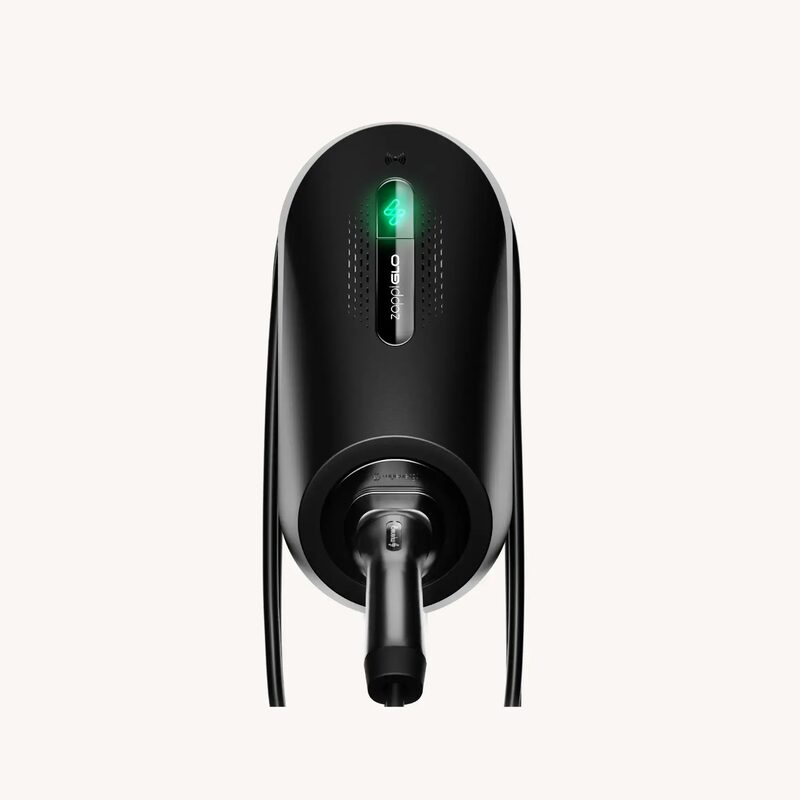
Charge Anytime rates for specific car brands, including 7p for Volvo drivers
OVO has run partner rates for particular vehicle brands. The published Volvo page records an exclusive partner rate of 7p per kWh for smart charging, set against OVO's UK average standard variable rate of 26.34p per kWh at the time16. That is a substantial discount to the standard rate, and it is tied to the brand of car rather than to the household's circumstances.
The general Charge Anytime rate recorded in independent guidance is 14p per kWh3, and the pay-as-you-go add-on rate was recorded at 14p per kWh on 4 November 202517. The gap between 7p and 14p is the value of the brand partnership, and it applies only to drivers of the qualifying vehicles.
Two conditions shape who can use any of these rates. The first is the flexibility restriction in the terms, which prevents a household signing up to another non-OVO scheme that enters the home or EV into Flexibility Services2. The second is vehicle verification: OVO has previously asked to see the V5C for an EV or plug-in hybrid before a customer could move onto an EV product18. That is a document check on ownership, not a credit check.
For a household, the brand rate is the clearest example of a tariff whose value depends on something outside the home: the make of car in the driveway. It reduces the running cost of that vehicle but does nothing for gas use, heating or the rest of the electricity bill. EV tariffs sets out how brand-linked and general EV rates compare across suppliers.
Smart export: the SEG Beyond Exclusive tariff at 12p per kWh

OVO runs three Smart Export Guarantee products at different rates, and the differences are about eligibility rather than about the electricity exported.
SEG Beyond Exclusive pays 12p per kWh to OVO customers signed up for OVO Beyond, with a total installed capacity of up to 30kW4. It has no fixed end date5. The standard OVO SEG Tariff pays 4.0p per kWh on a 12 month fixed term5. SEG Install Exclusive pays 20p per kWh to customers who bought solar panels and a battery through OVO, and 15p per kWh to those who only installed solar panels4. Buying solar and a battery from OVO and having OVO supply the energy is the condition for the Install Exclusive tariff19.
The spread across the market is wide. SEG rates are set by individual suppliers and can be as low as 0.01p per kWh, and as high as 20 to 40p per kWh1. For comparison, one competitor's SEG tariff is recorded at 15p per kWh2. That range is why the export tariff deserves as much attention as the import tariff in a solar household.
For a household with panels, the export rate is the part of the arrangement that turns a cost into an income. It does not reduce dependence on the grid, because the home still imports at night and in winter, but it changes the economics of the array. The Smart Export Guarantee explains the scheme, and SEG export rates compares what suppliers pay.
Heat Pump Plus: suspended for new customers
Heat Pump Plus was OVO's specialist electricity tariff for heat pump owners, recorded at 15p per kWh in independent guidance11. It is no longer open to new applicants. OVO suspended accepting new customers in December 20256, and stopped all new sign-ups as of 1 February 2026, contacting affected customers6.
The product was always narrow. Independent reporting described it as available only as an add-on to customers who install a heat pump through the OVO and Heat Geek offer, or who have a compatible heat pump listed on the OVO website20. Earlier analysis described the OVO heat pump tariff as available only as part of a bundle with a new heat pump, as an introductory offer21. That is a bundled product rather than an open tariff, and the bundle is what has closed.
The trial behind it produced a result worth recording. OVO, with Nesta and Kaluza, published findings from a three-month trial of 58 households on Heat Pump Plus showing that automatic heating shifts cut peak electricity demand by 30%6. That is a demand-shifting result, not a price result, and it says nothing about what an individual household would save.
For heat pump owners looking at tariffs now, independent guidance is to look for a dynamic tariff or a heat pump tariff22. Heat pump electricity tariffs covers what remains available across suppliers, and heat pump time-of-use tariffs explains how a time-of-use structure interacts with a heat pump's running pattern.
Battery Boost: discontinued
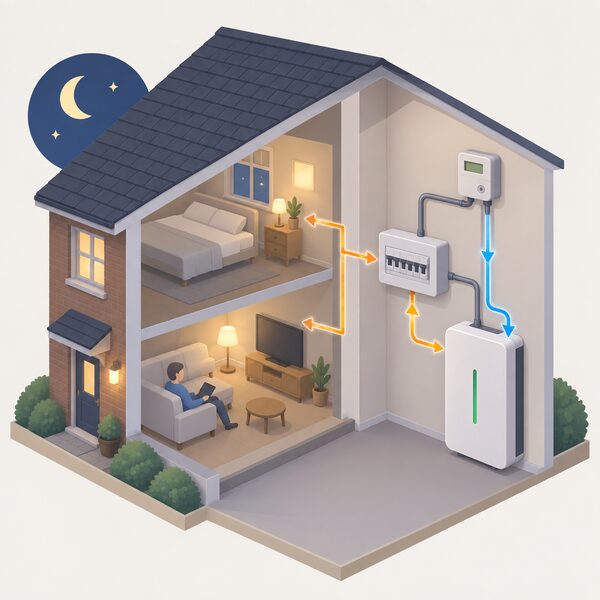
Battery Boost was OVO's add-on for homes with a home battery, and it has been withdrawn. The add-on was no longer available after January 20267, and was discontinued in February 20267. Households that held it have lost the product; households considering a battery now cannot apply for it.
The closure matters because battery add-ons are one of the few tariff structures that pay a household for shifting energy in both directions. A battery can absorb cheap overnight electricity and either use it later or export it, and a supplier product that rewards that behaviour changes the payback calculation for the battery itself. With Battery Boost gone, an OVO household with a battery is left with the standard import tariff and a SEG export tariff.
The OVO SEG Tariff does accept battery storage: the scheme listing records battery storage as included, with a 12 month fixed term, a 4.0p rate and payments every three months5. That is an export arrangement rather than a battery-specific import product. Exporting from a home battery covers how battery export is treated under the Smart Export Guarantee, and home battery time-of-use explains how a battery pairs with a time-of-use import tariff.
Rewards, the app and eligibility: what to check before switching
OVO's Beyond loyalty programme sits behind the best export rate. SEG Beyond Exclusive requires the household to be signed up for OVO Beyond, and pays 12p per kWh against the 4.0p on the standard OVO SEG Tariff4. In April 2026 OVO promoted Beyond rewards for the new tax year, highlighting prize draws, partner discounts, banked solar panels, EV miles and heating credit offers23. The programme is therefore both an eligibility condition for a tariff and a rewards scheme in its own right.
The app side is straightforward. The OVO Charge app is the route for smart charging under Charge Anytime3. A free Energy Saver App is also available to households through the Low Carbon Hub24. Neither carries a stated subscription charge in the published material, but both depend on a working internet connection and, in the case of supplier apps, on the supplier's systems being available.
Eligibility checks vary by product. Charge Anytime requires an existing OVO home energy tariff, fixed or standard variable3, and excludes households enrolled in other flexibility schemes2. EV products have previously required a V5C18. OVO accepts direct debit, cash or cheque, and prepayment customers25.
On service quality, Ofgem's July to August 2025 survey of customers' satisfaction with their supplier drew 314 OVO Energy responses, including SSE26. Citizens Advice scored OVO 2.5 out of 5 for fewer complaints received in January to March 202625. Ofgem has also recorded 2,372 OVO Energy customers overcharged in a price cap compliance decision27.
For Feed-in Tariff enquiries, OVO Electricity Ltd publishes a separate contact route: 0330 102 7421 and fits@ovoenergy.com30. General pay monthly contact is 0330 303 5063, prepayment is 0330 175 9669, and there is a mobile hotline on 01173 326 94525.
On supply mix, OVO's overall fuel mix was 6% zero carbon, with 4% from renewables, over 2024-04-01 to 2025-03-3131. The Greener Electricity bolt-on is 100% renewable31, and OVO's own figure for renewable share is 11%25. All EV tariffs currently available offer 100% renewable electricity32. That is a supply-mix claim about certificates rather than about electrons, and it does not change the physical dependence on the grid.
For a household, the independence position is this: OVO supplies electricity and gas through the grid, so the home remains dependent on a supplier and on network infrastructure whatever tariff it holds. Charge Anytime reduces the cost of EV miles but adds a dependence on an app, a charge point and the supplier's control systems. The best export rate depends on holding a loyalty programme membership. The heat pump and battery products that once offered something more tailored have closed. Tariffs and household energy independence sets out what a tariff can and cannot change.
Sources32 cited
- E.ON and OVO acquisition announced, Uswitch, 2026
- Charge Anytime terms, OVO Energy, 2026
- EV energy tariffs: OVO, Uswitch, 2025
- Smart Export Guarantee rates: the best and worst SEG tariffs, Which?, 2026
- Smart Export Guarantee, Solar Energy UK, 2026
- Heat Pump Plus tariff: what's happening, OVO Energy forum, 2026
- Best SEG rates, Sunsave, 2026
- How do I read my OVO Energy bill?, Uswitch, 2025
- Understand your electricity and gas bills, Ofgem, 2026
- Standard variable rate tariffs, OVO Energy, 2026
- Heat pumps vs boilers, Which?, 2025
- How to switch energy supplier, Which?, 2026
- Types of energy tariff, Confused.com, 2025
- Electric vehicles: debunking myths, Energy Saving Trust, 2025
- Smart charging electric vehicles, Energy Saving Trust, 2025
- Charge Anytime for Volvo drivers, OVO Energy, 2025
- Charge Anytime monthly plans, OVO Energy, 2025
- Best energy providers for EV owners, Carwow, 2021
- Solar panel costs, Which?, 2026
- A heat pump might be a lot cheaper than you think, Which?, 2024
- Future of energy retail report, Nesta, 2024
- Tariffs for renewable technology, Energy Saving Trust, 2026
- Spring clean your spending: OVO Beyond, OVO Energy, 2026
- Cap Zero retrofit, Low Carbon Hub, 2025
- OVO Energy details, Citizens Advice, 2026
- Customers' satisfaction with their supplier, Ofgem, 2025
- Supplier compliance: price cap requirements, Ofgem, 2025
- How to get help with energy bills, Confused.com, 2025
- Energy bills help, Scope, 2026
- Feed-in Tariff licensee contact details, Ofgem, 2026
- Green energy, Uswitch, 2024
- Electric cars and energy bills, Uswitch, 2026
 OVO EnergyOVO Energy supplies gas and electricity to homes across Britain and is being taken over by E.ON.