

In this guide
Heat Geek is a training network and an installer directory, not a manufacturer. It trains heating engineers to a published standard and then lists those who pass on a map that householders can search, with the strongest entries carrying Verified or Elite status1. Nothing about the badge changes what is fitted in a home: the equipment still comes from a heat pump maker, and the certification that unlocks government grant money still comes from the Microgeneration Certification Scheme.
That distinction matters when comparing quotes. A Heat Geek installer is a route to a designed, monitored installation with a performance guarantee attached, and the network's public focus is air source heat pumps, including high-temperature units fitted with as few other changes as possible2. The guarantee is the part that separates it from a standard quote: a minimum seasonal coefficient of performance of 3.5, checked digitally after commissioning.
The money side is straightforward. An air-to-water heat pump costs around £11,000 to install, and the Boiler Upgrade Scheme provides a grant of £7,500 towards it3. The £7,500 grant covers nearly 60% of the average cost of installing a heat pump, based on the average cost in 20234. What remains is quoted by the installer, and the spread is wide.
What Heat Geek is, and what it is not
The network sits in the same part of the market as any other installer directory, but with a training arm attached. Engineers go through a course, and the directory lists those who have completed it. Independent guidance on choosing a heat pump installer describes the practical use of the map plainly: a householder can look for those with Verified or Elite status on Heat Geek's map of trained installers1.
What the network does not do is certify installations for grant purposes. That is a separate function. The Boiler Upgrade Scheme requires eligible heat pumps to meet a minimum seasonal coefficient of performance rating of 2.8, and the installer has to be approved under the scheme5. Certification of the work itself runs through MCS, and the installation contractor must register the energy device with MCS's installation database within 10 days of installation where they are MCS certified6.
So a Heat Geek badge and an MCS certificate answer different questions. The badge speaks to how the installer was trained and how the network vets them. The certificate speaks to whether the installation meets the standard that unlocks grant funding and building sign-off. A household comparing quotes needs both, and neither substitutes for the other.
There is also a consumer protection layer that has nothing to do with either. Independent guidance on heating controls advises making sure the installers you speak to are certified with a scheme like TrustMark7. HIES accredited installers go through verified qualifications and certifications8. Which? Trusted Trader heating engineers have all been through a rigorous vetting procedure to prove their expertise and quality of work before qualifying for Trusted Trader status9. These are parallel checks, and a household can use them alongside the network's own status markers.

Verification: how Verified and Elite status is earned

The network's own map is the place the status appears, and it is the marker independent guidance points to when advising households on how to pick a fitter1. The two tiers exist to separate installers who have completed training from those who have gone further, and the practical advice to a householder is to look for one of the two badges rather than an unbadged entry1.
It is worth being precise about what a badge of this kind can and cannot tell you. It is not a government scheme, not a certification body and not a guarantee underwritten by a regulator. It is a network's own assessment of its members. That is a meaningful signal, because the network has an interest in the quality of work done under its name, but it is not the same as an accreditation with a statutory footing.
The wider market has several of these layers, and they are worth knowing because they are what a household can actually check. The European Heat Pump KEYMARK Scheme certificate is maintained and held in force through periodic review and verification10. The Warm Homes Local Grant requires all installers working on the scheme to be subject to a rigorous vetting and onboarding process, including checks on qualifications, accreditations, insurance, health and safety standards and customer satisfaction11. Independent research into clean heat neighbourhood schemes found participants wanted reassurance through online reviews such as Checkatrade or word-of-mouth recommendations12.
Training standards: 120 hours and a 100% pass mark
The network's training is built around a long course with a demanding assessment, and the wider industry context explains why. The Heat Pump Association upskilling course can be completed in under a week13, which sets a much lower bar than a 120 hour programme with a full pass mark. The two are aimed at different things: a short course brings an existing heating engineer up to speed on heat pumps, while a longer programme is intended to produce a designer as well as a fitter.
The industry needs both, and the numbers show the scale of the gap. NAPIT has already trained over 500 installers under the Heat Training Grant14. The government target reported by MCS is 600,000 heat pump installations a year by 2028, and the UK Government target is the same figure15. Meeting that from a standing start requires a training pipeline far larger than any single network.
Training also has a paperwork consequence that households feel. Where work is notifiable, the certificate must be delivered within 30 days of the work being completed, by the installer or the installer's registration body16. MCS certified installation contractors must register the energy device within 10 days of installation6. A well trained installer is more likely to get these steps right, and a missed registration is one of the more common ways a household ends up without the paperwork it needs for a grant or a sale.

The £250 design consultation and what it buys
A design consultation is a paid visit and specification exercise, charged before any installation work is agreed. It is not a sales survey. The output is a system design: heat loss calculation, emitter sizing, flow temperature target and a specification for the unit.
Independent research on heat pump quotations shows how design fees appear in practice. One example quote of £5,300 from Pumpio includes £2,000 for the unit, £2,400 for installation, £600 electrical, and £400 design2. A second example, a £4,900 quote from Helios Heating for a 12 kW air source system, breaks down as £2,000 for the unit, £2,000 for installation, £600 electrical and £300 for design2. Design is a real line item in both, and it is a small share of the total.
The same research found a homeowner willing to pay for certainty: one respondent said they would be happy to pay £300 extra on the installation for the added peace of mind2. That is the case for a paid design stage in a householder's own words. The fee buys a specification that a fitter can be held to, rather than a verbal estimate.
Whether the fee is credited back against the installation price depends on the individual installer's terms, and it is worth asking before booking. What the fee does not do is commit a household to proceed, and it does not by itself make the installation eligible for a grant.
Performance guarantee: SCOP of 3.5, monitored and fixed free

The guarantee is the network's most distinctive offer. It commits to a minimum seasonal coefficient of performance of 3.5, with digital monitoring after commissioning and a commitment to put right a system that falls short, at no charge.
To see how far above the baseline that sits, compare it with the scheme rules. Boiler Upgrade Scheme eligible heat pumps must have a minimum seasonal coefficient of performance rating of 2.85. The Domestic Renewable Heat Incentive required all heat pumps to have a minimum Seasonal Performance Factor of 2.517, and Ofgem's guidance for that scheme states heat pumps must have a minimum Seasonal Performance Factor of 2.518. A guarantee at 3.5 is a materially higher bar than either.
The monitoring is what makes the guarantee enforceable rather than aspirational. Government research on heat pump systems observed during home visits found that across the systems observed, settings consistently remained as the installer had left them19. That finding cuts both ways: it shows that a good commissioning setup tends to persist, and it shows that a poor one does too. Continuous monitoring is how a shortfall gets caught.
"I would be happy to pay £300 extra on the installation for the added peace of mind."
Costs after the Boiler Upgrade Scheme grant
The headline figures are the grant and the typical installation cost. Air-to-water heat pumps cost around £11,000 to install, but the Boiler Upgrade Scheme provides a grant of £7,5003. The £7,500 grant covers nearly 60% of the average cost of installing a heat pump, based on the average cost in 20234. The gap between the two figures is the household's share, and it is quoted by the installer rather than published.
The scheme is also expanding. The government has consulted on beginning to provide grants to support the installation of heat batteries with a value of £2,500, once appropriate product, design and installation standards have been implemented20. Heat batteries are a different product from a heat pump, and the £2,500 figure is a proposal rather than a payment a household can claim today.
| Item | Figure | Basis |
|---|---|---|
| Air-to-water heat pump installation | around £11,000 | Independent guidance, 20263 |
| Boiler Upgrade Scheme grant | £7,500 | Independent guidance, 20263 |
| Grant as share of average 2023 cost | nearly 60% | Official legislation, 20234 |
| Proposed heat battery grant | £2,500 | Official consultation, 202520 |
| Example design fee in a quote | £300 to £400 | Independent research, 20262 |
VAT treatment is not stated in these figures, so they should be read as quoted rather than as confirmed VAT-inclusive prices. The 0% rate on installing energy-saving materials including heat pumps is time limited, and the position after that date is a matter for the tax rules rather than the installer.
Vaillant, Quiet Mark and what the network specialises in
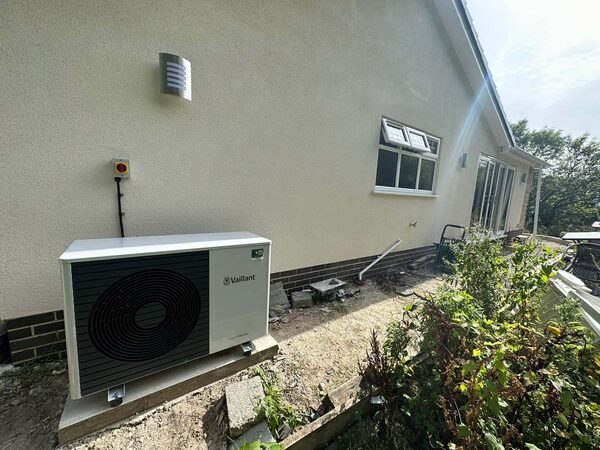
The network's public specialism is air source work, and specifically the high-temperature end of it. Services such as Octopus Turbo and Heat Geek Zero Disrupt focus on installing high-temperature heat pumps while limiting other changes21. That is a meaningful proposition for a household that wants to keep its existing radiators and pipework rather than commission a full retrofit.
Quiet Mark certification appears in the wider market for the equipment side. InstaGroup is listed as supported by a nationwide installer network22. Quiet Mark certification is a noise marker on specific products rather than a statement about the installer.
Ground source is a different matter. For ground source heat pumps there is extra work involved, including digging trenches or boreholes23. Installing a ground source heat pump is not a DIY job, and independent guidance says sizing, design and installation should be done by a suitably qualified professional, with a Microgeneration Certification Scheme certified installer sought24. The installation of a ground source heat pump typically takes one to two days for a professional installer to complete, once the groundworks are done24. A network built around air source work is not the obvious route to a borehole.
Where Heat Geek installers cover
The network is described as nationwide in the wider installer market, with InstaGroup listed as supported by a nationwide installer network22. Coverage of that kind is a directory claim rather than a guarantee of a local fitter, and the practical check is whether a trained installer is available for the property's postcode.
For a household, the coverage question connects to the grant process. The application is installer-led, with the installer applying for the grant on the property owner's behalf25. Homeowners do not need to apply directly, an approved heat pump installer will submit an application on their behalf26. Your installer will apply for the grant on your behalf through Ofgem27. The installer discounts the grant from the invoice, applies to Ofgem for a grant voucher, and redeems the voucher after installation and commissioning25.
That sequence means the installer's own approvals matter more than the network badge. Independent guidance recommends getting quotes from at least three certified different installers who are with the Microgeneration Certification Scheme23. A household comparing a Heat Geek quote with two others is doing the check that the guidance actually asks for.
What a household should expect in practice

A heat pump installation typically carries two layers of guarantee: a manufacturer's warranty covering the equipment itself, and an installer's guarantee covering the quality of the workmanship and the installation as a whole28. Both should be in writing before work starts, and they have different parties behind them.
The handover stage has its own checklist. Have all instruction signs and labels been installed?29 is one of the items on the official project completion list, and it is the kind of detail that separates a commissioned system from one that was simply switched on. A monitored installation with a performance guarantee depends on that stage being done properly.
The independence picture is mixed, and it is worth stating plainly. A heat pump moves a home off gas and off a gas supplier, which is a real gain in energy sovereignty. What remains is an electrical dependence: the system runs on grid electricity from a supplier, and the performance guarantee depends on digital monitoring, which in turn depends on the controls and connectivity staying in place. The design and the commissioning are what determine whether the guarantee is met, and those are done once, by people.
Sources29 cited
- Heat pumps advice, CAT, 2025
- Would performance guarantees increase consumer confidence in heat pumps, Nesta, 2026
- Electric heating advice, Centre for Sustainable Energy, 2026
- Public Accounts Committee report, UK Parliament, 2023
- Boiler Upgrade Scheme: installers, Ofgem, 2026
- Register energy devices in homes or small businesses, GOV.UK, 2021
- Thermostats and heating controls, Energy Saving Trust, 2026
- HIES homeowners, HIES, 2026
- How we assess boilers, Which?, 2025
- European Heat Pump KEYMARK certificate, Heat Pump KEYMARK, 2025
- Oxfordshire expands support to make homes warmer, Oxfordshire County Council, 2026
- Household preferences for clean heat schemes, Nesta, 2025
- Heat pump upskilling evidence, UK Parliament, 2022
- NAPIT welcomes clarity in the Warm Homes Plan, NAPIT, 2026
- Heat Pump Ready Programme stream 2 projects, GOV.UK
- Approved Document L Volume 1 consultation, Welsh Government, 2025
- Domestic RHI Essential Guide, Ofgem, 2024
- Domestic RHI: eligible heating systems, Ofgem, 2026
- Clean heat transition report, GOV.UK, 2026
- Boiler Upgrade Scheme and certification requirements for clean heat schemes, GOV.UK, 2025
- How to get homes more ready for heat pumps, Nesta, 2026
- InstaGroup, Quiet Mark, 2026
- Air source heat pumps vs ground source heat pumps, Energy Saving Trust, 2026
- Installing a ground source heat pump, Which?, 2025
- Boiler Upgrade Scheme, Find government grants, 2026
- £5 million to help Welsh households invest in greener homes, Welsh Government, 2026
- Heat pumps, GOV.UK, 2026
- Heat pump certifications, CPA, 2026
- Heat pump project completion, Local Energy Scotland, 2026