
In this comparison
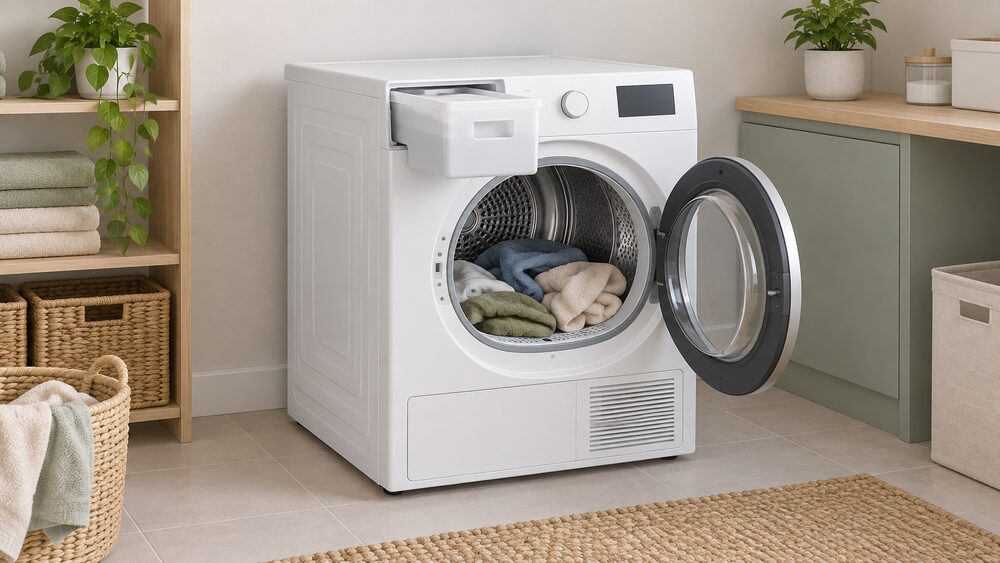
Three dryer types are still weighed up by UK households, but the market has moved decisively towards one of them. Heat pump tumble dryers recycle the warm air inside the drum, and that single design difference is why they use considerably less electricity than older vented models1. Which? testing in the past year covered more than 70 heat pumps, just four condenser models and no vented dryers at all, which tells you where the retail range now sits2.
The running cost gap is the headline. The average heat pump tumble dryer adds around £54 a year to energy bills, against about £100 for a condenser, based on three full loads a week on cotton and cupboard dry settings at the July energy price cap of 26.11p/kWh2. Which? has separately put heat pump dryers at an average of £50 a year, and at £57 in an earlier press release3. The purchase price runs the other way: independent guidance is that heat pump dryers are generally more expensive to buy but much cheaper to run4.
What follows is how each type dries, what it costs, where it can be installed, what maintenance it needs, and what a dryer does and does not do for a household's energy independence.
Condenser, vented or heat pump: which fits which home
The three types differ in where the moisture goes, and that determines which homes they suit.
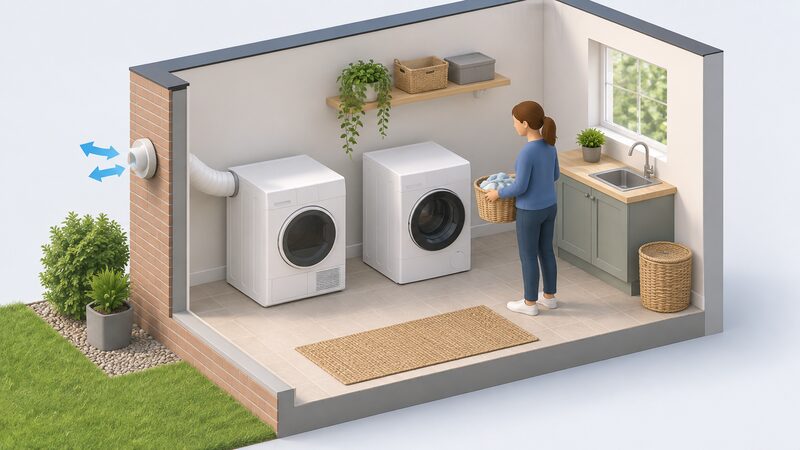
A vented dryer pulls air from the room, heats it, tumbles it through the laundry and pushes the damp exhaust outside through a hose or duct. It needs an external wall, a window vent kit or a permanent duct, and it draws replacement air from the room, so it works best in a utility room, garage or outbuilding where that air loss does not matter.
A condenser dryer keeps the air inside the machine. It repeatedly heats cold air, usually to a maximum of 70 to 75°C, passes it through the drum, then cools it so the moisture condenses out into a tank or a drain2. No external vent is needed, so it can sit anywhere with a power supply and somewhere to put the water.
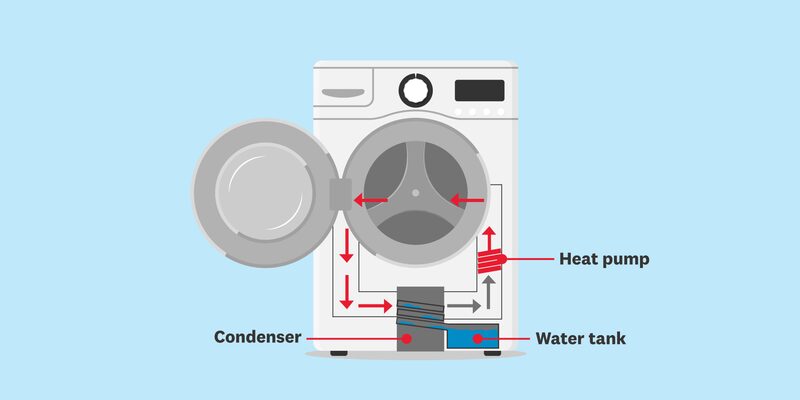
A heat pump dryer is a condenser in principle but runs far cooler. It recycles the warm air for better efficiency, whereas condensers do not reuse that hot air, so they use much more energy when running2. The drum does not tend to get hotter than around 50°C2.
The practical fit follows from that. Vented suits a home with a spare external wall and no wish to handle water. Condenser suits a flat or an internal room with no vent route. Heat pump suits almost any position, because it needs neither a vent nor, on many models, manual tank emptying, and it is the type now dominating the shops.
| Vented | Condenser | Heat pump | |
|---|---|---|---|
| Where the moisture goes | Outside through a hose or duct | Condensed into a tank or drain | Condensed into a tank or drain |
| External vent needed | Yes | No | No |
| Drum temperature | Not stated | Maximum of 70 to 75°C2 | No hotter than around 50°C2 |
| Average running cost | Not stated | About £100 a year2 | Around £54 a year2 |
| Drying time | Not stated | Baseline | Can take almost twice as long2 |
| Water tank to empty | No | Yes, unless drained | Yes, unless drained |
| Circuit demand | 11.0 A5 | 11.0 A5 | Not stated |
How each type dries: where the moisture goes
The mechanics are worth understanding because they explain both the running cost and the drying time.
In a vented dryer, moisture leaves the building as vapour. That is simple and effective, but it means heated indoor air is thrown away with it, and the replacement air has to be warmed again by the home's heating.
In a condenser dryer, the damp air is cooled so the water condenses and collects. The principle is the same one used in refrigerant dehumidifiers, which draw in moist air and pass it over cold coils, so moisture condenses on the coils and collects in a water tank or drains away6. The heat released in condensing is not captured for the next load, which is why condensers use much more energy when running2.
A heat pump dryer closes the loop. The condenser is a high-temperature heat exchanger where the refrigerant enters as a high-temperature vapour, rejects heat to the heat sink by condensation at a high pressure and leaves as a high-temperature liquid7. In a dryer, that rejected heat goes back into the drum air rather than out of the building. Most heat pumps use an electrically driven compressor8, and the higher the temperature difference between the heat source and the target heat, the harder the compressor works and the more electricity it requires9. Running the drum cooler is therefore not a compromise but the mechanism of the saving.
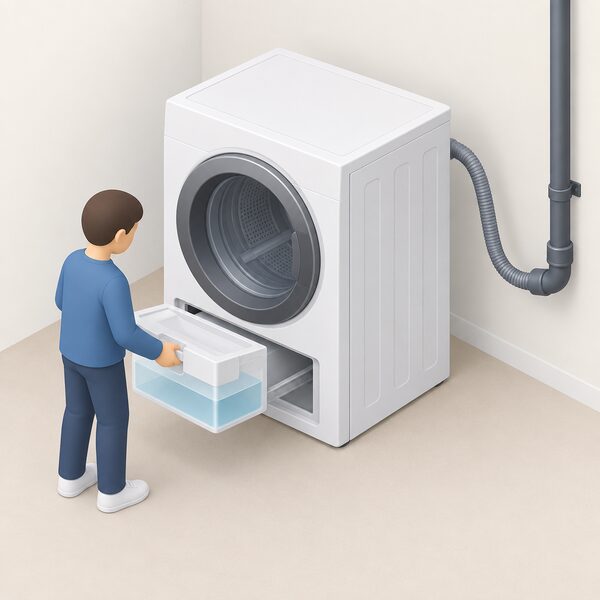
The moisture still has to go somewhere. It collects in a tank or, where a drain hose is fitted, goes straight to the waste pipe. Nothing is vented to the outside on a condenser or heat pump machine.
Running costs: why heat pump dryers use far less electricity
The gap between the types is large enough to change a household's electricity bill, and it comes from one design choice.
Which? measured the average heat pump tumble dryer at around £54 a year, against about £100 for a condenser, on three full loads a week at the July energy price cap of 26.11p/kWh2. Earlier Which? figures put heat pump dryers at £50 a year on average and at £57 on average respectively3. The variation reflects the price cap in force when each figure was calculated and the test load assumed, not a disagreement about the direction of travel.
The extreme case shows how wide the spread runs. Tests by the consumer champion found a Hoover HLEV10LG vented tumble dryer would cost over five times as much to run as the most energy-efficient heat pump3. That is a comparison between the worst vented machine tested and the best heat pump, not between averages, but it illustrates the range.
Two other figures put the dryer in context. Independent guidance states that the latest heat pump tumble dryers use considerably less electricity than older vented models10. And on laundry generally, doing a wash at 30 degrees instead of 40 makes it 38 per cent cheaper according to Which? tests, a saving that applies to washer dryers and condenser tumble dryers as well3.
The dependence that remains is on electricity, and on whatever generates it. A heat pump dryer lowers the amount drawn, but it does not remove the household from the grid or from a supplier. It reduces exposure to price, which is a different thing from independence.
Drying time and temperature: what each type means for your laundry

Lower temperature is the trade-off for lower running cost, and it shows up as time.
Heat pumps can often take almost twice as long to dry the same amount of clothing in tests2. A condenser, running at 70 to 75°C, drives moisture out faster; a heat pump at around 50°C takes longer to remove the same water2. The pattern mirrors heat pumps in heating generally, where unlike gas boilers, heat pumps operate at lower temperatures over longer periods11.
For laundry, the practical consequences are fabric care and scheduling. A cooler drum is gentler on fibres and on anything with elastane or a care label that warns against high heat. The cost is that a load started in the evening may not finish before bed, and a household used to back-to-back loads will find the machine occupied for longer.
There is a regulatory dimension to temperature as well. For household washing machines and washer dryers, the maximum temperature reached for 5 minutes inside the laundry being treated is a defined measurement point in the ecodesign rules12. That is a washing requirement rather than a drying one, but it shows that cycle temperature is a regulated characteristic, not a marketing claim.
Where a household's main constraint is time rather than money, a condenser or vented machine will finish sooner. Where the constraint is the electricity bill, the heat pump's slower cycle is the price of the saving.
Installation and placement: venting, tanks and drainage
Placement is where the three types diverge most sharply, and it is often the deciding factor in a flat or a small house.
A vented dryer needs a route to the outside. The principle is the same as for portable air conditioning, which needs to be properly vented to the outside using a special fitting for the window; if the vent is just put through an open window, heat comes back in13. A permanent duct through a wall or a sealed window kit avoids that, but it fixes the machine's position.
A condenser or heat pump dryer needs no vent. It needs a power supply, clearance for airflow, and either a tank to empty or a drain connection. Because the heat pump version recycles air rather than expelling it, airflow around the unit matters more than it does for a vented machine.
Built-in installation is possible for heat pump dryers. A Haier-branded built-in heat pump tumble dryer is a product type that exists on the UK market14. Clearance and ventilation requirements for a specific model come from the maker's installation instructions.
Electrical demand is similar across the types. A condenser or vented tumble dryer draws 11.0 A5, which is a substantial load and one reason dryers are usually on their own circuit rather than sharing a ring with other high-demand appliances.
Upfront price versus lifetime cost
Purchase price and running cost pull in opposite directions, and the balance depends on how much the machine is used.
Independent guidance is that heat pump tumble dryers are generally more expensive to buy but much cheaper to run4. The running cost figures above show the scale of the annual difference: around £54 against about £100 on the same assumptions2. Over a decade of heavy use, that gap is substantial; over occasional use, it is not.
The wider evidence on heat pumps as a category shows how lifetime cost is usually distributed. Upfront, running and installation cost make up approximately 15 to 20 per cent, 55 to 65 per cent and 20 per cent respectively of the total cost of a heat pump over its lifetime, according to a NESTA estimate15. Running cost, not purchase price, dominates the lifetime total. One worked example puts a heat pump at £10,000 upfront plus £130 a year for 15 years, a total lifetime cost of £11,95016.
Whole-life comparisons against gas boilers vary by house type and by whether a grant is applied. For a large detached house from 2022, one analysis found a heat pump £90 a year cheaper than a gas boiler with a £5,000 grant, and £240 a year more expensive with a high efficiency system17. For a medium terraced house, the heat pump was £190 a year more expensive with a high efficiency system17. The direction depends on the property and the assumptions, which is why no single figure settles the question.
For dryers specifically, prices are installer and retailer quoted, and no published price range is available here. The decision rests on the running cost difference and how many loads a week the household actually dries.
Maintenance: filters, condensers and water tanks
Maintenance differs by type, and neglecting it costs efficiency.
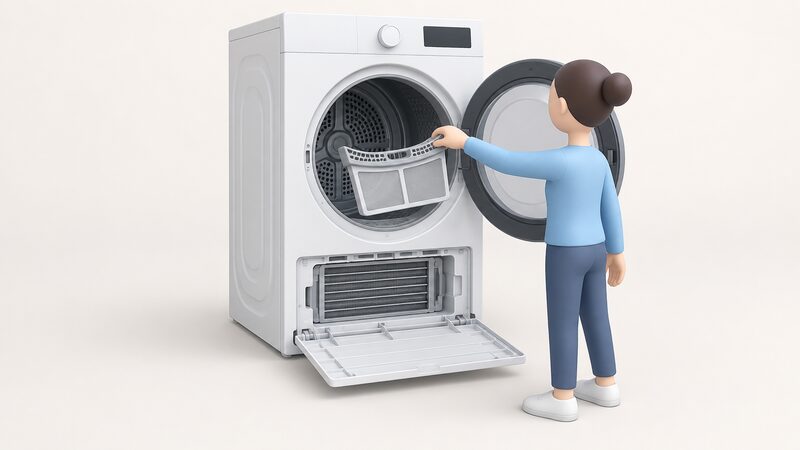
All three types have a lint filter, usually in the door aperture or the front of the drum, which should be cleared regularly. A blocked filter restricts airflow and lengthens drying time on any machine.
Condenser and heat pump dryers add a second cleaning task. The condenser or evaporator collects lint and dust that passes the first filter, and a fouled heat exchanger cannot condense moisture or, on a heat pump, transfer heat efficiently. Cleaning it periodically is part of keeping the running cost figures above achievable in practice.
Water handling is the third difference. A condenser or heat pump dryer collects water in a tank that must be emptied, unless a drain hose is fitted so it goes straight to waste. A vented dryer has no tank at all, because the moisture leaves through the duct.
- After every load: clear the lint filter on any type.
- Periodically: clean the condenser or evaporator on a condenser or heat pump machine.
- As needed: empty the water tank, or fit a drain hose so it empties itself.
- Vented machines: check the duct for blockages and keep the external outlet clear.
What a dryer adds to household energy independence
A tumble dryer is a load, not a source, and it is worth being plain about that.
What a heat pump dryer does is cut the electricity that load draws. Independent guidance states that the latest heat pump tumble dryers use considerably less electricity than older vented models10, and the measured running cost difference, around £54 against about £100 a year, is the size of the gain2. For a household watching a price cap, that is a real reduction in exposure.
What it does not do is remove dependence. The machine still runs on grid electricity from a supplier, and its efficiency depends on a compressor, a sealed refrigerant circuit and, on some models, electronic controls. Repairs outside warranty generally require a manufacturer's parts and, often, a manufacturer's engineer. That is a different kind of dependence from a gas supply, but it is dependence.
The comparison with home heating is instructive. Heat pumps are up to 3 times more efficient than other heating systems according to Welsh Government guidance19, and a typical modern condensing gas boiler has an efficiency of 0.9, compared to 2.4 for an air source heat pump and 3.4 for a ground source heat pump20. The same physics that makes a heat pump boiler efficient makes a heat pump dryer efficient: moving heat rather than generating it.
For a household building independence, the sequence is to reduce the load first, then consider what supplies it. A heat pump dryer reduces the load. Whether the remaining electricity comes from the grid, a supplier's green tariff or a home array is a separate decision, and one that sits with the wider steps set out in how to take more control of your home's energy. Laundry temperature choices, such as washing at 30 degrees rather than 40, stack with the dryer's efficiency to cut the total3.
Sources20 cited
- Why no one should mourn the condenser dryer, Which?, 2026-06-10
- The tumble dryer ban: what does it mean for you, Which?, 2026-07-09
- Which? warns against buying cheap appliances that rack up huge energy bills, Which?, 2023-11-09
- New energy efficiency labels for tumble dryers in Northern Ireland, Energy Saving Trust, 2026-05-20
- Ratings of electrical appliances, Electrical Safety First, 2026-09-19
- Dehumidifiers, Electrical Safety First, 2026-09-19
- How a heat pump works, Heat Pumping Technologies, 2025-09-26
- Heat pump methodology, GOV.UK, 2026
- Electricity network constraints and the new build heat standard, Scottish Government, 2021-10-07
- Top energy savings tips, National Energy Action, 2026-07-13
- Is your home suitable for a heat pump, CPA, 2026-02-18
- Ecodesign requirements for household washing machines and washer dryers, legislation.gov.uk, 2019-03-11
- How to keep your home cool in hot weather, Centre for Sustainable Energy, 2026-07
- Product safety report: Haier heat pump tumble dryer, GOV.UK, 2025-05-20
- EINAS 2025: heat and buildings, GOV.UK, 2025-06
- Heat pumps on subscription, ClimateXChange, 2024-02-21
- How the costs of heat pumps compare to gas boilers since the energy crisis, Nesta, 2022
- Product recalls and alerts, GOV.UK, 2022-04-07
- Your essential guide to heat pumps, Welsh Government, 2025-02-20
- Heat in buildings strategy, Scottish Government, 2021-10
 Hot Water CylindersWhich hot water cylinder suits your home, and what is the real difference between a vented one, an unvented one and a thermal store?
 Which Homes Suit a Heat PumpMost UK homes can have a heat pump fitted, so the real question is whether yours makes it easy or expensive.
 Air-to-Water Wet SystemsAir-to-water heat pumps feed radiators, underfloor heating and a hot water cylinder, and are the most common domestic heat pump in the UK.
 Monobloc and Split Heat PumpsWhich heat pump suits your home, a monobloc or a split?
 Using a Heat Pump for CoolingCan a heat pump cool your home in summer as well as heat it in winter?
 The Full Heat Pumps GuideWill a heat pump keep my house warm in winter, and what does one cost to buy and run?