
In this comparison
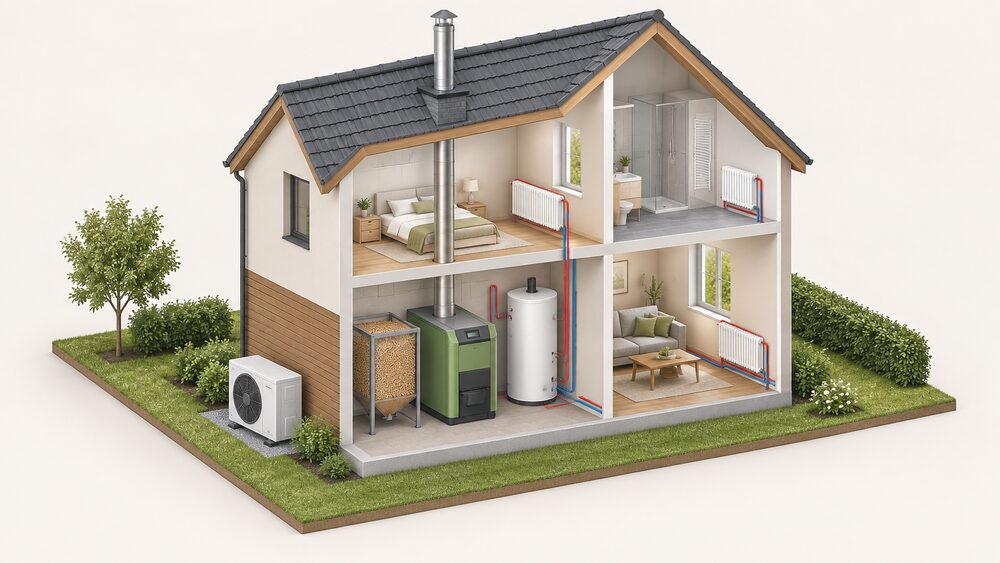
A heat pump and a biomass boiler are the two technologies the Boiler Upgrade Scheme funds for a home that is off the gas grid, and they are the two most different ways of heating a house that the same grant can buy. One runs on electricity and moves heat from the air or the ground. The other burns wood and makes heat on site. Both must provide space heating and hot water, and both must be capable of meeting the full demand of the property1.
The grant position is the first thing households compare. The scheme pays £7,500 off the cost and installation of an air source heat pump and £5,000 off a biomass boiler1. For eligible off-gas grid properties replacing oil or liquefied petroleum gas, an air source or ground source heat pump can attract an uplifted grant of £9,000, a figure that does not extend to biomass2. One grant is available per property, and the scheme runs in England and Wales only1.
The efficiency gap is the second. Government guidance states heat pumps are typically more than three times as efficient as a gas boiler, and the Climate Change Committee puts the figure at around three to four times3. The same guidance notes the energy needed can be less than a third of that required by a gas boiler to produce an equivalent amount of heat5. A biomass boiler has no equivalent multiplier: it converts wood into heat at a rate set by the appliance and the fuel.
What each technology offers a UK household
The Boiler Upgrade Scheme offers upfront capital grants to property owners to install heat pumps and, in limited circumstances, biomass boilers, replacing fossil fuel heating with a focus on off-gas grid homes8. Biomass is the narrower route by design. Ofgem guidance states biomass boilers may only be installed in properties in rural areas, and the emissions certificate must show particulate matter no higher than 30g/GJ net heat input and NOx no higher than 150 g/GJ net heat input2. A heat pump carries no such location restriction.
Both technologies must distribute heat using a liquid, and both must provide space and hot water heating to the property9. That rules out warm air systems and any biomass stove that heats one room. The eligible technologies under the scheme are air-to-water heat pumps, air-to-air heat pumps, ground source heat pumps including water source heat pumps and shared ground loops, and biomass boilers2. Air-to-air heat pumps are eligible for residential properties only, and self-build properties are eligible for heat pumps only2.
Take-up tells its own story. Since the scheme launched, air source heat pumps account for 67.4% of accreditations, ground source 13.2%, biomass 11.1% and solar thermal 8.3%10. The same split appears in the 2023-24 figures11. Public attitudes data suggests part of the reason: 36% of owner-occupiers say they do not know enough about biomass boilers to decide, against 38% for hybrid heat pumps12.
Specifications: what the scheme requires
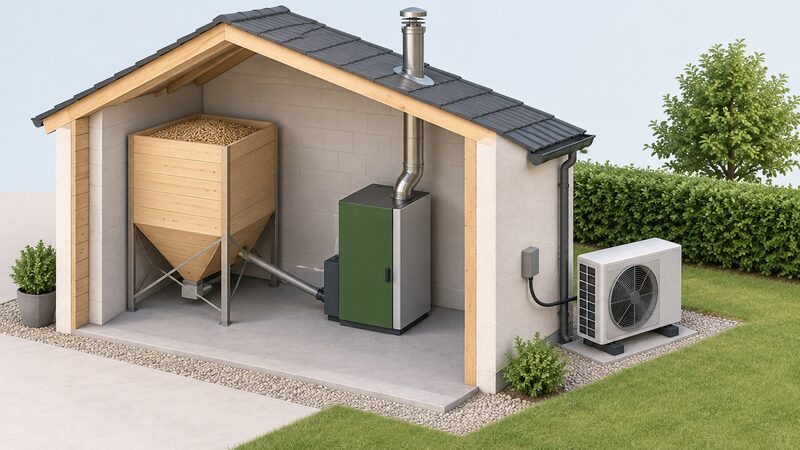
The specification rules are where the two technologies diverge most sharply, and they are set by the scheme rather than by the manufacturer.
| Requirement | Heat pump | Biomass boiler |
|---|---|---|
| Space and hot water | Must provide both, meeting full demand1 | Must provide both, meeting full demand1 |
| Heat distribution | Liquid9 | Liquid9 |
| Maximum capacity | 45 kWth individual, 70 kWth multi, 300 kWth total shared ground loop2 | 45 kWth individual2 |
| Location | Any eligible property | Rural areas only2 |
| Emissions | In situ SCOP of at least 2.8 for air-to-water and ground source2 | Particulate matter no more than 30g/GJ, NOx no more than 150 g/GJ2 |
| Standards | MCS standards approved by the Secretary of State2 | MCS standards approved by the Secretary of State2 |
The capacity ceilings matter for larger properties. An individual heat pump system is capped at 45 kWth, a multi heat pump system at 70 kWth, and a shared ground loop system at 300 kWth total with each connected heat pump not exceeding 45 kWth2. An individual biomass boiler system is capped at 45 kWth2. Above those figures the scheme does not apply.
The heat pump efficiency test is measured in situ: air-to-water and ground source heat pumps must achieve a seasonal coefficient of performance of at least 2.82. There is no equivalent performance threshold for biomass, which is regulated instead on what comes out of the flue. For the metering arrangements that applied under the earlier Renewable Heat Incentive, heat output from a biomass boiler and any additional heaters on the same distribution system was measured to Class 3 of the Measuring Instruments Directive, with heat metering resolution no finer than 1Wh accuracy class13.
What the warranty and scheme conditions cover
Neither technology carries a scheme-backed warranty. What the Boiler Upgrade Scheme imposes is a set of conditions on the installation, and the manufacturer's own warranty sits separately on top of that.
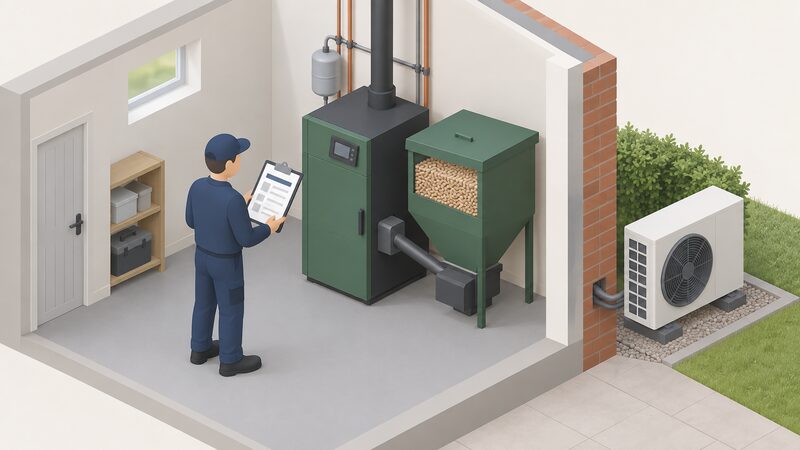
The application is a two-stage process: the installer submits a voucher application, Ofgem issues a voucher, the installer submits a voucher redemption application, and the installer receives the grant payment14. Installation must follow within 3 months for air-to-water heat pumps, air-to-air heat pumps and biomass boilers7. The application must then be properly made within 120 days of the commissioning date2.
Several conditions void eligibility outright. Properties classed as social housing are not eligible, including shared ownership properties7. A property will not be eligible if a previous BUS grant has already been received for installing a heat pump or biomass boiler at the same address, and only one voucher can be redeemed per property2. The previous heating system being replaced must have been a fossil fuel-based system or an electric heating system that does not include a heat pump2. Hybrid systems are excluded: government guidance states you cannot get a grant for a hybrid heat pump system, for example a combination of gas boiler and air source heat pump, and integrated fossil fuel hybrid systems do not meet the definition of an air source or ground source heat pump15.
The installer must be certified by the Microgeneration Certification Scheme1. All heating systems installed under the scheme must meet the relevant MCS standards approved and published by the Secretary of State2. From 28 April 2026, properties are no longer required to have a valid energy performance certificate to apply, and BUS heat pumps can be installed alongside supplementary heating appliances provided those appliances are not fossil fuel based2.
What each route costs
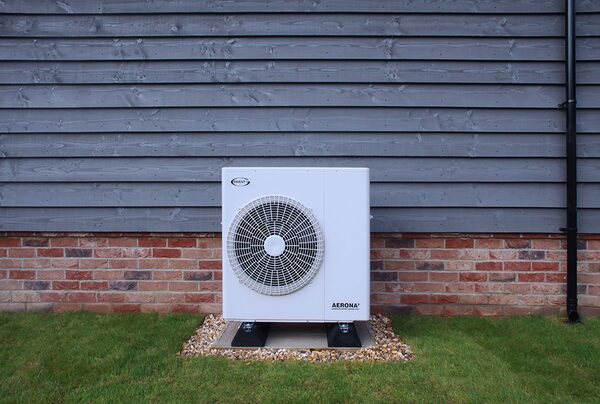
The published cost figures are uneven, and that unevenness is itself the finding. A parliamentary committee report gives around £11,600 for an average heat pump, describing it as four times more expensive than a gas boiler6. The same comparison appears in the committee's summary17. That is a 2024 figure and covers installation, not running cost.
For biomass boilers there is no equivalent published UK figure. Prices are installer-quoted, and the grant of £5,000 is applied against whatever the installer quotes1. The absence of a benchmark is worth stating plainly rather than filling with an estimate.
The grant structure is where the comparison becomes concrete:
- Air source heat pump: £7,500 off the cost and installation1
- Biomass boiler: £5,000 off the cost and installation1
- Air-to-air heat pump: £2,50018
- Uplifted grant for eligible off-gas grid properties: £9,000 for air source or ground source heat pumps2
- Standard grant for eligible properties that do not qualify for the uplift: £7,5002
The uplifted amount applies where the previous heating system being replaced was fuelled by oil or liquefied petroleum gas2. It is available for applications properly made on or after 21 July 20262. Biomass does not attract the uplift, so an off-gas grid household replacing oil faces a £4,000 difference in grant between the two routes before any installation cost is considered.
The scheme opened on 23 May 2022 and closes on 30 December 20291. Ofgem is the scheme administrator, and applications are made to Ofgem for a grant voucher1. General queries go to the BUS Enquiries team7.
Where the two routes stand on company and scheme status
There is no single manufacturer to assess here, because both categories span many makers. What can be assessed is the status of the scheme and the pattern of accreditations.
The Boiler Upgrade Scheme is active and administered by Ofgem, providing upfront capital grants towards the cost of installing approved heat pumps19. It launched on 23 May 2022 to support the decarbonisation of heat in buildings19. The most recent quarterly report covers the period from 1 May 2026 to 31 July 202620. The scheme provides upfront capital grants to support the installation of heat pumps and biomass boilers in homes and non-domestic buildings20.
The accreditation split is the clearest signal of where the market sits. Biomass accounts for 11.1% of accreditations since scheme launch, against 67.4% for air source heat pumps and 13.2% for ground source10. That is a minority route, and the rural-only restriction plus the absence of an uplifted grant explains much of it.
On the wider policy picture, the government is providing grants to encourage property owners to install low carbon heating systems such as heat pumps15. The scheme is open to domestic and small non-domestic properties15. The majority of government-supported heat pump installations in the year ending June 2025 came through the Energy Company Obligation, at 31% of installations22.

What each route means for household energy independence
This is where the two technologies part company most completely, and the difference is about what a household still depends on after installation.
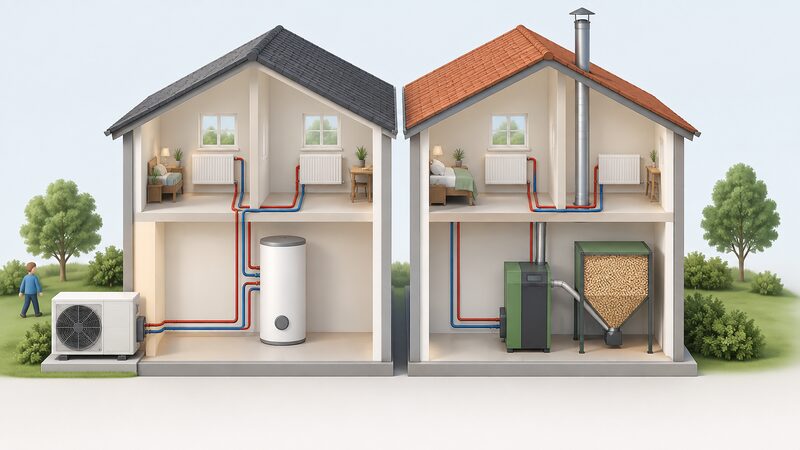
A heat pump replaces a fuel delivery with an electricity supply. It does not remove dependence on the grid, and it does not remove dependence on a supplier. What it changes is the fuel: no oil tank, no LPG bottle, no wood store, no flue. Government guidance states heat pump technology currently offers a carbon saving of up to 65% compared with a gas boiler23, and separately that heat pumps offer up to 70% less CO2 over 15 years than a gas boiler with zero emissions at point of use24. The Scottish Government's Heat in Buildings Strategy states the higher efficiency of a heat pump means the amount of energy needed can be less than a third of that needed by a gas boiler to produce an equivalent amount of heat5.
A biomass boiler replaces a fossil fuel delivery with a wood delivery. It removes dependence on gas, oil and LPG, and it removes dependence on the electricity grid for the heat itself, though the boiler still needs power for pumps, fans and controls. What it introduces is a new supply chain: pellet or log suppliers, a fuel store, and a flue. For a household with access to a reliable local wood supply, that is a genuine form of independence. For one without, it is a different dependency rather than a removed one.
The carbon accounting differs too. A heat pump's emissions fall as the grid decarbonises, because the fuel is electricity. A biomass boiler's emissions are set at the point of combustion and do not improve with grid changes. The Climate Change Committee's seventh carbon budget places heat pumps at around three to four times more efficient than gas boilers, which is the basis for lower household energy bills as well as lower emissions4.
The honest summary for a household weighing the two: a heat pump trades a fuel dependency for an electricity dependency and a supplier relationship, with a grant of £7,500 or £9,000 and a published average cost of around £11,6001. A biomass boiler trades a fossil fuel dependency for a wood supply dependency, with a grant of £5,000, a rural-only restriction, and no published UK cost benchmark1. Neither removes dependence entirely. Both are eligible under the same scheme, and the scheme's own rules make the choice narrower than it first appears.
Sources24 cited
- What you can get from the Boiler Upgrade Scheme, GOV.UK, 2026-09-18
- Boiler Upgrade Scheme guidance for installers v5.1, Ofgem, 2026-07-02
- Demand for heat pumps rises following increase in applications to the Boiler Upgrade Scheme, GOV.UK, 2024-05-23
- The Seventh Carbon Budget, Climate Change Committee, 2025-02-26
- Heat in Buildings Strategy, Scottish Government, 2021-10
- Boiler Upgrade Scheme: report, Public Accounts Committee, 2024-05-26
- Boiler Upgrade Scheme guidance for property owners V5, Ofgem, 2026-04-28
- Energy Company Obligation ECO4 Guidance Delivery V1, Ofgem, 2022-10-14
- Boiler Upgrade Scheme Installer Guidance, Ofgem, 2022-07-21
- Boiler Upgrade Scheme Annual Report 2024 to 2025, Ofgem, 2025-07
- Domestic RHI Annual Report 2023-24, Ofgem, 2024-07
- DESNZ Public Attitudes Tracker: heat and energy use in the home, winter 2025, GOV.UK, 2025
- Domestic RHI Guide to metering, Ofgem, 2022-03
- Boiler Upgrade Scheme quarterly report issue 14, Ofgem, 2025-11-26
- Home and business grants, schemes and advice, East Herts Council, 2026-09-17
- BUS Property Owner guidance V2.3, Ofgem, 2023-09-25
- Boiler Upgrade Scheme: summary, Public Accounts Committee, 2024-05-26
- Carbon Budget and Growth Delivery Plan: heat and buildings factsheet, GOV.UK, 2026-06-23
- Boiler Upgrade Scheme annual report April 2025 to March 2026, Ofgem, 2026-07-31
- Boiler Upgrade Scheme quarterly report issue 17, Ofgem, 2026-08-31
- Energy Swap, Energy Ombudsman, 2026-09-19
- Heat pump deployment quarterly statistics, United Kingdom 2025 Q2, GOV.UK, 2025
- Boiler Upgrade Scheme launch, Ofgem, 2026-09-17
- Heat pump campaign, GOV.UK, 2026-09-10
 Hybrid Heat PumpsHow hybrid systems pair a heat pump with a gas, oil or LPG boiler, what decides which appliance runs, what they cost, how much gas they displace, and why the Boiler Upgrade Scheme will not fund them.
 Replacing a Gas or Oil BoilerSwapping a gas, oil or LPG boiler for a heat pump changes how your home is heated and how much it costs.
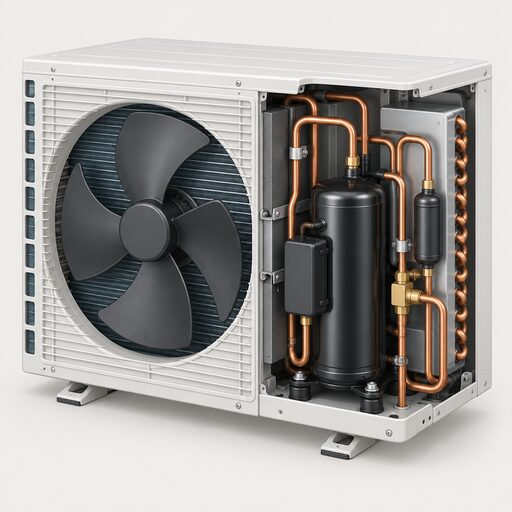 Air Source Heat PumpsHow an air source heat pump takes heat from outdoor air, the difference between air-to-air and air-to-water systems, typical efficiency, the £7,500 Boiler Upgrade Scheme grant, noise and planning limits, and what ownership means for a household's energy independence.
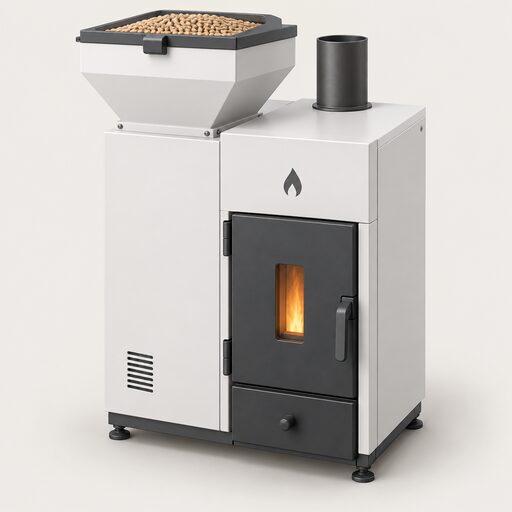 Biomass Boilers and StovesHow pellet and log biomass boilers and room stoves work in UK homes: the £5,000 Boiler Upgrade Scheme grant and its rural, off-gas-grid conditions, emissions limits, smoke control area law, fuel sourcing and the practical demands of storage and maintenance.
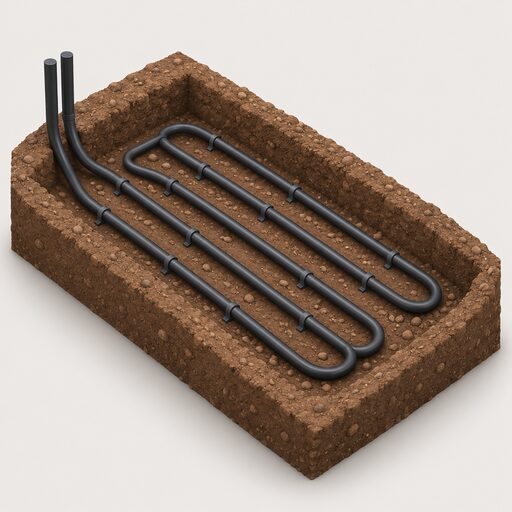 Heat Pumps vs BoilersWill a heat pump actually cost less to run than my boiler, and does it heat the house as well?
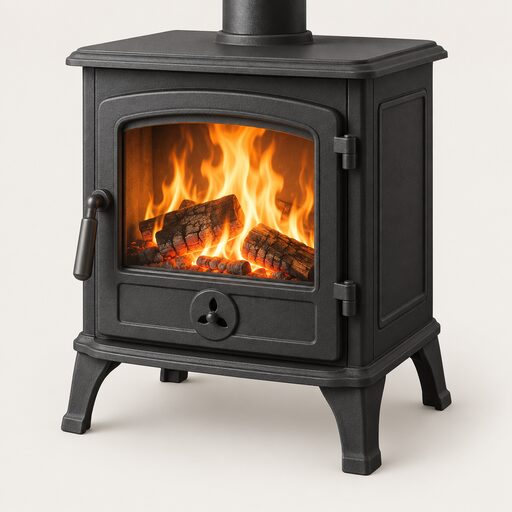 Heating Off the Gas GridThe options for the four million UK households with no mains gas connection: oil, LPG, electric, heat pump, biomass and solid fuel, and how their costs, storage and supply security compare.