
In this answer
Short answer
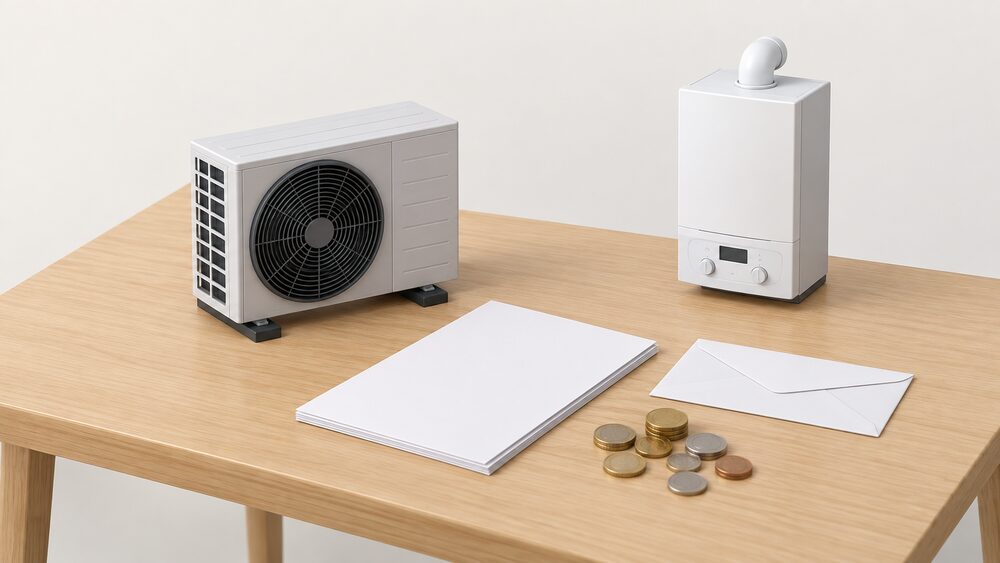
A hybrid heat pump, a combination of a gas boiler and an air source heat pump, cannot be funded through the Boiler Upgrade Scheme. The rule is explicit: "You cannot get a grant for a hybrid heat pump system (for example a combination of gas boiler and air source heat pump)"1. Ofgem's own guidance for property owners lists hybrid systems, whether installed as a split or integrated system and whether on or off the gas grid, among the ineligible technologies2.
What the scheme funds instead is a standalone low carbon heating system. The standard grant is £7,500 off the cost and installation of air-to-water heat pumps, ground source heat pumps and water source heat pumps3. For eligible off-gas grid properties, an uplifted grant of £9,000 applies to air-to-water or ground source heat pumps, available from 21 July 2026 and running until 31 March 20274. Air-to-air heat pumps attract £2,500 in residential buildings6.
The exclusion matters because a hybrid is often proposed as a lower-cost, lower-disruption route for a home that is hard to insulate or has an undersized radiator system. The scheme's design does not accommodate that middle path: it funds systems that can meet a property's full space heating and hot water demand on their own7.
No grant for hybrids: what the scheme rules say
The Boiler Upgrade Scheme's exclusion of hybrids is not a matter of interpretation. Ofgem's guidance for property owners states that hybrid systems, defined as any combination of a boiler and electric heat pump, are ineligible, and this applies whether the system is split or integrated and whether the property is on or off the gas grid2. The scheme's own consumer-facing page repeats the rule in plain terms1.
The underlying logic is that the scheme funds low carbon heating that replaces a fossil fuel system, not one that runs alongside it. Ofgem's installer guidance requires that the heat pump or biomass boiler must be capable of meeting the full space heating and hot water heating demands of the property7. A hybrid, by design, shares that load with a boiler, so it cannot satisfy the requirement.
The exclusion has been in the scheme's guidance since at least December 2023, when version 2.2 added a section clarifying the position on hybrid heat pumps, with footnotes referencing BUS regulation 29. It is not a recent tightening.
There is a separate point about replacement. The scheme also excludes grants to replace a low carbon heating system1. A household that already has a heat pump and wants to add a boiler as backup, or vice versa, is outside the scheme on both counts.
What the Boiler Upgrade Scheme does fund instead
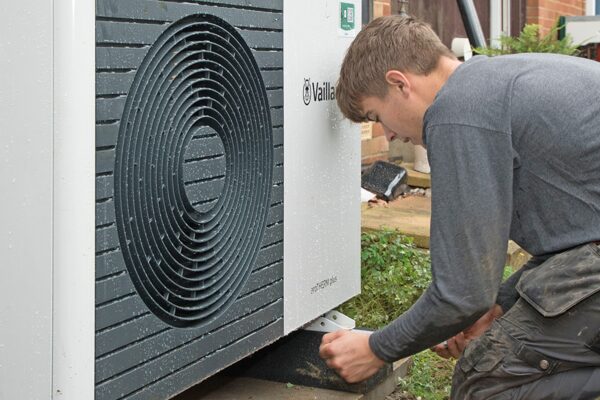
The scheme provides upfront capital grants towards the cost of installing approved heat pumps10. It is not a loan, a tariff subsidy or a payment over time: it is a capital contribution that reduces the invoice at the point of installation.
The eligible measures are heat pumps, biomass boilers and heat batteries in homes and non-domestic buildings11. For heat pumps specifically, the funded technologies are air-to-water, ground source and water source heat pumps at the standard £7,500 rate3, with air-to-air heat pumps funded at £2,500 in residential buildings6. Biomass boilers attract £5,000 off the cost and installation6.
The scheme replaced the Domestic Renewable Heat Incentive, which paid participants over time for renewable heat generated12. The Boiler Upgrade Scheme is part of the government's £13.2 billion Warm Homes Plan, rather than being funded in addition to that budget as previously expected13.
For a household, the practical effect is that the grant is tied to a specific technology choice. A standalone heat pump that can carry the whole heating and hot water load is the funded route. A hybrid, however sensible it may be for a particular property, is not.
Eligibility rules that apply to any heat pump application
Beyond the technology exclusion, several rules apply to any application. The property must not be a new build that the developer is still building; if a household moves into a finished new build with a fossil fuel boiler, a grant for a heat pump may be available14. New properties are not eligible with the exception of certain self-builds15, and heat pumps may be eligible for BUS funding on self-build properties where all other scheme rules are met17.
A property is not eligible if a previous BUS grant has already been received for installing a heat pump or biomass boiler at the same address4. The scheme also excludes properties that have already been given government funding or support for a heat pump or biomass boiler14.
On the EPC requirement, the position has changed. From 28 April 2026, properties are no longer required to have a valid Energy Performance Certificate to apply for BUS4. Exempt properties still need to submit a valid EPC at voucher application stage19. Government has also stated its intention to amend BUS eligibility criteria to relax the EPC requirement from 2026/27 onwards, adopting a hybrid model20.
The legal basis for the new-parts requirement sits in the Boiler Upgrade Scheme (England and Wales) Regulations 2022. Regulation 9(1)(a) requires, with one minor exception, all parts of a heat pump to be new for scheme eligibility21.
Grant amounts: £7,500 standard and £9,000 off-gas grid uplift
| Technology | Grant | Conditions |
|---|---|---|
| Air-to-water heat pump | £7,500 | Standard rate3 |
| Ground source heat pump | £7,500 | Standard rate3 |
| Water source heat pump | £7,500 | Standard rate3 |
| Air-to-water or ground source heat pump | £9,000 | Eligible off-gas grid properties, until 31 March 20274 |
| Air-to-air heat pump | £2,500 | Residential buildings6 |
| Biomass boiler | £5,000 | Off the cost and installation6 |
The £9,000 uplift applies to eligible off-gas grid properties heated by LPG or oil, for air-to-water or ground source heat pumps22. It became available from 21 July 20264. The standard £7,500 rate applies to air-to-water, ground source and water source heat pumps3.
The scheme's budget position has been reported in different terms. One account places the scheme within the government's £13.2 billion Warm Homes Plan13.
How the installer-led application process works
The Boiler Upgrade Scheme is installer-led and a property owner cannot apply directly5. The installer applies for the grant on the property owner's behalf, discounts the grant from the invoice, applies to Ofgem for a grant voucher, and redeems the voucher after installation and commissioning8.
The process has two stages. The installer submits a voucher application, Ofgem issues the voucher, the installer submits a voucher redemption application, and the installer receives the grant payment23. It is described in Ofgem's guidance as an installer-led two stage application process, with the installer applying for and redeeming the voucher19.
Property owners considering installing a heat pump or biomass boiler can apply to the scheme through an MCS certified installer to help reduce the upfront cost3. The installer must commission and install the heat pump within 120 days of applying for the grant, or it will not be eligible14.
"It is an 'installer-led' two stage application process, which means the property owner's chosen installer will apply for"
Where a hybrid heat pump still fits a household's plans
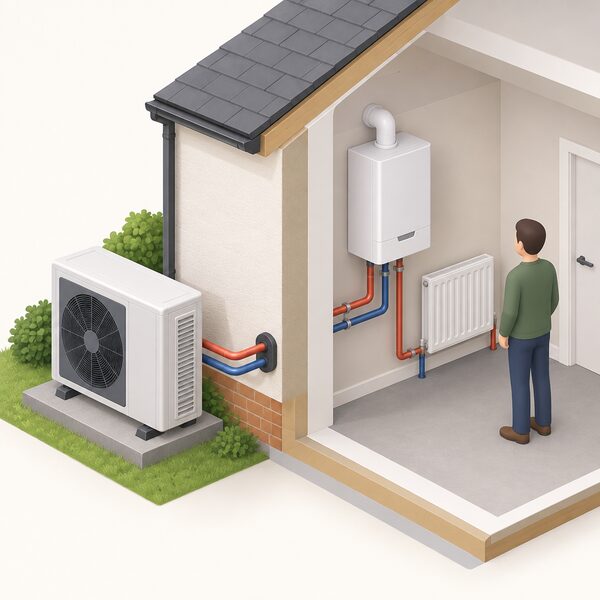
A hybrid heat pump remains a legitimate technology choice for a household, even though it cannot be grant-funded. It can suit a property where a standalone heat pump would struggle to meet peak demand without extensive fabric work, or where a household wants to retain a gas boiler as a backup.
The grant route for a hybrid sits elsewhere. The Warm Homes: Local Grant treats retrofit and packaged hybrid heating systems as eligible measures for homes currently heated by mains gas only, where a new gas boiler is fitted only the heat pump component can be funded24. The Warm Homes: Social Housing Fund takes a similar approach: retrofit and packaged hybrids, where the heat pump and gas boiler components are in separate units, are eligible, and only the heat pump component can receive funding where a new gas boiler is fitted25.
For a household weighing a hybrid against a standalone heat pump, the grant position is a material difference. A standalone air-to-water heat pump can attract £7,500, or £9,000 off the gas grid, while a hybrid attracts nothing under the Boiler Upgrade Scheme. The trade-off is between upfront support and the practical fit of the system to the property.
On energy independence, a hybrid reduces gas dependence but does not remove it: the boiler still runs on mains gas or delivered fuel, and the household remains connected to a supplier for that fuel. A standalone heat pump with the grant support shifts the heating load to electricity, which can be increasingly sourced from domestic generation, but it also increases reliance on the grid and, if the system is app-controlled, on a manufacturer's cloud service. Neither route delivers full independence, and the grant rules currently favour the one that removes the fossil fuel boiler entirely.
Sources25 cited
- What you can get, GOV.UK, 2026-09-17
- Boiler Upgrade Scheme guidance for property owners, Ofgem, 2026-09-17
- Boiler Upgrade Scheme, Ofgem, 2026-09-17
- Boiler Upgrade Scheme guidance for installers v5.1, Ofgem, 2026-07-02
- Boiler Upgrade Scheme guidance for property owners V5, Ofgem, 2026-04-28
- Carbon Budget and Growth Delivery Plan: heat and buildings factsheet, GOV.UK, 2026-06-23
- Boiler Upgrade Scheme installer guidance, Ofgem, 2022-07-21
- Boiler Upgrade Scheme, Find Government Grants, 2026-09-18
- Summary of updates to Boiler Upgrade Scheme guidance for property owners v2.4, Ofgem, 2023-12
- Boiler Upgrade Scheme annual report April 2025 to March 2026, Ofgem, 2026-07-31
- Reforming consumer protection for home upgrade schemes, GOV.UK, 2026-06-17
- Russell and Kate's story: solar panels and a heat pump, Energy Saving Trust, 2026-08-13
- Ministers urged to clarify energy efficiency support funds, End Fuel Poverty Coalition, 2025-11-18
- Check if you're eligible, GOV.UK, 2026-09-17
- Boiler Upgrade Scheme quarterly report issue 4, Ofgem, 2023-05-31
- Boiler Upgrade Scheme quarterly report issue 5, Ofgem, 2023-08-31
- Boiler Upgrade Scheme guidance for property owners v5 draft, Ofgem, 2026-03-25
- Boiler Upgrade Scheme guidance for installers V5, Ofgem, 2026-04-28
- Boiler Upgrade Scheme property owner guidance V2.3, Ofgem, 2023-09-25
- Amendments to the Boiler Upgrade Scheme: government response, GOV.UK, 2025-11
- Consumer protection issues in third party ownership models for heat pumps, Nesta, 2026-06-02
- Boiler Upgrade Scheme statistics July 2026, GOV.UK, 2026-08-27
- Boiler Upgrade Scheme quarterly report issue 14, Ofgem, 2025-11-26
- Warm Homes: Local Grant policy guidance, GOV.UK, 2026-07
- Warm Homes: Social Housing Fund wave 3 scheme guidance addendum, GOV.UK, 2026-06
 Hybrid Heat PumpsHow hybrid systems pair a heat pump with a gas, oil or LPG boiler, what decides which appliance runs, what they cost, how much gas they displace, and why the Boiler Upgrade Scheme will not fund them.
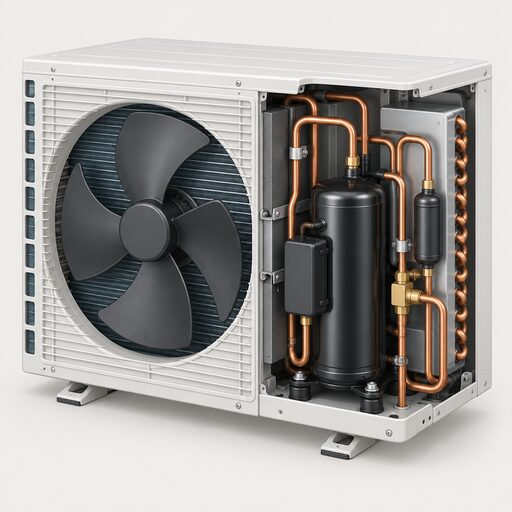 Air Source Heat PumpsHow an air source heat pump takes heat from outdoor air, the difference between air-to-air and air-to-water systems, typical efficiency, the £7,500 Boiler Upgrade Scheme grant, noise and planning limits, and what ownership means for a household's energy independence.
 Air-to-Air Heating and CoolingAir-to-air heat pumps deliver warm air through indoor fan units rather than hot water to radiators.
 High Temperature Heat PumpsHigh-temperature heat pumps deliver flow temperatures of roughly 65 to 80°C, close to boiler levels, so existing radiators can often stay in place.
 Ground Source Heat Pump CostWhat a ground source heat pump costs in the UK, splitting groundworks and drilling from the heat pump and internal works, and how the £7,500 Boiler Upgrade Scheme grant and the £9,000 off-gas-grid uplift change the figure.
 Energy IndependenceA heat pump runs your heating on electricity instead of gas or oil, so how much does that really cut what you pay and how exposed you are when fuel prices jump?