
In this answer
Short answer
Heat batteries are not eligible for the Boiler Upgrade Scheme today. Government has said a £2,500 grant for heat batteries will be available once the legislation and appropriate product standards are in place, and that grant support will only become available once technical product standards have been established1. No opening date has been published, and the scheme's approved grant categories and values do not yet list thermal storage.
The barrier is certification, not policy intent. Every heating system installed under the scheme must meet the relevant MCS standards approved and published by the Secretary of State, and installers must be MCS certified3. Heat batteries cannot yet be certified against a thermal energy storage standard, so they cannot satisfy that condition. MCS consulted on a Thermal Energy Storage System Standard in March 2025 and announced a pilot in September 20255.
For a household, the practical position is that a heat battery can be bought and installed now, but not with scheme money. The technology itself is well established as a category: energy storage systems include battery storage, thermal storage and heat batteries, and heat batteries store energy as heat from electricity, including grid power or a home renewable source, or from surplus heat from a boiler, heat pump or another heating system6.
What the Boiler Upgrade Scheme funds today
The scheme provides grants to assist with installation costs, and its purpose is to cover part of the cost of replacing a fossil fuel heating system with a renewable heating system11. It provides upfront capital grants to support the installation of heat pumps and biomass boilers in homes and non-domestic buildings13. The original fund was £450m, announced in October 2021, spent on grants that predominantly subsidise the upfront cost of replacement14.
Eligibility turns on replacement. A household must be fully replacing an existing fossil fuel system such as an oil or gas boiler, or an electric heating system such as storage or panel heaters, and there is no funding for replacing existing low carbon heat systems15. Fossil fuel heating systems include oil, gas, electric or LPG16. Hybrid systems, meaning any combination of a boiler and electric heat pump whether installed as a split or integrated system and whether on or off the gas grid, are not eligible, and neither is the replacement of low carbon heat systems17.
The scheme operates in England and Wales18. Applications properly made on or after 28 April 2026 fall under the current guidance, and uplifted grants for eligible off-gas grid properties apply to applications on or after 21 July 20263. The scheme opened for grant applications on 23 May 202219.
For energy independence, the scheme's design matters as much as its value. It pays to remove a fossil fuel appliance entirely, which cuts a household's exposure to oil or gas supply and price. It does not pay to keep a boiler as a backup, which is why hybrid arrangements sit outside it. A heat battery, which can take surplus heat from a boiler as well as from a heat pump, sits awkwardly against that rule until the standards work is finished.
Heat batteries: what they are and how they store heat
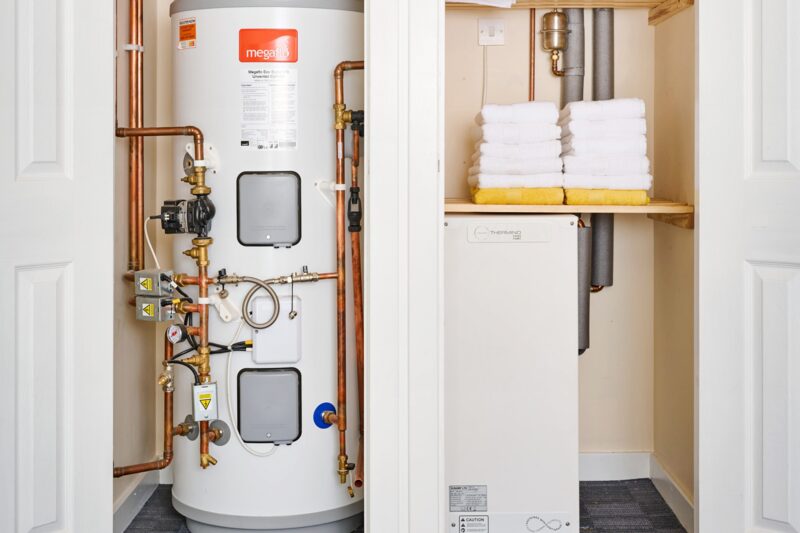
A heat battery stores energy as heat rather than as electricity. The energy can come from electricity, whether from the grid or a household's own renewable source, or from surplus heat from a boiler, a heat pump or another heating system6. That dual input is what separates the category from a conventional hot water cylinder, which stores water heated by a single source.
Some heat batteries can be used as a thermal store within a central heating system, typically alongside a heat pump6. That is the configuration most relevant to grant eligibility, because it ties the battery to a heat pump rather than to a retained boiler. A conventional electric boiler, by contrast, usually includes a large hot water tank to store the heat20.
The distinction between thermal storage and electrical storage matters when reading scheme documents. Energy storage systems cover battery storage, thermal storage and heat batteries as separate examples6. Electrical battery storage appears on the VAT relief list for energy-saving materials; heat batteries do not10. A household comparing the two is comparing products that are treated differently in both tax and grant rules.
What a heat battery does for independence depends on its input. Charged from a home solar array or a cheap overnight tariff, it shifts the household's heating demand away from the moment of use and reduces reliance on gas delivered by a supplier. Charged from surplus heat off a gas boiler, it improves efficiency but leaves the gas dependence in place, and that is the configuration the scheme's replacement rule is designed to exclude.
Eligibility: why heat batteries are not yet covered
Two separate conditions block heat batteries. The first is the approved list. The scheme's notice of approved grant categories and values sets out what can be funded, and thermal storage is not among the categories7. The second is certification. All heating systems installed under the scheme must meet the relevant MCS standards approved and published by the Secretary of State, and installers must be MCS certified and meet the MCS standards3. MCS certification is required for installations to qualify for the funding8.
The same logic appears in the Warm Homes: Social Housing Fund. Heat batteries will not be eligible for that fund until they can be MCS certified, and once MCS certified, SAP-eligible heat batteries will be eligible5. That wording sets out the sequence plainly: certification first, eligibility second. The same sequence applies to the Boiler Upgrade Scheme, where government has said grant support for heat batteries will only become available once technical product standards have been established2.
There are also exclusions that would catch some heat battery designs regardless of certification. Fossil fuel hybrids are not eligible9. Exhaust air-to-air heat pumps are not eligible for support under the scheme at this time9. Air-to-air heat pumps are only eligible for residential buildings21. A heat battery paired with a retained fossil fuel appliance would run into the first of these.
For a household, the eligibility question is therefore not simply whether the product works. It is whether the product can be certified, whether the installation removes the fossil fuel appliance entirely, and whether the property has already taken public money for a low carbon heating system. A heat battery installed alongside a working gas boiler would fail the replacement test even after the standard exists.
The £2,500 grant: when applications are expected to open
Government has stated that a £2,500 grant for heat batteries will also be available once the legislation and appropriate product standards are in place1. Independent guidance repeats the figure, describing £2,500 off the cost of installing a heat battery to work with a central heating system for eligible households in England or Wales6. No date for opening applications has been published.
The scheme's grant values have moved before. The government increased its grant by 50% for new heat pumps, announced in November 202323. The higher grant rate applies only to new applications submitted from 21 July 202624. Households may be able to access a grant of up to £2,500 for air-to-air heat pumps25. The approved grant categories notice lists £2,500 as a grant value7.
The published figures do not settle every case. The approved grant categories notice gives £2,500 as a grant value, while other scheme material gives £7,500 for heat pumps, and no ruling settles which figure applies to which technology7. A household reading grant figures should check the specific technology and application date rather than relying on a single headline number.
The scheme has also been expanded in scope. Grants were expanded to include air-to-air heat pumps and thermal batteries, announced in November 20252. A consultation on reforming consumer protection for home upgrade schemes refers to support for installation of heat pumps, biomass boilers and heat batteries in homes and non-domestic buildings26. Expansion of the categories and payment for heat batteries are separate steps: the first has been announced, the second waits on standards.

The standards that must be in place first: MCS certification and SAP eligibility
The MCS Thermal Energy Storage System Standard is the certification route being built for this product category. MCS consulted on it in March 2025 and announced a pilot in September 20255. Until it is published and products can be certified against it, heat batteries cannot meet the requirement that all heating systems installed under the scheme meet the relevant MCS standards approved and published by the Secretary of State3.
Certification operates at two levels. Products are certified, and installers are certified. MCS describes a route for certifying products27. On the installer side, heat pump installations funded by the Boiler Upgrade Scheme need to be carried out by an MCS-certified installer28. The scheme's own installer guidance states that installers must be MCS certified and meet the MCS standards4.
SAP eligibility is the second gate. The Warm Homes: Social Housing Fund wording is explicit that once MCS certified, SAP-eligible heat batteries will be eligible5. SAP is the assessment method used to score a home's energy performance, and a measure that cannot be modelled within it cannot be counted. A heat battery that is certified but not SAP-eligible would still fall outside.
"MCS consulted on a Thermal Energy Storage System Standard in March 2025 and announced a pilot in September 2025."
For a household, this is the part of the timeline that cannot be compressed by choosing a different installer or a different product. The standard is a sector-level document. Until it exists, no heat battery installation can be certified for scheme purposes, and no grant can be claimed, whatever the announced £2,500 figure says.
What a heat battery grant would mean for householders

A grant would change the upfront arithmetic of a heat battery installation, but not the underlying dependence. The scheme exists to help with the upfront cost of low carbon heating technologies29. It provides a grant to help cover the costs of installing low carbon heating technologies, such as heat pumps30. The government offers grants to homeowners to install low carbon heating systems such as heat pumps31. A UK Government grant helps pay for a heat pump or biomass boiler in England and Wales32.
What a heat battery adds to independence is the ability to store heat rather than buy it at the moment of use. Charged from a home renewable source or from surplus heat, it decouples heating demand from the grid's peak. What remains is the input: a heat battery charged from a gas boiler leaves the household on gas, and one charged from electricity leaves it on a supplier and the grid. The battery shifts when energy is used, not where it comes from.
The scheme's replacement rule shapes which version of that a household can fund. Because eligibility requires fully replacing an existing fossil fuel system, and because fossil fuel hybrids are not eligible, a grant-funded heat battery would need to sit in a system with no retained fossil fuel appliance15. That is a stronger condition than the technology itself requires, and it is the condition that would determine what a grant-funded installation looks like.
Households weighing a heat battery now are therefore weighing a product that can be installed and used, against a grant that has been announced but not opened. The related questions of how a heat battery compares with a cylinder, and how the leading products differ, are covered in heat battery vs hot water cylinder and Sunamp vs Caldera heat batteries. The wider picture of how storage technologies fit a home's independence sits in Emerging Technology and Household Energy Independence, and the certification landscape in Standards and Certification for Emerging Energy Products.
Sources32 cited
- Carbon Budget and Growth Delivery Plan: heat and buildings factsheet, GOV.UK
- Response to amendments to the Boiler Upgrade Scheme, Energy Systems Catapult, 2025-11-18
- Boiler Upgrade Scheme guidance for installers v5.1, Ofgem, 2026-07
- Boiler Upgrade Scheme, Ofgem, 2026-09-17
- Warm Homes: Social Housing Fund wave 3 scheme guidance addendum, GOV.UK, 2026-06
- Storing energy, Energy Saving Trust, 2026-07-15
- Notice of approved grant categories and values for the Boiler Upgrade Scheme, GOV.UK, 2026-07-21
- Certifying your product, MCS, 2026-05-18
- Boiler Upgrade Scheme guidance for installers V5, Ofgem, 2026-04-28
- VAT energy saving materials and grant funded heating supplies, HM Revenue and Customs, 2026-09-17
- Boiler Upgrade Scheme, Oxfordshire County Council, 2026-09-17
- Boiler Upgrade Scheme research briefing, UK Parliament, 2026-09-19
- Boiler Upgrade Scheme quarterly report issue 12, Ofgem, 2025-05-30
- What the Heat and Buildings Strategy means for MCS certified installers, MCS, 2021-10-21
- Boiler Upgrade Scheme, Find government grants, 2026-09-18
- Apply for the Boiler Upgrade Scheme, GOV.UK, 2026-09-17
- Boiler Upgrade Scheme, RECC, 2026-09-17
- Boiler Upgrade Scheme, Ofgem, 2026-09-17
- Boiler Upgrade Scheme leaflet, GOV.UK, 2022-05
- Electric heating, Energy Saving Trust, 2026-07-01
- Boiler Upgrade Scheme guidance for property owners v5 draft, Ofgem, 2026-03-25
- Boiler Upgrade Scheme guidance for property owners v5.1, Ofgem, 2026-07
- Heat pump applications surge after increase in government grant, GOV.UK, 2023-11-30
- Oil heating heat pump grant, Low Carbon Hub, 2026-08-11
- Boiler Upgrade Scheme, MCS, 2026-07-21
- Reforming consumer protection for home upgrade schemes, GOV.UK, 2026-06-17
- What the Warm Homes Plan and Future Homes Standard mean for installers, NICEIC, 2026-04-23
- Energy incentives and schemes, South Cambridgeshire District Council, 2026-09-17
- Boiler Upgrade Scheme guidance for property owners, Ofgem, 2025-02-03
- Energy jargon buster, Energy Saving Trust, 2026-03-20
- What you can get, GOV.UK, 2026-09-17
- MCS announces pilot for new thermal energy storage systems installation standard, MCS, 2025-09-15
 Hydrogen Heating PolicyWill hydrogen ever heat your home, and when will the government decide?
 Heat Batteries with Heat PumpsCan a heat battery replace a hot water cylinder if you have no space for one?
 Solid-State BatteriesAre solid-state batteries on sale yet, and should you wait for one?
 Policy, Targets and Coming RulesHeat pumps are central to the government's plans for greener home heating.
 Financing an InstallationPaying monthly for a boiler, solar panels, battery or heat pump sounds simple, but who actually lends you the money and what happens if the work goes wrong?
 Grants and Energy IndependenceCan you get a grant for solar panels or a battery?