In this guide
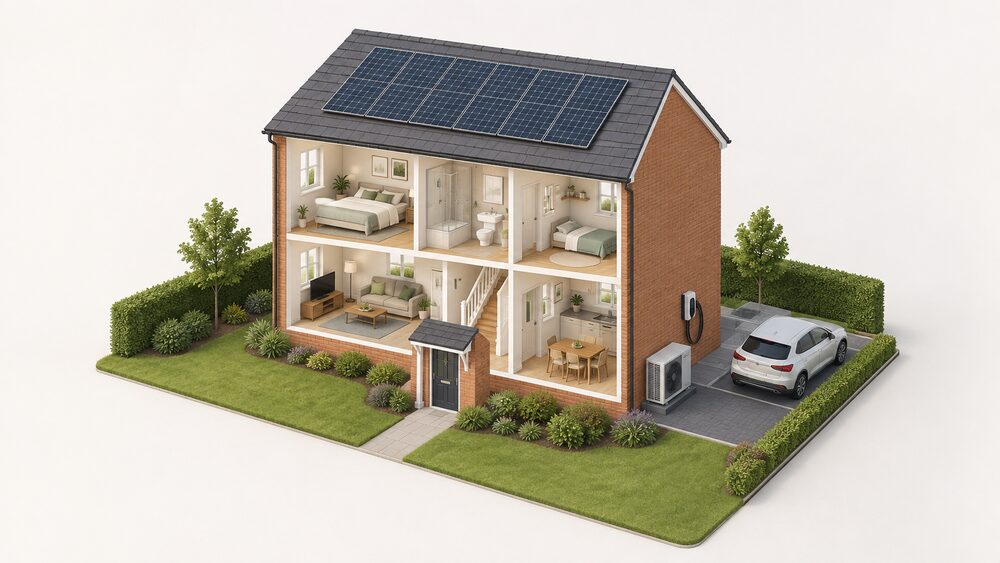
Octopus Energy is a domestic electricity and gas supplier that also installs home energy hardware through its own services arm. It entered the heat pump market in 2021 with the launch of Britain's first research and development centre for heat pumps in Slough1, and the smart hardware side of the business began fitting solar panels on domestic rooftops in 20232. Home EV chargepoints complete the set, alongside the Electroverse public charging network and a group of smart tariffs.
The installation arm matters because it is one of the largest domestic heat pump installers in the UK, and it sells the whole chain: the appliance, the tariff that runs it, and the app that monitors it. That is convenient, and it is also the shape of the dependence. A heat pump moves a home off gas and onto electricity, but not off the grid or off a supplier. Solar turns a roof into a small generator, but the household still buys power at night and in winter. Smart charging and remote monitoring run through broadband and the supplier's platform.
This page sets out what Octopus Energy Services installs, what the work involves, what the public schemes require, and where the limits sit. It describes the arrangements rather than recommending them.
What Octopus Energy is and how its installation arm fits in
Octopus Energy supplies gas and electricity to households and also sells and fits low carbon hardware. The two sides are commercially linked: the hardware is designed to run on the supplier's own tariffs, and the tariffs are designed around the hardware. Octopus Energy Ltd is listed as a mandatory Smart Export Guarantee licensee, trading as Octopus, for the sixth SEG year from 1 April 2025 to 31 March 20267. In the fifth SEG year it recorded 191,631 registrations, accounting for 71% of all SEG installations4. That figure is about export payment registrations rather than installations carried out, but it shows how much of the domestic solar market routes through the company.
The supplier also appears in official innovation work. Under the ECO4 innovation route, innovation measure 025 was awarded to Octopus Energy Ltd8. It has been the registered electricity supplier for a local energy scheme at Broughton-in-Furness, coordinating contractual requirements, smart meter installations and settlement and billing9. Those are supplier roles rather than installer roles, and they are worth separating from the fitting work.
The installation side has not been without problems. Which? reported in March 2026 on a heat pump preparation job that damaged a customer's garden; Octopus apologised, said the installation was more complex than usual, undertook to manage the remainder of the installation personally with senior oversight, and agreed to compensate the customer for costs and inconvenience10. The same consumer body has noted that Octopus Energy has seen up to a 40% variance in the total energy requirement for heating and hot water from one assessor to another11. That is a survey design point rather than a fault, but it explains why two quotes for the same house can differ.
For a household, the practical question is which parts of the chain are regulated and which are commercial. Grants, building regulations and installer certification are set by government and scheme rules. Tariffs, app features and charger compatibility are set by the supplier and can change.
Heat pump installation: what is included and who does the work
Octopus Energy Services carries out heat pump installations itself rather than subcontracting to a partner network. The company entered the market in 20211, and its own customer research, published in February 2026, reports that 94% of heat pump customers say their home feels as comfortable or more comfortable than it did with the previous boiler, 89% say the system is just as easy or easier to maintain, and 85% say it costs the same or less to run3. A separate survey of hosts in a heat pump trial found Octopus to be the most commonly used installer, named by 46 hosts, ahead of Aira on 6 and EnergyZone and British Gas on 5 each13.
The work itself is governed by building regulations. Heat pump installation work must meet the requirements of the Building Regulations, and the person carrying out the work must be suitably competent14. Where a registered competent person does the work, a Building Regulations compliance certificate goes to the occupier14. For a ground source system, the definition of installing energy-saving materials includes carrying out groundworks, or dredging a body of water, to install pipework or other equipment necessary for the operation of the heat pump15. That is why ground source work is a bigger project than an air source swap.
For new dwellings, the operating and maintenance information handed to the owner should include the heat loss calculation, the design flow temperature, confirmation of the competent person scheme, the size of the emitter circuit and the minimum set back temperatures17. A householder buying a retrofit should expect the equivalent documents for an existing house.
On the electricity connection, the process runs through the local network operator. Electricity North West advises contacting an accredited heat pump installer first to confirm whether the electricity supply is adequate to support the heat pump, and notifying the network operator once it is installed18. That step applies to its own region, but the principle of checking supply capacity before committing is general.
Planning, permissions and the dropout problem
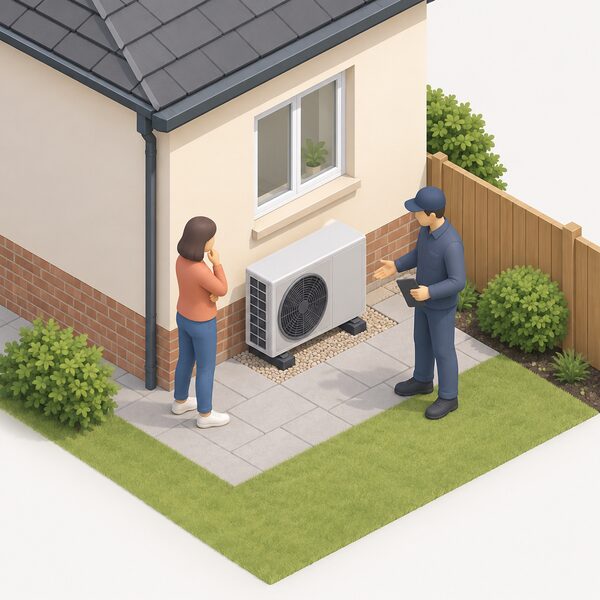
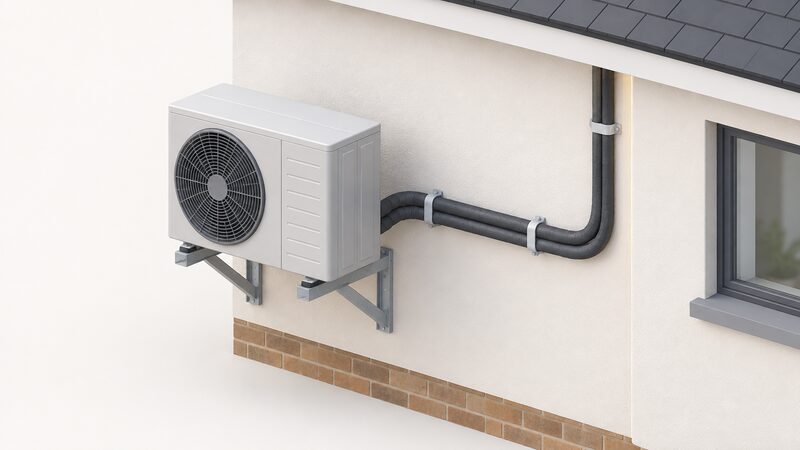
Planning is the point at which heat pump projects most often stall. An individual air source heat pump requires an external unit19, and government figures cited by Octopus show that 34% of those who order a heat pump are discouraged or drop out for reasons attributed to planning permission6. That is a supplier's own figure, and it is the clearest single number on why orders do not convert into installations.
The rules differ across the UK. In Scotland, the Building Standards Technical Handbook for domestic buildings, in its April 2026 version, covers electric vehicle charging under section 7.2, including charge point provision to new dwellings, provision to domestic buildings undergoing major renovation, mixed development, location, specification, enabling infrastructure and information on installation and operation20. Approved Document L Volume 1 covers the equivalent ground for dwellings in England14, and a consultation version covers Wales17. Where a property is listed, in a conservation area or in a flat, permitted development rights may not apply and a formal application may be needed.
The practical consequence is that a heat pump quote is not a fixed commitment until the siting and permission position is settled. A householder weighing up an installation should expect the installer to raise the external unit position early, because that is the decision that determines whether the project proceeds on the standard route or needs consent.
Solar panels: when Octopus Energy Services began installing and what it covers
The smart hardware side of Octopus Energy's business started installing solar panels on domestic rooftops in 20232. A Which? partnership offer announced in September 2023 covered heat pumps across most of England and Wales and solar across most of England, with priority installation, specialist advice and an Octopus Home Mini device to track electricity use, plus a 5% exclusive discount for Which? members2. Eligibility for that offer required Which? membership, but not an existing Octopus Energy supply account2.
Rooftop solar is a permitted development right in many cases. Guidance from one local authority states that solar panels can be used in the building, subject to the usual limits on siting and on listed buildings21. The export side is where the supplier relationship becomes financial: a solar installation needs an export tariff to be paid for what it sends to the grid, and Octopus Energy Ltd holds mandatory SEG licensee status for the sixth SEG year from 1 April 2025 to 31 March 20267.
The independence question for solar is straightforward. A rooftop array generates during daylight and reduces the amount of electricity bought at those times. It does not store anything unless a battery is added, and it does not remove the grid connection, which remains the backup for evenings, winter and outages. The export tariff converts surplus into a payment, but the rate is set by the supplier and can change.
EV chargepoints: free supply and installation for households
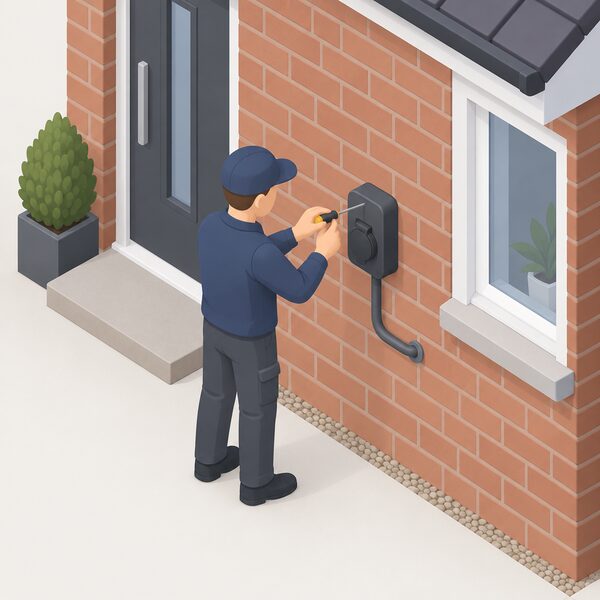
Octopus has promoted free supply and installation of a home chargepoint on qualifying tariffs. The charger is only part of the cost picture, and the public grant rules set the conditions that any installation has to meet.
The Electric Vehicle Chargepoint Grant for Households with On-Street Parking requires an OZEV approved installer to complete the installation, and requires an eligible chargepoint model to be fitted22. The general EV chargepoint grant helps towards the cost of installing a chargepoint socket at a property, and is aimed at renters or flat owners23. Costs are obtained by contacting an OZEV approved installer24. Grants for renters and flat owners to install charge points at home were confirmed in June 202525.
| Requirement | Detail |
|---|---|
| Installer | Must be approved by the Office for Zero Emission Vehicles22 |
| Chargepoint | Must be an eligible model22 |
| Who the grant is aimed at | Renters and flat owners installing at home23 |
| Cost information | Obtained from an OZEV approved installer24 |
New build provision is handled separately through building standards. The Scottish technical handbook covers charge point provision to new dwellings and to domestic buildings undergoing major renovation, along with location, specification and enabling infrastructure20. Approved Document L Volume 1 covers the same ground for dwellings in England14.
For a household, a home chargepoint is the cheapest place to charge a car, and it is also the point at which the household's electricity demand rises sharply. That demand is what smart tariffs are designed to shift.
Public charging beyond the home: the Octopus Electroverse network
Electroverse is a roaming platform rather than a charging network of its own. It brings multiple networks into one platform, letting a driver access a large number of chargers through a single account, which simplifies payment and sometimes unlocks lower rates or promotions26. Networks that have joined include GeniePoint in August 2022, Evyve and PoGo in June 2023, and Believ and RAW Charging, whose interviews were published on the Electroverse community site in 202427.
The value of roaming is administrative: one app, one payment method and one bill across networks that would otherwise each need a separate account. The limit is that the physical chargers still belong to other operators, so availability, reliability and price at any given post are set by that operator, not by Octopus. Public charging is also more expensive per unit than charging at home, which is why the home chargepoint remains the anchor of running costs.

Smart charging: how Octopus tariffs connect to home chargepoints
Octopus offers three EV tariffs for customers who want to charge at home27. Intelligent Octopus Go works by the supplier charging the car at times when energy is at its cheapest, to save as much as possible27. That is a managed arrangement: the supplier decides when the car draws power, within the limits the household sets.
Compatibility is the constraint. Intelligent Octopus Go works with a list of compatible chargepoints and vehicles, and that list changes as makers update hardware. The VCHRGD Seven Pro became compatible with the tariff in September 202628. A householder choosing a charger therefore has to check the current compatibility list rather than assume any smart charger will work.
The same flexibility logic applies to heat pumps. Additional savings are possible with flexible electricity tariffs29, and official consultation work treats domestic electric vehicle charge points, heat pumps and battery energy storage systems as examples of energy smart appliances that can provide domestic-scale flexibility30. That is the direction of travel: the appliances become controllable loads that the supplier can shift.
The dependence this creates is real. A smart tariff needs a smart meter, a working broadband connection and the supplier's platform. If the platform changes its compatible device list, the household's hardware does not change with it.
What Octopus installation means for household energy independence
The honest summary is that an Octopus installation changes the fuel and the metering, not the underlying dependence. A heat pump moves a home off gas and onto electricity, which removes one supply relationship and deepens another. Solar with an export tariff turns a roof into a small generator, but the household still buys power at night and in winter, and the export rate is set by the supplier. A home chargepoint cuts the cost of running a car, but it adds load to the same grid connection.
What genuinely improves is control over when energy is used. Flexible tariffs, a home battery and a chargepoint that can be scheduled let a household shift demand into cheaper periods, and official work treats these appliances as domestic-scale flexibility assets30. That is a real gain, and it is a gain in cost and carbon rather than in autonomy.
The remaining dependencies are worth naming plainly: the grid connection, the electricity supplier, the gas network for any home that keeps a boiler, the broadband line that carries the app and the smart tariff, and the manufacturer or supplier that maintains the platform. Where a household adds solar and a heat pump but keeps a gas boiler as backup, it retains a gas supply as well.
The installer relationship is the other long term tie. Heat pump work must meet the Building Regulations and be carried out by a suitably competent person14, and the paperwork that follows, including the compliance certificate and the operating information, is what a future buyer or warranty claim will rely on. Guidance on checking certification, contracts and aftercare sits in the wider guide to home energy installers and retailers, with the certification detail at MCS certified installers and the handover documents at your MCS certificate and installation handover pack. For the funded routes, installer requirements for grants sets out what a scheme demands of the firm doing the work.
Sources30 cited
- Octopus launches its new heat pump Cosy 6, Flexi-Orb, 2023-09-14
- Which? and Octopus Energy launch solar panel and heat pump offer, Which?, 2023-09-12
- Watt a Save 2026, Home Builders Federation, 2026-02-02
- Smart Export Guarantee Annual Report Year 5, Ofgem, 2025-12
- Heat pump installation guidance, Department for Energy Security and Net Zero, 2026-09-10
- Help to save households money and deliver cleaner heat to homes, GOV.UK, 2024-11-21
- Smart Export Guarantee supplier list, Ofgem, 2025-03-26
- ECO4 innovation approved innovation measures, Ofgem, 2026-02
- Community and local energy case studies, Electricity North West, 2026-09-20
- Heat pump prep work ruined my garden, Which?, 2026-03-06
- Reforming EPCs to support households in the energy transition, Which?, 2024-04-29
- Octopus Energy Watt a Save, Home Builders Federation, 2026-02
- Seeing is believing: the hosts, their properties and their installers, Nesta, 2024-11-13
- Approved Document L Volume 1: Dwellings, Ministry of Housing, Communities and Local Government, 2026
- Building Act 1984, Schedule 7A, Part 2, Chapter 2, legislation.gov.uk, 2026-09-17
- Building Act 1984, Schedule 8, Part II, Chapter 23, legislation.gov.uk, 2024-02-01
- Approved Document L Volume 1 consultation version, Welsh Government, 2025-08
- Heat pumps: apply for a new connection, Electricity North West, 2026-09-19
- Heat in Buildings Strategy strategic environmental assessment, Scottish Government, 2021-02
- Building Standards Technical Handbook, Domestic (April 2026), Scottish Government, 2026-03
- Solar panels, East Hertfordshire District Council, 2026-09-17
- Electric Vehicle Chargepoint Grant for Households with On-Street Parking, GOV.UK, 2026-09-17
- Electric vehicle chargepoint grant: household, GOV.UK, 2026-09-17
- Electric vehicle chargepoint installers, GOV.UK, 2026-09-17
- Electric vehicle charging, Society of Motor Manufacturers and Traders, 2025-06-25
- How to find the best charging stations without home charging, Carwow, 2026-06-21
- Octopus Energy EV tariffs, Uswitch, 2025-10-09
- Best home EV chargers UK, We Power Your Car, 2026-09-17
- Post note 0699, Parliamentary Office of Science and Technology, 2026-09-19
- Smart Secure Electricity Systems programme consultation, Department for Energy Security and Net Zero, 2025-12-10
 Octopus Energy heat pumps and the Cosy rangeOctopus Energy designs, makes and installs its own heat pumps in the UK, sold as the Cosy 6, Cosy 9 and Cosy 12 with a matching smart tariff, controls and an eight-year warranty on its own-brand units.
 Octopus Energy TariffsWondering what Octopus actually offers, and whether any of it suits your home?
 Octopus EnergyOctopus Energy is the largest electricity supplier in Great Britain and the second largest for gas.
 Octopus Cosy heat pumpsThe Octopus Cosy range explained: Cosy 6 output, what the package includes, which homes it suits, running costs on the Cosy tariff, Hush Mode and the Care Plan.
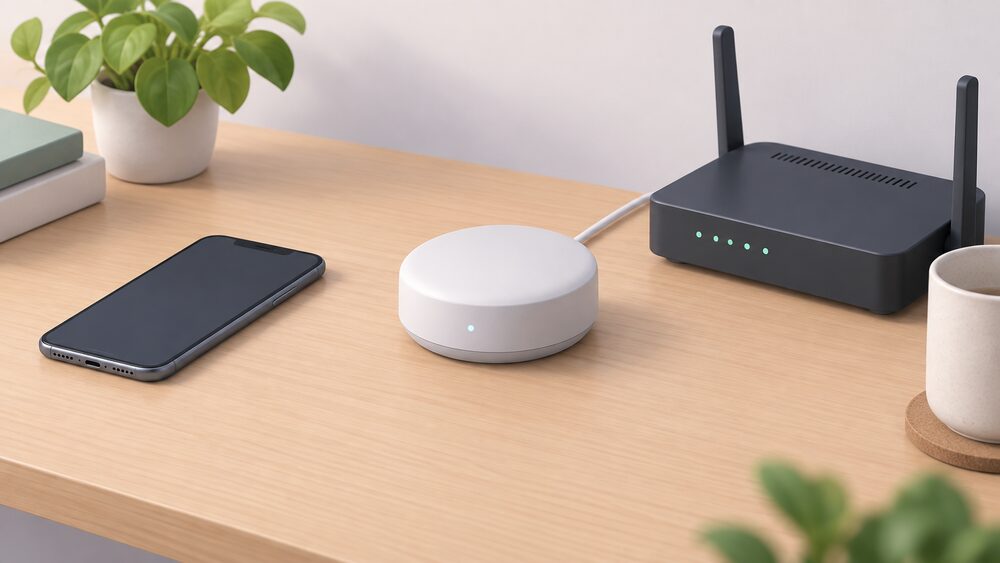 Octopus Home MiniThe Octopus Home Mini is a wi-fi device that pulls smart meter data into the Octopus app and online account every 5 to 15 seconds, giving near real-time electricity and gas visibility to Octopus customers.