In this guide
Octopus Electroverse is a roaming payment service for public EV charging: one account, one app and one card that work across many different charging networks rather than one. Octopus describes it as the largest charging network in Europe, and states that more than 1,426,060 chargers work with Electroverse across over 1,300 charging networks in the UK, Europe and beyond1. Joining is free, and Octopus states it never charges subscription or transaction fees1.
The commercial case rests on two things. First, consolidation: a driver holds one payment method instead of an account with each operator, which independent guidance describes as bringing multiple networks into one platform and sometimes unlocking lower rates or promotions3. Second, tariff-linked discounts: Octopus Go customers receive 5% off all public charging through Electroverse, and Intelligent Octopus Go customers receive 8%, once the Octopus Energy account is linked in the app1.
What Electroverse does not do is generate electricity or reduce the underlying price of a kilowatt hour. Rates are set by the charge point operators, and public charging carries 20% VAT1. The service sits between the driver and the operator, and the dependence it creates is on a working mobile connection, an app account and Octopus's own platform.
One card and app across Europe's largest charging network
Electroverse is a roaming platform, not a charge point operator. It holds commercial agreements with charging networks and presents their chargers inside a single interface, so a driver can start a session without registering separately with each operator. Octopus states that customers can use the app or the Electrocard to access over 850,000 connected chargers across 40 European countries, and that this represents 80% of chargers on Europe's public charging network6. More recent figures put the total higher: over 1,234,551 charging stations globally as of December 2025, with over 700 new partners added during that year taking the total to 1,5377.
The numbers published by Octopus do not all measure the same thing, and it is worth reading them carefully. The product page cites more than 1,426,060 chargers working with Electroverse1; a support article cites over 920,000 chargers across the UK and Europe2; the 2025 round-up cites over 1.2 million partnered chargers and over 1,234,551 charging stations globally7. These are different snapshots taken at different dates and on different definitions of "partnered" and "connected", so they should be read as a growing network rather than a contradiction.
For a household, the practical effect is that public charging stops being a matter of holding six apps. Independent guidance notes that this consolidation lets a driver access a large number of chargers through a single account, simplifying payment3. The dependence that remains is on the operators themselves: Electroverse does not own the hardware, does not set the price, and cannot fix a broken unit. Its own guidance is that when a broken charger is reported, it tells the charge point operator so they can fix it8.
Free to join, with no subscription or transaction fees
There is no membership cost. Octopus states that Electroverse is free to join for everyone and that it never charges subscription or transaction fees1. Its beginner's guide repeats the point: "It's also completely free to sign up - no pesky subscription fees here"9. The support pages confirm the same position, adding that rates are set by the charge point operators, with exclusive discounts added where possible2.
That structure matters because it separates the two costs a driver faces. The platform cost is zero. The energy cost is whatever the operator charges, and Electroverse passes that through with a stated guarantee: the rate shown in the app is the rate charged1. There is no membership tier that unlocks a lower headline rate, and no monthly fee that has to be earned back through volume.
Eligibility is equally open. Octopus states plainly that a driver does not need to be an Octopus Energy customer: "No! We want charging to be as simple as possible for every EV driver in the UK, whether you're with Octopus Energy for your home energy supply or not"1. The discounts are the exception, and they are tied to specific Octopus tariffs rather than to being a customer in general.
Payment is by linking a debit or credit card, or using Apple Pay, and billing occurs after each charging session9. The Electrocard is free to order1. Sign-up is stated as taking under 30 seconds, with charging possible the same day1.
How you charge: app, Electrocard and plug and charge
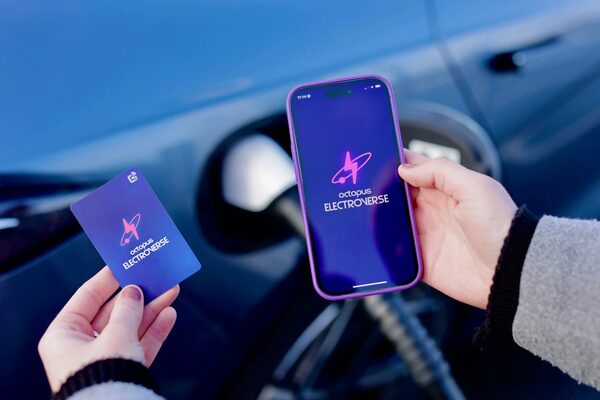
There are three routes into a session. The first is the app: Octopus states that its in-app charging feature lets a driver start a session at any compatible charge point on the network9. The second is the Electrocard, an RFID card that can start a charge where the app is inconvenient1. The third is Plug & Charge, available on compatible vehicles, where the car identifies itself and charging begins with no app or card interaction at all9.
The in-app process is a short sequence: tap 'Charge', select the connector, plug the vehicle into the charge point, then tap 'Start charge'8. Compatibility is not universal, and Octopus advises checking a station's access information for 'Electroverse App' before relying on it2.
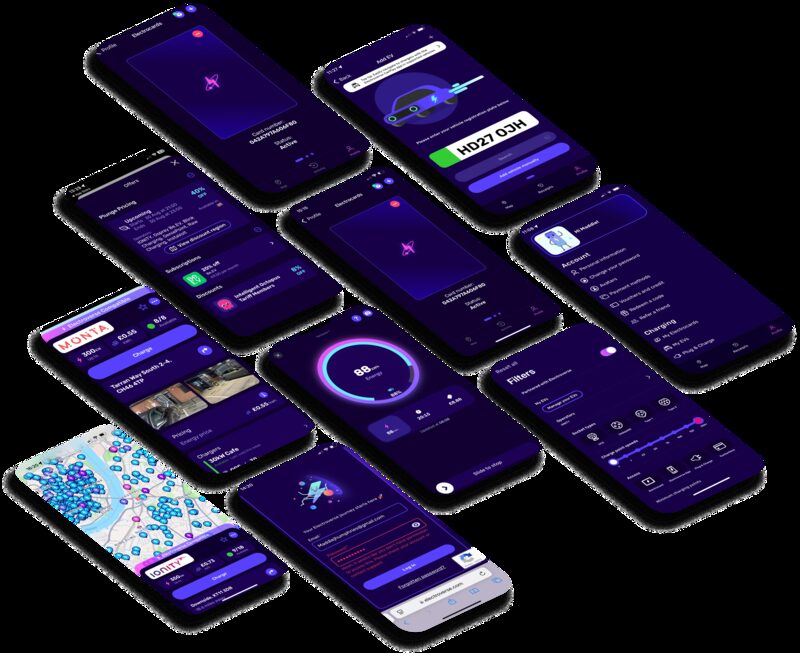
The app runs on iOS and Android, and also on Android Auto, Apple CarPlay and Android Automotive OS, which puts charger navigation on the car's own screen1. In December 2025 Octopus added new map pins, real-time charge tracking on charging screens, and an 'Offers' tab collecting discounts, offers and subscriptions in one place7.
Finding and planning a charge: maps, filters and route planner
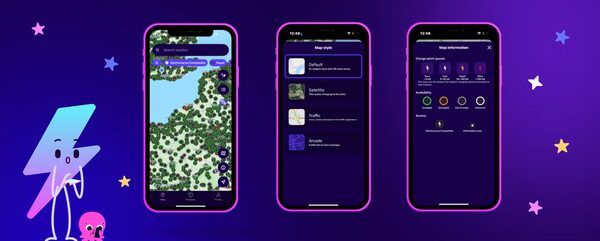
The map is the working part of the service. Octopus states that all coloured map pins are partnered with Electroverse and can be charged at with the app or the Electrocard8. Each pin carries charger speed in kW, the price per kWh, live availability, the address with directions, photos, operator connection fees, access details and opening hours8. The map can be filtered by charging network, by speed in kW and by connector type such as CCS or Type 29.
A route mapper plots an EV-friendly journey once a vehicle is added to the account9. Independent guidance on long journeys makes the same recommendation in general terms: use chargepoint finder apps to map out where chargepoints lie along the route10. Live availability data is the feature that makes this useful rather than theoretical, since it reflects whether a charger is currently in use or out of service11.
The community contributes to the data. Octopus reports that the Electroverse community added over 25,000 charging photos to the app7, which is how a driver can see whether a bay is accessible, whether there is a canopy, or whether the charger sits at the back of a car park.
For a household without a driveway, this is the part of the service that carries the most weight. Public charging is the substitute for home charging, and finding a working, available, correctly rated charger is the daily problem. The map and filters address that directly. What they cannot do is guarantee the charger works when the driver arrives, which is why the operator relationship matters.
What it costs to charge: rates set by operators
Electroverse does not set the price of a kilowatt hour. Its product page states that the rates reflected on the network are provided by the charge point operators, and that exclusive discounts are added where possible1. The guarantee that follows is the one that matters commercially: the rate shown in the app is the rate charged1. There is no post-session adjustment and no separate platform markup.
Public charging carries 20% VAT, which is the rate applied to electricity bought at a public charge point5. That is a materially different position from domestic electricity, and it is one reason public charging costs more per unit than charging at home.
Operators may also levy charges beyond the energy rate. Independent guidance on one UK network notes that connection fees, overstay fees or alternative pay-as-you-go rates may apply12. Electroverse surfaces operator connection fees on its map pins8, which is the practical way to check before committing to a session.
Discounts for Octopus tariff customers: 5% to 8% off
The discounts are the clearest financial benefit, and they are narrow. Octopus Go customers receive a 5% discount off all public charging through Electroverse, and Intelligent Octopus Go customers receive an 8% discount1. The earlier guidance confirms the same two rates: "If you are an Octopus Go customer or an Intelligent Octopus Go customer, you can get a 5% or 8% discount across the whole of the Electroverse"4.
Access requires linking the Octopus Energy account inside the Electroverse app4. Without that link, the discount does not apply, even where the driver is on the right tariff. Octopus currently offers three EV tariffs for drivers who want to charge at home13, so the discount applies to a subset of its own customer base rather than to all of it.
The discount applies to public charging through Electroverse, not to home charging, and it does not change the underlying operator rate. It is a reduction on the price the app shows. For a household that charges mostly at home and uses public charging occasionally, the value is modest; for one that relies on public charging regularly, it compounds across every session.
Credits work alongside the discount. Octopus states that credits act as an additional way to pay for charging sessions, and that any credits on the account are automatically applied to the next charging session14. They can be redeemed by tapping 'Redeem a code' in the account settings14. Credits received through referral, sign-up or other means can only be redeemed on the Electroverse network and cannot be refunded to a bank account or transferred to another Octopus Energy account2.
Charging abroad and the small print
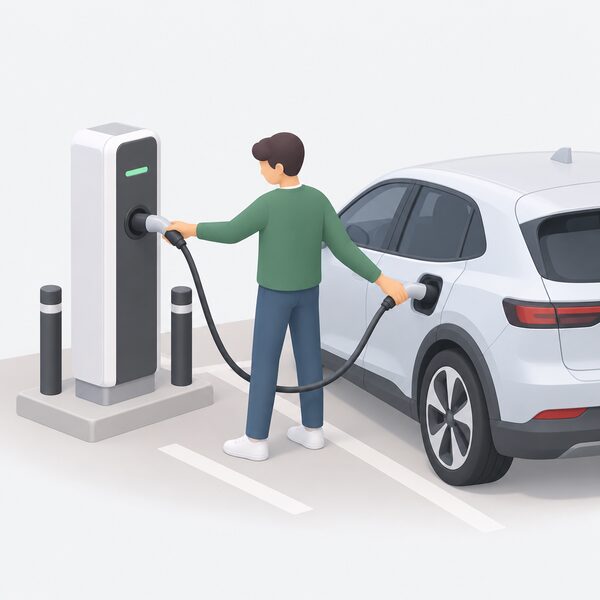
The Electrocard works outside the UK, but the billing currency changes. Octopus states that any charging session outside the UK will be billed in the local currency, at the bank's conversion rate, and that a non-sterling transaction fee may apply depending on the bank2. The Electrocard itself is free1. There is no separate Electroverse foreign usage fee stated.
Credits have a defined lifecycle. A code redemption can take up to 24 hours to be applied2, and the refer a friend scheme pays out within 24 hours once its steps are completed14. Support responses are stated as within one business day2. Account closure is handled in the app under 'support', and any outstanding payments must be settled before deactivation completes2.
"If you choose to charge with Electroverse, you will not be eligible for refunds or charging credits to account for price differences with other providers."
Two further points sit in the small print. First, cable requirements: chargers at 50kW and above generally have their own cable, but below that a driver may need to supply one2. Independent guidance confirms that most slow and fast chargers are untethered15, that on-street charge points are mostly untethered16, and that a Type 2 to Type 2 cable is required for Tesla home and public AC chargers, while Superchargers use tethered cables17. Second, charge security: Octopus states that if the charging cable is locked to the vehicle, someone else cannot stop the charge from their phone2. Where a home charger is enrolled in a smart charging service such as Intelligent Octopus Go, independent guidance is that users must disable all other control sources to prevent conflicts18.
For a household's energy independence, the position is mixed. Electroverse removes the need for multiple operator accounts and gives one route to a very large public network, which reduces the friction of charging away from home. It does not reduce dependence on the public grid, on third-party operators, on a mobile data connection, or on Octopus's platform and app. Home charging, covered in EV charging at home, remains the route that changes the cost base rather than the payment method.
Sources18 cited
- Octopus Electroverse, Octopus Electroverse, 2026
- Octopus Electroverse FAQs, Octopus Electroverse, 2026
- How to find the best charging stations without home charging, Carwow, 2026
- Which charging discounts can EV drivers get with Octopus Electroverse, Octopus Electroverse, 2024
- Electric car charging costs: all you need to know, Zapmap, 2026
- Octopus Electroverse is Europe's largest EV roaming network, Octopus Electroverse, 2024
- Octopus Electroverse wrapped 2025, Octopus Electroverse, 2025
- Charging location pins on the Octopus Electroverse map, Octopus Electroverse, 2025
- A beginner's guide to Octopus Electroverse, Octopus Electroverse, 2026
- Electric vehicle battery basics, Energy Saving Trust, 2025
- What is live data, Zapmap, 2026
- Be.EV network guide, Zapmap, 2026
- Octopus EV energy tariffs, Uswitch, 2025
- Octopus Electroverse credits: what are they and how do they work, Octopus Electroverse, 2024
- How to use electric car charging points, Which?, 2026
- On-street charging, Zapmap, 2026
- EV connector types, Zapmap, 2026
- Making home energy management work for consumers, Energy Systems Catapult, 2026