
In this comparison
Whether Octopus Tracker is worth taking over a fixed tariff turns on one structural difference: a tracker is not usually subject to the Ofgem price cap, so the household carries the wholesale price risk that a fixed deal removes1. Tracker costs usually follow wholesale energy prices and can change on a daily basis, while a cap tracker follows the level of the energy price cap and often provides a guaranteed discount against it, so it changes when the cap changes1.
That means the comparison is not "cheaper or dearer" in the abstract. It is a question of which direction prices move over the term, and how much of that movement the household is willing to absorb. Tracker tariffs are not subject to the price cap, so a household should be able to save if prices drop below the cap, and can be charged more than the cap if prices rise beyond its limit2.
The rest of this page sets out how the rate is set, what the trade-off actually is, who tends to gain, how to run the numbers on your own usage, and the limits that come with a wholesale-linked price.
What the Tracker tariff actually is
A tracker tariff is a supply contract whose unit rate is linked to an external price rather than set for a fixed term. The two common forms behave very differently. A cap tracker tracks the level of the energy price cap and often provides a guaranteed discount against it, so it changes when the cap changes2. A wholesale tracker follows wholesale energy prices directly, and those costs can change on a daily basis1.
Some tracker tariffs also carry an in-built discount against the price cap, and that discount is often taken out of standing charges, so while unit rates would change like a normal tracker, the standing charge carries the benefit3. Others that follow the price cap offer a fixed discount on unit rates versus the cap instead2. The distinction matters because it decides whether the saving scales with how much energy a household uses or is a flat amount.
The regulatory background is worth knowing. Fixed-term tracker tariffs are no longer able to track the price of tariffs offered by suppliers, but only a published stock exchange quotation or index, or a financial market rate over which the supplier has no control5. That rule is what makes a tracker a genuine index product rather than a supplier's own price in disguise.
Tracker is not the same as Agile. Agile is a dynamic half-hourly tariff that keeps users in control but requires more engagement6. Tracker prices a longer period. Both sit outside the cap, but the granularity of the signal and the attention each demands are different.

How Tracker prices are set and when they change
The reset frequency is the single most practical difference between tracker products. A cap tracker changes every three months when the price cap is reset, and most providers guarantee a discount on the price cap4. A wholesale tracker can move far more often, in principle daily, because it follows wholesale energy prices1.
The price cap itself is calculated according to wholesale energy prices during each price cap assessment period7. Ofgem's wholesale cost review collected data from 11 suppliers representing 96% of the retail market, and all suppliers told Ofgem they observed demand destruction across some or all of the cap periods8. That is the mechanism a cap tracker is riding: the cap is a lagged reflection of wholesale costs, and a tracker is a more immediate one.
For a household, the practical consequence is timing. A cap tracker gives three months of certainty at a time and a stated discount. A wholesale tracker gives a price that can move within a billing period, so the bill depends on when energy was used and what the index did. Neither is a fixed price, and neither is capped.
Tracker versus a fixed tariff: the core trade-off
A fixed tariff sells certainty. A tracker sells exposure, in both directions. The trade-off is that a household gives up knowing its unit rate in exchange for the possibility of paying below the cap when wholesale prices fall.
The evidence on how that plays out is mixed by design. Some consumers will be better off and some will lose out9. That is the honest summary of any change to how costs are recovered, and it applies directly here: a tracker is not a saving, it is a position.
Where the discount sits changes who gains. A tracker whose discount is on the unit rate produces higher savings with higher usage, and vice versa2. A tracker whose discount is on the standing charge is better for lower-consumption households than a tracker where the discount is on the unit rate2. So two households on the same tracker, with the same rates, can have opposite experiences purely because of how much they use.
There is also an engagement cost. Monitoring a time-of-use tariff once it is set up can require a greater level of engagement than consumers may be used to10. Tracker is less demanding than a half-hourly tariff, but it is not a set-and-forget product in the way a fixed deal is.

What the comparison depends on: wholesale prices and the price cap
Everything in this comparison runs through the price cap and the wholesale market behind it. The cap is calculated according to wholesale energy prices during each price cap assessment period7. A tracker that follows the cap inherits that lag; a tracker that follows the wholesale market leads it.
The direction of travel is what decides the outcome. If wholesale prices fall below the level baked into the cap, a tracker priced below the cap saves money. If they rise above it, the tracker costs more, because tracker tariffs are not usually subject to the price cap2. The Ofgem price cap does not apply to them11.
There is a wider cost question that sits underneath this. Time-of-use tariffs could push up the cost for individual suppliers of providing default products12. That is a structural point about how these products interact with the default tariff market, not a prediction about any one household's bill, but it explains why suppliers manage tracker availability carefully.
"the price cap is calculated according to wholesale energy prices during each price cap assessment period"
Who tends to benefit from a tracked rate, and who does not
The clearest split is by consumption. Where the discount is on the unit rate, higher usage will mean higher savings, and vice versa2. A high-consumption household on a unit-rate-discount tracker gets more from it than a low-consumption household on the same product. Where the discount is on the standing charge, the reverse holds: those products are better for lower-consumption households than a tracker where the discount is on the unit rate2.
The second split is by tolerance for movement. A household that needs a predictable monthly figure is poorly served by a rate that can change daily1. A household that can absorb a higher bill in a rising market, and wants the benefit if prices fall, is better matched to the product.
The third is by engagement. Dynamic tariffs such as Agile Octopus keep users in control but require more engagement6. Tracker sits between a fixed deal and a half-hourly tariff on that scale, but it still asks the household to watch the rate.
There is a risk that applies to shifting load generally, and it is worth stating plainly: charging based on time-of-use tariffs has risks of coordination induced load spikes13. If many households respond to the same price signal at the same time, the benefit can be eroded. That is a system-level limit on how much any one household can reliably gain from moving its use.

How to run the comparison on your own usage

The comparison only means anything against a household's own consumption, and the tools for that are mostly built on smart meter data. Loop analyses smart meter data with information about your home and lifestyle to give tailored energy-saving tips, and its solar simulator shows the impact of different solar panel systems on bills14. That is a route to seeing how a rate change translates into a bill change.
For Octopus customers specifically, the Octopus Compare app is currently only available for Octopus tariffs and customers, who can provide their account number and an API key to make the comparisons15. That is the most direct way to compare two Octopus products against actual half-hourly usage.
The general principle is to compare annual cost, not unit rate. A tracker with a lower unit rate but a higher standing charge can lose to a fixed deal at low usage, and win at high usage. The discount basis decides which way that goes2.
Switching between Tracker and fixed: what is involved
Moving between a tracker and a fixed tariff is a contract change, and the terms of the tracker contract govern it. Tracker tariff contract lengths are usually fixed, and while some tracker tariffs carry exit fees, others do not2. Exit fees only apply to fixed-term deals, including some tracker tariffs, and cannot be charged in the last 49 days of the term4.
That 49-day window is the practical lever. A household inside it can move without an exit fee on a fixed-term product. Outside it, the fee depends on the product.
Consumer understanding of this is weak. On exit fees, the share that can identify that they may still apply to a fixed contract even when moving to another deal with the same supplier was 57% net saying true16. In other words, a large minority do not realise that staying with the same supplier does not automatically avoid the fee.
Availability is the other constraint. Suppliers pause sign-ups when conditions change: Octopus temporarily stopped switching and sign-ups for its Flux tariffs17. A tracker that is open today may not be open next month, and a household that leaves one may not be able to return on the same terms.

Risks and limits of a tracked tariff
The first limit is the cap. Tracker tariffs are not usually subject to the price cap, so customers can be charged more than the cap if prices rise beyond its limit2. There is no ceiling on the downside.
The second is peak exposure. A household takes the risk of paying more than a standard tariff at peak demand times, such as dinner time, though there can be periods of much lower cost18. On a tracker that prices a longer period this is less acute than on a half-hourly tariff, but the exposure exists.
The third is engagement. Monitoring a time-of-use tariff once it is set up can require a greater level of engagement than consumers may be used to10. A tracker that is not watched is a tracker whose benefit is not captured.
The fourth is structural. Time-of-use tariffs could push up the cost for individual suppliers of providing default products12, and charging based on time-of-use tariffs has risks of coordination induced load spikes13. These are system effects, not household choices, but they shape how durable the product is.
Finally, availability is not guaranteed. Products are paused and withdrawn, and a household that has built its budget around a tracker rate may find the product closed to new sign-ups or the terms changed at renewal17.
What this means for household energy independence
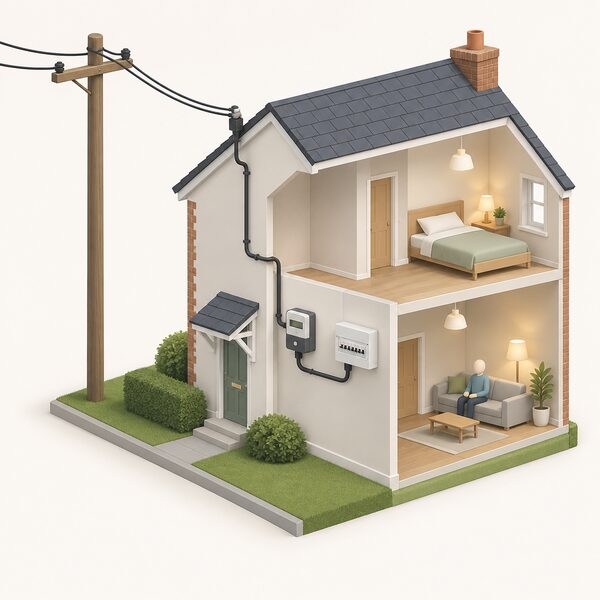
A tracker does something specific for independence: it removes the supplier's own price-setting from the unit rate. Fixed-term tracker tariffs can no longer track the price of tariffs offered by suppliers, but only a published stock exchange quotation or index, or a financial market rate over which the supplier has no control5. The rate a household pays is tied to a public index rather than a commercial decision.
What remains is dependence on the wholesale market itself, and on the supplier's willingness to keep the product open. A tracker does not reduce the household's exposure to gas and electricity prices; it changes the mechanism by which that exposure is passed through. A fixed tariff does the opposite, converting an uncertain pass-through into a known rate for a term.
Neither is independence from the grid or from a supplier. Both are contracts with a supplier, both depend on the network, and both are priced off the same wholesale market. The choice is about who carries the price risk over the term, and how much attention the household is prepared to give the rate in return.
For the wider picture of how these products sit alongside each other, see tracker energy tariffs, fixed-rate energy tariffs and the UK energy tariffs guide. The direct comparison of the two structures is covered in is a tracker tariff better than a fixed tariff, and the half-hourly alternative in Agile and dynamic half-hourly electricity tariffs.
Sources18 cited
- Energy tariffs explained, Uswitch, 2026-02-17
- What is a tracker tariff?, Uswitch, 2026-06-26
- Types of energy tariff, Confused.com, 2025-11-03
- How to switch energy supplier, Which?, 2026-05-15
- Retail Market Review: statutory consultation on domestic proposals, Ofgem, 2013-06-20
- Making home energy management work for consumers, Energy Systems Catapult, 2026-02-12
- February 2026 price cap announced, Uswitch, 2026-02-23
- Energy price cap wholesale costs review, Ofgem, 2023-12-15
- Response to Ofgem consultation on the Targeted Charging Review, Citizens Advice, 2019-02-07
- Smart timing: making time-of-use tariffs work for consumers, Citizens Advice, 2025-09-09
- Choosing an energy tariff, Citizens Advice, 2023-08-24
- Response to Ofgem's call for input on the future of domestic tariffs, Citizens Advice, 2024-05-24
- Demand flexibility, CREDS, 2026
- How to use your smart meter data, Which?, 2026-07-14
- Consumer engagement with smart electricity tariffs, Which?, 2024-11
- Understanding consumers' energy tariff choices, Ofgem, 2025-07
- Octopus temporarily pause new sign-ups to Flux tariffs, MoneySavingExpert forum, 2025-03-05
- Can a smart meter save you money?, ivie, 2024-08-22
 Tracker vs Price CapTracker tariffs can cost more than the price cap, so how do they compare?
 How Tracker Tariffs WorkTracker tariffs move your unit rate with wholesale prices or the Ofgem price cap, so what you pay can change daily.
 The Full Tariffs GuideWhich energy tariff suits how you live, and will switching really save you money?
 Fixed and Variable TariffsCompares capped standard variable tariffs with fixed deals, including exit fees, contract end and rollover.
 Fixed-Rate Energy TariffsWhat a fixed energy tariff fixes and what it does not, the contract lengths sold in the UK, exit fees and the 49-day window, how fixed rates compare with the price cap, and what happens when the term ends.
 Batteries and Smart TariffsA home battery can earn its keep if your electricity prices change through the day.