
In this comparison
An air fryer costs less to run than a conventional oven for most single meals, and the reason is straightforward: it draws less power and runs for less time. An average air fryer uses between 1.4 and 1.7 kWh of energy an hour, against about 2 to 5 kWh for an average oven1. Air fryers also typically cook food 20% quicker than ovens2.
The annual figures make the gap concrete. Which? puts the average air fryer at £33 a year, based on cooking a meal twice a week, and the highest running cost among the models it tested at £533. A built-in single electric oven averages £63 a year if used three times a week, and a freestanding electric cooker £593. A separate comparison puts a large air fryer at £94 to £146.22 a year and an electric oven at £104.44 to £261.10, both based on 200 hours of cooking a year2.
The saving is real but conditional. It is largest for one or two people cooking single portions, and it narrows or disappears when an oven is already full, when a large twin basket air fryer runs for a long period, or when the oven is doing batch cooking that would otherwise take several air fryer cycles.
Why an air fryer uses less power than an oven
The headline difference is the size of the heated cavity. An air fryer circulates hot air in a small, enclosed basket, so the element runs for a shorter proportion of the cooking cycle to hold temperature. An oven heats a much larger volume, and much of that volume is empty air.
The power ratings show the range on both sides. Single drawer air fryers tend to be around 1500W while twin drawer versions are closer to 2600W, with a maximum draw of up to 11 amps4. A modern electric oven averages around 2100 watts an hour5, and electric ovens are commonly rated at 2.0 to 2.2 kWh on medium to high heat6. A large twin basket air fryer can therefore draw more at any instant than a modern oven, which is why instantaneous wattage alone is a poor guide.
What separates them in practice is the energy consumed per cook, not the peak draw. The Energy Saving Trust calculation for an air fryer is 1.4 to 1.7 kWh power rating multiplied by one hour of use multiplied by a £0.2635 per kWh energy price cap1. The same source puts an oven at 64p to £1.61 for 15 minutes of preheating plus an hour of cooking, a total of 1.25 hours1. Preheating is a large part of that: an oven has to bring a much bigger mass of metal and air up to temperature before food goes in.
"This means that preheating your oven for 15 minutes and cooking your food for an hour will cost you between 64p and £1.61."
For a household's energy independence, the point is modest but real. Cooking is a load a home controls entirely, and shifting it to a lower-draw appliance reduces the electricity a home must buy or generate. It does not remove dependence on the grid or a supplier, and it does nothing about gas used for heating, which is the larger load in most homes.
Cooking time: the other half of the cost equation
Cost is power multiplied by time multiplied by the unit price of electricity, so a lower wattage appliance run for longer can cost more than a higher wattage one run briefly. That is why cooking time matters as much as the rating on the label.
Air fryers typically cook food 20% quicker than ovens, and guidance suggests reducing cooking times by 20% when following oven recipes2. A chicken breast can be cooked in as little as 15 to 20 minutes in an air fryer instead of 30 or more minutes in the oven2. Against that, some air fryers take 10 to 15 minutes to reach the desired temperature, which eats into the advantage on short cooks2.
The hourly costs across the range show how much the appliance size matters:
| Appliance | Energy use per hour | Cost per hour |
|---|---|---|
| Small air fryer (1 basket) | 0.8 kWh | 21p2 |
| Small air fryer (1 basket) | 1.3 kWh | 34p2 |
| Small air fryer (1 basket) | 1.6 kWh | 42p2 |
| Large air fryer (2 baskets) | 1.8 kWh | 47p2 |
| Large air fryer (2 baskets) | 2.0 kWh | 52p2 |
| Large air fryer (2 baskets) | 2.5 kWh | 65p2 |
| Large air fryer (2 baskets) | 2.8 kWh | 73p2 |
| Electric oven | 2 to 5 kWh | 52p to £1.312 |
A separate figure puts an oven at 55p per hour of use at 2100W7, and another at around 57p an hour for an average modern electrical oven5. The spread between 52p and £1.31 for ovens reflects the range of models and settings rather than a disagreement about method.
Microwave or air fryer: which is the cheaper alternative to an oven

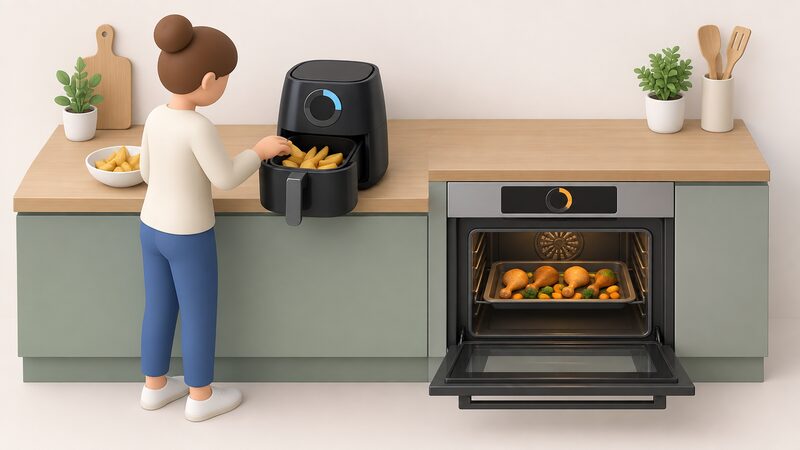
Both are cheaper than an oven, and the reason given is the same for each: they use less power and take less time to cook8. National Energy Action groups microwaves, air fryers and slow cookers together as often cheaper than ovens8, and the Energy Saving Trust suggests an air fryer or microwave instead of an oven to save energy10.
Slow cookers are also described as more energy efficient than hob or oven cooking, taking several hours but using very little electricity9. That is a different pattern of saving: low power over a long period rather than high power over a short one.
The comparison between microwave and air fryer specifically is not settled by a single figure here. What the sources support is that both beat a conventional oven on the same two grounds, and that the choice between them depends on the food. A microwave heats food through moisture and is quick for reheating and steaming; an air fryer circulates dry heat and browns and crisps. For a household weighing up which to buy first, the honest position is that the running cost difference between the two is smaller than the difference between either and an oven.
What the comparison does and does not tell you
The per hour and per year figures compare appliances running in isolation. They do not capture how a household actually cooks, and several habits change the arithmetic.
Opening the oven door repeatedly to check on food lets out hot air and wastes energy; peeking through the glass door avoids it12. Leaving an oven door open a little after cooking lets residual heat enter the kitchen, if it is safe to do so10. Neither habit changes the appliance's rating, but both change what a cook costs.
Batch cooking is the clearest limit on the air fryer case. Ovens are good for batch cooking, and an air fryer is described as cheaper to use specifically when cooking for one or two people12. A household cooking a large tray of vegetables and a joint of meat for four is using the oven's capacity, and splitting that across several air fryer baskets would not save.
There is also a safety boundary. Appliances should only be used for their intended purpose, and ovens, hobs and outdoor heaters should not be used to keep a room warm13. An air fryer is a cooking appliance, not a heater, and the same rule applies to it.
Finally, the comparison says nothing about purchase price, counter space, noise or cooking quality. It is a running cost comparison only, and the running cost gap between a £33 a year air fryer and a £63 a year oven is £30 a year on those figures3. That is worth having, but it is a small line in a household budget next to heating.
Where the savings show up in practice: which foods suit an air fryer
The savings are largest where the oven would otherwise be heated for a small quantity of food. Reheating, single portions, small cuts of meat and frozen items that cook quickly all suit a small basket, and the 20% time reduction compounds the lower draw2.
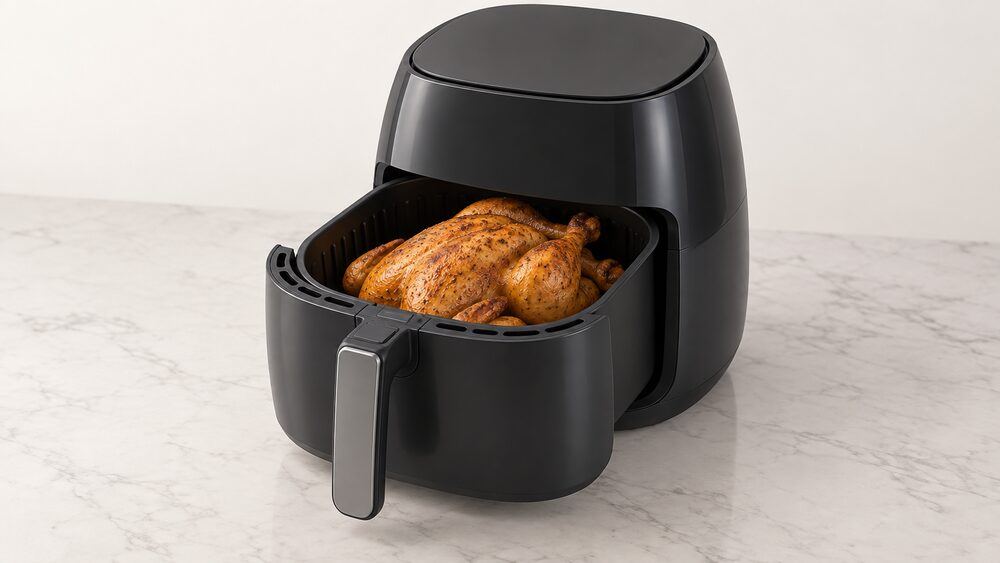
Which? found it costs 18p to roast a chicken in an air fryer, compared with 38p in a built-in electric oven14. That is a single-item comparison on a whole chicken, and it is the kind of cook where the air fryer's smaller cavity does the work. One energy-saving guide reports a saving of £263.80 a year from swapping from an electric oven to an air fryer, and a saving of over 75% from swapping from an electric oven to a microwave and air fryer together15. Those are the largest figures in this comparison and they assume a near-total swap, not occasional use.
The pattern is consistent across the sources: the air fryer wins on small, quick, single-portion cooks, and the oven wins on volume. A household that roasts a joint once a week and reheats leftovers the rest of the time will see a smaller saving than one that uses the air fryer for most meals.
How to compare running costs yourself: wattage, time and the unit price of electricity
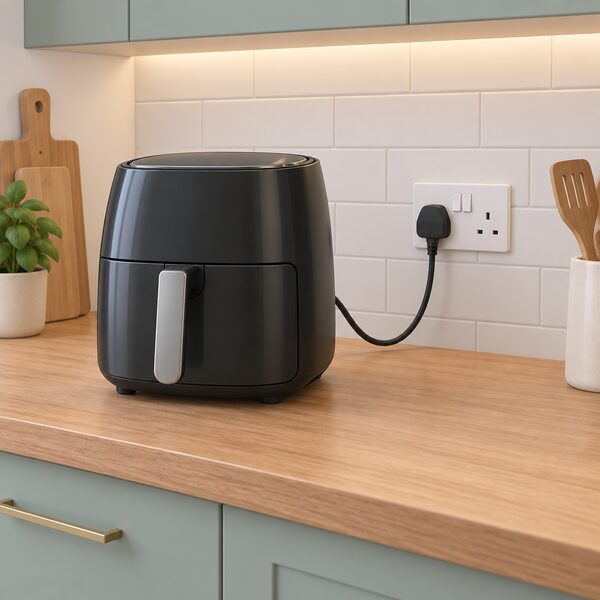
The method is the same for any appliance. Take the wattage, multiply by the hours it runs to get watt hours, then convert to kilowatt hours and multiply by your unit rate in pence per kWh. A kilowatt is a rate of use and a kilowatt hour is the amount used, which is what a supplier bills for16.
Worked examples from the sources show the range of inputs. The Energy Saving Trust used a £0.2635 per kWh energy price cap in its air fryer calculation1. One cooking cost comparison used £0.34 per kWh6. A 1.4kW air fryer run for one hour at a rate of £1.40 per kWh equivalent works out at 35p in one press-release example17. Your own tariff rate is the figure that matters, and it will differ from all of these.
Annual figures depend heavily on assumed use. The same air fryer range produces £41.78 to £104.44 a year for a compact model and £94 to £146.22 for a large one, both based on 200 hours of cooking a year2. Which? uses a different basis, cooking a meal twice a week for the air fryer and three times a week for the oven, which is why its £33 and £63 figures sit lower3.
For a household working through the quick wins and no-cost measures first, cooking is one of the easier loads to shift, because it needs no installer and no capital work. It sits alongside other appliance decisions such as the kettle or electric hob comparison and the wider question of which appliances use most electricity. None of these removes dependence on a supplier or the grid; they reduce the volume of electricity a home has to buy, which is the part a household controls directly.
Sources17 cited
- What appliances use more electricity, Smart Energy GB, 2026-03-16
- How much does it cost to run an air fryer, Uswitch, 2026-07-01
- How much your appliances cost to run, Which?, 2026-10-01
- Ratings of electrical appliances, Electrical Safety First, 2026-09-19
- How to save energy at home: home appliances, IVIE, 2026-09-20
- Energy efficient cooking, Uswitch, 2025-01-27
- How much electricity am I using, Centre for Sustainable Energy, 2026-07
- Preparing for winter, National Energy Action, 2025-10-14
- Cold weather energy saving: your top tips, Energy Saving Trust, 2025-09-22
- Energy saving tips for Christmas dinner, IVIE, 2024-09-27
- EDF Customer Support Fund, Charis Grants, 2026-09-17
- Top five tips to save energy in the kitchen, Energy Saving Trust, 2026-05-20
- Fire safety in the home, Electricity North West, 2026-09-19
- Which? finds household appliance running costs have risen nearly 60 per cent, Which?, 2023-05-01
- Which? warns against buying cheap appliances that rack up huge energy bills, Which?, 2023-11-09
- What is a kWh, kW and kWh explained, OVO Energy, 2024-05-13
- Eight hours of free electricity over the early May bank holiday weekend, Uswitch, 2026-03-29
 Heat Pump Running CostsWhat does a heat pump cost to run each year, and is it cheaper than a gas boiler?
 Running CostsA portable air conditioner costs roughly twenty to forty pence for every hour it runs, while a fixed unit uses far less electricity for the same cooling.
 Heating Schedules and SetbackIs it cheaper to leave the heating on low all day, or set it to come on only when you need it?
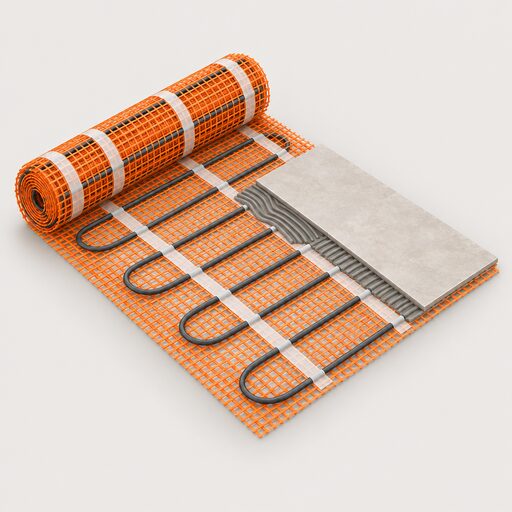 Underfloor Heating SystemsWhich rooms suit electric underfloor heating and which need a wet system?
 Appliance Running CostsWorking out what your appliances cost to run comes down to two things: how much power they use and what you pay per unit of electricity.
 Heat Pumps vs BoilersWill a heat pump actually cost less to run than my boiler, and does it heat the house as well?