
In this comparison
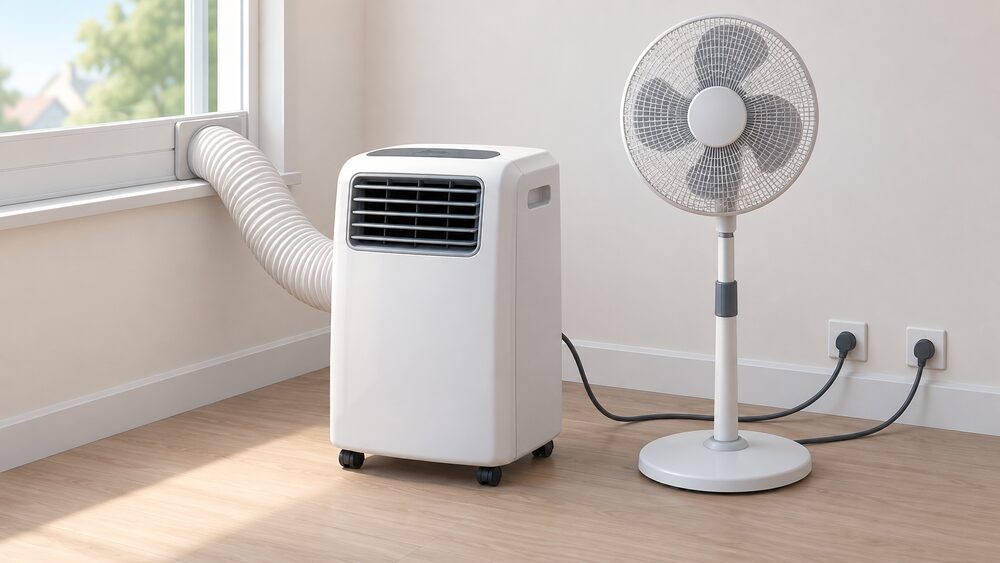
A fan and a portable air conditioner do different jobs, and the running costs reflect that. Independent guidance puts a typical portable air conditioner drawing 1,000 to 1,500W at around 26 to 39p per hour, roughly 14 to 20 times more than a fan1. The same guidance puts a large 75W fan at 1.9p per hour, a pedestal fan at 50W at 1.3p per hour and a small 20W desk fan at 0.5p per hour, all based on an electricity price of 25.7p per kWh1.
The gap is not a pricing quirk. A fan moves air around to create a cooling sensation on the skin and does not lower the temperature of a room, while an air conditioner actively removes heat and reduces room temperature1. One buys comfort for pennies an hour; the other buys a cooler room for tens of pence an hour.
For a household thinking about energy independence, the choice matters less than the load it adds. Cooling is a discretionary, weather-driven demand that arrives in the same weeks as high grid prices, and a portable unit is the most electricity-hungry way to meet it. This page sets out the published figures, what drives them, and where the extra cost of air conditioning is and is not justified by the evidence.
The running cost gap: fans at pennies, air conditioning at 26 to 39p an hour
The headline comparison comes from independent guidance that prices a typical portable air conditioner at 1,000 to 1,500W and around 26 to 39p per hour, against a fan at roughly 14 to 20 times less1. The same source gives the fan side of the ledger in detail: a large 75W fan at 1.9p per hour, a pedestal fan at 50W at 1.3p per hour and a small desk fan at 20W at 0.5p per hour, all calculated on 25.7p per kWh1.
Other independent figures sit in the same band. A consumer body puts the average fan at around 3p per hour, based on a draw of less than 100W2. Guidance from a national energy charity states that fans usually cost less than 2p an hour to run4. The spread between 0.5p and 3p reflects the size of the fan and the price of electricity assumed, not a disagreement about the physics.
On the air conditioning side, a press-release estimate for a 1kW portable unit gives £1.47 for a day and £13.37 for a week, on the cheapest fix rates and average daily use of 9.1 hours3. The same release prices a built-in air conditioning unit at 2.7kW at £3.97 a day and £36.10 a week on the same basis3. Those are modelled figures for a specific tariff and usage pattern, and a household on a standard variable rate would see more.
The practical reading is that a fan costs pennies an hour and a portable air conditioner costs tens of pence an hour, and the ratio holds across every published figure. What the ratio does not tell you is whether the cooling is worth it, which depends on the room, the weather and who is in it.
"Air conditioners, meanwhile, can cost between 24p and £1.23 per hour, varying greatly by size and efficiency"
Fans usually cost less than 2p an hour to run, against 24p to £1.23 an hour for air conditioners, a range that varies greatly by size and efficiency1. Some units cost in the region of 75p per hour to run, while more powerful systems can cost closer to £2 per hour1.
Why a portable air conditioner costs so much to run: 1,000 to 1,500W of power
The cost is set by the power draw. Independent guidance rates a typical portable air conditioner at 1,000 to 1,500W1, and safety guidance gives a wider range of 900 to 2,000W, noting that the higher the BTU rating the higher the power in watts5. A press-release figure for the 2.2 million UK homes with portable air conditioning units uses 1kW as its working assumption3.
That is a load comparable to a fan heater, and the running costs land in the same place. A 2kW fan heater costs 55p an hour on an example tariff of 27.69p per kWh6, and a 3kW fan heater costs 74p an hour, or £414.40 if used four hours a day from November to February7. A portable air conditioner is not a fan heater, but it draws from the same order of magnitude, which is why its hourly cost is measured in tens of pence rather than single pence.
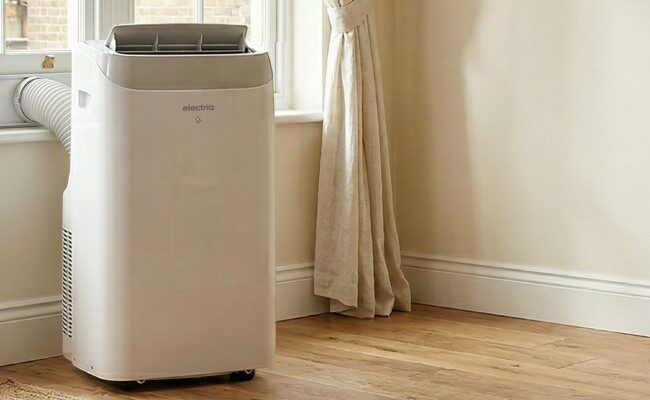
There is a second penalty specific to portables. Independent guidance states that portable units use 30 to 50 per cent more electricity than fixed systems8. A fixed split system moves heat outdoors through a permanent installation; a portable unit exhausts through a hose, and the same guidance notes the inefficiency that comes with it. For a household weighing a portable unit against a fixed air-to-air heat pump, that 30 to 50 per cent is the number that separates them.
The efficiency of the cooling itself is regulated. Official guidance for Wales states that the energy efficiency ratio of an air conditioner working in cooling mode should be a minimum of 3.879. That is a minimum standard for the appliance, not a running-cost guarantee, and it does not change the fact that a unit drawing 1,000 to 1,500W will cost more per hour than one drawing 50W.
How much cheaper a fan is: up to 20 times less per hour
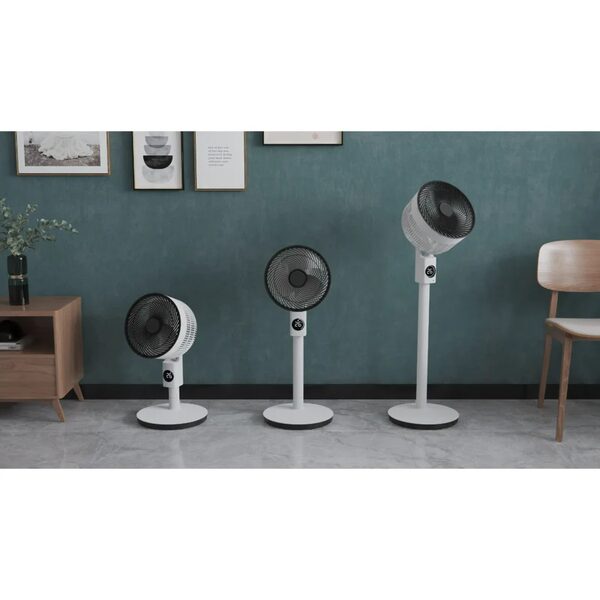
The fan side of the comparison is where the numbers are most consistent. Independent guidance gives 1.9p per hour for a 75W large fan, 1.3p for a 50W pedestal fan and 0.5p for a 20W desk fan, all at 25.7p per kWh1. A consumer body puts floor and desktop fans at typically 60W or less, which it says means under 2p per hour to run10. A national energy charity states that fans usually cost less than 2p an hour4, and a fuel poverty charity puts the average fan at under 100W and around 3p per hour2.
The range across these sources is explained by what is being measured. A small desk fan is not the same appliance as a large floor fan, and the assumed electricity price differs between documents. The direction is the same in every case: single-digit pence per hour, and often less than 2p.
The comparison with air conditioning is where the "up to 20 times" figure comes from. Independent guidance states that a portable air conditioner at 26 to 39p per hour is roughly 14 to 20 times more than a fan1. Taking the top of the air conditioning range and the bottom of the fan range gives a wider ratio still, but the published comparison is 14 to 20 times.
For a household, the arithmetic is simple enough to run on a hot afternoon. A 75W fan left on for 24 hours at 1.9p per hour comes to about 46p. A portable air conditioner at 26 to 39p per hour reaches the same total in roughly one to two hours. Neither figure includes the cost of the appliance, and neither is a recommendation.
| Appliance | Power | Running cost per hour | Basis |
|---|---|---|---|
| Small desk fan | 20W | 0.5p | 25.7p per kWh1 |
| Pedestal fan | 50W | 1.3p | 25.7p per kWh1 |
| Large fan | 75W | 1.9p | 25.7p per kWh1 |
| Average fan | under 100W | around 3p | Independent estimate2 |
| Air cooler | 75W | 11p per day, £1 per week | Cheapest fix rates3 |
| Portable air conditioner | 1,000 to 1,500W | 26 to 39p | Independent guidance1 |
| Portable air con unit | 1kW | £1.47 per day, £13.37 per week | Cheapest fix rates, 9.1 hours daily3 |
| Built-in air con unit | 2.7kW | £3.97 per day, £36.10 per week | Cheapest fix rates, 9.1 hours daily3 |
What drives the difference: cooling versus moving air
The cost gap follows from what each appliance does. Independent guidance is explicit that fans move air around to create a cooling sensation on the skin and do not lower the temperature of a room, while air conditioners actively remove heat and reduce room temperature1. A fan is a small motor turning blades; an air conditioner is a refrigeration circuit with a compressor, and the compressor is what draws the power.
There is a third category between them. Air coolers, also called evaporative coolers, use water to slightly cool air and are described as more effective than fans in dry conditions1. A press-release figure prices a 75W air cooler at 11p a day and £1 a week on the cheapest fix rates3. That places it well below a portable air conditioner and above a fan, which matches its position in the market.
The physics also sets a limit on fans that has nothing to do with cost. Independent guidance states that if the room temperature is above 35 degrees Celsius, a fan will likely heat you up rather than cool you down8. In a UK heatwave that threshold is rarely reached indoors, but in a top-floor flat or a south-facing room it is not impossible, and it is the point at which the cheap option stops working.
For a household's energy independence, the distinction matters. A fan is a small, intermittent load that any home can carry on a standard tariff, and it needs nothing from the grid beyond the usual supply. A portable air conditioner is a large, weather-driven load that arrives in the same weeks as peak prices, and it depends on the same grid and the same supplier as everything else in the home. Neither appliance generates or stores energy, so neither reduces dependence on the grid; they differ only in how much of it they use.
When the extra cost of air conditioning is worth it
The evidence does not support a general answer, and the sources are careful about it. Independent guidance states that actual costs vary depending on a home's insulation, temperature settings, energy prices and how the system is used12. That applies to any cooling or heating appliance, and it is the reason two identical units can produce different bills in two homes.
Where air conditioning is a fixed system rather than a portable one, the running-cost picture changes. Independent guidance on air-to-air heat pumps states that they deliver lower running costs than other types of electric heating and plug-in air conditioning13. A separate independent source puts air-to-air running costs as likely to be lower than using an oil boiler and similar to a gas boiler or an air-to-water heat pump with a standard electricity tariff at current energy pricing14. Those are comparisons for a permanently installed system, not a plug-in portable unit.
The case for a portable unit rests on circumstances the figures cannot capture: a bedroom that stays above 30 degrees overnight, a household with a medical need for a cooler room, or a rented flat where a fixed installation is not possible. The case against rests on the hourly cost and the fact that a portable unit uses 30 to 50 per cent more electricity than a fixed system8.
For households considering a fixed system instead, the wider evidence on heat pumps is relevant. Independent guidance notes that a heat pump can cost less to run than a gas boiler on a heat pump time-of-use tariff15, and one analyst's figure puts the potential saving at more than 50 per cent compared with a gas boiler, requiring high quality installation, high efficiency and a heat pump tariff16. Those figures are about heating, not cooling, and they depend on the tariff and the installation.
Cutting cooling costs without air conditioning
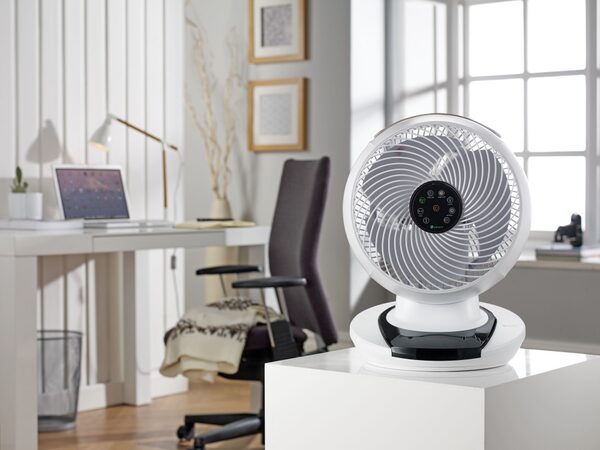
The cheapest measures are not appliances at all. Independent guidance lists air drying laundry as free4, and the same logic applies to shading, ventilation and timing chores away from the hottest hours. A national energy charity's summer guidance sets out fans, air coolers and air conditioners as the three powered options, with fans at the bottom of the cost range1.
Where a fan is used, size matters more than anything else. A 20W desk fan at 0.5p per hour costs a third of a 75W large fan at 1.9p per hour1. Running a fan only in the room that is occupied, rather than moving it from room to room, keeps the hours down. The published figures do not include a standby or idle cost for fans, and none is given.
Air coolers are the middle option. At 75W they cost 11p a day and £1 a week on the cheapest fix rates3, and independent guidance describes them as more effective than fans in dry conditions1. In humid weather their effect is weaker, which is a performance limit rather than a cost one.
For households that already have a heat pump, cooling may come from the same equipment. Independent guidance states that an air-to-air heat pump delivers lower running costs than other types of electric heating and plug-in air conditioning13. That is a fixed installation, and it is a different proposition from a portable unit bought for one hot week.
The impact on your overall electricity use
Cooling is a small share of a UK home's annual electricity use but a large share of its summer peak. Globally, the International Energy Agency has reported that using air conditioners and electric fans to stay cool already accounts for about a fifth of the total electricity used in buildings around the world17. That is a global figure from 2018, and it describes buildings rather than homes, but it shows the scale that cooling reaches in aggregate.
At household level, the effect depends entirely on hours and wattage. A 75W fan run for eight hours a day costs about 15p a day at 1.9p per hour1. A 1kW portable air conditioner run for the same eight hours costs £1.47 a day on the cheapest fix rates3, which is roughly ten times as much for the same period. Over a two-week heatwave the difference is between about £2 and about £20.
That is the energy independence question in miniature. A fan adds a load a home can absorb without changing its tariff or its habits. A portable air conditioner adds a load that arrives with the weather, at the time of year when wholesale prices and demand are both high, and it does nothing to reduce the home's reliance on the grid or its supplier. A fixed air-to-air heat pump can also heat in winter, which spreads its cost across the year, but it is still an electricity-dependent appliance.
For households in flats or rented homes where fixed installations are not possible, the practical options are the ones in this page: a small fan, shading, ventilation and timing. For those weighing a fixed system, the comparison with a portable unit is set out in air-to-air heat pump vs portable air conditioner, and the wider context on hot-weather risk is in overheating and hot weather in UK homes.
Sources17 cited
- Summer energy tips, National Energy Action, 2026-08-13
- High temperatures herald health fears for millions, End Fuel Poverty Coalition, 2024-08-12
- The cost of keeping cool, Uswitch, 2026-04-30
- Save money using your electrical appliances, Citizens Advice, 2023-05-10
- Ratings of electrical appliances, Electrical Safety First, 2026-09-19
- Are electric heaters eco friendly?, Which?, 2026-01-15
- Beware cheap appliances that cost you twice as much in the long run, Which?, 2024-03-05
- How to keep your home cool in hot weather, Centre for Sustainable Energy, 2026-07
- Approved Document L draft consultation, Welsh Government, 2019-12
- Is air conditioning worth it in the UK?, Uswitch, 2026-07-14
- Bans on F-gas in new products and equipment, GOV.UK, 2019-08-21
- Electric wallpaper explained, Energy Saving Trust, 2026-03-26
- How a heat pump can cool your home, Which?, 2026-07-17
- Air-to-air heat pumps: common questions on air conditioning, Nesta, 2026-06-24
- Air source heat pumps, Energy Saving Trust, 2026-07-16
- Air source heat pump costs and savings, Which?, 2026-04-14
- The Future of Cooling, IEA Heat Pump Centre, 2018-05-17
 Running CostsA portable air conditioner costs roughly twenty to forty pence for every hour it runs, while a fixed unit uses far less electricity for the same cooling.
 Air Conditioning CostPublished UK equipment prices and the parts of an installed price for portable, single split, multi-split and whole-house air conditioning.
 Types of Air ConditioningPortable, wall-mounted, multi-room or ducted: which air conditioning suits your home?
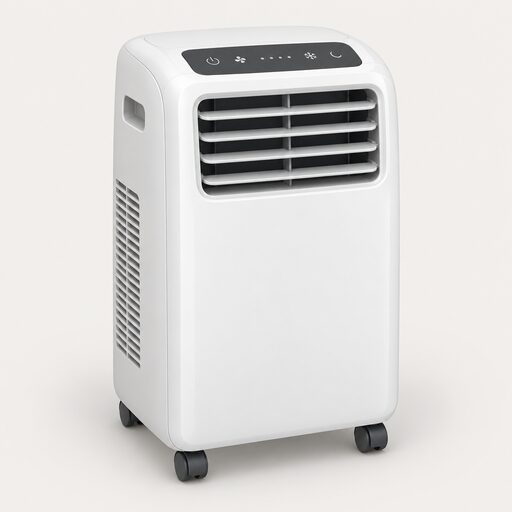 The Full Cooling and Air Conditioning GuideDo you really need air conditioning in a British summer, or would a fan and better shading do the job?
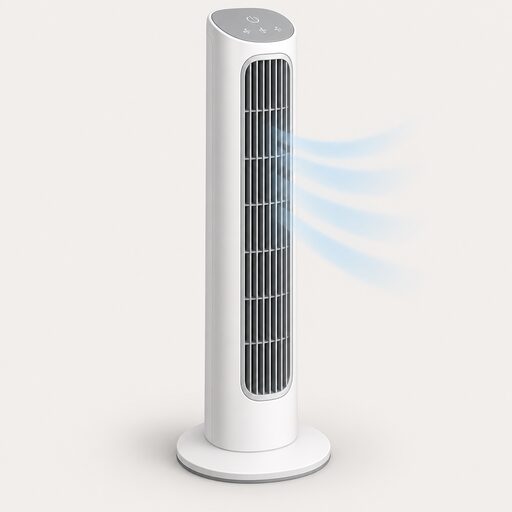 Electric FansHow electric fans cool people rather than rooms, what the main UK fan types (desk, pedestal, tower, ceiling and bladeless) draw in watts and cost per hour, where they fall short in a heatwave, how to use them safely, and how they fit alongside night ventilation and shading.
 Appliance Running CostsWorking out what your appliances cost to run comes down to two things: how much power they use and what you pay per unit of electricity.