
In this guide
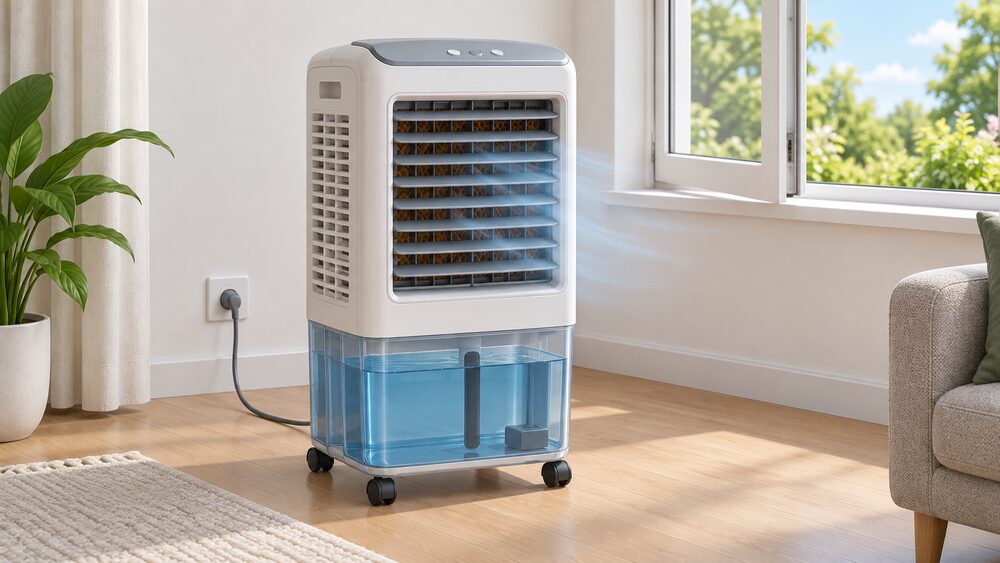
An evaporative air cooler cools a room by drawing warm air through pads soaked with water, which lowers the air temperature before the air is released back into the room1. It has no compressor and no refrigerant: the cooling comes from water evaporating. It plugs into an ordinary socket, and most domestic models need no installation at all, only water in the tank and a nearby power point1.
The cooling is modest. One UK seller states that the air leaving an evaporative cooler is likely in the region of 3 to 5 degrees less than the ambient temperature of the space it is used in2. National Energy Action describes air coolers as using water to "slightly cool air", and says they are more effective than fans in dry conditions3. That qualification matters in the UK, where hot spells are often humid: the drier the air, the more water it can take up and the greater the cooling; in very humid conditions, performance may be reduced1.
The trade is low power for low cooling. Uswitch lists an air cooler at 75W4, against 1,000 to 1,500W for a typical portable air conditioner, which National Energy Action puts at around 26 to 39p per hour to run3. For a household, that makes an evaporative cooler an inexpensive, low-demand way to take the edge off a warm room, not a substitute for air conditioning in a severe or muggy heatwave.
What an evaporative air cooler is and how it cools
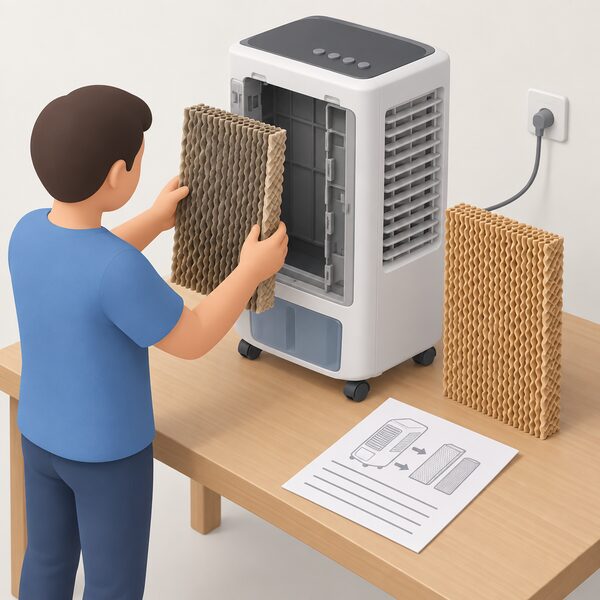
An evaporative cooler is a fan in a box with a water reservoir and a set of absorbent pads. Water from the tank wets the pads, a fan pulls room air through them, and as the water evaporates it takes heat from the air passing over it. The cooled, moister air is then blown into the room1. The seller of the iKool range describes the technology in plain terms as using "evaporative technology for refreshing airflow"1.
The same word, evaporator, appears in air conditioners and heat pumps, but the process is different. In a refrigeration circuit the evaporator is a low-temperature heat exchanger where refrigerant enters as a low-temperature liquid, absorbs heat by evaporating at low pressure, and leaves as a vapour; that refrigerant is then compressed and the heat rejected elsewhere, usually outdoors6. In an evaporative cooler, the water is not recovered: it leaves the machine as vapour and stays in the room.
Two consequences follow. First, the unit only works as designed when it has water. A cooler will usually still run with an empty tank, but then gives only the same effect as a standard fan2. Second, there is no thermostat in the usual sense. The seller's support page states that evaporative coolers "do not have a thermostat built in and rely on a fresh air supply, provided by open doors and windows"2. The machine cannot be set to hold a room at a chosen temperature; it produces a stream of air a few degrees cooler than the room, for as long as it runs.
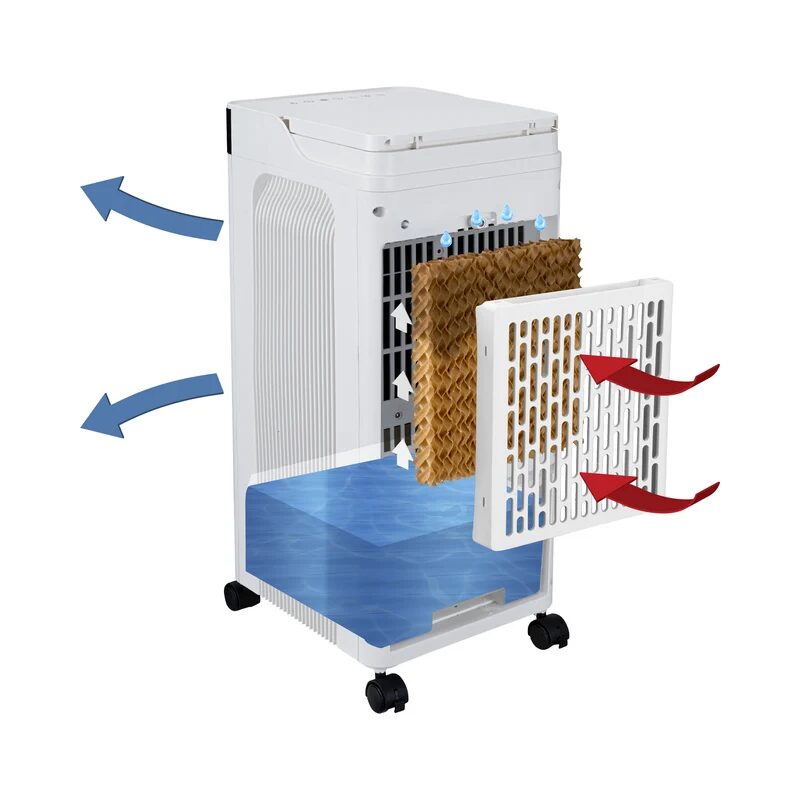
Evaporative cooling adds moisture, not refrigerant
The defining feature of an evaporative cooler is that it cools by putting water into the air. Every litre that leaves the tank ends up as vapour in the room. That is the reverse of what an air conditioner does: in cooling mode an air conditioning system takes moisture out of the air and so acts partly as a dehumidifier2. It is also the reverse of a refrigerant dehumidifier, which draws in moist air, passes it over cold coils and collects the condensed water in a tank7. The comparison is covered in more detail on the page on air conditioning, dry mode and humidity.
The seller of the iKool range confirms that the coolers raise humidity, and presents this as "beneficial in dry environments"1. UK independent advice is more cautious about deliberately adding water to indoor air. The Centre for Sustainable Energy, discussing the old practice of putting water bowls on warm air heaters, states:
"There's no truth in the 'dry air' claim, and purposely evaporating water into the air in your home can create problems with damp caused by condensation, so it's best not to do this"
That guidance was written about heating systems, not coolers, but the physics is the same: water evaporated indoors has to go somewhere. In a well-ventilated room the moist air is carried out through open windows and replaced; in a sealed room, humidity rises, the cooling effect falls, and cold surfaces can gather condensation.
The principle itself is sound and familiar. Plymouth Energy Community notes that water has a natural cooling effect through evaporation, and that even a small pond can lower surrounding air temperatures9. The same process that cools a garden near a pond is what an evaporative cooler concentrates into a box.
For energy independence, the absence of refrigerant is a real advantage. The seller states that evaporative coolers do not require refrigerants1, so there is no refrigerant charge to leak, no sealed circuit needing a certified engineer, and no reliance on specialist servicing. What remains is a dependence on a mains water supply to fill the tank and a grid or battery supply for the fan.
The UK climate: where evaporative coolers help and where they fall short
Evaporative cooling works best when the air is warm and dry. The seller of the iKool range describes its domestic units as "ideal for dry or moderately humid climates" and states that in very humid conditions cooling performance may be reduced1. National Energy Action's summary is that air coolers are more effective than fans in dry conditions3.
The UK climate is mostly mild. The Energy Saving Trust states that air temperatures fluctuate between -5°C and 25°C for at least 95% of the year for most UK homes10. The Centre for Alternative Technology notes that in this mild climate some form of passive ventilation is usually appropriate11. For most of the year, therefore, there is little need for any mechanical cooling at all, and the hot spells when it is wanted are often warm and humid rather than hot and dry. That is precisely the condition in which an evaporative cooler gives least.
The need for cooling is rising. The Climate Change Committee's 2026 Independent Assessment of UK Climate Risk suggests that almost a quarter (22%) of UK buildings will need active cooling in a future with 2°C of warming12, a figure Carbon Brief also reports for the UK housing stock, noting that just 4% of households in England currently have air conditioning5. In fieldwork from 7 to 11 August 2026, 36% of UK adults reported using more energy than in previous summers to keep their home cool13.
Awareness of cheaper routes lags behind. Evidence to the London Assembly found that while 64% of consumers recognise that energy efficiency measures help keep homes warmer, only 42% understand that the same measures can help keep homes cool in summer14. Shading, insulation and ventilation reduce the heat a cooler has to fight; the page on passive cooling sets these out, and the wider outlook is on UK climate and cooling demand.
In practice, an evaporative cooler in a UK home is most useful on warm, dry days in a room with a through-draught, directed at the people in it. On close, sticky days, especially during a prolonged heatwave, its effect narrows towards that of a fan, and it is not designed to protect a vulnerable person from dangerous indoor heat. The page on heatwaves and health at home covers who is most at risk.
Evaporative cooler vs fan vs air conditioning
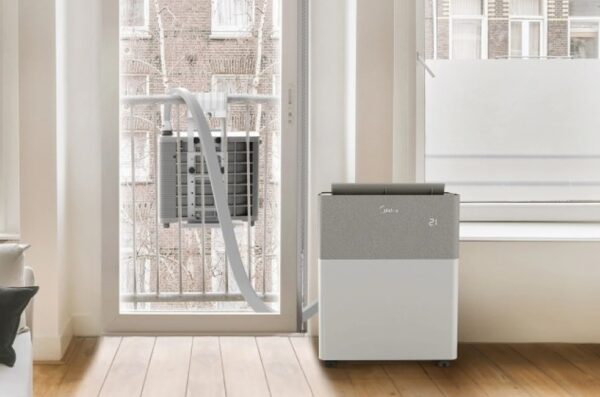
The three appliances sit on a clear scale of power use and cooling effect. A fan moves air but does not lower its temperature. An evaporative cooler lowers the air temperature a few degrees by evaporation. An air conditioner removes heat and moisture from the room and rejects them outside.
| Electric fan | Evaporative cooler | Portable air conditioner | |
|---|---|---|---|
| How it cools | Air movement only | Evaporation of water through soaked pads1 | Refrigerant circuit, heat vented outdoors15 |
| Cooling effect | None to air temperature | Around 3 to 5 degrees below ambient2 | Controlled by thermostat |
| Power | Far cheaper to run than air conditioning9 | 75W4 | 1,000 to 1,500W, around 26 to 39p per hour3 |
| Humidity | Unchanged | Raised1 | Lowered in cooling mode2 |
| Windows | Open or closed | Needs fresh air from open doors and windows2 | Sealed room, properly vented2 |
| Refrigerant | None | None1 | Yes |
Independent advice is consistent on running costs. Plymouth Energy Community states that fans are far cheaper to run than air conditioning, and that air conditioning increases electricity use and can add significantly to summer bills9. National Energy Action puts a typical portable air conditioner at roughly 14 to 20 times the cost of running a fan3. The Centre for Sustainable Energy adds that portable air conditioners use 30 to 50% more electricity than fixed systems, and must be vented to the outside through a proper window fitting, because a hose simply pushed through an open window lets heat back in15.
An evaporative cooler sits between the two: it draws little more power than a larger fan and adds a small real drop in air temperature, but its effect depends on the weather in a way air conditioning does not. Fixed reverse-cycle systems are another route: Nesta describes air-to-air heat pumps as a highly effective, low-carbon way to heat and cool UK homes, though they remain uncommon in the UK16. The side-by-side detail is on portable air conditioner vs evaporative cooler, air conditioning vs fans and electric fans for cooling.
Open windows and fresh air: how a cooler is meant to run
Evaporative coolers and air conditioners need opposite conditions. The seller's support page states that evaporative coolers rely on a fresh air supply from open doors and windows, while air conditioning "works best in a completely sealed environment", with all windows and doors kept closed during operation2.
The reason is humidity. A cooler adds water vapour to the room; with windows open, that moist air is carried out and drier air replaces it, so evaporation continues. Closed up, the room grows steadily more humid and the cooling tails off.
This sits alongside, not against, general UK advice on hot weather. Citizens Advice notes that a well insulated home is usually easier to keep cool, with ventilation by opening windows at night and using extractor fans and vents17. Electricity North West advises keeping blinds down and windows closed when the temperature outside is warmer than inside18. The practical tension is plain: on a day when the outdoor air is hotter than the room, opening windows to feed an evaporative cooler brings in hot air. A cooler is best matched to times when outdoor air is at or below indoor temperature, such as evenings and nights, a pattern described on night ventilation.
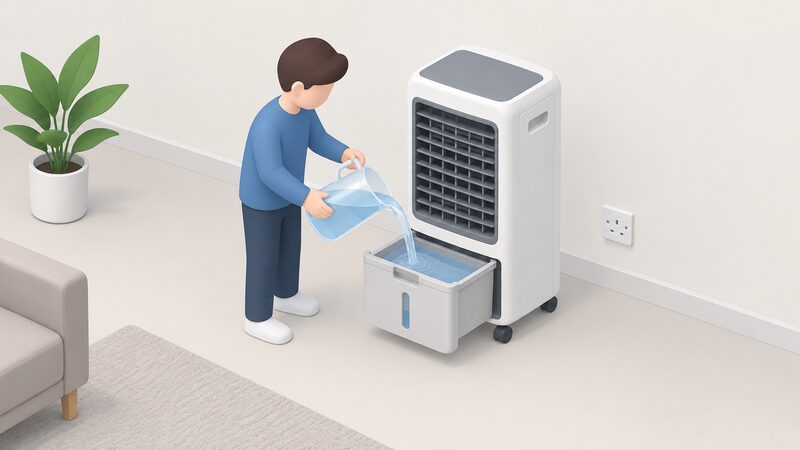
Water tanks: size, filling and how long a tank lasts
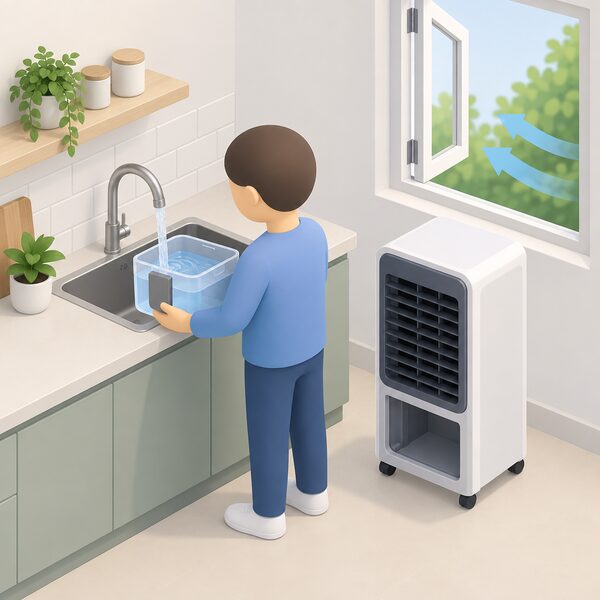
Every domestic evaporative cooler has an integral water tank, filled by hand. The seller describes most domestic models as plug-and-play, needing only water in the tank and a nearby power socket1. Of the iKool-25 Plus, it states that the water tank "Provides extended cooling without frequent refills"1. No tank capacity in litres and no hours-per-tank figure is published for the models covered here, so run time per fill cannot be stated.
What drives water use is the rate of evaporation: warmer, drier air and higher fan speeds use water faster, while humid air uses it more slowly, but in humid air the cooling falls too. When the tank runs dry, the unit usually carries on as a plain fan2.
The water in the tank needs managing. National Energy Action states that users should follow the instructions "to avoid the risk of Legionnaires' disease"3. Standing water held at room temperature in a unit that blows fine air into a living space is the concern. The instructions typically cover how often to empty and refill, how to clean the tank and pads, and when to replace pads. By analogy, Electrical Safety First advises dehumidifier owners to empty the water tank after each use (where required) and before moving the unit7; that rule was written for dehumidifiers, but the same sense applies to any appliance with a water reservoir that is moved around.
Portability: moving and positioning the unit room to room
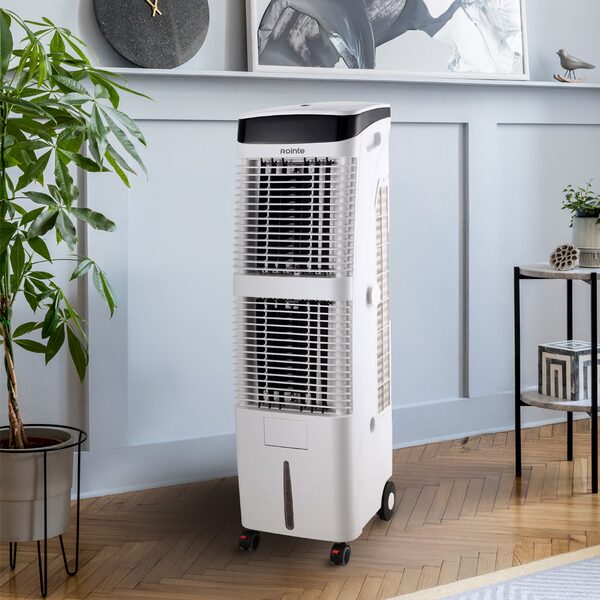
Portability is one of the main differences between an evaporative cooler and fixed air conditioning. There is no outdoor unit, no refrigerant pipework, no exhaust hose and no condensate drain, so the unit can be moved to wherever it is needed, subject only to a socket and a supply of fresh air.
The seller describes the iKool-25 Plus as "Easy to move and position as needed", and the larger iKool-80 Plus as easy to move and position "using wheels"1. It lists suitable rooms as living rooms, bedrooms, conservatories and home offices1.
Moving a cooler with water in the tank risks spills. The Electrical Safety First rule for dehumidifiers, to empty the tank before moving the unit7, reflects a general caution around water, mains electricity and floors. In practice a cooler gives most benefit when aimed at the people in the room, rather than left to "cool the room", since its output is a stream of air a few degrees cooler rather than a controlled room temperature2.
For independence, portability means one low-power appliance can follow the household through the day: the living room in the afternoon, a bedroom in the evening. There is no fixed installation to plan, no landlord or planning consent tied to an external unit, and nothing left behind when a household moves.
Domestic and commercial use: which setting suits which model
Evaporative coolers are sold for homes and for larger spaces. Within the iKool range, the seller describes the iKool-25 Plus as "Perfect for residential use" and the iKool-50 Plus as a "Domestic & commerical product"1. The iKool-80 Plus is the larger, wheeled model in the same range1.
The seller's general positioning for domestic units is "living rooms, bedrooms, conservatories, home offices, or anywhere you need cost-effective cooling"1. Larger units are aimed at bigger rooms and workspaces with more open doors and air movement, conditions in which evaporative cooling tends to suit better, since a steady supply of fresh air is part of how the method works2.
No room-size ratings, airflow rates or tank capacities are published for these models, so there is no basis here for matching a model to a room by floor area. What can be said is that the same limits apply at every size: cooling of a few degrees below ambient, reduced in humid air, and dependent on ventilation2. A conservatory is a common target; the cooling by home type page covers the particular heat problems of conservatories, top-floor flats and garden rooms.
The iKool range: 25 Plus, 50 Plus and 80 Plus compared
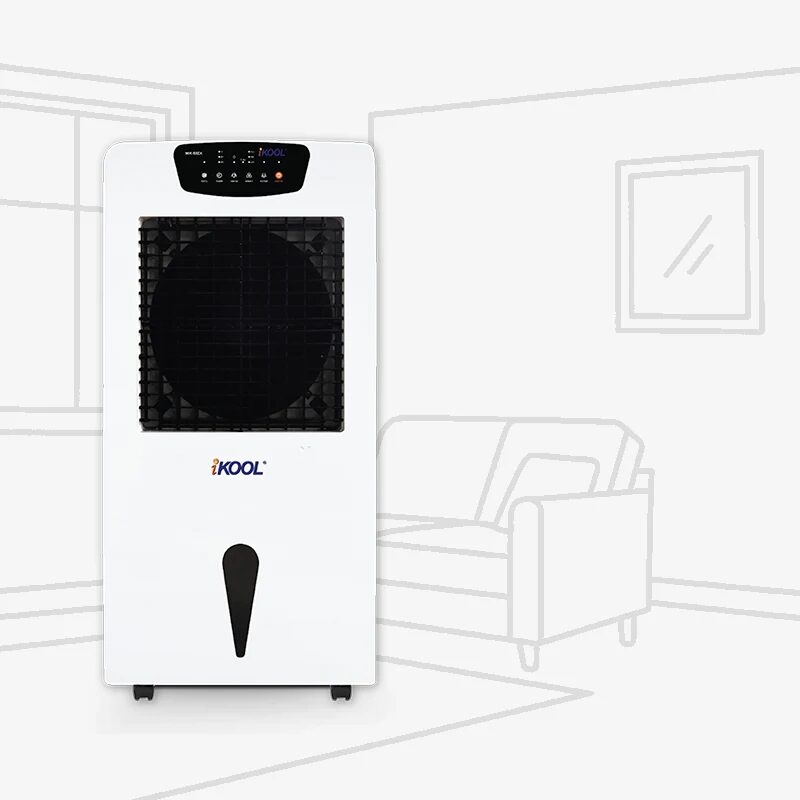
The iKool range is sold in the UK by Cool Easy. The table sets out what the seller publishes for each model, with prices shown including VAT as at 23 September 20261.
| Model | Stated use | Portability | Price listed (inc VAT) | "High Street" comparison price (inc VAT) |
|---|---|---|---|---|
| iKool-25 Plus Evaporative Cooler | Residential | Easy to move and position | £52.00 (£43.33 ex VAT) | £199.99 (£166.66 ex VAT) |
| iKool-50 Plus Evaporative Cooler | Domestic and commercial | Not stated | Documents disagree: £30.00 and £264.99 both appear | £294.99 (£245.83 ex VAT) |
| iKool-80 Plus Evaporative Cooler | Larger unit | Wheels | £169.00 (£140.83 ex VAT); a figure of £425.99 also appears | £594.99 (£495.83 ex VAT) |
The "High Street" figures are the seller's own comparison prices, not independent prices from other retailers. For the iKool-50 Plus, two different selling prices appear on the same seller's pages and the conflict has not been resolved; both are given above. For the iKool-80 Plus, £169.00 appears in both listings, with a further figure of £425.99 on one of them.
The seller also states that the iKool-25 Plus has "Low power consumption for cost-effective operation"1. No wattage, airflow, tank size or room-size rating is published for any of the three models, so a like-for-like technical comparison cannot be made from the maker's figures. Brands of refrigerant-based portable units are covered on air conditioning brands sold in the UK.
Cost: what an evaporative cooler costs to buy and run
Buying. Evaporative coolers are among the cheapest ways to add any active cooling. Listed prices for the iKool range on 23 September 2026 ran from £52.00 inc VAT for the iKool-25 Plus to £169.00 inc VAT for the iKool-80 Plus, with the iKool-50 Plus price disputed between two listings (£30.00 and £264.99)1. There is no installation cost for most domestic models, which need only water and a nearby socket1. Fixed air conditioning, by contrast, involves an installer survey and fitting; see air conditioning cost.
Running. Uswitch lists an air cooler at 75W4. National Energy Action gives a typical portable air conditioner of 1,000 to 1,500W as costing around 26 to 39p per hour3. The seller states that evaporative coolers use significantly less electricity than traditional air conditioning1, and the power figures bear that out; the gap in cooling delivered is just as large. The bill a household sees depends on its tariff and hours of use; air conditioning running costs sets out the comparison for refrigerant units.
Other costs. Water from the tap, and replacement pads when worn, as set out in the maker's instructions.
Independence. At 75W, a cooler is light enough to be run from a modest home battery or a sunny afternoon's solar output. Ember estimates that on the first two days of the June 2026 heatwave, average domestic-scale solar generated 16 kWh, the equivalent of running a 3 kW air conditioning unit for about 5 hours a day12. A load far smaller than that sits comfortably within daytime solar output. The dependencies that remain are the mains water supply, the electricity supply when the sun is not shining, and the maker for spare pads and parts. The wider picture is on cooling and energy independence and running air conditioning on solar panels.
Safety and overnight running
No UK body cited here publishes a specific rule on running an evaporative cooler overnight. The clearest safety point for coolers is hygiene: National Energy Action warns of a risk of Legionnaires' disease if the instructions are not followed3.
For other portable plug-in appliances, the guidance is cautious. Electrical Safety First advises against running a dehumidifier overnight or while away from home unless the manufacturer specifies that it is safe for unattended use7. For portable heaters, it states that it is recommended not to use one overnight, and never to leave one unattended while asleep19. These rules concern different appliances, but they show the standard UK safety bodies apply: the manufacturer's own statement on unattended running decides the question for any given model.
Sources19 cited
- Domestic evaporative air coolers, Cool Easy, 2026-09-23
- Frequently asked questions, Cool Easy, 2026-09-23
- Summer energy tips, National Energy Action, 2026-08-13
- The cost of keeping cool: four million homes now use air conditioning, Uswitch, 2026-04-30
- Eight facts about air conditioning, Carbon Brief, 2026-07-10
- How does a heat pump work, Heat Pumping Technologies, 2025-09-26
- Dehumidifiers safety advice, Electrical Safety First, 2026-09-19
- Energy saving myths, Centre for Sustainable Energy, 2026-07
- Make your home more comfortable in warmer weather, Plymouth Energy Community, 2026-09-20
- Air source vs ground source heat pumps, Energy Saving Trust, 2026-07-16
- Low energy buildings, Centre for Alternative Technology, 2025-06-27
- UK solar homes power equivalent of five hours of daily air con use during heatwave, Ember, 2026-06-21
- News feed, End Fuel Poverty Coalition, 2026
- Are London's homes ready for a heatwave: collated call for evidence, London Assembly, 2026-06
- How to keep your home cool in hot weather, Centre for Sustainable Energy, 2026-07
- Air-to-air heat pumps, Nesta, 2026-09-17
- Make sure your home is energy efficient, Citizens Advice, 2026-09-19
- Keeping cool, Electricity North West, 2026-09-19
- Portable heaters safety advice, Electrical Safety First, 2026-09-17
 Warm Air Heating SystemsWarm air heating works by pushing heated air through vents in your floors or walls.
 Cooling and Heat PumpsCan an air conditioner heat your home as well as cool it?
 Air Conditioning and HumidityExplains how air conditioners remove moisture as they cool, what dry or dehumidify mode does and how extraction rates are stated.
 UK Cooling DemandPublished data on air conditioning ownership and home overheating, with projections for summer temperatures in each UK nation, and what rising cooling demand means for summer electricity use.
 Air-to-Air Heating and CoolingAir-to-air heat pumps deliver warm air through indoor fan units rather than hot water to radiators.
 Using a Heat Pump for CoolingCan a heat pump cool your home in summer as well as heat it in winter?