
In this comparison
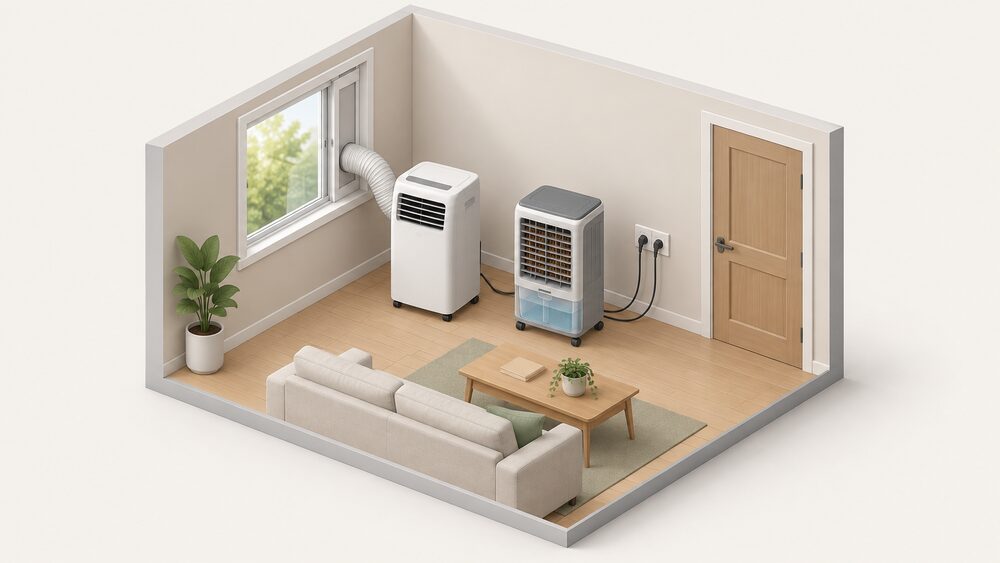
A portable air conditioner and an evaporative cooler are both wheeled boxes that promise relief in a heatwave, and they sit at opposite ends of the running-cost scale. A typical portable air conditioner draws 1,000 to 1,500 W and costs around 26 to 39p per hour to run1. Fans and portable evaporative coolers use less than 0.1 kWh, and some as little as 20 W, which is 0.02 kWh2. That is the whole argument in two figures: the air conditioner buys real, measurable cooling with electricity, and the evaporative cooler buys a gentler temperature drop with a fraction of the power.
The difference in what they do is just as sharp. A portable air conditioner actively cools the air in the room and must discharge the heat it removes through an exhaust hose to the outside3. An evaporative cooler draws warm air through water-soaked pads and lowers the air temperature by evaporation, adding moisture to the room as it does so5. One is a refrigeration machine that has to be vented; the other is a fan with a wet pad that has to be fed with water and air.
For a household weighing energy independence, the choice is between a high-draw appliance that depends on the grid for every hour it runs and a low-draw one that depends on a water supply and on the weather being dry. Neither removes the dependence on electricity, and neither is a substitute for keeping heat out of the building in the first place.
Portable air conditioner vs evaporative cooler: the short answer
The evaporative cooler is far cheaper to run, and the portable air conditioner is the only one of the two that reliably lowers the temperature of a closed, humid British room. Independent guidance from the National Energy Action describes air coolers as using water to slightly cool air and as more effective than fans in dry conditions1. A typical portable air conditioner, by the same guidance, costs around 26 to 39p per hour, roughly 14 to 20 times more than a fan1. The Centre for Sustainable Energy adds that portable units use 30 to 50% more electricity than fixed systems3.
So the cost gap is not marginal. Running a portable air conditioner for four hours a day at the maker's own figure of 35p per hour for a 12,000 BTU model comes to a running cost the maker states as 35p per hour8. An evaporative cooler on the same schedule draws a small fraction of that, because it has no compressor. The trade is that the cooler's effect depends on the air being dry and moving, and it adds humidity to the room rather than removing it.
There is a second cost that rarely appears in the comparison. Portable air conditioners are less efficient than fixed systems by design: because the main unit sits inside the room and vents through a hose, they may not feel as quiet or efficient as a fixed system9. One maker states that although a portable A+ class model might appear efficient, it could still consume 2.4 times more electricity than a wall-mounted unit of the same class6. The evaporative cooler avoids that penalty entirely, but it also avoids the cooling.
For a household, the honest framing is this: the evaporative cooler is a low-cost way to take the edge off a dry heat, and the portable air conditioner is a high-cost way to hold a room at a set temperature regardless of humidity. Neither is a route to independence from the grid. Both plug into a wall socket, and both stop working in a power cut.
How each one cools: refrigeration versus evaporation
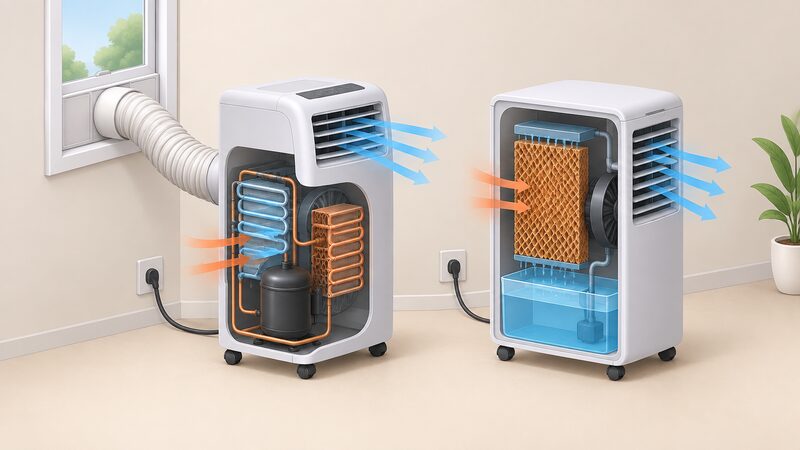
A portable air conditioner is a small refrigeration circuit. The evaporator is a low-temperature heat exchanger where the refrigerant enters as a low-temperature liquid, absorbs heat from the heat source by evaporation at a low pressure and leaves as a low-temperature vapour10. That heat is carried to the condenser and rejected, which is why the unit has to be vented: the warmth taken out of the room has to go somewhere, and in a portable unit it goes out through the hose4. The Meaco Cirro 12000 BTU uses R290 refrigerant, charged at 200g, and is not an inverter model8.
An evaporative cooler has no refrigerant at all. It uses a wet pad, soaked with cold water stored in a tank, to lower the air temperature by evaporation11. Warm air is drawn through the water-soaked pads, naturally lowering the air temperature before it is released into the room5. The energy that drives the cooling is the latent heat of evaporation, not a compressor, which is why the electricity draw is so small. The trade is that the moisture stays in the air, and the cooling stops when the pad dries out.
"Air coolers are appliances that use a wet pad, soaked with cold water stored in a tank, to lower the air temperature by evaporation."
That distinction drives everything else on this page. A refrigeration unit can be sized in kW and BTU and will deliver that output in a sealed room. An evaporative cooler cannot be sized in kW at all, because its output depends on the dryness of the incoming air. One maker states plainly that evaporative coolers do not have a thermostat built in and rely on a fresh air supply, provided by open doors and windows4. A portable air conditioner, by contrast, works best in a completely sealed environment, so all windows and doors should be kept closed while it operates4.
Running cost: what each type costs to run per hour
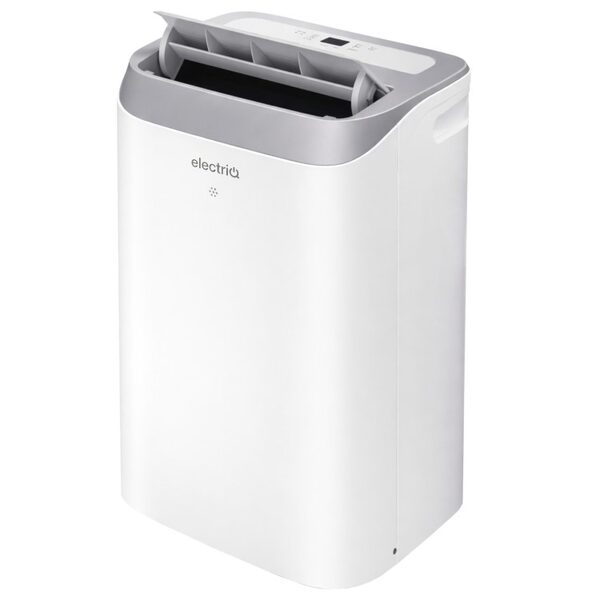
Running cost is where the two types separate most clearly, and the figures come from a mix of independent guidance and makers' own product pages. Independent guidance puts a typical portable air conditioner at 1,000 to 1,500 W and around 26 to 39p per hour1. A separate independent guide, using a July 2026 Ofgem price cap of 26.11p per kWh, puts a portable unit at 0.75 to 1.5 kW and £0.20 to £0.39 per hour2. The two ranges overlap and agree on the order of magnitude.
Makers publish their own running costs against specific models, and these are useful because they name the unit:
| Model | Cooling capacity | Stated cost to run |
|---|---|---|
| MeacoCool MC Series Pro 9000 BTU | 9,000 BTU | 25p per hour, based on 24.67p per kWh12 |
| Meaco Cirro 12000 BTU | 12,000 BTU | 35p per hour8 |
| Meaco Cirro+ 14000 BTU | 14,000 BTU | 40p per hour13 |
| Meaco Cirro+ 16000 BTU | 16,000 BTU | 46p per hour14 |
| electriQ AirFlex 14000 BTU | 14,000 BTU | £1.50 per day, based on typical daily use of 4 hours15 |
The pattern is that cost rises with capacity, which is what the higher BTU figures imply. The Meaco Cirro 12000 BTU draws 1,350 W in cooling8, and the electriQ P12C 12000 BTU draws 1,550 W7. Both sit inside the independent 1,000 to 1,500 W band, with the electriQ slightly above it. An independent press release gives a portable air con unit at 1kW a weekly cost of £13.37 at cheapest fix rates, based on average daily use of 9.1 hours over seven days16.
Against that, fans and portable evaporative coolers use less than 0.1 kWh, and some as low as 20 W, which is 0.02 kWh2. No maker in this comparison publishes a pence-per-hour figure for an evaporative cooler, and none publishes a daily water consumption figure either. What the makers do say is that the units provide extended cooling without frequent refills and offer low power consumption for cost-effective operation5. The honest position is that the evaporative cooler's running cost is a small fraction of the air conditioner's, and that no published per-hour figure exists to quote.
Cooling power: BTU output versus temperature drop
BTU stands for British Thermal Unit, another way of measuring cooling output, often used for portable air conditioners and some fixed systems9. It is a fixed output: a 12,000 BTU unit is rated at 3.5 kW of cooling7, and that rating holds in a sealed room. The electriQ P12C is listed at 12,000 BTU and 3.5 kW7, the Meaco Cirro 12000 BTU at 12,000 BTU8, the Meaco Cirro+ 14000 BTU at 14,000 BTU13 and the Meaco Cirro+ 16000 BTU at 16,000 BTU14.
An evaporative cooler has no equivalent rating, because its output is a temperature drop rather than a heat removal rate. One maker puts the effect at likely in the region of 3 to 5 degrees less than the ambient temperature of the space it is used within4. That is a real but modest drop, and it depends on the air being dry. The same maker notes that evaporative coolers will usually still operate without water, but only with the same effect as a standard fan4.
Independent guidance from the National Energy Action describes air coolers as using water to slightly cool air and as more effective than fans in dry conditions1. That is a weaker claim than a BTU rating, and deliberately so: there is no standard test that turns an evaporative cooler's performance into a kW figure.
For comparison, one maker's portable air conditioner is reported to have reduced the temperature by 11°F (6°C) in about eight minutes, a figure for a specific unit rather than a category17. That is a faster and larger drop than the 3 to 5 degrees attributed to evaporative cooling, and it comes with the electricity draw described above.
Where each type works best: humidity, ventilation and room size
Humidity decides which of the two types suits a room. One maker states that domestic evaporative air coolers are ideal for dry or moderately humid climates, and that in very humid conditions cooling performance may be reduced5. The same maker notes that evaporative cooling adds humidity, which can be beneficial in dry environments5. Netatmo's guidance is blunter: air coolers are best used in small rooms and when the air is dry, because the humidity can impair their performance11.
British summers are frequently humid, which is the central problem for evaporative cooling here. Independent guidance from the National Energy Action frames air coolers as more effective than fans in dry conditions, which is a conditional endorsement1. Where the air is dry, the cooler works; where it is not, the effect shrinks towards that of a fan.
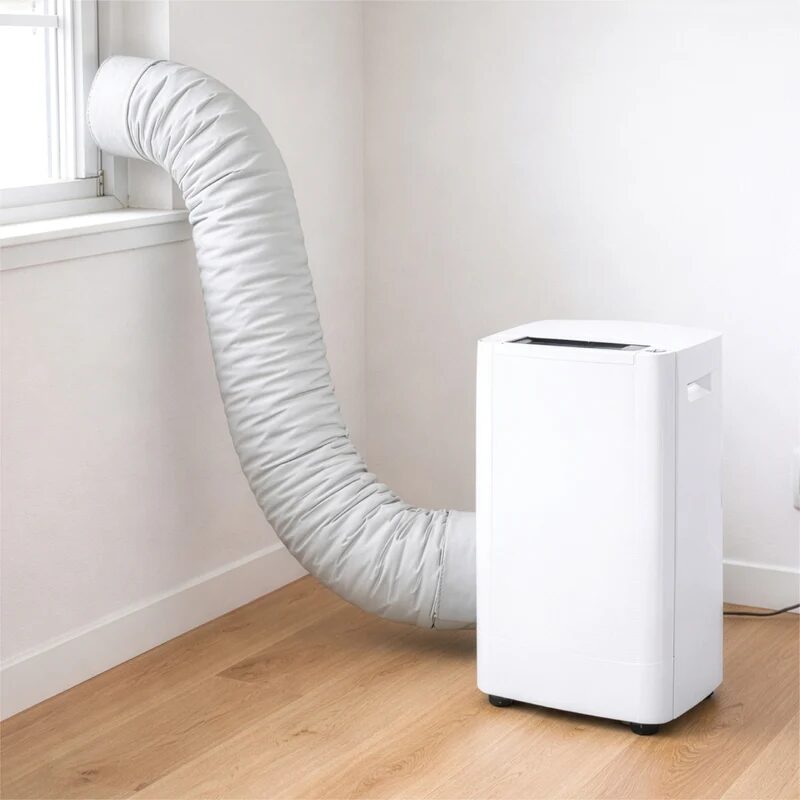
Ventilation requirements pull in opposite directions. A portable air conditioner works best in a completely sealed environment, so all windows and doors should be kept closed while in operation4. An evaporative cooler relies on a fresh air supply, provided by open doors and windows, and has no thermostat built in4. A household cannot run both strategies in the same room at the same time.
Room size is where the portable air conditioner has published numbers. Makers list room sizes against each model:
| Model | Listed room size |
|---|---|
| MeacoCool MC Series Pro 9000 BTU | 16 to 26 m²12 |
| Meaco Cirro 12000 BTU | 20 to 30 m²8 |
| Meaco Cirro+ 16000 BTU | 35 to 40 m²14 |
Those figures are approximate: ceiling height, insulation, glazing and sun exposure can affect cooling performance18. Independent guidance suggests aiming for 18,000 BTUs for the best results2, which is above every model listed here, and one maker notes that portable air conditioning units still have a place, particularly for temporary set-ups or rooms under 10 m²6. Packaged air conditioners generally have less cooling capacity than split systems and are suitable for small indoor areas but not powerful enough to cool a large room19.
Evaporative coolers are marketed for living rooms, bedrooms, conservatories, home offices, or anywhere cost-effective cooling is wanted5, and one model is described as perfect for residential use5. No room-size figures are published for them, which follows from the absence of a BTU rating.
Noise, venting and installation
Noise is the portable air conditioner's weakest point. One maker states that portable air conditioners often operate at higher noise levels of up to 65 dB6. Another puts most portable units at approximately 56 dB sound pressure during operation4. A specific model, the electriQ AirFlex 14000 BTU, is listed at 65 dB sound pressure20. The range across sources is wide, and the higher figure is the one to plan around for a bedroom.
The reason for the noise is structural: because the main unit sits inside the room and vents through a hose, it may not feel as quiet or efficient as a fixed system9. A maker describes portable air conditioning as an auxiliary device with limited cooling capacity and noisier than a fixed unit21, and notes that portable smart air conditioners are usually less powerful22. None of this is a defect so much as a consequence of putting the compressor in the room being cooled.
Installation is where both types are easy. Most cooling and heating portable air conditioners are plug-and-play, needing only a power supply and a way to vent hot air outdoors23. No permanent installation is required: the unit is positioned near a window, the exhaust hose connected, and cooling started24. Pro Breeze states that its portable air conditioners come with a window kit for quick setup and that there is no need for permanent installation25. Portable models are standalone units that can be easily plugged into a wall socket26.
Evaporative coolers are simpler still. Most domestic evaporative coolers are plug-and-play, requiring only water in the tank and a nearby power socket5. They are easy to move and position as needed, and some models have wheels5. Standard air conditioners and portable air conditioning units do not require a water connection4, so the plumbing requirement runs the other way: the air conditioner needs a vent, the evaporative cooler needs a tap.
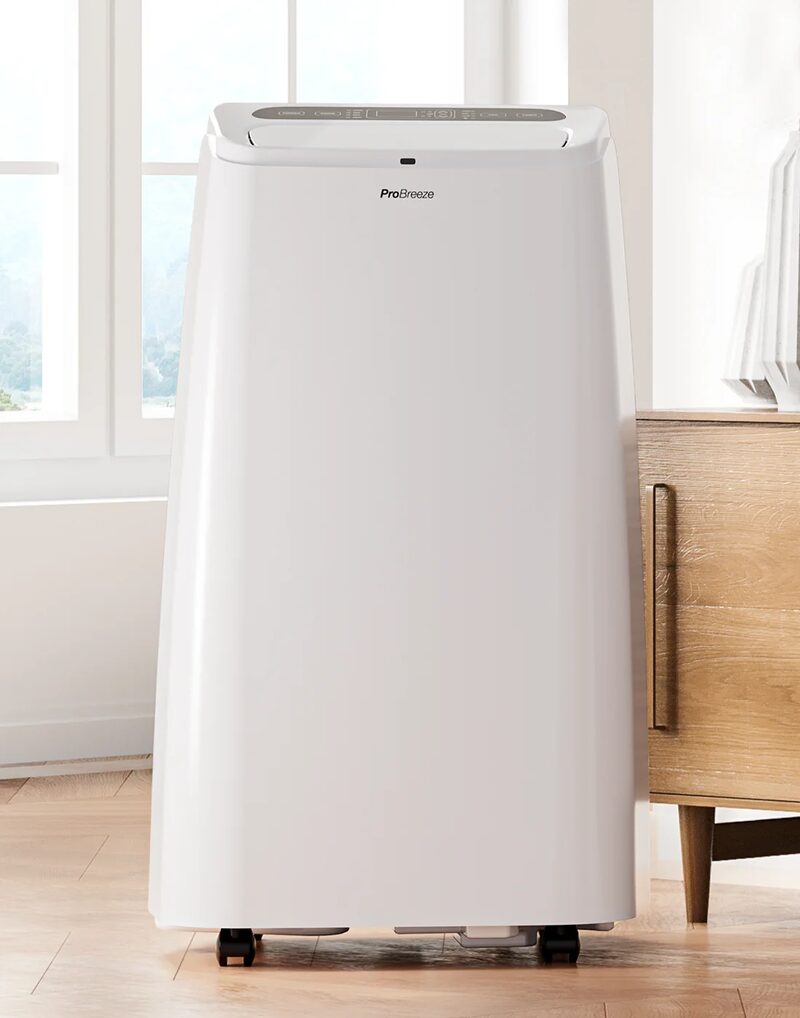
Availability: the Cirro 12000 BTU portable air conditioner is back in stock
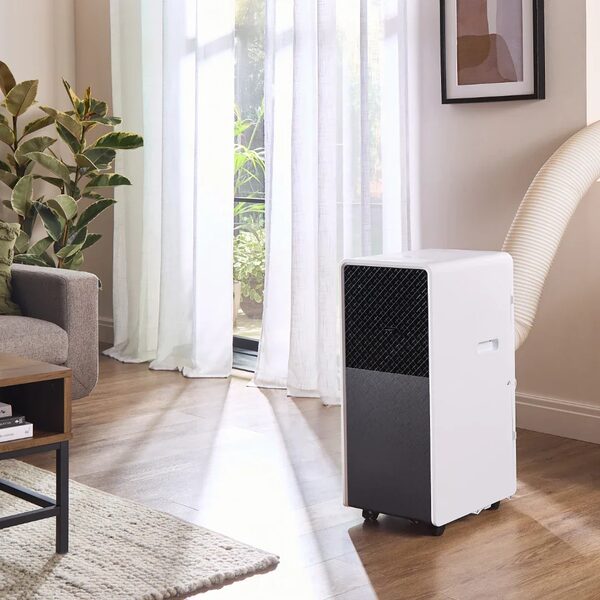
Stock matters on this comparison because the most-cited 12,000 BTU model in the running-cost figures has been unavailable. The Meaco Cirro 12000 BTU portable air conditioner is listed as sold out, with a restock date of March 2027 on the maker's product page8. A dated event records the same unit returning to stock in October 2026, so the two dates disagree and the position should be checked before ordering27.
The rest of the Cirro range is in the same position. The Meaco Cirro+ 16000 BTU is sold out with a back in stock date of April 202714, and the Meaco Cirro+ 14000 BTU is sold out with a back in stock date of April 202713. Inverter technology, which the maker describes as delivering a smarter, more efficient approach to portable air conditioning, is available on selected Cirro models rather than across the range18. The Meaco Cirro 12000 BTU is not an inverter model8.
Where a unit is available, the specification is worth reading in full, because the headline BTU figure hides the details that decide whether a unit suits a room. The Meaco Cirro 12000 BTU runs on 220 to 240V at 50Hz, moves a maximum of 400m³ of air per hour, removes 1.6 litres of moisture per hour, has a 1 to 24 hour on/off timer, a glow in the dark remote, child lock, voice control through Amazon Alexa and Google Assistant, and optional app compatibility over 2.4 GHz and 5 GHz Wi-Fi8. It has no heating capacity8. A variant of the same unit is listed with both cooling and heating, at 35p per hour for cooling and 29p per hour for heating28.
Alternatives exist across the range. The electriQ P12C 12000 BTU is listed as suitable for a home, office or conservatory, with a 150 mm (6-inch) exhaust hose7. The Aermec PST is a portable air conditioner for heating, cooling, dehumidification or ventilation only, at home and at the office29. Dimplex lists portable air conditioners that actively cool the air in the room30.
For a household thinking about independence, the availability picture is a reminder of where the dependence sits. These are manufactured goods with restock dates set months ahead, sold through retailers, drawing grid electricity, and in some cases tied to a phone app for scheduling. An evaporative cooler depends on a water supply and dry air instead, and its cooling stops when either fails. Neither type removes the household's reliance on the grid, and neither replaces the cheaper first step of keeping solar gain out of the building, which is covered in passive cooling and external shading, shutters and awnings.
Sources30 cited
- Summer energy tips, National Energy Action, 2026-08-13
- Is air conditioning worth it in the UK?, Uswitch, 2026
- How to keep your home cool in hot weather, Centre for Sustainable Energy, 2026-07
- FAQs, Cooleasy, 2026-09-23
- Domestic evaporative air coolers, Cooleasy, 2026-09-23
- Air-to-air heat pumps for small rooms, Daikin, 2026-09-17
- electriQ P12C 12000 BTU Portable Air Conditioner for rooms up to 30 sqm, electriQ, 2026-09-23
- Meaco Cirro 12000 BTU Super Quiet Smart Portable Air Conditioner, Meaco, 2026-09-23
- Air conditioning size guide, Cooleasy, 2026-09-23
- WAVE 1 vs WAVE 2 portable air conditioner, EcoFlow, 2025-06-16
- Cooling down a room: what is the best way, Netatmo, 2026-09-20
- MeacoCool MC Series Pro 9000 BTU Portable Air Conditioner and Dehumidifier, Meaco, 2026-09-23
- Meaco Cirro+ 14000 BTU Super Quiet Inverter Smart Portable Air Conditioner, Meaco, 2026-09-23
- Meaco Cirro+ 16000 BTU Super Quiet Inverter Smart Portable Air Conditioner, Meaco, 2026-09-23
- electriQ AirFlex 14000 BTU Air Conditioner, electriQ, 2026-09-23
- The cost of keeping cool: four million homes now use air conditioning, Uswitch, 2026-04-30
- Landlord friendly air conditioning and heat pumps for rentals, Cooleasy, 2026-09-23
- Air conditioners, Meaco, 2026-09-23
- Packaged air conditioning, Netatmo, 2026-09-20
- electriQ AirFlex 14000 BTU Air Conditioner with Heating Function and Venting Kit, electriQ, 2026-09-23
- Home air conditioning, Netatmo, 2026-09-20
- Smart air conditioner, Netatmo, 2026-09-20
- Cooling and heating portable air conditioners, Cooleasy, 2026-09-23
- Domestic portable air conditioners, Cooleasy, 2026-09-23
- Air conditioners, Pro Breeze, 2026-09-23
- Guide to air conditioning units, EDF Energy, 2024-05-22
- Meaco Cirro 12000 BTU Super Quiet Smart Portable Air Conditioner and Heater, Meaco, 2026-09-23
- Aermec PST, Aermec, 2026-09-17
- Heat pump work, Heat Pumping Technologies, 2025-09-26
- Cooling, Dimplex, 2026-09-17
 Running CostsA portable air conditioner costs roughly twenty to forty pence for every hour it runs, while a fixed unit uses far less electricity for the same cooling.
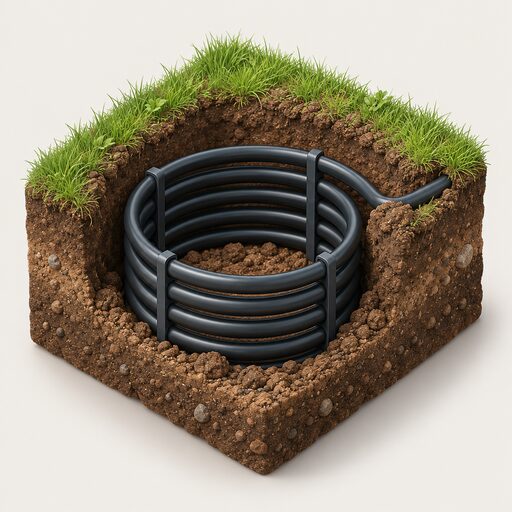 Passive Cooling at HomeKeeping a home cool without air conditioning comes down to blocking heat before it gets in, then letting trapped heat out.
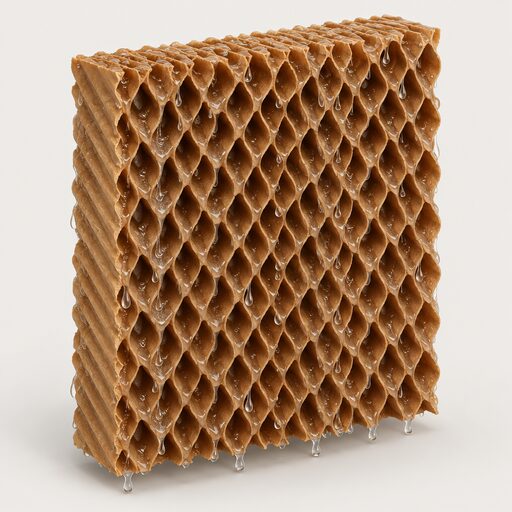 Evaporative Air CoolersHow evaporative coolers lower air temperature by evaporating water, why humidity limits the cooling they give in the UK, and what to know about water tanks, running power, prices and hygiene.
 Cooling and Heat PumpsCan an air conditioner heat your home as well as cool it?
 Types of Air ConditioningPortable, wall-mounted, multi-room or ducted: which air conditioning suits your home?
 Underfloor Heating SystemsWhich rooms suit electric underfloor heating and which need a wet system?