
In this guide
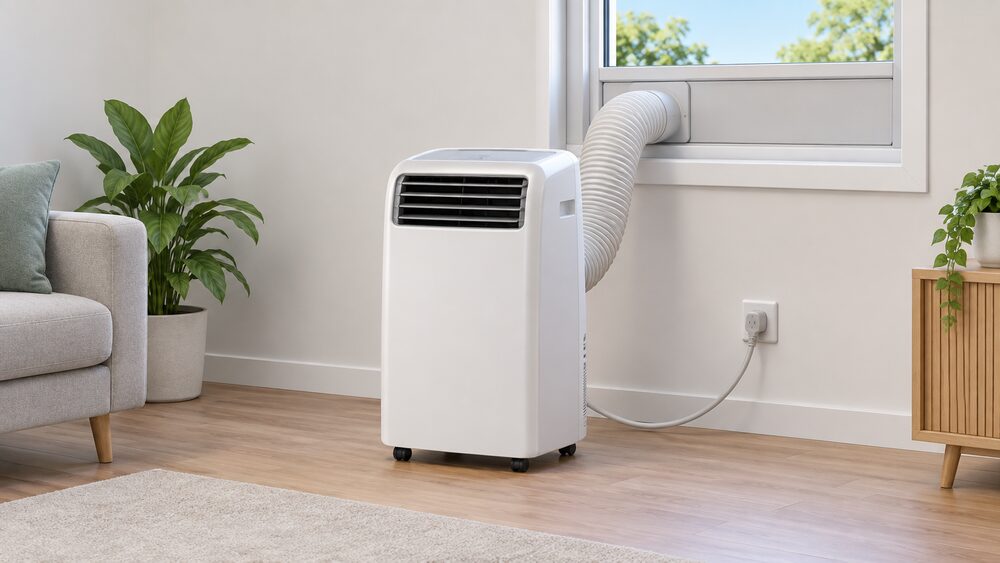
The electriQ P12C is a 12,000 BTU portable air conditioner rated at 3.5 kW of cooling, sold for rooms up to 30 square metres and built as a single-hose unit with a heat pump for heating as well as cooling1. It carries a Class A energy rating at 2.6 EER, draws 1,345W at 6.5A in the maker's headline figure, and is supplied with a standard UK 3-pin 13A plug on a 220 to 240V, 50Hz supply1. The refrigerant is R290, charged at 210g1.
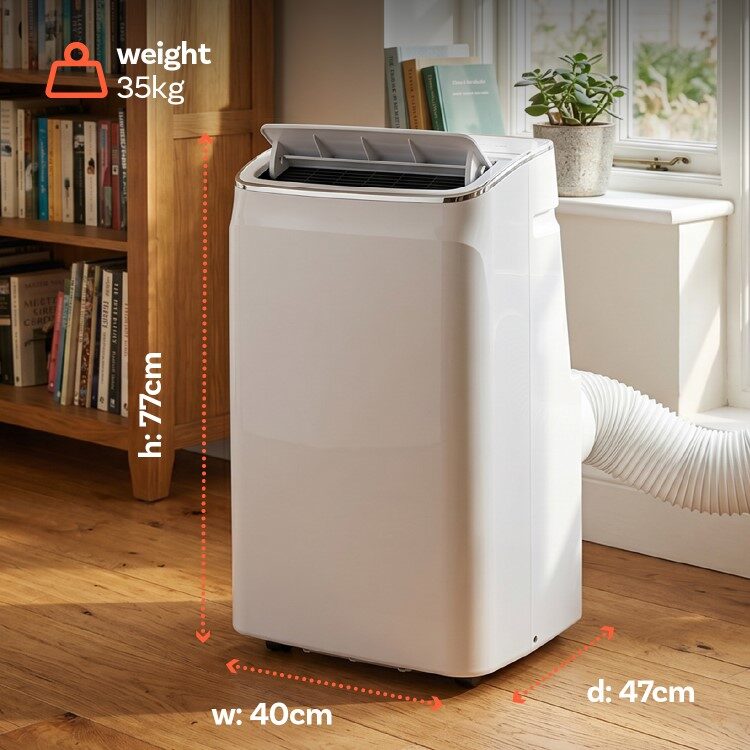
It is a floor-standing appliance rather than a fixed system: 28.2 kg net, 35.8 by 41.9 by 68.8 cm, on castors, with a 1.5 metre power cord and a 1.8 metre maximum exhaust hose1. Nothing is installed in the fabric of the building, and nothing is wired in. That is the appeal and also the limit, because a portable unit of this kind has to reject its heat through a hose to the outside, and it stays dependent on a household electricity supply for every hour it runs.
The P12C sits in a wider electriQ portable range that runs from 10,000 BTU to 18,000 BTU, with several models sharing the same 150 mm hose diameter and 1.8 metre hose ceiling2. This page sets out what the maker publishes for the P12C specifically: its specifications, what 12,000 BTU realistically covers, how it behaves in heating and dehumidifying, what it is like to live with, how it vents, how it is controlled, and what the one-year warranty means for a household weighing up energy independence.
Specifications at a glance: 12000 BTU, 3.5 kW and Class A efficiency
The headline numbers are straightforward. The P12C is rated at 12,000 BTU, which the maker also expresses as 3.5 kW of cooling capacity, and it holds a Class A energy efficiency rating at 2.6 EER1. Airflow is quoted at 410 m³/h, and the unit is listed for home, office and conservatory use1. The thermostat is adjustable between 16°C and 31°C, with an auto mode that holds a preset 23°C1.
Two power figures appear on the maker's page and they are not the same thing. Power consumption is listed at 1,345W at 6.5A, while power input in cooling is listed at 1,550W1. The first is the running figure a household would use to think about load, the second the input under cooling conditions. Both are maker figures for this model, and neither should be read as an average across a season, because a portable unit cycles: it draws its rated input while the compressor runs and much less when it does not.
| Specification | P12C figure |
|---|---|
| Cooling capacity | 12,000 BTU / 3.5 kW1 |
| Energy rating | Class A (2.6 EER)1 |
| Power consumption | 1,345W / 6.5A1 |
| Power input (cooling) | 1,550W1 |
| Airflow rate | 410 m³/h1 |
| Thermostat range | 16°C to 31°C1 |
| Refrigerant | R290 (210g)1 |
| Dimensions | 35.8 x 41.9 x 68.8 cm1 |
| Net weight | 28.2 kg1 |
| Power supply | 220 to 240V / 50Hz1 |
The maker lists the P12C as manufactured in China and shipped directly for quality checks1. For a household thinking about independence, that is a supply chain fact rather than a performance one: spares and service run through the retailer and the manufacturer rather than a local trade, and the appliance cannot be repaired by a general heating engineer in the way a gas boiler can.
Cooling performance: what 12000 BTU covers, and where it falls short
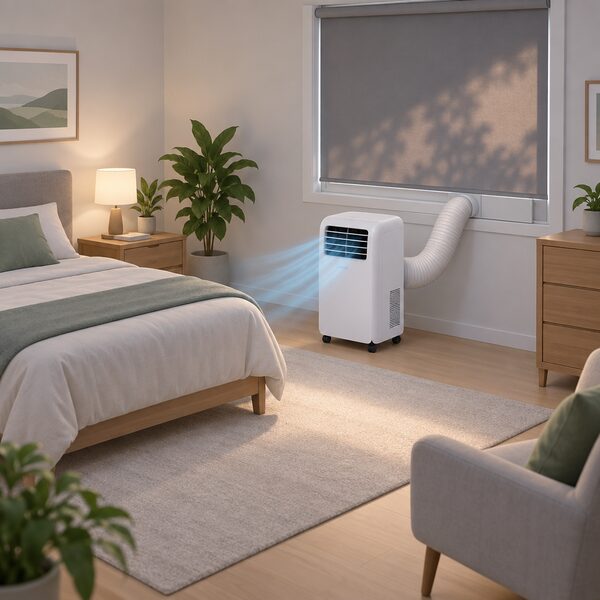
The maker rates the P12C for a maximum cooling area of 30 square metres1. That is the figure to work from, and it is a ceiling rather than a promise. Room size is only one variable: ceiling height, glazing area, orientation, insulation and the number of occupants all change the cooling load, and a west-facing conservatory of 20 square metres can be harder to cool than a shaded bedroom of 30.
The wider electriQ range shows how the maker positions 12,000 BTU. The portable air conditioning index describes 12,000 BTU as suited to larger rooms, living spaces and offices, and lists a 12,000 BTU model for areas up to 35 square metres2. The P12C's own page states 30 square metres1. The two figures come from the same maker and differ by five square metres, which reflects different assumptions about the room rather than a different machine. Treating 30 square metres as the working figure and 35 as optimistic is the safer reading.
Where a 12,000 BTU portable unit falls short is in open-plan or heavily glazed space, and in any room where the heat gain keeps climbing through the afternoon. A single-hose portable also works against itself to a degree: it draws air from the room it is cooling and pushes it outside, and replacement air has to come back in from elsewhere in the house, often warmer. That is a characteristic of the format rather than a fault in this model, and it is why single hose and dual hose portable air conditioners behave differently in the same room.
The lowest operating temperature is listed at 16°C1, which matches the bottom of the thermostat range. For most UK cooling use that is well below anything a household would set, but it matters if the unit is being used to hold a room at a specific temperature rather than simply take the edge off a hot afternoon. Sizing the unit to the room is the single biggest determinant of whether it performs as expected, and the general method is set out in what size air conditioner you need.
Heating and dehumidifying: year-round use beyond cooling
The P12C is not a cooling-only appliance. The maker lists a heating function described as a heat pump for efficient heating, and positions it as suitable for year-round use1. That places it in the same category as the wider electriQ range, where 4-in-1 operation covering air conditioning, heating, fan and dehumidifier is standard across several models3. The EcoPlus10HPW is described by the maker as using an air-to-air heat pump for both cooling and heating5.
A heat pump heating mode is a different proposition from a resistive heater. It moves heat rather than generating it, which is why the format is treated separately in air conditioning that heats. The maker does not publish a heating output figure for the P12C on its product page, so the heating capacity of this specific model cannot be stated here. For comparison, the EcoPlus12HPW is listed at 3.52 kW cooling and 2.784 kW heating3, which shows the pattern: heating output sits below cooling output on the same chassis.
Dehumidification is the third function. The maker quotes up to 36 litres per day for the P12C, but adds the qualification that in typical UK home use around 8 to 20 litres per day is more likely1. That gap between the headline and the realistic figure is the most useful thing on the page. The 36 litre figure assumes warm, humid conditions; a UK room in a wet autumn will not deliver it. For context across the range, the P18CW is listed at up to 43.2 litres per day6.
"Powerful moisture extraction of up to 36L per day"
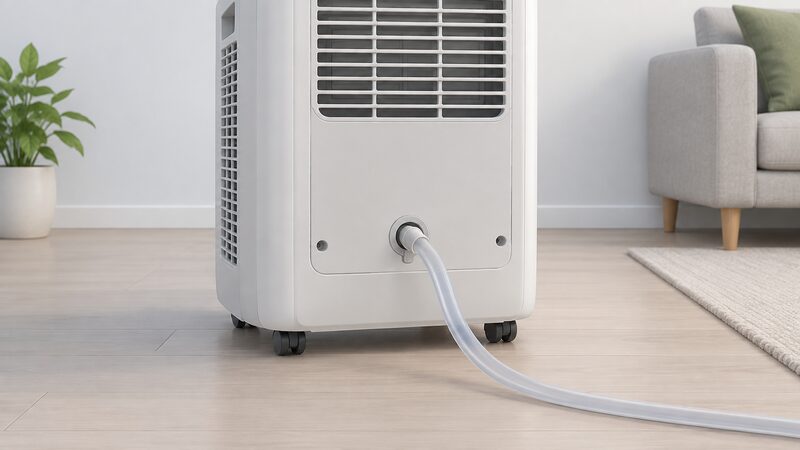
The P12C does not need any water filling1. It is a refrigeration unit, not an evaporative cooler, so there is no pad to wet and no tank to top up. The only water it handles is condensate drawn out of the room air. In normal cooling the maker states the exhaust and vent kit is only required in cooling mode, and the unit does not need continuous drainage1. In dehumidifier mode, or in very humid conditions, a hose connected to the rear drain outlet and run downwards under gravity carries the condensate away. The maker's guidance for the wider range is that a drain hose of about 13 mm internal diameter suits the condensate port7.
Noise, size and weight: what it's like to live with
The P12C is listed at 64dB sound power and 49 to 52dB sound pressure1. Those are two different measurements and the distinction matters when comparing appliances. Sound power is the total acoustic energy the machine emits; sound pressure is what a person hears at a given distance in a given room. The maker also lists a single sound pressure figure of 49dB elsewhere on the same page1. For a bedroom, the sound pressure figure is the one that describes the experience, and 49 to 52dB is roughly the level of a quiet conversation or a background radio.
That is not silent, and it is worth being honest about what it means. A portable air conditioner of this size has a compressor and a fan in the same cabinet as the person hearing it, unlike a split system where the noisy part sits outside. Households sensitive to night noise often find that a portable unit in the same room is a compromise, and the alternatives are set out in what is the quietest air conditioning for a bedroom.
Physically, the P12C is 28.2 kg net and measures 35.8 cm wide, 41.9 cm deep and 68.8 cm high1. It is on castors, but 28.2 kg is a two-handed lift up a flight of stairs, and the unit needs floor space plus clearance behind it for the hose. The maker's guidance for a comparable model in the range is a minimum clearance of 10 to 15 cm behind the unit to allow adequate airflow and proper exhaust hose connection4. The power cord is 1.5 metres1, which is shorter than many households expect and is worth measuring against the nearest socket before deciding where the unit lives.
| Model | Cooling | Weight | Noise |
|---|---|---|---|
| P12C | 12,000 BTU / 3.5 kW1 | 28.2 kg1 | 64dB power, 49 to 52dB pressure1 |
| EcoPlus12HPW | 12,000 BTU3 | 30.2 kg3 | Not stated |
| P16HPW | 16,000 BTU4 | 37 kg4 | Not stated |
| P18CW | 18,000 BTU6 | 35 kg6 | Not stated |
The pattern across the range is that weight climbs with capacity, from 28.2 kg at 12,000 BTU to 37 kg at 16,000 BTU1. The P12C is at the lighter end, which is one practical argument for it in a flat or a room where the unit has to be moved between spaces.
Venting and installation: hose, window kit and wall vent options
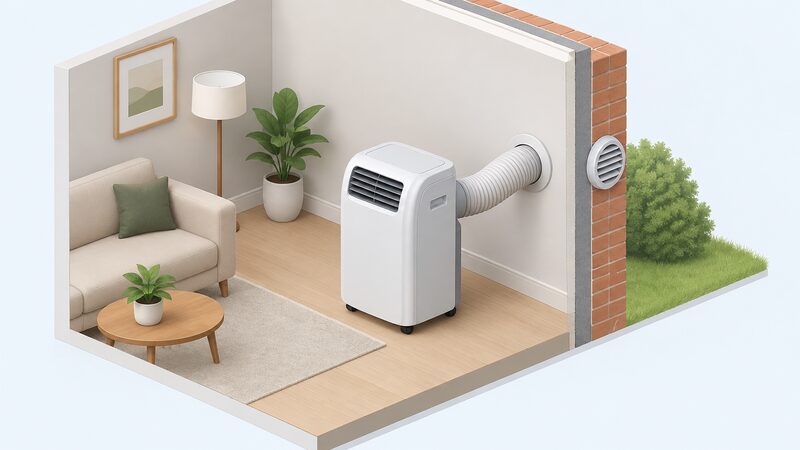
Every portable air conditioner has to be vented so that the heat it removes from the room goes somewhere else. The maker states this plainly: all portable air conditioners must be vented out so the heat is removed from the room that is being cooled1. Without venting, the unit will not cool effectively, because it is simply moving heat around the room it is standing in.
The P12C uses a 150 mm (6 inch) diameter exhaust hose, with a maximum length of 1.8 metres1. The maker's guidance on extension is direct: the standard hose should be used, because an extension can put additional strain on the unit1. That is a hard limit rather than a preference. The same 1.8 metre ceiling appears on the P16HPW and the P18CW, while the EcoPlus models are listed at 2.0 metres4. A household that needs to reach further than 1.8 metres is looking at a different model or a different approach, not a longer hose.
The supplied window kit is designed for sliding or sash windows and the maker states it is not ideal for other window types1. That is the single most common practical problem with portable air conditioning in UK homes, because casement and tilt-and-turn windows are widespread and a slide bar does not seal against them. The P18CW page is more explicit still, noting the kit does not fit all windows, especially casement or tilt-and-turn styles commonly found in UK homes, and that an additional adapter or seal kit may be needed6.
For a permanent solution, the maker states a 150 mm (6 inch) wall vent kit or flange should be used, because that matches the exhaust hose1. The same 150 mm diameter appears across the range, and the maker notes the hose is compatible with most standard tumble dryer vent openings8. That makes a fixed wall vent a realistic option for a household that intends to use the unit in the same room every summer, and it removes the window sealing problem entirely. The trade-off is a hole in the wall and the loss of the unit's portability.
Controls, smart operation and power supply
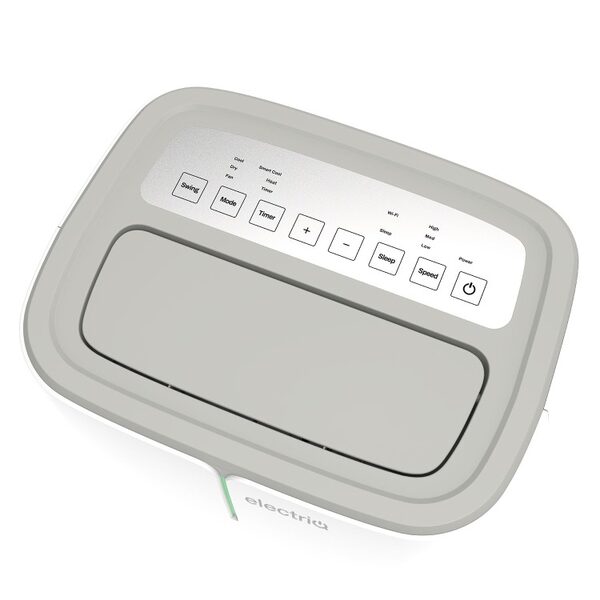
The P12C has electronic controls, a 24-hour start/stop timer, a remote control and a display-off function1. It can be operated or scheduled using a smartphone or tablet, which the maker lists as smart control1. The fan has three speeds, low, medium and high1. There is also an auto restart function that returns the unit to its previous settings after a power failure1.
The wider range shows what smart control means in practice across electriQ models. The P16HPW works with Amazon Echo and Google Home for voice operation4, and the EcoPlus12HPW can be controlled remotely or by voice with Amazon Echo, Alexa or Google Home Assistant3. The P18CW has built-in WiFi smart control, operable or schedulable from a smartphone or tablet, alongside an electronic control type and a remote control with batteries included6.
That chain of control is where a portable air conditioner's dependence becomes visible. Local operation at the panel and by infrared remote works without any network. Scheduling from outside the home, and any voice control, depend on a home broadband connection, the manufacturer's servers and a manufacturer's app. If the app is withdrawn or the servers are retired, the appliance still cools, but the remote features stop. That is a different kind of dependence from the electricity supply, and it is worth separating the two: the P12C cannot run without mains power at all, and its smart features cannot run without a working internet connection and a supported app.
The electrical side is simple. The P12C is supplied with a standard UK 3-pin 13A plug and is designed to run from a normal household socket on a 220 to 240V, 50Hz supply1. The P18CW is described in the same terms, plugging straight into a standard UK household 3-pin socket at 230 to 240V, 13A, with no special wiring or installation required6. No electrician is needed, no circuit is dedicated, and the unit can be unplugged and moved. The power cord is 1.5 metres on the P12C1, and the same 1.5 metre cord length appears on the EcoPlus12HPW and the P18CW3.
Warranty and what owning it means for energy independence
The P12C carries a one-year warranty1. That is the shortest term in the range and it is consistent across it: the EcoPlus12HPW, the P18CW and the EcoPlus10HPW are all listed at one year, and the P16HPW is described as a 12 month hassle-free warranty3. A household comparing this with fixed air conditioning, where longer terms are available, should read the one-year term as the maker's own statement of expected support period rather than as a reflection of build quality.
What the P12C does for a household's energy independence is limited and specific. It provides cooling and some heating in one room without any installation, any refrigerant engineer, any planning consent and any change to the building. It can be bought, used and removed by a tenant. It runs from a standard socket, so it needs no new circuit. In a heatwave, that is genuine resilience: a room can be kept habitable without waiting for a survey, a quote or a fitting date.
What it does not do is reduce dependence. The unit runs entirely on mains electricity, so it depends on the grid and on a supplier for every hour of operation, and its running cost moves with whatever tariff the household is on. The wider context for that is set out in air conditioning running costs. It depends on a manufacturer in China for the appliance and on the retailer for spares and service1. Its smart features depend on broadband and an app. Its heating mode depends on the same electricity supply, so it does not diversify a household's fuel in the way a gas boiler or a wood stove does. And its one-year warranty means that after the first year, repairs are a household cost.
For households where the electricity supply itself is a concern, there is a separate protection worth knowing about. Energy UK's Vulnerability Commitment includes not disconnecting households where the customer is unable to protect their own personal welfare because of age, disability, health or severe financial insecurity9. That is a supplier commitment rather than a feature of the appliance, but it is the relevant safety net for a home that depends on electricity for cooling. The broader picture of what cooling appliances can and cannot do for a home's independence is covered in home cooling and energy independence.
Sources9 cited
- electriQ 12000 BTU Portable Air Conditioner for rooms up to 30 sqm, electriQ, 2026-09-23
- Portable Air Conditioners, electriQ, 2026-09-23
- electriQ EcoPlus12HPW Air Conditioner, electriQ, 2026-09-23
- electriQ P16HPW Air Conditioner, electriQ, 2026-09-23
- electriQ EcoPlus10HPW Air Conditioner, electriQ, 2026-09-23
- electriQ P18CW Air Conditioner, electriQ, 2026-09-23
- electriQ A2/AirFlex15 Air Conditioner, electriQ, 2026-03-18
- electriQ A2/EcoSilent12HPW Air Conditioner, electriQ, 2026-03-02
- Priority Services Register for energy companies, Turn2us, 2026-09-08
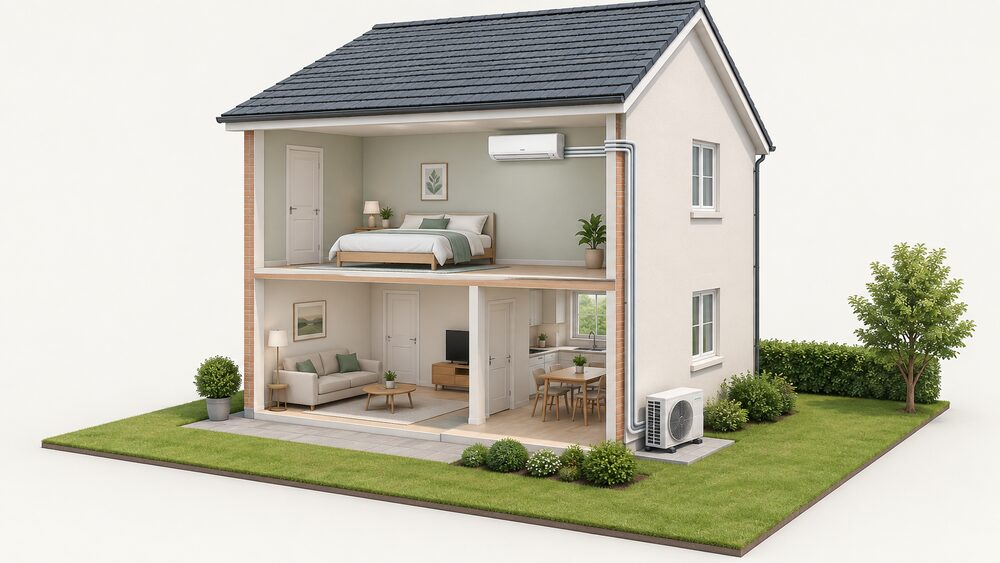 electriQ split air conditioners with heat pumpPopular budget maker of air-to-air split units bought by householders.