
In this answer
Short answer
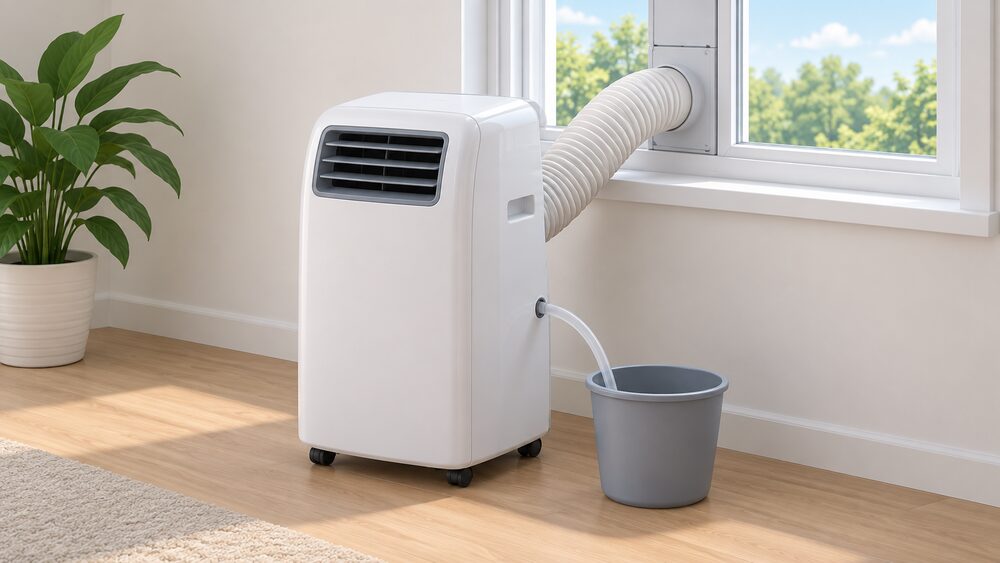
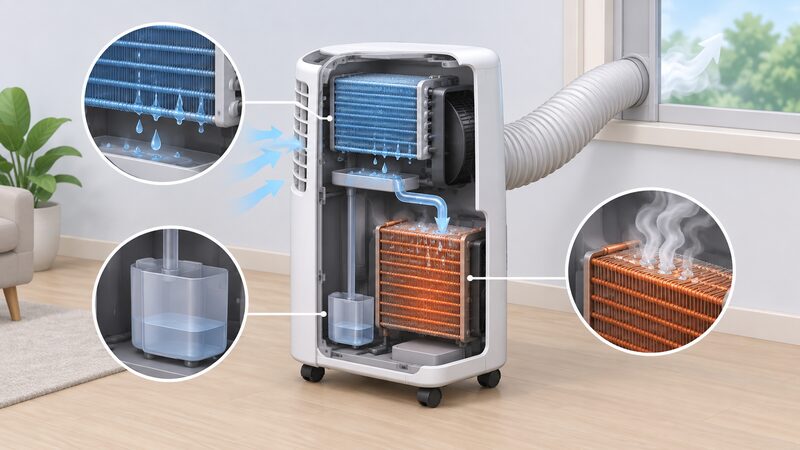
For normal cooling, most portable air conditioners do not need a drain hose. They are plug and play, needing only a power supply and a way to vent hot air outdoors, and standard air conditioning and portable units do not require a water connection at all1. The moisture pulled out of the room is handled inside the unit by a self-evaporative system, which uses most of it to cool the condenser coils, so the water tank does not need emptying as often4.
A drain hose becomes necessary in three situations: when the unit is run in dehumidifier (Dry) mode, in very humid conditions, or when the internal water tank fills and the unit locks out with a fault code5. One maker states that in cooling mode the drain hose is only required if the internal water tank becomes full, shown as error code E4, or if the unit is used in dehumidifier mode6.
What a drain hose does not replace is ventilation. Every portable air conditioner must be vented out so the heat is removed from the room being cooled, and a vent simply pushed through an open window lets heat back in5. Drainage and venting are separate jobs, and only one of them is optional in cooling mode.
The short answer: cooling without a drain hose
Portable air conditioners remove warm air from the room and vent it outside through an exhaust hose, while circulating cooled air indoors2. That is the whole operating principle, and it explains why no water connection is needed: the unit is a sealed system running refrigerant, so no plumbing for a water supply is required, except in rare water-cooled systems3. There is no permanent installation either. The unit is positioned near a window, the exhaust hose is connected, and cooling starts2.
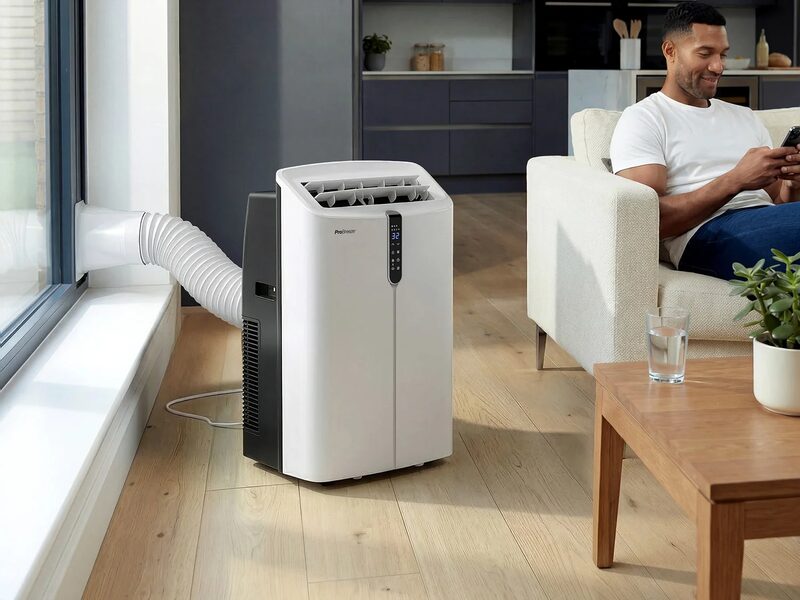
The practical setup is a window kit. Pro Breeze portable air conditioners come with a window kit for quick setup and no permanent installation, and Honeywell units are equipped with exhaust hoses and window kits4. Portable air conditioning is convenient because it can be moved around the house, stored away when not in use, and needs no fitting work12. One maker describes portable units as a plug and play setup rather than any kind of proper or professional installation3.
Two limits sit alongside that convenience. A single unit cannot cool multiple rooms at once, though portable models with wheels are easy to move between rooms4. And portable units are not usually equipped with service valves, so they do not require full services, but their mesh filters need regular cleaning3. Pro Breeze describes its air conditioners as low maintenance, with washable filters and easy-access drainage points4.
For a household, the drainage question is therefore narrow. In cooling mode the unit manages its own condensate. The hose is a fallback for the conditions described below, not part of the standard setup.
When a drain hose is required
The clearest case is Dry mode. One maker states that the unit requires you to manually empty the water tank unless continuous drainage is set up using a hose8. Air conditioning systems do take moisture out of the air in cooling mode and act like a dehumidifier as well, and there is a Dry mode, but it is not designed to be a standalone dehumidifier, and dehumidification does not happen in heating mode3. A household using Dry mode to deal with damp air is asking the unit to collect water faster than the self-evaporative system can dispose of it.
High humidity is the second case. One maker states that continuous drainage is only needed in dehumidifier (Dry) mode or very humid conditions5. The third case is simply a full tank: the drain hose is required if the internal water tank becomes full, shown as error code E4, or if the unit is used in dehumidifier mode6.
Some portable air conditioners also double as dehumidifiers, cooling the room while helping reduce humidity and tackle damp4. Where damp is the underlying problem rather than heat, a dedicated dehumidifier draws moisture out of the air and can be particularly useful if clothes are often dried inside the house13. In kitchens, bathrooms and utility rooms, extractor fans are required to remove excess moisture, and opening a window helps where there is no extractor fan14. Purge ventilation, delivered simply by opening windows or doors, removes high concentrations of pollutants and water vapour15.
How self-evaporating cooling works
A self-evaporative system uses most of the moisture collected to cool the condenser coils, so the water tank does not require emptying as often4. The condenser is where the heat taken from the room is rejected before the exhaust air leaves through the hose. Passing moist air over it helps that rejection, and the water leaves as vapour with the exhaust rather than collecting in the tank.
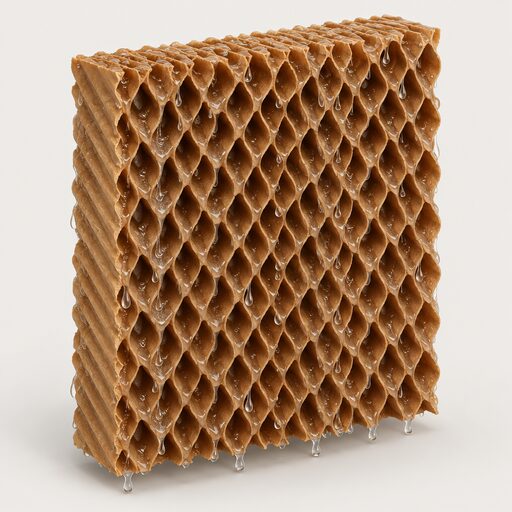
This is not the same as evaporative cooling, which is a different product. Domestic evaporative air coolers work by drawing warm air through water-soaked pads, naturally lowering the air temperature before releasing it into the room16. They use water to slightly cool air and are more effective than fans in dry conditions17. A self-evaporative air conditioner is not adding moisture to the room; it is reusing its own condensate internally.
That distinction matters because deliberately adding moisture to indoor air is not a cooling strategy. Independent guidance is blunt on the point: there is no truth in the dry air claim, and purposely evaporating water into the air in a home can create problems with damp caused by condensation, so it is best not to do this18. Water does have a natural cooling effect through evaporation, and even a small pond can lower surrounding air temperatures, but that is an outdoor effect19.
Drainage options: tank, continuous hose and pump
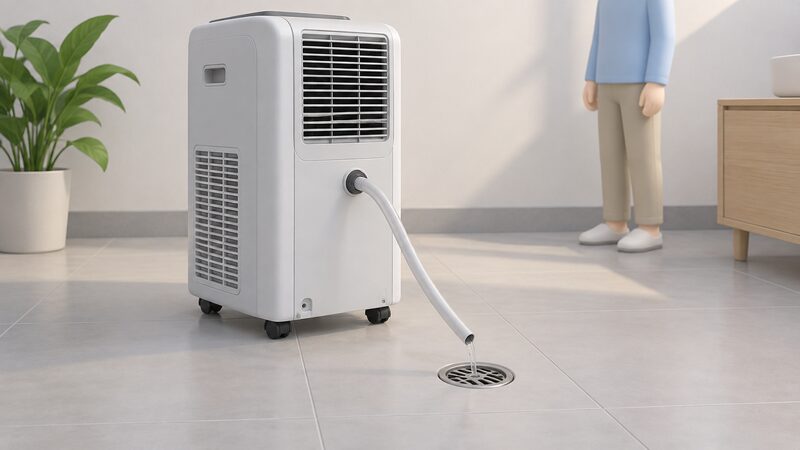
Portable units divide into three practical arrangements. The simplest is the internal tank, emptied by hand. The second is gravity drainage through a hose to a drain or container. The third is a unit with an automatic drainage feature in cooling mode, which eliminates manual drainage20.
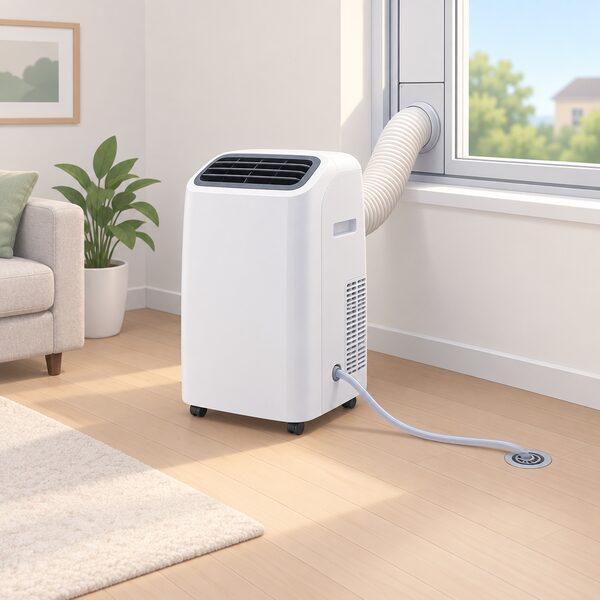
Gravity drainage has one hard requirement: the hose must run downward. One maker states that a dedicated permanent drainage kit is not included, and instead a standard hose connection is used, which must run downward for gravity drainage to work correctly9. A hose that has to rise to reach a drain will not work by gravity, and a pump arrangement is the alternative where the drain sits above the unit's outlet.
The wider building context is worth knowing, because condensate is treated seriously elsewhere in a home. Gas condensing boilers must have a condensate drain provided with an outlet for its removal21, and boiler condensate is slightly acidic and must be drained into a suitable drain because it contains contaminants22. Homeowners with condensing boilers are asked to locate the condensate drainage pipe and ensure it is adequately insulated23. Condensate drainage pipes may be internal, external, or a combination, under British Standards, Building Regulations and boiler manufacturers' installation instructions23. Air conditioning condensate is not boiler condensate, but the principle that water has to go somewhere suitable holds.
| Arrangement | How it works | Where it suits |
|---|---|---|
| Internal tank | Condensate collects; emptied by hand | Normal cooling in average humidity5 |
| Continuous hose | Standard hose connection, must run downward9 | Dry mode, very humid conditions, long runs5 |
| Automatic drainage | Automatic drainage feature in cooling mode, no manual drainage20 | Households wanting no emptying routine |
Setting up the drain hose correctly
The connection is a push-fit hose onto the unit's condensate outlet. One maker specifies a drain hose with an internal diameter of about 13 mm (½ inch) to connect to the unit's condensate outlet6. Another supplies a 65 cm drainage hose with the unit10. Those two figures set the practical limits: a short, correctly sized hose that falls continuously to a drain.
The route matters more than the length. Gravity drainage depends on a continuous fall, so the hose should not be looped, kinked or allowed to sit in water at the outlet end. Where the drain is further away than the supplied hose reaches, the run has to be extended with the same internal diameter and kept falling throughout, or replaced with a pumped arrangement.
Maintenance around the drainage point is modest. Independent safety guidance for dehumidifiers, which share the same water-handling design, is to empty the water tank after each use where required and before moving the unit24. Portable air conditioning units are not usually equipped with service valves, so they do not require full services, but mesh filters require regular cleaning3. Pro Breeze units have washable filters and easy-access drainage points4.
What drainage means for running a portable AC independently
Drainage is the smallest of the dependencies a portable air conditioner carries, and it is the one a household can usually remove entirely. In cooling mode the unit manages its own condensate, so there is no plumbing, no water supply and no permanent installation2. That is what makes portable units suitable for tenants or temporary spaces: packaged air conditioning needs no plumbing work or outdoor units25.
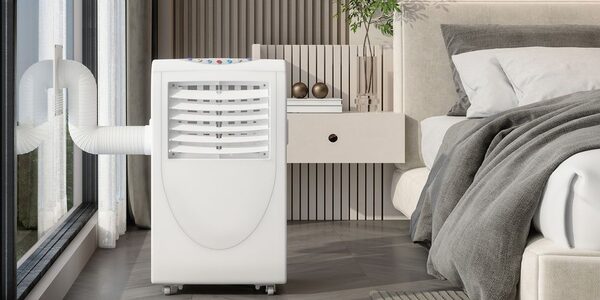
The dependencies that remain are the ones that matter for independence. The unit needs electricity from the grid or a supply, and it needs somewhere for the exhaust heat to go. It must be properly vented to the outside using a special fitting for the window, because a vent simply put through an open window will let heat back in26. IGLU portable units release heat through a pipe that must go through the window to an outlet on the outside27. Every portable air conditioner must be vented out so the heat is removed from the room being cooled5.
There is also a maintenance dependency on the building itself. Below ground drainage should be inspected periodically, including testing to ensure water is draining freely away from the property28. Where a household relies on a gravity hose running to an outside drain, that drain is part of the cooling setup, and a blocked or slow drain shows up as water where it should not be.
The comparison with fixed systems is instructive. Fixed models must be fitted by a professional, and several companies should be contacted for quotes12. A fixed system with cooling and dehumidification functions needs a drain29, and air-to-water heat pumps require the condensate drain to be checked as part of routine maintenance30. Ducted units often include a drain hose as a standard accessory to make drainage design easier in tight ceiling spaces31, and some heat pump accessories are built for reliable condensate drainage even during frost periods32. A portable unit sidesteps all of that by handling its own water, at the cost of a tank to watch and a hose to fit when conditions demand it.
For the wider picture of what cooling equipment does and does not do for a household's independence, see Home Cooling and Energy Independence, and for how portable units compare with fixed options, Portable Air Conditioners: How They Work and Their Limits and Split vs portable air conditioning for UK homes.
Sources32 cited
- Cooling and heating portable air conditioners, Cooleasy, 2026-09-23
- Domestic portable air conditioners, Cooleasy, 2026-09-23
- FAQs, Cooleasy, 2026-09-23
- Air conditioners, Pro Breeze, 2026-09-23
- electriQ P18CW 18000 BTU Smart Portable Air Conditioner, electriQ, 2026-09-23
- electriQ AirFlex 14000 BTU Portable Air Conditioner (refurbished), electriQ, 2026-03-18
- electriQ A2/EcoSilent12HPW Air Conditioner, electriQ, 2026-09-23
- electriQ P18HP 18000 BTU Portable Air Conditioner with Heat Pump, electriQ, 2026-09-23
- electriQ P16HPW Air Conditioner, electriQ, 2026-09-23
- Meaco Cirro 12000 BTU Super Quiet Smart Portable Air Conditioner, Meaco, 2026-09-23
- Portable air conditioners, Honeywell Air Comfort, 2026-09-23
- Home air conditioning, Netatmo, 2026-09-20
- How to stop condensation, Which?, 2026-05-26
- Ventilation, Centre for Sustainable Energy, 2025-07
- BESA focus areas: ventilation, BESA, 2026-09-20
- Domestic evaporative air coolers, Cooleasy, 2026-09-23
- Summer energy tips, National Energy Action, 2026-08-13
- Energy saving myths, Centre for Sustainable Energy, 2026-07
- Make your home more comfortable in warmer weather, Plymouth Energy Community, 2026-09-20
- WAVE 1 vs WAVE 2 portable air conditioner, EcoFlow, 2025-06-16
- Tips for buying gas boilers, Viessmann, 2022-06-16
- My boiler isn't working, Northern Gas Networks, 2026-07-24
- Get fit for winter: insulate your pipes to prevent freezing, HHIC, 2016-09-12
- Dehumidifiers, Electrical Safety First, 2026-09-19
- Packaged air conditioning, Netatmo, 2026-09-20
- How to keep your home cool in hot weather, Centre for Sustainable Energy, 2026-07
- Portable air conditioners, Haverland, 2023-07-06
- Traditional building maintenance, Historic Environment Scotland, 2026-09-20
- Aquarea air radiators, Panasonic, 2026-09-17
- Heat pump maintenance, Wolf, 2026-09-17
- Medium Static Pressure Duct, Fujitsu General, 2026-09-23
- AHP-DT.1, Stiebel Eltron, 2026-09-17
 Passive Cooling at HomeKeeping a home cool without air conditioning comes down to blocking heat before it gets in, then letting trapped heat out.
 Air Conditioning and HumidityExplains how air conditioners remove moisture as they cool, what dry or dehumidify mode does and how extraction rates are stated.
 Cooling and Heat PumpsCan an air conditioner heat your home as well as cool it?
 Evaporative Air CoolersHow evaporative coolers lower air temperature by evaporating water, why humidity limits the cooling they give in the UK, and what to know about water tanks, running power, prices and hygiene.
 Using a Heat Pump for CoolingCan a heat pump cool your home in summer as well as heat it in winter?
 Radiators and EmittersWill your radiators still heat the house properly with a heat pump?