
In this answer
Short answer
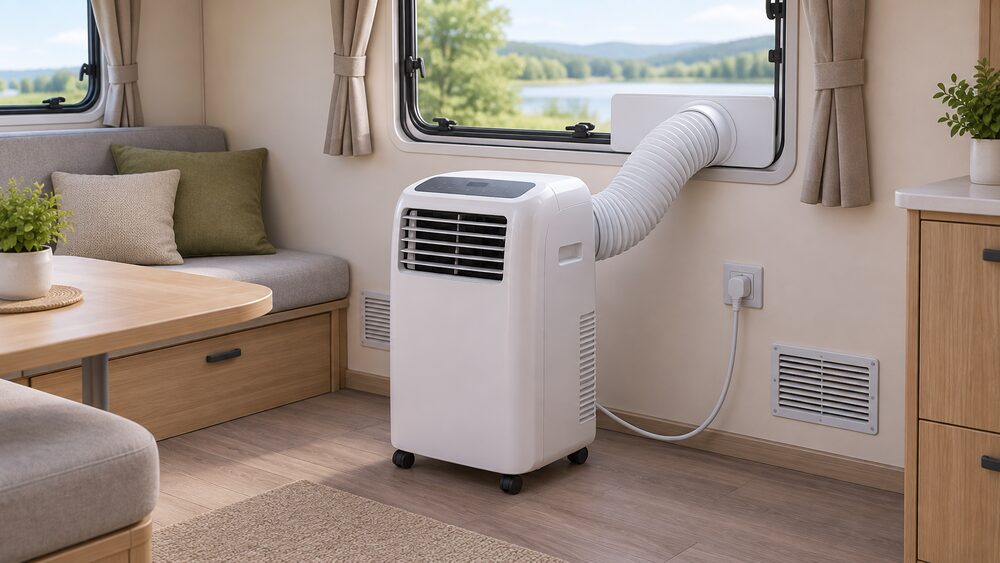
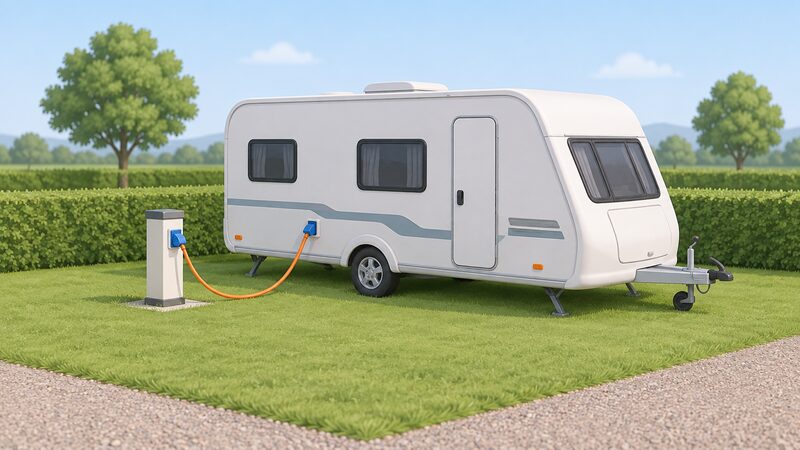
Yes, a portable air conditioner can be used in a caravan, and the product class suits the job: portable units are on castors so they can be wheeled from one room to another, and they are described as suitable for rooms under 10 m², which is the size band a caravan falls into1. Most cooling and heating portable air conditioners are plug-and-play, needing only a power supply and a way to vent hot air outdoors3.
The two constraints are power and venting. A portable air conditioner draws up to 2,000W and up to 9.3A, with a typical range of 900 to 2,000W1. It also has to send its hot air outside, and the usual method is a window kit or a special window fitting; a hose simply poked through an open window lets the heat straight back in4. Caravan windows are small and often awkwardly shaped, which is the practical obstacle rather than the principle.
What a portable unit does for independence is modest but real: it cools the space it stands in without any fixed installation, and it can be moved between a caravan and a home. What it does not do is remove dependence on a hook-up supply, a battery bank or a fuel. It is a plug-in appliance, and it still requires a reliable electricity supply to run5.
Can a portable air conditioner run in a caravan?
It can, on the same terms as any small room. A mobile air conditioner can be moved from one room to another, is placed on the ground, and needs no lengthy installation process8. That is exactly the profile a caravan wants: no outdoor unit, no refrigerant pipework, no fixed mounting, and nothing left behind when the van is sold or moved.
The limits are set by the unit's own design. A single unit cannot cool multiple rooms at once, though portable models with wheels make it easy to move the unit from room to room9. Packaged air conditioners generally have less cooling capacity than split systems and are not powerful enough to cool a large room7. In a caravan that is not a drawback, because the space is small, but it does mean one unit cools one zone.
There is a second, less obvious limit. Caravans are built with fixed ventilation, and that ventilation must stay open. Never block vents in caravans, motorhomes or holiday accommodation, and make sure appliances have enough fresh air to run safely10. A portable air conditioner is not a combustion appliance, so it does not create the carbon monoxide risk that a gas heater does, but the rule about vents still applies: the van's designed airflow is not something to seal up in pursuit of cooler air.
In practice, a caravan owner gets a unit that cools the living area or the bedroom, not both at once, and only while the van is on a supply that can carry it. That is a genuine gain in comfort on a hot pitch, and it is not independence from the grid or from a fuel.
Power: what a caravan supply can and cannot deliver

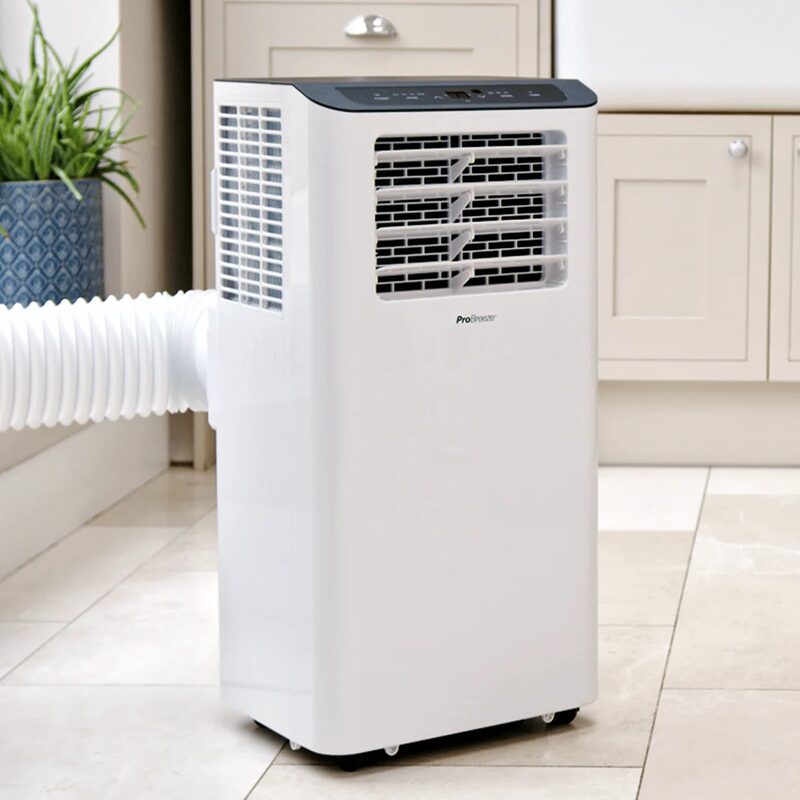
The electrical question is the one that decides whether a portable air conditioner is usable on a given pitch. Electrical Safety First gives a portable air conditioner a rating of up to 2,000W and up to 9.3A, with a typical range of 900 to 2,000W, and notes that the higher the BTU rating, the higher the power draw1. A typical portable air conditioner is quoted at 1,000 to 1,500W6.
That matters because a caravan hook-up is a shared, finite supply. A unit drawing 1,500W leaves little headroom once a kettle, a hob, a water heater or a battery charger is also running. The unit itself is simple: most cooling and heating portable air conditioners are plug-and-play, needing only a power supply and a way to vent hot air outdoors3. They still require a reliable electricity supply to run9. The supply is the constraint, not the appliance.
Running from a leisure battery is possible in principle and impractical in practice. An inverter such as the Victron Sun Inverter allows domestic equipment requiring 230V AC to be powered from 12V or 24V leisure or automotive batteries, and produces 230V AC11. Nothing in that stops an air conditioner being connected. What stops it is the arithmetic of a 1,000 to 1,500W load running for hours: the battery bank and inverter would have to be sized far beyond what a caravan normally carries, and the unit would still need venting.
Venting: where the hot air goes in a small space
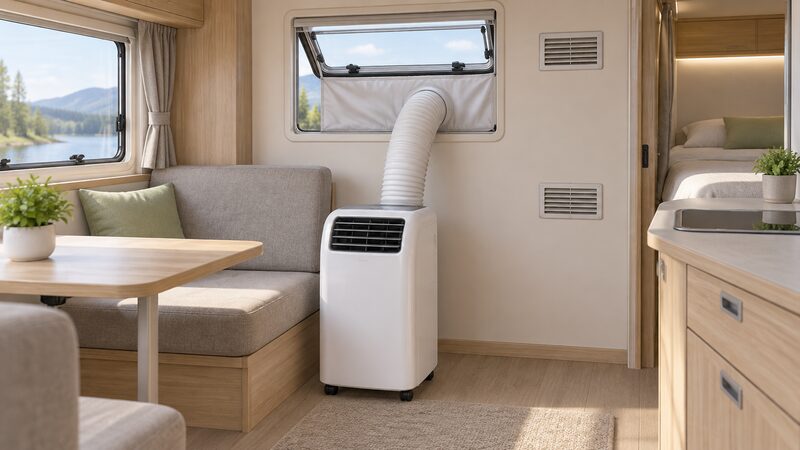
Venting is where caravan installations most often go wrong. Portable air-conditioning units need to be properly vented to the outside using a special fitting for the window; if the vent is just put through an open window, heat comes back in4. The unit removes warm air from the room and vents it outside via an exhaust hose while circulating cooled air indoors12. If the hose is not sealed to the opening, the two air streams mix and the cooling effect collapses.
Caravan windows complicate this. They are typically smaller than domestic windows, often hinged or top-hung, and the window kits supplied with portable units are designed around domestic casement and sash windows. Honeywell portable air conditioners are equipped with exhaust hoses and window kits13, and De'Longhi's Pinguino PAC EX93 Extreme has handles and castors for easy transportation14, but the fit of a kit to a caravan window is a physical question that has to be answered on the van itself.
There is a safety dimension that runs alongside the cooling one. Never block vents in caravans, motorhomes or holiday accommodation10. Sealing a caravan's fixed vents to keep cool air in would defeat the ventilation the van is designed around, and in a van with any gas appliance it would be dangerous. The correct approach is to seal the exhaust hose into one opening while leaving the van's designed ventilation alone.
Ventilation in small, sealed spaces is a subject in its own right. Intermittent extract ventilation, individual extractor fans in bathrooms, kitchens and utility rooms, is relatively cheap to install and reasonably effective but not always sufficient for very air-tight or damp-prone properties15. A caravan in summer is a small, sealed, damp-prone space, and adding an air conditioner does not remove the need to manage moisture.
Sizing: cooling output for a caravan's floor area
Caravans sit at the bottom of every sizing table. Portable air conditioning units are described as suitable for temporary set-ups or rooms under 10 m²2. Published sizing tables start well above that: 3.5 kW or 12,000 BTU for up to 30 m², 4.5 kW or 15,000 BTU for up to 40 m², 5.0 kW or 18,000 BTU for up to 45 m², 6.2 kW or 21,000 BTU for up to 50 m², and 10.0 kW or 34,000 BTU for up to 80 m²16.
| Room size up to | Output | Output |
|---|---|---|
| 30 m² | 3.5 kW | 12,000 BTU |
| 40 m² | 4.5 kW | 15,000 BTU |
| 45 m² | 5.0 kW | 18,000 BTU |
| 50 m² | 6.2 kW | 21,000 BTU |
| 80 m² | 10.0 kW | 34,000 BTU |
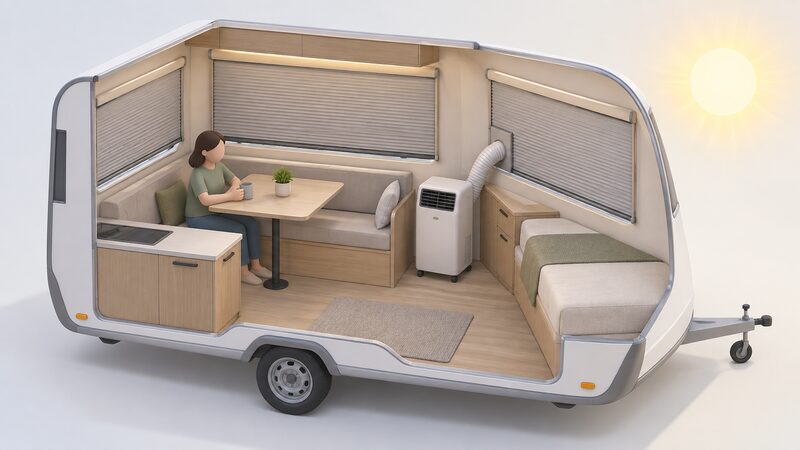
A caravan interior is a fraction of the smallest of those bands, so the smallest portable unit on the market is already in the right class. The complication is that a caravan is not a well-insulated room: it has large glazed areas relative to its floor, thin walls, and it sits in full sun on a pitch. Sizing by floor area alone understates the load, and a unit that is technically adequate for the square metres may struggle on a west-facing pitch in the late afternoon.
For comparison, fixed systems are sized on a different scale entirely. A Daikin multi-split outdoor unit is quoted with a cooling capacity of 5.2 to 9.0 kW17, which is more than any caravan needs and more than a caravan supply could run. Air-to-air heat pumps usually have one unit outside and at least one unit inside, connected by refrigerant pipes18, and those pipes are typically 6 to 12mm in diameter19. That is a fixed installation, and it is not a caravan option in the way a portable unit is.
Alternatives: 12V fans, evaporative coolers and roof-mounted units
The alternatives to a portable air conditioner in a caravan fall into three groups, and they do different jobs.
Fans. A standard fan uses about 20 times less electricity than a portable air conditioner20. A typical portable air conditioner at 1,000 to 1,500W costs around 26 to 39p per hour, roughly 14 to 20 times more than a fan6. On a limited hook-up supply, a fan is the option that leaves headroom for everything else.
Evaporative air coolers. These use water to slightly cool the air and are more effective than fans in dry conditions6. UK summers are frequently humid, which is the condition in which evaporative cooling works least well, and a cooler adds moisture to a small, sealed caravan interior. Portable air-conditioning units, by contrast, use 30 to 50% more electricity than fixed systems4, so the trade is between a low-power device that adds humidity and a high-power device that removes heat.
Roof-mounted and fixed units. Air conditioners can be fixed or mobile, wall-mounted, or ceiling-mounted as a cassette21. A roof-mounted unit is a fixed installation and sits outside the scope of a plug-in appliance, but it is the option that removes the venting problem entirely. Air-to-air heat pumps can provide heat in winter and air conditioning in summer22, which is a consideration for a caravan used year round, though the installation is a fixed one.
Costs to weigh before buying
The purchase price of a portable air conditioner is modest next to a fixed system. Portable packaged air conditioners cost between £170 and £700 depending on capacity and features7. A wider figure for portable air conditioning puts entry-level models at around £250, rising to more than £3,500 for more comprehensive systems such as portable split air conditioning24. The two figures describe different product classes, and the £170 to £700 band is the one that applies to a caravan-sized monobloc unit.
Running cost is where the money goes. A typical portable air conditioner at 1,000 to 1,500W costs around 26 to 39p per hour6. An independent estimate based on the July 2026 Ofgem price cap of 26.11p per kWh puts a portable unit at 0.75 to 1.5 kW and £0.20 to £0.39 per hour25. The two ranges overlap and differ at the bottom end; they are quoted on different assumptions, and the lower figure is not agreed between them.
| Item | Figure | Source basis |
|---|---|---|
| Purchase, portable packaged unit | £170 to £700 | Maker guidance7 |
| Purchase, portable air conditioning generally | around £250 to more than £3,500 | Maker guidance24 |
| Running cost, 1,000 to 1,500W unit | around 26 to 39p per hour | Independent guidance6 |
| Running cost, 0.75 to 1.5 kW unit | £0.20 to £0.39 per hour | Independent guidance, July 2026 price cap25 |
For a caravan, the cost calculation has an extra term: the pitch supply. A unit that draws 1,000 to 1,500W for several hours a day will consume a large share of a metered hook-up, and on some pitches electricity is charged separately. The purchase price is the smaller number.
What this means for independence is straightforward. A portable air conditioner gives a caravan owner cooling without a fixed installation, without an outdoor unit, and without a contractor. It does not give independence from the hook-up, from a metered supply, or from the grid. For a van used off-grid, the honest position is that a portable air conditioner is not the route; a fan, shade and night ventilation are.
Sources25 cited
- Ratings of electrical appliances, Electrical Safety First, 2026-09-19
- Air-to-air heat pumps for small rooms, Daikin UK, 2026-09-17
- Cooling and heating portable air conditioners, Cooleasy, 2026-09-23
- How to keep your home cool in hot weather, Centre for Sustainable Energy, 2026-07
- How does the installation of an air-to-air heat pump work?, Daikin UK, 2026-09-17
- Summer energy tips, National Energy Action, 2026-08-13
- Packaged air conditioning, Netatmo, 2026-09-20
- How does air conditioning work, Netatmo, 2026-09-20
- Air conditioners, Pro Breeze, 2026-09-23
- Holiday carbon monoxide safety tips, Northern Gas Networks, 2026-07-24
- Sun Inverter, Victron Energy, 2026-09-19
- Domestic portable air conditioners, Cooleasy, 2026-09-23
- Portable air conditioners, Honeywell Air Comfort, 2026-09-23
- De'Longhi Pinguino PAC EX93 Extreme Portable Air Conditioner, Quiet Mark, 2026-09-17
- Ventilation, Centre for Sustainable Energy, 2025-07
- Air conditioning size guide, Cooleasy, 2026-09-23
- Daikin 4 port multi air conditioner, Quiet Mark, 2026-09-17
- Air-to-air heat pumps, Energy Saving Trust, 2026-09-11
- Air-to-air heat pumps: a low carbon solution for UK homes, Nesta, 2026-02-17
- Do fans work in hot weather?, Ecotricity, 2025-07-15
- Cooling down a room: what is the best way, Netatmo, 2026-09-20
- Ministers urged to clarify energy efficiency support funds, End Fuel Poverty Coalition, 2025-11-18
- Energy efficient heaters, Uswitch, 2026-07-01
- Home air conditioning, Netatmo, 2026-09-20
- Is air conditioning worth it in the UK?, Uswitch, 2026
 Using a Heat Pump for CoolingCan a heat pump cool your home in summer as well as heat it in winter?
 Cooling and Heat PumpsCan an air conditioner heat your home as well as cool it?
 Ventilation and TemperatureWhere can you put a home battery so it stays warm enough in winter and cool enough in summer?
 Passive Cooling at HomeKeeping a home cool without air conditioning comes down to blocking heat before it gets in, then letting trapped heat out.
 Portable Power StationsWhat can a portable power station actually keep going in a power cut, and for how long?
 Running CostsA portable air conditioner costs roughly twenty to forty pence for every hour it runs, while a fixed unit uses far less electricity for the same cooling.