
In this guide
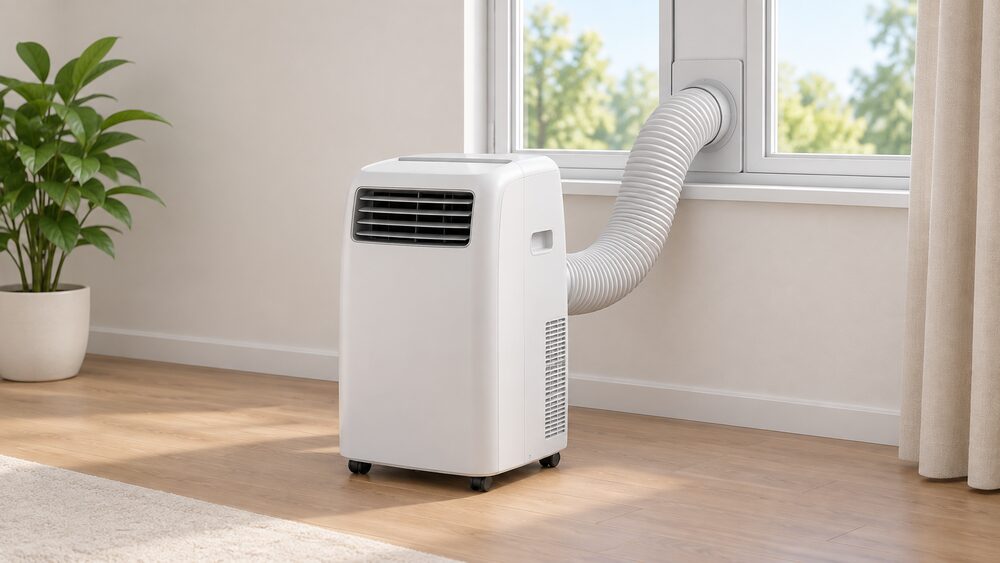
De'Longhi's Pinguino range is the portable air conditioning line most UK householders can name, and the published model data is thin. Two units carry Quiet Mark certification for the UK market: the Pinguino GentleJet Inverter PAC AP130i, a 13,000 BTU/H portable air conditioner and dehumidifier with inverter technology, and the Pinguino PAC EX93 Extreme, a 9,400 BTU/h (2.5kW/h) three-in-one appliance rated A+ for energy1.
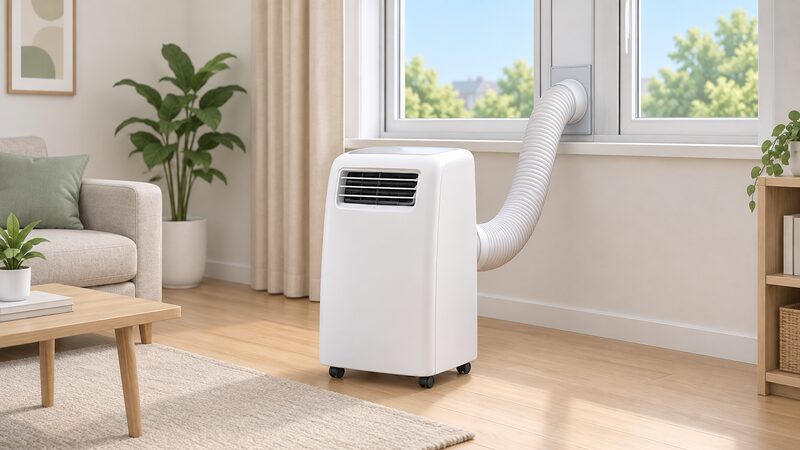
Both are monobloc portables: a single cabinet on castors, with a hose that has to go out of a window. That single fact shapes everything else about them, from how well they cool to how much noise they make and what they cost to run. The PAC EX93 Extreme is listed at 35kg with handles and castors, a soft touch control panel, an electronic timer and three fan speeds1.
What the Pinguino range covers
The Pinguino name covers portable air conditioners rather than a single product. The two models with published UK certification data sit at different points in the range. The PAC EX93 Extreme is the smaller of the pair at 9,400 BTU/h, described as a 3-in-1 appliance covering fan, air conditioning and dehumidifying, with a maximum dehumidifying figure of 60 in dehumidifying mode and refrigerant R2901. The GentleJet Inverter PAC AP130i is the larger unit at 13,000 BTU/H, described as a portable air conditioner and dehumidifier, with inverter technology and a dehumidification capacity of 73 L/24h alongside a fan-only mode1.
The range is not limited to cooling. De'Longhi also sells separate heating products under the Capsule name, including the Capsule Hobby HFS30C24.DG fan heater, listed for rooms up to 70m3 with a two-position base and an anti-frost function, and the HFX10B03.PK Capsule Desk Personal Fan Ceramic Heater, built around a ceramic heating element and described as engineered and tested for desk, short distance use2. Those are distinct appliances, not modes of a Pinguino.
For a household, the practical point is that the Pinguino badge does not by itself tell you the cooling output, the room volume the unit is intended for, or whether it uses inverter control. Those vary by model, and the model number is what identifies them. The wider market these units sit in is set out in portable air conditioners, and the alternatives that avoid a hose altogether are covered in air conditioning without an outdoor unit.
How a Pinguino portable air conditioner works
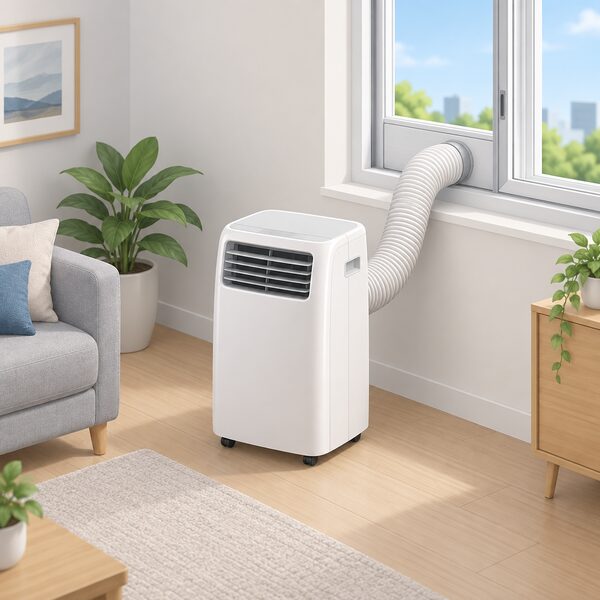
A Pinguino is a monobloc air conditioner: compressor, condenser, evaporator and fan all sit inside one cabinet. Because the condenser has to reject heat somewhere, and it cannot reject it into the room being cooled, the unit draws air across the condenser and pushes it out through an exhaust hose. That is why venting is not optional.
The PAC EX93 Extreme illustrates the specification pattern. It is listed with a cooling capacity of 9,400 BTU/h and 2.5kW/h, an energy efficiency ratio of 3.1, an energy class of A+, airflow of 250 to 300 to 350 m3/h across three fan speeds, and an electronic timer1. The GentleJet Inverter PAC AP130i is listed with inverter technology and a claim that it cools a space up to 30% more quickly1.
The inverter point matters more than the marketing language. An inverter compressor varies its speed rather than switching on and off at full power, which is the mechanism behind the PAC EX93 Extreme's listed claims of up to 70% less noise and 30% less energy consumption1. Those are the maker's figures for its own product, not independently measured outcomes in a UK room.
The energy efficiency ratio of 3.1 is worth reading against independent modelling. The Centre for Sustainable Energy models a cooling system operating at a coefficient of performance of 3.5, meaning 1 kWh of electricity gives 3.5 kWh of cooling4. A portable unit's real-world performance sits below its rated figure once the exhaust hose is losing heat back into the room, which is the central limitation of the format.
"operating at a Coefficient of Performance (COP) of 3.5 (i.e. 1 kWh electricity gives 3.5 kWh cooling)"
Cooling output and room size: matching the model to the space
The two certified models are aimed at different rooms. The PAC EX93 Extreme is listed for rooms up to 85m31. The GentleJet Inverter PAC AP130i is listed at 13,000 BTU/H, a step above the 9,400 BTU/h of the smaller unit1. Volume, not floor area, is the figure the maker publishes, and the two are not interchangeable: a room of the same floor area with a higher ceiling holds more air and takes more cooling.
Official guidance on sizing points in the same direction. A Welsh Government consultation on building regulations states that a cooling appliance should not be sized for more than 120% of the design cooling load5. Oversizing does not make a room colder faster in any useful way; it makes the unit cycle, which costs energy and does less to remove moisture.
The design cooling load itself depends on the fabric of the building, the glazing and the internal gains, not on the floor plan alone. Approved Document L Volume 1 sets out the standard for walls in existing dwellings and allows a lesser thermal performance where meeting the standard would reduce the internal floor area of the bounded room by more than 5%, provided the wall still achieves the best practicable thermal performance6. That is a rule about building work rather than about choosing a cooler, but it illustrates how much the envelope matters to the load a unit has to meet.
| Model | Cooling output | Room volume | Energy class |
|---|---|---|---|
| Pinguino PAC EX93 Extreme | 9,400 BTU/h, 2.5kW/h1 | up to 85m31 | A+1 |
| Pinguino GentleJet Inverter PAC AP130i | 13,000 BTU/H1 | Not stated | Not stated |
In practice, a householder choosing between the two is choosing between a room and a larger room, with the larger unit also carrying inverter control. The general method for matching output to space is set out in air conditioning sizing, and the conversion between kW and BTU is covered in air conditioner kW to BTU.
Single-hose versus dual-hose designs
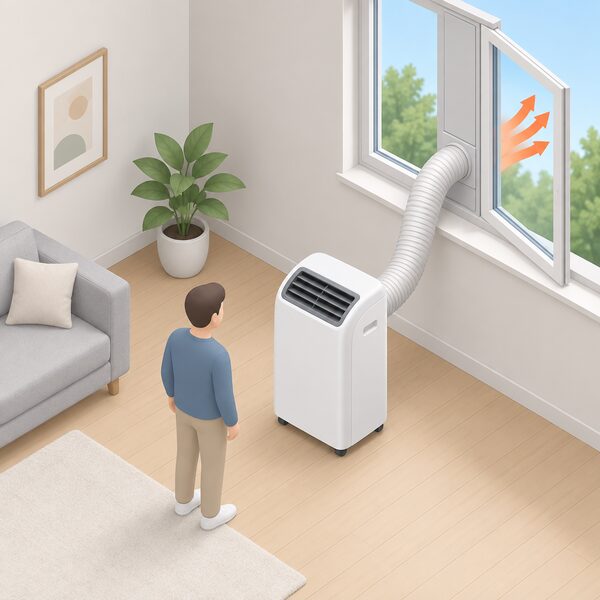
A monobloc portable air conditioner takes room air, uses part of it to cool the condenser, and exhausts that air outside through a single hose. The air leaving the room has to be replaced, and it is replaced by warm air drawn in from elsewhere in the house or through gaps in the fabric. That is the structural weakness of the single-hose design, and it is why a portable unit cools less effectively than its rated output suggests.
The alternative is a twin-duct arrangement, where one hose brings outside air in to the condenser and a second takes it away, so the room's air is not used for cooling the machine. The trade-offs between the two arrangements are set out in single hose vs dual hose portable air conditioners, and the wider comparison between portable and fixed systems is in split vs portable air conditioning.
The published Pinguino data does not state which duct arrangement each model uses, so a householder cannot settle the question from the certification listings alone. What the listings do give is the cooling output, the room volume and the energy class, which are the figures that determine whether a unit suits a given room at all.
Installation and venting through a window
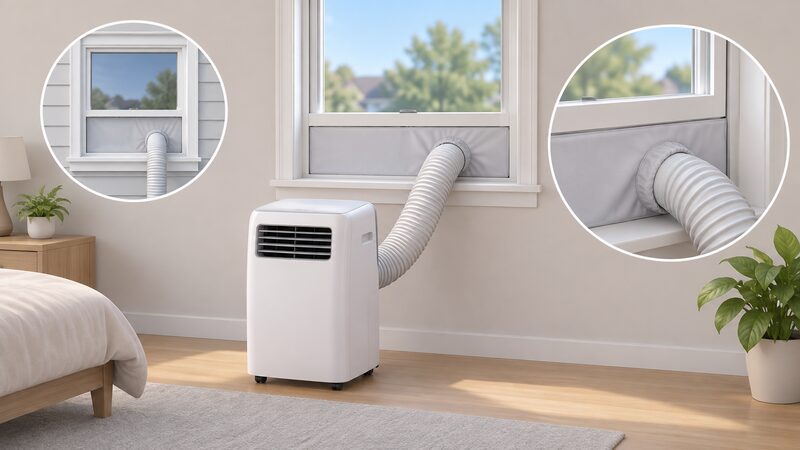
Venting is the one installation task a portable air conditioner demands, and doing it badly undoes the cooling. Independent guidance is direct on the point: portable units need to be properly vented to the outside using a special fitting for the window, and a vent simply put through an open window will let heat back in7.
"they need to be properly vented to the outside using a special fitting for the window. If the vent is just put through a"
The same principle appears in building guidance. Appliances other than flueless appliances should incorporate or be connected to suitable flues which discharge to the outside air8. A portable air conditioner is not a combustion appliance, but the logic is identical: the exhaust has to leave the building, and it has to leave without opening a hole that lets the heat straight back in.
Window kits exist for this reason. They seal around the hose where it passes through the window opening, so the window can stay closed against the hose. Where a window has trickle vents, those sit at the top of the window and can be adjusted by cords, rods or by hand, and they provide ventilation without the need to open windows, which reduces noise levels as a consequence9. A trickle vent is not a substitute for a vent kit, but it does mean a room can have some background ventilation without the window standing open.
Running costs and power use
There is no published running cost figure for a Pinguino in the certification data. What the listings give is the input side: the PAC EX93 Extreme is rated A+ for energy, with an energy efficiency ratio of 3.1 and a listed claim of 30% less energy consumption1. The GentleJet Inverter PAC AP130i carries inverter technology, which is the mechanism by which a compressor varies its speed instead of cycling1.
The nearest independent cost figures in the public advice are for dehumidifiers, which are the closest domestic appliance in duty cycle. Running costs for those are approximately 4p and 15p per hour, depending on their size and settings10. A portable air conditioner draws considerably more than a dehumidifier when the compressor is running, so those figures describe a different appliance and should not be read across as an air conditioning cost.
The independent modelling that does bear on cooling is the coefficient of performance of 3.5 used by the Centre for Sustainable Energy, where 1 kWh of electricity gives 3.5 kWh of cooling4. That is a modelled figure for a cooling system, not a measurement of any Pinguino. The gap between a rated efficiency ratio and delivered cooling in a real room is where running costs are actually decided, and it is driven by the venting arrangement, the room's heat gains and how long the unit runs.
The wider cost picture, including how portable units compare with fixed systems, is set out in air conditioning running costs and portable air conditioner running cost per hour.
Noise levels in practice
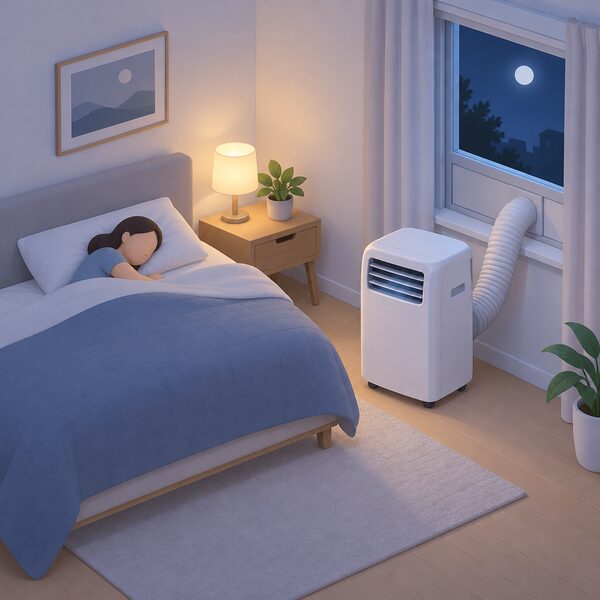
Noise is the most common complaint about portable air conditioning, and the reason is structural: the compressor and both fans sit in the same cabinet as the person being cooled. The PAC EX93 Extreme is listed with a claim of up to 70% less noise, and both certified models hold Quiet Mark certification1.
To put decibel figures in context, independent guidance gives a scale: heavy traffic at 90 dB, a business office at 65 dB, a library at 35 dB, and a quiet forest at 15 dB11. A portable air conditioner running in a bedroom sits somewhere in the middle of that range, and the compressor cycling is what makes it noticeable at night.
Official research on heat pump noise gives a sense of how much a small change in operating speed can buy. A very small reduction in energy efficiency can reduce noise emissions by about 5 dB(A), with the acoustic emission dropping from 67.2 dB(A) to 62.2 dB(A) at a standardised speed12. That is a study of air source heat pumps rather than portable air conditioners, but the relationship between compressor speed and noise is the same, and it is why inverter control matters for a unit used in a bedroom.
The general question of what noise levels mean for indoor units and for neighbours is covered in air conditioning noise, and the wider subject of cooling a home quietly is addressed in home cooling.
De'Longhi: the company behind the range
De'Longhi is an established domestic appliance manufacturer, and the Pinguino range is sold into the UK market through retail channels rather than through a heating installer network. The certification listings for both models state that they are available for the UK market1.
That retail route shapes what a household can expect. There is no installer relationship to maintain, no annual service visit and no registration with a heating trade body. The unit arrives boxed, is set up by the householder, and is supported through the manufacturer's consumer support channels and the retailer's returns process. Warranty registration for domestic appliances is normally done on the manufacturer's website or by calling the manufacturer13.
The contrast with the heating trade is worth stating plainly. Manufacturers in the boiler and heat pump market publish long operating histories: Glow-worm describes designing and manufacturing dependable, energy efficient heating systems for more than 90 years, Trianco describes a heritage spanning more than 165 years, and OCHSNER claims many of its systems provide continuous service for over 40 years14. Chesneys is described as having nearly 40 years of experience in the industry, and Chilli Penguin as a company that set up in 200117. Those are heritage claims from other sectors, and they are not a measure of a portable air conditioner's service life.
What a household is buying with a Pinguino is a self-contained appliance with a manufacturer behind it, not a system with a service contract. The dependence it creates is on the electricity supply and on the manufacturer for parts and support, and the unit's useful life is set by the compressor and by how well the filters and condensate are managed.
Where the Pinguino format has limits
The limits of a monobloc portable are worth stating as firmly as its benefits. It has to be vented, and venting through an open window lets heat back in7. It puts the compressor in the room it is cooling, which is why noise is the recurring complaint. It takes up floor space and, at 35kg for the PAC EX93 Extreme, is not something to move between floors casually, though handles and castors are provided1.
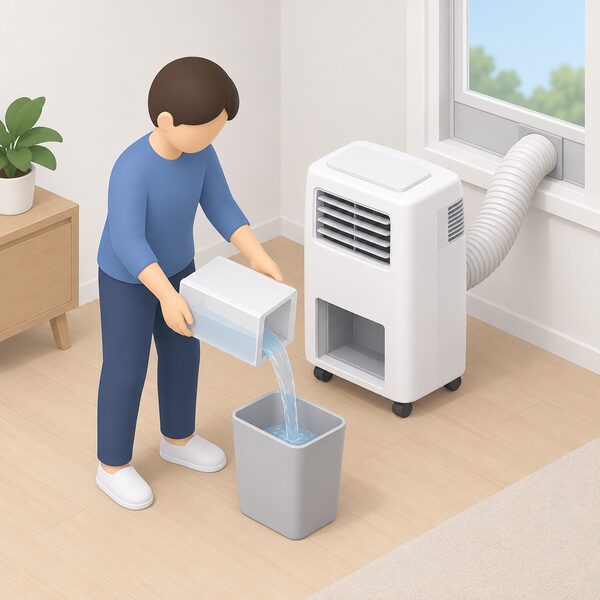
Condensate is the other routine task. Independent guidance for dehumidifying appliances is to empty the water tank after each use and before moving the unit19. A portable air conditioner produces condensate as it cools, and in humid weather that tank fills quickly. Refrigerant dehumidifiers work best in warmer temperatures and are generally more energy efficient in such conditions, which is the same window in which a portable air conditioner is most useful19.
For a household weighing energy independence, the position is straightforward. A Pinguino runs entirely on mains electricity, so it adds to a home's electrical demand at exactly the time of year when the grid is under summer peak pressure, and it does nothing to reduce dependence on a supplier. It needs no gas connection and no installer, which makes it the lowest-friction way to cool a single room, and it can be run from a home solar array during daylight hours. What it cannot do is cool a whole house, and it will not match the efficiency of a fixed split system. The alternatives are set out in types of air conditioning and split air conditioning, and the independence question more broadly in home cooling and energy independence.
Sources19 cited
- De'Longhi Pinguino GentleJet Inverter PAC AP130i, Quiet Mark, 2026-09-17
- De'Longhi Capsule Hobby HFS30C24.DG Fan Heater, Quiet Mark, 2026-09-17
- De'Longhi HFX10B03.PK Capsule Desk Personal Fan Ceramic Heater, Quiet Mark, 2026-09-17
- Summer fuel poverty and the new price cap, Centre for Sustainable Energy, 2026-08-26
- Building Regulations Part L and F review stage 2a, Approved Document L, Welsh Government, 2020-11
- Building Regulations Approved Document L Volume 1 2026, Welsh Government, 2026-04
- How to keep your home cool in hot weather, Centre for Sustainable Energy, 2026-07
- Building Regulations guidance Part J, heat producing appliances, Welsh Government, 2026-09-17
- Ventilation and trickle vents, Glass and Glazing Federation, 2026-09-20
- Condensation, damp and mould, Plymouth Energy Community, 2026-09-20
- Jargon buster, MIMA, 2026-09-20
- ASHPs, noise and permitted development rights in Wales, phase 1 report, Welsh Government, 2023-12-13
- Common mistakes that can invalidate your boiler warranty, Which?, 2025-10-22
- Glow-worm, Quiet Mark, 2026-09-17
- Trianco, Quiet Mark, 2026-09-17
- OCHSNER, Quiet Mark, 2026-09-17
- Chesneys have made the cleaner choice, HETAS, 2025-11-06
- An increasing choice for cleaner choice, HETAS, 2023-10-17
- Dehumidifiers, Electrical Safety First, 2026-09-19