
In this comparison
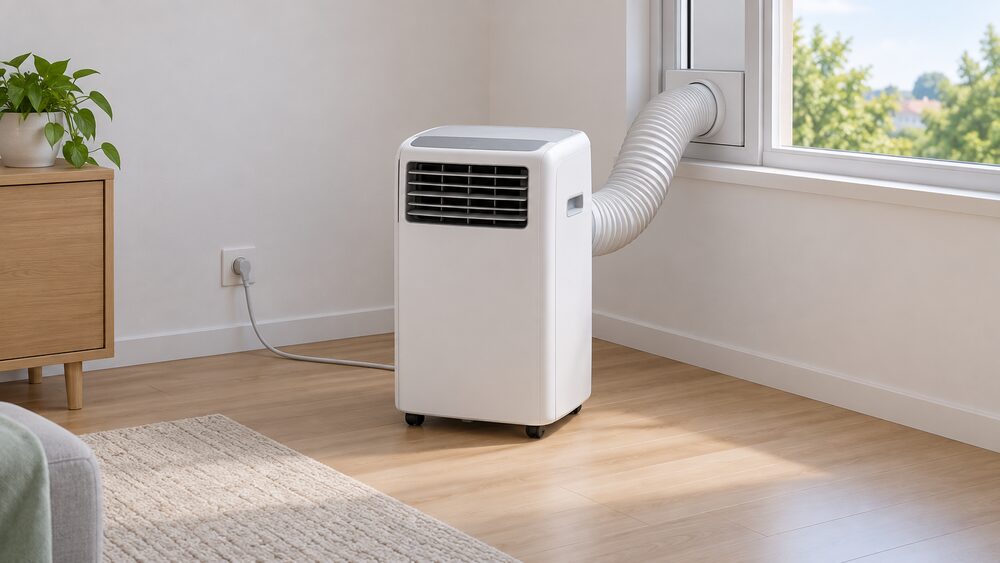
An inverter portable air conditioner varies the speed of its compressor instead of switching it on and off at full power. Daikin states that inverter air conditioners use up to 30% less electricity than non-inverter systems, and that they carry a higher upfront cost, 20% to 35% higher on average1. Meaco claims up to 35% lower energy consumption on selected Cirro models fitted with inverter technology, and states plainly that savings vary with room size, insulation, climate, usage patterns and electricity tariffs, and are greatest during extended operation2.
The gap between those two figures is not a contradiction so much as a difference of scope: one is a general maker figure for air conditioning, the other a claim for a specific range. Both point the same way. The saving comes from run hours, not from the badge on the box. A portable unit that is switched on for a fortnight of hot weather has very little consumption to reduce, and the higher purchase price of an inverter model has little time to be recovered.
What follows sets out how the two compressor styles differ, what each does to running cost, comfort and noise, when a fixed-speed unit still fits, and what a household gives up either way. Portable air conditioning remains a plug-in appliance drawing grid electricity through a 13 amp circuit, so it does nothing for a home's energy independence beyond the room it cools.
Inverter and non-inverter portable air conditioners: the basic difference
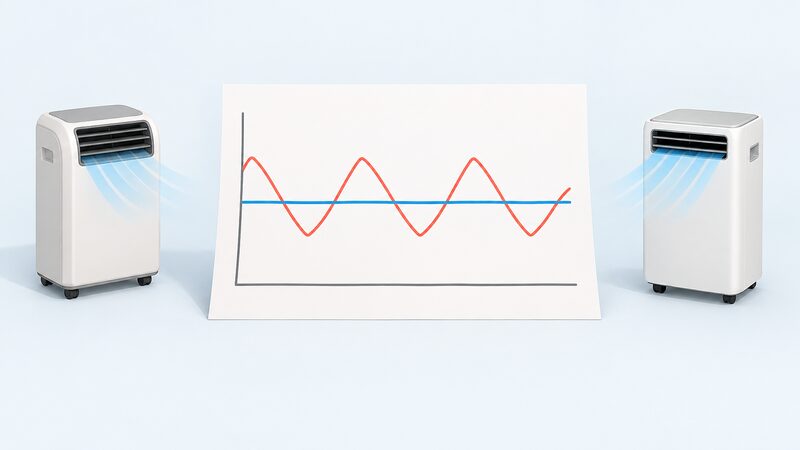
A non-inverter air conditioner runs a fixed-speed compressor at full power, repeatedly switching on and off, which creates energy spikes at each restart1. Daikin states that the compressor inside a non-inverter unit has only one set operational mode and cannot be adjusted5. The result is a room that overshoots the set temperature, then drifts above it, then overshoots again.
Inverter control replaces that with a frequency converter that regulates the speed of the compressor motor, slowing or stopping the compressor when the target temperature is reached6. The compressor does not have to stop to reduce output, so it can hold a steady condition rather than cycling between full power and nothing.
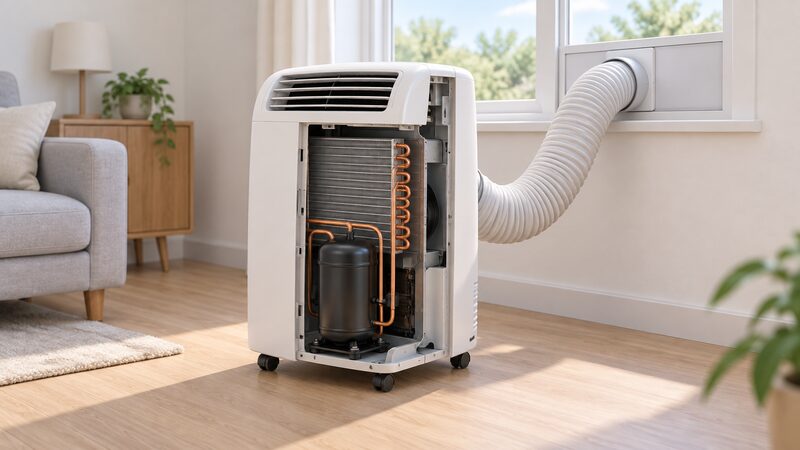
That distinction sits inside a technology that is otherwise unchanged. A portable air conditioner removes warm air from the room and vents it outside through an exhaust hose while circulating cooled air indoors7. Cooleasy describes the appliance as, in essence, a refrigerator without the insulated box covering its parts8. Most cooling and heating portable units are plug and play, needing only a power supply and a way to vent hot air outdoors, with no permanent installation and no water connection9.
The inverter is therefore a control strategy for the compressor, not a different method of cooling. It changes how hard the compressor works minute by minute, and that is where both the electricity saving and the comfort difference come from.
Running costs: why inverters use less electricity

The mechanism is straightforward. A fixed-speed compressor draws its full rated power whenever it runs, and it runs in bursts. An inverter compressor modulates, so most of its operating time is spent below maximum draw. Daikin puts the resulting saving at up to 30% less electricity than non-inverter systems, and gives a worked example: if a non-inverter unit consumes 1,000 kWh annually, an inverter model using 600 kWh cuts electricity consumption accordingly1.
Against that, the National Energy Action figures for what a portable unit costs to run set the scale. A typical portable air conditioner drawing 1,000 to 1,500W costs around 26 to 39p per hour, roughly 14 to 20 times more than a fan3. Plymouth Energy Community makes the same point from the advice side: fans are far cheaper to run than air conditioning, and air conditioning increases electricity use and can add significantly to summer energy bills11.
Two further figures matter for anyone weighing a portable unit against a fixed one. Daikin states that a portable A+ class model could still consume 2.4 times more electricity than a wall-mounted unit of the same class4, and the Centre for Sustainable Energy puts portable units at 30 to 50% more electricity than fixed systems11. Inverter control narrows the gap between two portable units; it does not close the gap between a portable unit and a fixed one.
"In many cases, inverter ACs use <b>up to 30% less electricity</b> than non-inverter systems."
Inverter air conditioning systems also deliver lower electricity use, more stable temperatures, quieter operation and better comfort over longer periods than stop-start systems2. The trade-off sits in the purchase price: inverter units carry an upfront cost premium of 20% to 35% higher on average than non-inverter units, and the maker's own worked example puts a non-inverter unit at 1,000 kWh annually against 600 kWh for an inverter model1. Parts may be more expensive, but inverter ACs often require fewer repairs due to their efficient operation1.
The independence picture is unchanged by any of this. A portable air conditioner is a grid appliance. It adds load to a household's electricity bill and to the national demand peak on the hottest afternoons, and it stores nothing. The Energy and Climate Intelligence Unit's 2030 modelling contrasts a net zero household with a heat pump and an electric vehicle, using almost 85% less imported energy at 3.4MWh a year, against more than 20MWh a year for a home without upgrades12. Cooling appliances sit on the wrong side of that comparison unless they are matched with generation.
Temperature stability and comfort over longer periods
This is where the two designs diverge most in daily use, and where the difference is felt rather than measured. A non-inverter unit can only control indoor temperature by stopping and starting repeatedly5. Daikin describes the pattern as starting and stopping, resting, then starting and stopping again, which uses more energy13. The room swings around the set point.
Inverter control adjusts cooling and heating output continuously to suit the room's temperature, with reduced start-up times13. Because output can fall rather than cease, the unit holds a condition instead of chasing one. Over a long afternoon or a full night, that is the difference between a room that stays even and a room that is alternately cold and warm.
The mechanical consequence is stated by Daikin as a lifespan comparison: inverter units often last longer due to efficient operation, while non-inverter units typically have a shorter life due to stress from constant cycling1. Fewer restarts mean less wear on the compressor, and Daikin adds that while inverter parts may be more expensive, the units often require fewer repairs because of their efficient operation1.
For a household, the practical reading is that the comfort case for inverter control is strongest exactly where the unit runs longest. A bedroom unit left on overnight, or a home office unit running through a working day, spends most of its time in the modulating range where the inverter does its work. A unit switched on for an hour during a heatwave spends most of its time pulling the room down, which is the phase where both designs run near full power.
Noise: what the compressor style means in practice
Compressor cycling is audible. Each restart brings a step change in sound, and the repeated on and off pattern is often more noticeable than a steady hum. Inverter control removes the restarts, and Daikin describes inverter units as operating quietly, especially in silent mode1.
The wider context is that portable air conditioners are not quiet appliances. Daikin states that portable air conditioners often operate at higher noise levels of up to 65 dB4. Netatmo lists portability's advantages as being able to move the unit around the house, store it away when not in use, and needing no fitting work, but lists as disadvantages that it is an auxiliary device with limited cooling capacity and noisier than a fixed unit14. Netatmo also notes that fixed air conditioning is quiet and performs better than portable units14.
Maker figures for specific portable models show what is achievable. Meaco quotes 45 dB in Super Quiet mode on the Cirro 12000 BTU15, and 52 dB at low fan speed on the MeacoCool MC Series Pro 9000 BTU and 53 dB on the 10000 BTU model16. Those are low-fan-speed figures, and the same units will be louder at higher fan settings.
The Cirro range is a useful illustration of how noise is engineered separately from compressor type. Meaco states that Cirro models are designed with an advanced Dual-Wrapped Compressor that delivers quieter performance without compromising on cooling power2, and that inverter technology is available on selected Cirro models2. In other words, a quiet portable unit is not automatically an inverter unit, and an inverter unit is not automatically quiet. Both attributes need checking on the specification.
When a non-inverter unit still makes sense
Fixed-speed portables remain the cheaper purchase and the simpler machine. Daikin states that inverter air conditioners carry a higher upfront cost than non-inverter units, at 20% to 35% higher on average1. For a household buying a unit for a few weeks a year, that premium is real money against a saving that only accrues over run hours.
Daikin's own guidance on where portables fit is specific: portable air conditioning units still have a place, particularly for temporary set-ups or rooms under 10 m², but for longer-term use a fixed system is the better answer4. That is a maker of fixed systems speaking, but it aligns with the independent running-cost figures above.
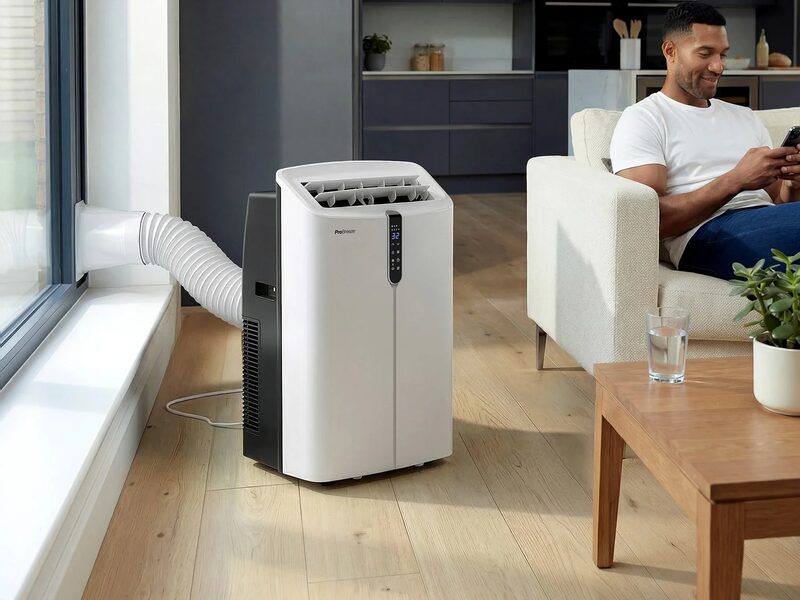
The other conditions that favour a fixed-speed portable are practical rather than thermal. Portable units are ideal for bedrooms, lounges, home offices and rental properties where fixed systems may not be possible7. They need no permanent installation: position the unit near a window, connect the exhaust hose and start cooling7. Pro Breeze units come with a window kit for quick setup and need no permanent installation10. Portable units are not usually equipped with service valves, so they do not require full servicing, though mesh filters need regular cleaning9.
Against that, a single portable unit cannot cool multiple rooms at once, though models with wheels can be moved between them10. EDF Energy notes that portable models tend to be less expensive upfront compared to split systems, but are not as efficient as split units and tend to use more energy, especially when left running all day18. For a household that wants one room comfortable during a short hot spell, that trade is often acceptable. For one that expects to run cooling every summer for a decade, it is not.
Meaco Cirro 12000 BTU: a non-inverter example
The Cirro 12000 BTU is a useful case because it is a high-specification portable unit that does not use inverter control. Meaco lists inverter technology as No on both the cooling-only and the cooling and heating versions15. It is nonetheless an A-rated unit with a 12000 BTU cooling capacity and a cooling power consumption of 1350 watts15.
| Specification | Meaco Cirro 12000 BTU |
|---|---|
| Inverter technology | No15 |
| Energy rating | A15 |
| Cooling capacity | 12000 BTU15 |
| Cooling power consumption | 1350 watts15 |
| Heating capacity | N/A (cooling-only model)15 |
| Heating power consumption | 1100 watts (heater model)19 |
| Noise in Super Quiet mode | 45 dB15 |
| Maximum airflow | 400m³ / hour15 |
| Moisture removal | 1.6 litres / hour15 |
| Refrigerant | R290 / 200g15 |
| Modes | Cool, Fan, Dry, Sleep15 |
| Temperature range | 16°C and 32°C15 |
| Timer | 1 to 24 hours15 |
| App and voice control | Yes (optional), via Amazon Alexa and Google Assistant15 |
| WiFi connectivity | 2.4 GHz and 5 GHz15 |
| Dimensions | 722 × 430 × 358 mm (HWD)15 |
| Duct length and diameter | 1.8 m, 15 cm15 |
| Window kit | Up to 39 cm width, up to 4 m in length, all window types15 |
| Design origin | Designed by Meaco's in-house team in the UK15 |
| Availability | Back in stock March 202715 |
The specification shows what a non-inverter portable can still offer: app and voice control, a sleep mode, a 24 hour timer, R290 refrigerant and a low noise figure in its quiet mode. What it does not offer is the modulating compressor, so the 1350 watt cooling draw is drawn in the cycling pattern described above rather than being held below maximum for most of the run.
The MeacoCool MC Series Pro models follow the same pattern at lower capacity, with inverter technology listed as No on both the 9000 BTU and 10000 BTU versions16. Meaco's position across its range is that inverter technology is available on selected Cirro models rather than across the board2, so the specification line is the thing to read.
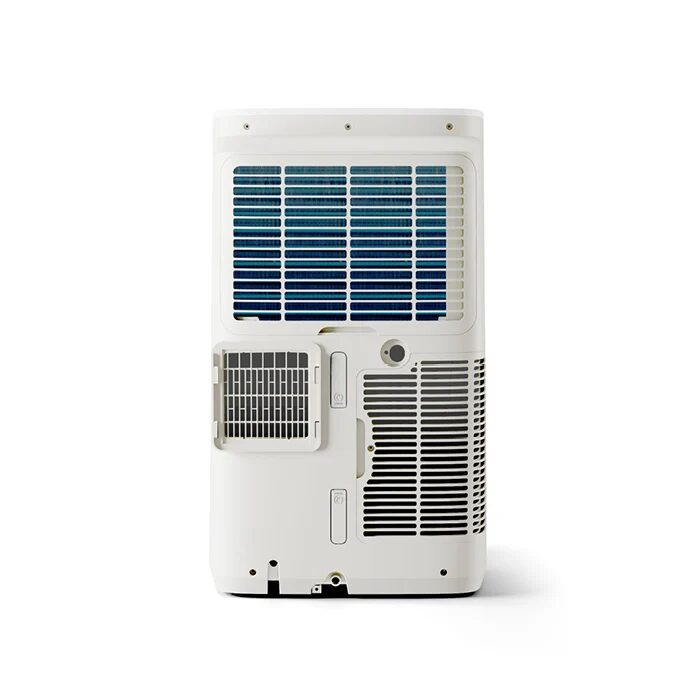
What the savings depend on: how long you run the unit
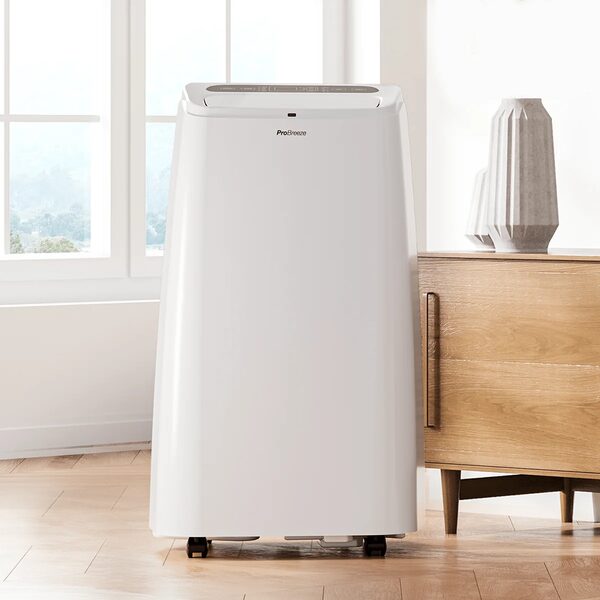
The arithmetic of an inverter premium is a race between a higher purchase price and a lower hourly draw, and the only variable a household controls is hours. Daikin states that over a 5 to 10 year period the improved efficiency can lead to noticeable savings on electricity bills compared with traditional systems, and that for many homeowners the long-term operating savings can balance the initial investment within a few years1. Both statements assume sustained use.
Meaco's caveat on its own 35% claim is the clearest statement of the conditions: energy savings will vary depending on room size, insulation, climate, usage patterns and electricity tariffs, and savings are greatest during extended operation, with the unit correctly sized for the room and installed in accordance with the instructions2. Every one of those variables is outside the appliance.
Sizing is the one a household can get wrong most easily. A unit that is undersized for the room runs near full power for most of its life, which is the mode where inverter control delivers least. A correctly sized unit reaches its set point and then modulates, which is where the saving lives. The same logic applies to the room itself: a well-insulated, shaded room reaches temperature sooner and stays there longer than a conservatory or a loft room.
There is also a comparison the inverter question can obscure. A portable unit of any compressor type uses more electricity than a fixed system: 30 to 50% more according to the Centre for Sustainable Energy11, and 2.4 times more than a wall-mounted unit of the same class in Daikin's figure4. Choosing an inverter portable over a non-inverter portable is a smaller decision than choosing a fixed system over a portable one, and the running-cost pages set out that wider comparison.
For energy independence, the position is the same for both compressor types. Neither generates anything, neither stores anything, and both draw from the grid at the moment of peak summer demand. The saving an inverter delivers is a smaller bill and a lower load, which is worth having, but it is an efficiency gain within a dependence, not a step away from it. Households looking at generation alongside cooling can compare the options on running air conditioning on solar panels and the wider picture on home cooling and energy independence.
Sources19 cited
- Inverter air conditioners, Daikin, 2026-09-17
- Air conditioners, Meaco, 2026-09-23
- Summer energy tips, National Energy Action, 2026-08-13
- Air-to-air heat pumps for small rooms, Daikin, 2026-09-17
- What is inverter technology?, Daikin, 2026-09-17
- Home air conditioning comfort guide, Netatmo, 2026-09-23
- Domestic portable air conditioners, Cooleasy, 2026-09-23
- How does air conditioning work, Cooleasy, 2026-09-23
- FAQs, Cooleasy, 2026-09-23
- Air conditioners, Pro Breeze, 2026-09-23
- How to keep your home cool in hot weather, Centre for Sustainable Energy, 2026-07
- Household energy security in 2030, Energy and Climate Intelligence Unit, 2024
- Inverter technology, Daikin, 2026-09-17
- Home air conditioning comfort guide (UK), Netatmo, 2026-09-20
- Meaco Cirro 12000 BTU portable air conditioner, Meaco, 2026-09-23
- MeacoCool MC Series Pro 10000 BTU, Meaco, 2026-09-23
- MeacoCool MC Series Pro 9000 BTU, Meaco, 2026-09-23
- Guide to air conditioning units, EDF Energy, 2024-05-22
- Meaco Cirro 12000 BTU portable air conditioner and heater, Meaco, 2026-09-23
 Running CostsA portable air conditioner costs roughly twenty to forty pence for every hour it runs, while a fixed unit uses far less electricity for the same cooling.
 Inverters and Inverter-ChargersIf the power goes off, what actually keeps your fridge and boiler running?
 Air Conditioning CostPublished UK equipment prices and the parts of an installed price for portable, single split, multi-split and whole-house air conditioning.
 Passive Cooling at HomeKeeping a home cool without air conditioning comes down to blocking heat before it gets in, then letting trapped heat out.
 Split Air ConditioningA split air conditioning system cools or heats one room using an indoor unit and an outdoor unit linked by pipes.
 Cooling and Heat PumpsCan an air conditioner heat your home as well as cool it?