
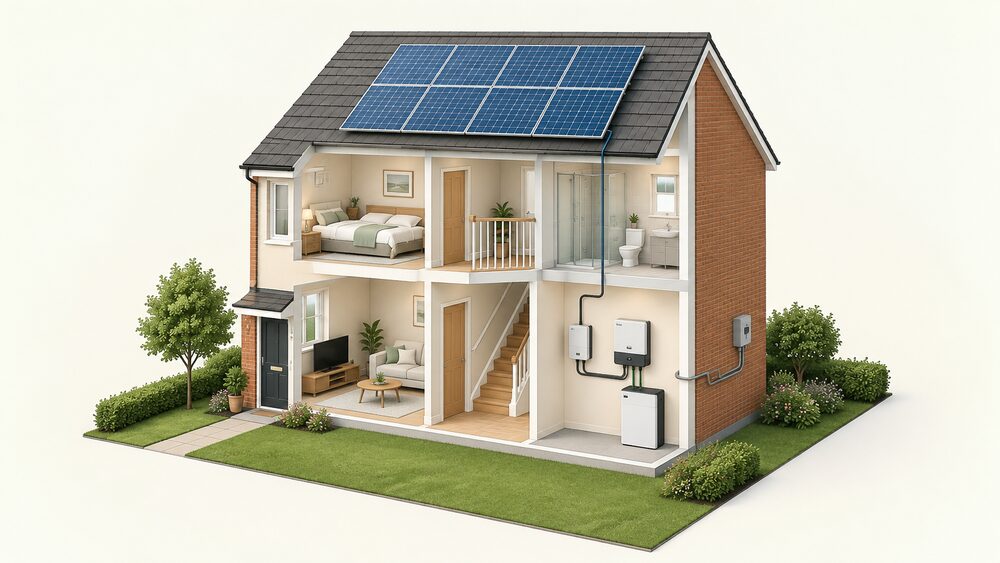
In this comparison
A string inverter is a single central unit that converts DC power from one or more connected strings of solar modules into AC power for the house and the grid1. It is the most common and cheapest option, because it connects panels in series2. A hybrid inverter does the same conversion but adds battery management, connecting to the grid while also managing battery storage3. The choice between them is really a choice about batteries: whether the home wants them now, later, or not at all.
The practical difference shows up in three places. A hybrid can run without a battery, like a grid-tie inverter, or use one for backup4. A hybrid paired with a battery disconnects from the grid during a blackout and keeps the home powered from solar and stored energy5. And a hybrid costs more: it is described as the most expensive system type because of battery integration, with a higher upfront cost and a more complex installation3.
Efficiency is closer than the marketing suggests. String inverter efficiency is often above 95%6, and a quality string inverter at 95 to 98% is said to perform just as well on a simple unshaded roof at lower cost7. A DC coupled hybrid is described as slightly higher efficiency, because the battery charges DC to DC8. What a hybrid does not fix on its own is shading: its shade performance is moderate, with the entire string able to be affected, though DC optimisers can mitigate this5.
What a string inverter does, and what a hybrid inverter adds
A string inverter is a centralised unit handling conversion for an entire group or string of panels12. The name comes from the wiring: single-phase string inverters are called string inverters because they are designed to be connected to a string of solar panels wired together in series13. The panels are connected in series, which is what makes the type cost-effective and easy to install14.
The hardware is undemanding. String inverters have a lightweight, compact design with integrated mounting hardware, and pre-wired plug-and-play systems reduce the complexity of on-site assembly6. Protection features include a high ingress protection rating, surge protection and anti-islanding, which guards against electrical faults and grid failures6. Monitoring is typically at system, string or MPPT level unless power optimisers are added15.
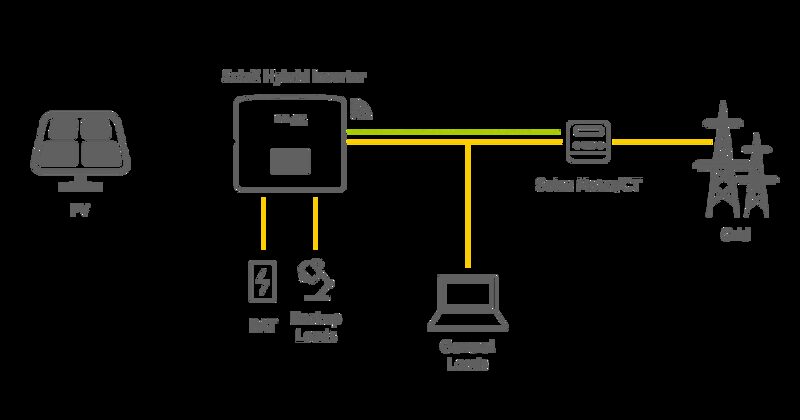
A hybrid inverter manages power flow between the solar panels, battery storage and the utility grid4. It combines inverter technology with battery storage14. The battery requirement is flexible: a hybrid can often operate without batteries, like a grid-tie inverter, or use them for backup4. Sungrow hybrid inverters are stated to work best with lithium-ion batteries, especially LFP, which last longer and offer better efficiency than lead-acid16.
The trade-offs are real. A hybrid has a higher upfront cost because of its advanced features, and the installation process is more complex3. A failure in the device results in the simultaneous loss of both solar generation and battery storage, and it is typically compatible only with specific battery brands, which limits future upgrade options4.
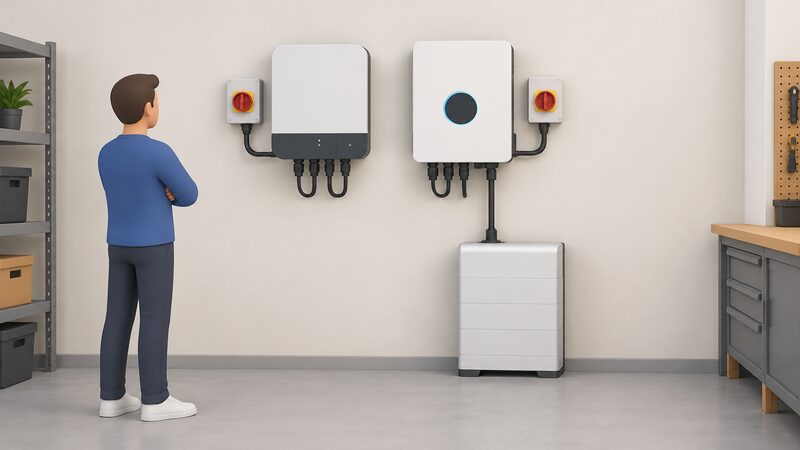
String or hybrid: which fits which home
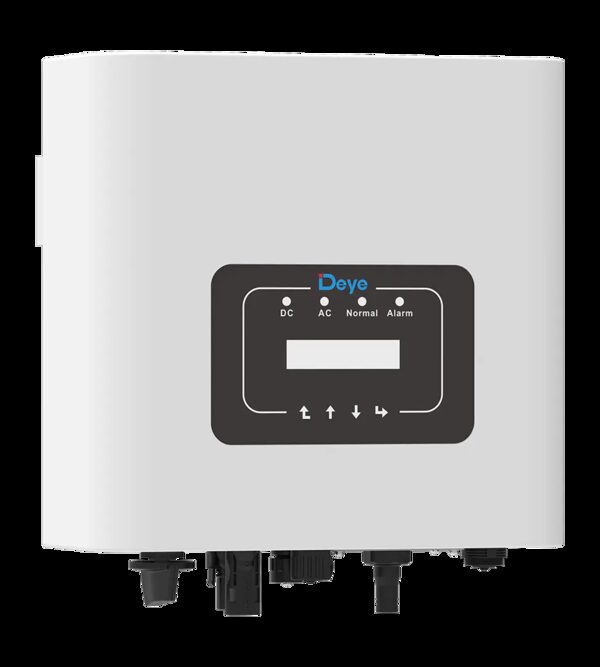
String inverters are the most common type for domestic applications and have been used for decades14. Single-phase string inverters are the more common type in residential solar energy systems13. For a straightforward roof with little shading and no battery plan, the string inverter is the established default, and it is the cheapest option2.
A hybrid suits a household that expects to store energy, whether at installation or later. It is described as ideal for homeowners wanting to lower bills and have backup power during outages4. It also suits a system that is being installed or renewed, where a DC coupled battery can be planned in from the start8.
The middle ground matters here. An AC battery suits an existing working solar system, while a hybrid inverter can be more efficient and is convenient if the system still needs to be installed or renewed8. For a home with a working string inverter and no appetite to replace it, the AC route keeps the existing hardware. For a new build or a full renewal, the DC route through a hybrid is the tidier arrangement.
There is also a control-layer question. Homey works with either a hybrid inverter or a separate AC battery as long as there is a way to exchange data or a suitable integration17. That means the choice of inverter does not by itself decide whether a home can run smart routines, though the data available depends on the hardware.
| Home situation | Sensible starting point | Why |
|---|---|---|
| New system, no battery planned | String inverter | Most common domestic type, cheapest, decades of use2 |
| New system, battery planned now or soon | Hybrid inverter | Manages solar, battery and grid in one unit4 |
| Existing working string system, battery wanted | AC coupled battery | Suits an existing working solar system8 |
| Shaded roof | String with optimisers, or microinverters | Optimisers work with a string inverter to enhance individual panel performance14 |
| Backup wanted during outages | Hybrid with battery | Disconnects from the grid and runs the home from solar and stored energy5 |
Efficiency: what each type delivers in practice
String inverter efficiency is often above 95%6. A quality string inverter at 95 to 98% efficiency can perform just as well at a lower cost on a simple unshaded roof7. Those are the figures that matter for a typical domestic array, and they sit in the same band as most hybrid units.
Manufacturer datasheets push the ceiling higher. Canadian Solar lists residential string inverters at a maximum efficiency of 98% for the 5kW variant, commercial string inverters at 98.6% for the 15 to 25 kW variant, and utility string inverters at 99.01%18. Those are peak figures for specific models rather than whole-system performance, and they are quoted for the string category, not for hybrids.
On the battery side, a DC coupled hybrid is described as slightly higher efficiency because the battery charges DC to DC8. That is a modest advantage and it applies to the battery path, not to the panel-to-house conversion. A hybrid's shade performance is moderate, with the entire string able to be affected, though adding DC optimisers can help mitigate this5. A string inverter has the same characteristic, which is why optimisers exist as a separate product.
The honest summary is that efficiency is not the deciding factor. The gap between a good string inverter and a hybrid is small, and it is smaller than the gap created by shading, orientation or a badly sized array. What differs is what the unit can do with the energy once it has been converted.
Adding batteries later: why the inverter type matters
This is where the decision is hardest to reverse. A hybrid inverter can be more efficient and is convenient if the system still needs to be installed or renewed, while an AC battery suits an existing working solar system8. The two routes have different cost profiles: a DC coupled hybrid means paying for the battery plus a new inverter, described as a higher upfront hardware cost8.
A string inverter has no battery input of its own. String inverter systems may need additional shutdown equipment, while hybrid string inverters can support DC coupled batteries15. So a household with a plain string inverter that later wants storage is looking at an AC coupled battery, which sits on the AC side and leaves the existing inverter in place.
The hybrid route has its own constraints. A hybrid is typically compatible only with specific battery brands, which limits future upgrade options4. That is a lock-in risk worth weighing at the point of purchase, because the battery market moves faster than the inverter market. Sungrow states that its hybrid inverters are compatible with top-tier battery brands, ensuring seamless integration16, but that is a statement about one maker's compatibility list, not a general guarantee.
Cost is the other factor. On-grid systems are the most affordable, while hybrid systems are the most expensive due to battery integration3. A household that buys a hybrid and never fits a battery has paid for capability it does not use. A household that buys a string inverter and later wants storage pays for an AC battery instead, which is a different but not necessarily worse sum.
Backup and off-grid: where only a hybrid qualifies
A hybrid inverter paired with a battery will automatically disconnect from the grid during a blackout and keep the home powered using solar and stored energy5. When the grid goes down, the hybrid disconnects from the utility and continues powering the home using solar panels and battery storage4. That is the capability a string inverter does not have.
An off-grid inverter is a different product again. Many off-grid inverters only support battery integration, drawing charge only from the battery4. They depend only on solar panels or battery storage, and they need maintenance4. A hybrid sits between the two: it connects to the grid while also managing battery storage3, and it can often operate without batteries or use them for backup4.
The distinction matters for anyone weighing independence. A grid-tied string system stops when the grid stops, regardless of how much sun is on the roof. A hybrid with a battery keeps selected circuits running. A true off-grid system removes the grid from the equation but takes on the maintenance and the battery dependence that come with it.
For most UK homes the hybrid is the practical middle path, because it keeps the grid connection and the export route while adding a backup function. The limit is that backup depends on the battery being charged and on the circuits being wired to the backup output, which is an installation decision rather than an inverter setting.
The main brands in the UK: Fox ESS and Sungrow
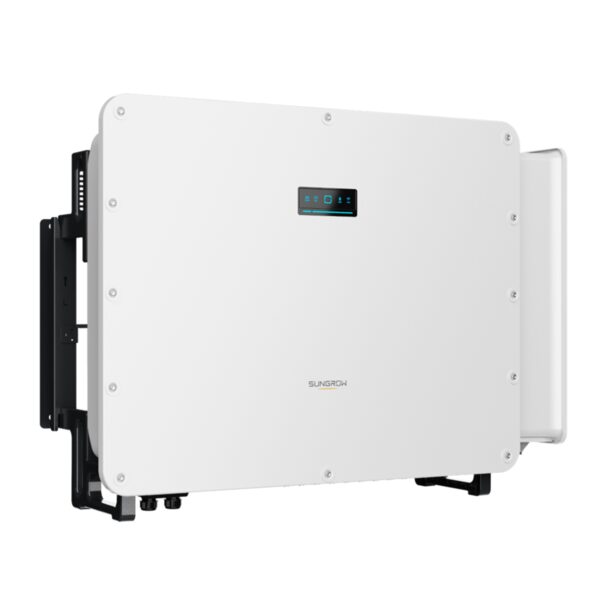
Sungrow was established in 1997 by the university professor Cao Renxian, and its products reach more than 150 nations19. The company reports a 26-year track record in the PV industry and states that it has more than 20 years of experience in clean power conversion19. It reports being deeply engaged in cloud computing, big data, artificial intelligence and Internet of Things20, and its iSolarCloud platform is listed as part of its residential solution alongside string inverters and optimisers21.
Its product range covers micro-inverters, residential inverters, string inverters, central inverters and modular inverters22. String inverters span power ratings from 2kW to 352 kW11, and the company states that they are commonly used in homes and businesses, including rooftops, carports, ground mounts and tracker systems11. Its 5kW hybrid inverter is listed for residential use and commercial applications, tracking system performance in real time23. Sungrow states that it offers solutions across on-grid, off-grid and hybrid categories3.
Fox ESS appears in the UK market through its own UK site and product pages, with a presence at Solar & Storage Live 2026 at the NEC Birmingham from 22 to 24 September on stand C1424. The company reported the number one market share in Europe's residential energy storage market in September 202624, and topped global residential ESS shipments in the first half of 202624. Infineon supplies silicon carbide technology to Fox ESS to enhance the efficiency of residential energy storage systems24. These are the company's own announcements, and they describe market position rather than product specification.
Other makers offer both categories. Sunsynk lists a three-phase unit described as a versatile hybrid inverter suited to residential systems and optimised for grid-tied systems25. Wondrwall offers two distinct options, a string inverter and a hybrid inverter26. Marley supplies a hybrid inverter, the ES G214. Deye holds an England G99 certificate for one of its single-phase string inverters13.
Cost, warranty and servicing
Warranty periods differ by type. Typical hybrid inverter warranty is 5 to 10 years9. Typical string inverter warranty is 5 to 12 years9. One source gives the industry standard string inverter warranty as 5 to 12 years7.
Servicing favours the string layout in one respect. String inverters are easier to service at ground level, whereas repairing a microinverter may require roof access and panel removal15. A hybrid is also a ground-level unit, so the same access advantage applies to both types compared with roof-mounted electronics.
Warranty claims run through the manufacturer. Sungrow provides a warranty claim page where the warranty information for a product can be self-checked, with email and online chat support giving one-to-one help27. Terms are checked against the current datasheet and installation manual1, so keeping those documents matters more than keeping the receipt alone.
What this means for household energy independence
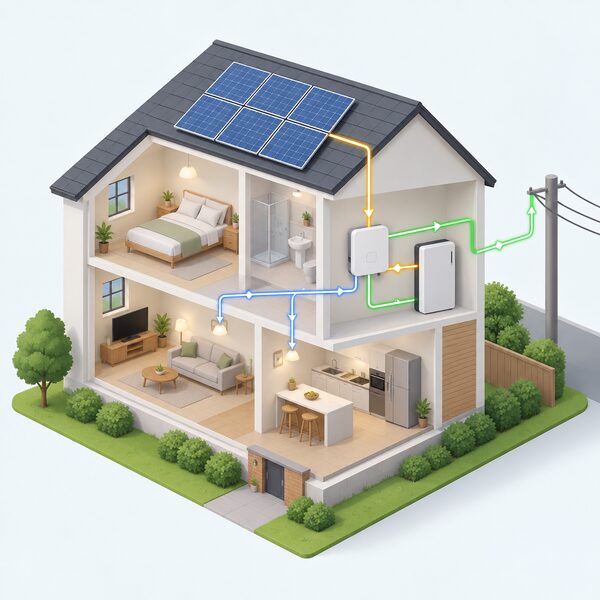
A string inverter gives a household generation without storage. It converts what the panels produce, sends it to the house or the grid, and stops there. The dependence that remains is on the grid for everything after sunset and during a power cut, and on a supplier for the import and export arrangements.
A hybrid inverter changes the shape of that dependence rather than removing it. It manages power flow between solar panels, battery storage and the utility grid4, which means the home can shift its own generation into the evening. Sungrow states that homeowners can benefit from reduced electricity bills, energy independence and a smaller carbon footprint by harnessing a 5kW hybrid inverter23. That is a maker's claim about its own product, and it describes a direction of travel rather than a measured outcome.
The limits are worth stating plainly. A hybrid still depends on the grid for import in winter and for export payments. It still depends on a manufacturer for firmware, monitoring and warranty service, and Sungrow's monitoring runs through its own cloud platform21. It still depends on a battery maker for the storage half of the system, and compatibility is typically limited to specific battery brands4. A hybrid with a battery can carry a home through a blackout, but only for the circuits wired to its backup output.
For a household weighing the two, the question is not which inverter is better but what the home intends to do with its own generation. A string inverter is the cheaper, simpler, longer-established route2. A hybrid is the route that keeps storage and backup open, at a higher upfront cost and with a more complex installation3. Both leave the household connected to the grid, and neither removes the need for a supplier.
Sources28 cited
- String inverter, Tigo Energy, 2026-09-17
- Solar panels, Electrical Safety First, 2026-09-17
- Inverter technologies compared: off-grid, on-grid and hybrid systems, Sungrow, 2025-01-07
- Off-grid vs hybrid inverter, SolaX Power, 2026-03-13
- Microinverter vs hybrid inverter, SolaX Power, 2026-08-25
- Everything you should know about solar string inverters, Sungrow, 2026-09-17
- Types of solar inverters, SolaX Power, 2025-12-16
- Add battery to existing solar system, SolaX Power, 2026-06-05
- Solar inverter warranty, SolaX Power, 2026-06-18
- Draft Regulatory Impact Assessment, Northern Ireland Department of Finance, 2021-10
- String inverter, Sungrow, 2026-09-17
- Solar string inverters vs micro inverters: what's the difference, Sungrow, 2026-09-17
- Is a single-phase string inverter the right choice for your residential solar energy system, Deye, 2023-04-15
- What type of inverter is best for solar, Marley, 2026-09-17
- Microinverter vs string inverter, SolaX Power, 2026-07-22
- What are the optimal configurations for a hybrid inverter, Sungrow, 2025-04-23
- Solar panels combined with home battery, Homey, 2026-09-20
- Inverter, Canadian Solar, 2026-09-17
- Benefits of choosing Sungrow solar power inverter for your home, Sungrow, 2026-09-19
- Cloud software, Sungrow, 2026-09-17
- Residential PV solution, Sungrow, 2026-09-17
- PV inverter, Sungrow, 2026-09-17
- Sungrow revolutionizing solar energy with the 5kW hybrid inverter, Sungrow, 2026-09-17
- Fox ESS UK, Fox ESS, 2026-09-22
- String Inverter 10kW 3P, Sunsynk, 2026-09-17
- Wondrwall inverter, Wondrwall, 2026
- Warranty terms and conditions list by country, Sungrow, 2026-09-19
- Domestic wind power, CAT, 2023-10-01
 Inverters and Inverter-ChargersIf the power goes off, what actually keeps your fridge and boiler running?
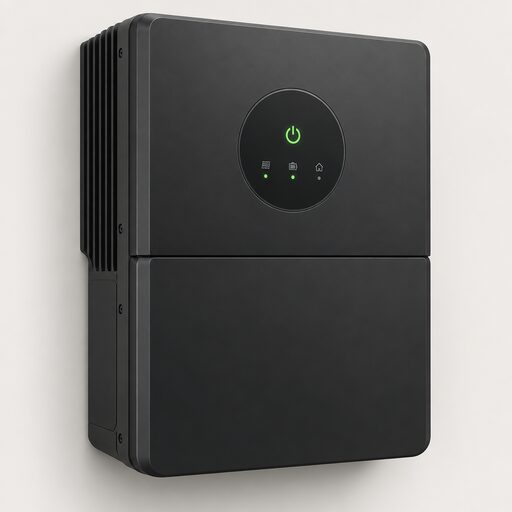 Hybrid InvertersA hybrid inverter lets you store solar power in a battery and use it later, all through one unit instead of two separate boxes.
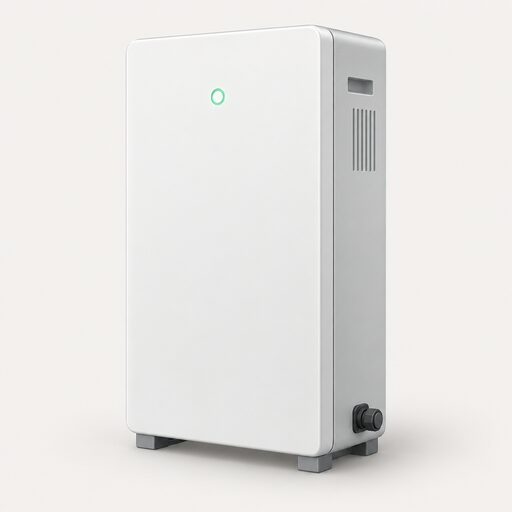 All-in-One Battery SystemsA single unit holding your battery and the equipment that turns its power into usable electricity.
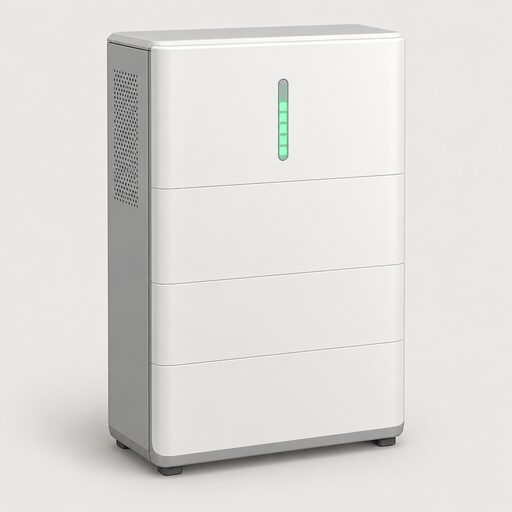 AC-Coupled vs DC-CoupledCan you add a battery to your existing solar panels without swapping the inverter, and does one kind waste more of your solar power than the other?
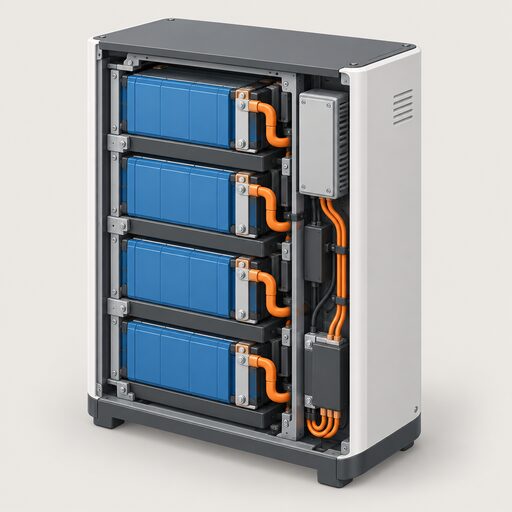 Batteries and IndependenceHow far home battery storage moves a UK household away from the grid and supplier pricing, covering self-sufficiency, winter limits, cost, lifespan, backup, export payments and flexibility earnings.
 Types of Home EV ChargerWhich home charger suits your car and your driveway?