In this guide
Sungrow is a Chinese inverter manufacturer that has become one of the largest suppliers of solar power conversion equipment in the world, and its residential range is sold in the UK through distributors and installers rather than direct to households. The company states it holds the number one position in PV inverter shipments, a ranking it attributes to S&P Global Commodity Insights for 20251. Its product range spans 0.45kW to 8,800kW, covering everything from a single domestic rooftop to utility-scale plants2.
For a home, the relevant products are the residential string inverters and the hybrid inverters that combine solar conversion with battery management. The SG6.0RS single-phase string inverter carries a 10 year warranty period3, and the SH6.0RS hybrid inverter is sold in the UK as part of a bundle with the SBH high-voltage battery4. Sungrow states that its hybrid inverters endure 10 to 15 years, which it describes as the industry norm for high-quality inverters5.
What the brand offers a household is a route to generating and storing its own electricity, with the grid used as a backup and an export destination rather than the sole supply. What it does not remove is dependence on that grid, on a licensed installer for the connection, and on the manufacturer for warranty service and monitoring software.
What Sungrow makes for homes: on-grid, off-grid and hybrid
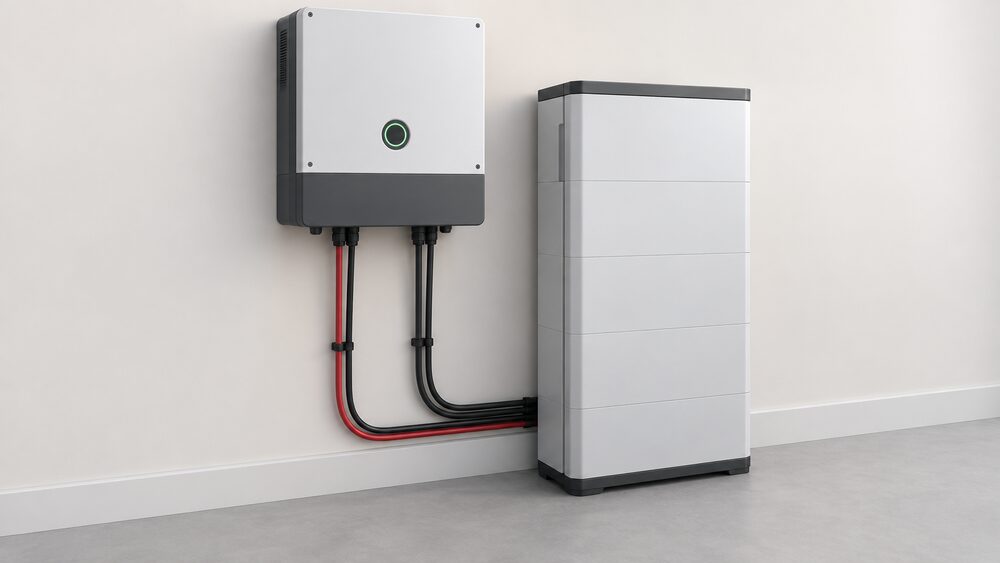
Sungrow divides its inverter output into three system types. On-grid inverters connect to the distribution network, support smart grid connectivity, enable energy export and are compatible with net metering arrangements8. Off-grid inverters carry battery management systems designed to maximise energy storage, for sites with no network connection at all8. Hybrid inverters sit between the two, offering advanced energy management that lets a household optimise the flow of power between the panels, a battery and the grid9.
The company's wider catalogue runs across micro-inverters, residential inverters, string inverters, central inverters and modular inverters2. The residential end of that list is what matters for a house: a wall-mounted unit sized to the array, with the hybrid versions adding a battery input and the ability to switch between grid-tied and off-grid modes depending on energy needs10.
| System type | Grid connection | Battery | Typical use |
|---|---|---|---|
| On-grid | Yes, with export and net metering support8 | Not required | Standard rooftop array |
| Off-grid | None | Battery management built in8 | Sites with no network supply |
| Hybrid | Yes, with grid-tied and off-grid modes10 | Battery input, energy management9 | Array plus storage |
Sungrow describes its residential solution as one that can be set up by just one person, and its home system as easy to install11. That is a statement about physical handling and mounting rather than about the electrical work, which in the UK is notifiable and has to satisfy the distribution network operator. The distinction matters because the inverter is the component that interfaces with the grid, and it is the part of a solar installation where the connection rules bite hardest. More on the different inverter types is at solar inverters and on the battery-integrated versions at hybrid inverters.
Efficiency: over 98% in practice
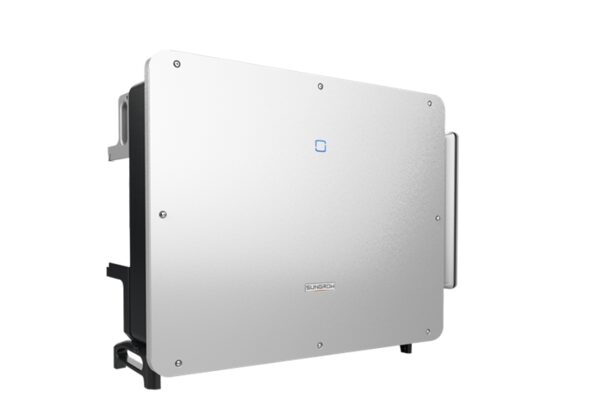
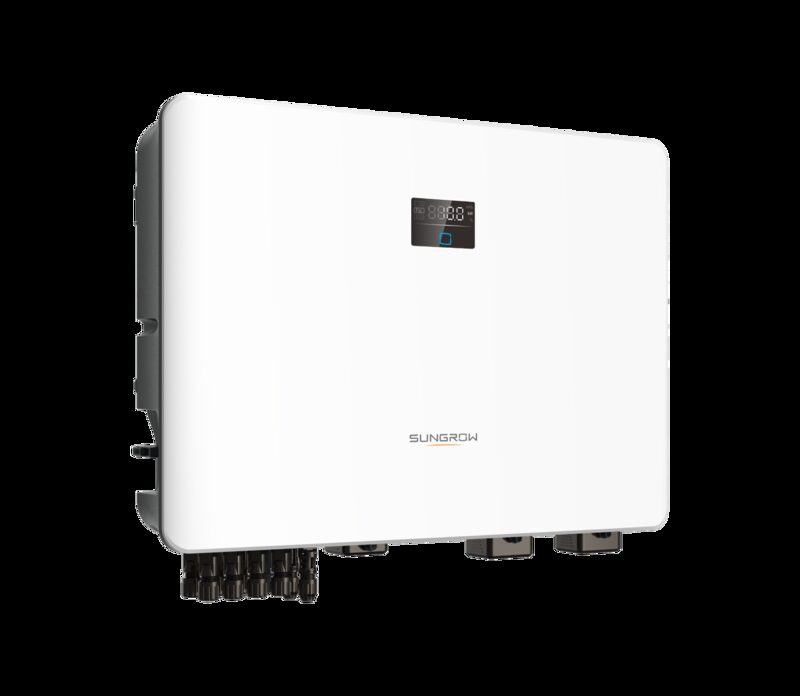
Sungrow quotes a maximum efficiency of 98.5% for the SG125CX-P2, describing it as a remarkable figure for a high-power string inverter6. The same number appears in the company's guidance on its multi-string range, where it is presented as a rate that lets a household capitalise on every ray of sunlight12. Elsewhere the company refers more broadly to PV solar power converters that are over 99% efficient5.
Those figures describe conversion efficiency: the proportion of the direct current arriving from the panels that leaves the inverter as alternating current. The gap between 98.5% and 99% is not a disagreement so much as a difference of product class and test condition, and the model-level figure is the one tied to a specific appliance. What the number does not capture is the loss elsewhere in the system, in the DC cabling, the connectors and the shading that never reaches the inverter at all.
Two technologies sit behind the headline. Sungrow lists PowerMax Global MPPT and PID Zero among the features of its inverters, the first concerned with tracking the array's maximum power point and the second with preventing potential induced degradation from eating into output over time11. The practical effect for a household is that a well-specified Sungrow inverter will not be the limiting factor in a domestic array; the panels, the roof orientation and the shading will be. The wider question of how inverter efficiency sits alongside module efficiency is covered at solar panel specifications and efficiency.
Warranty: 10 years on European residential models
Sungrow publishes warranty terms by country, and the UK sits within its European residential terms. The SG6.0RS string inverter is listed with a warranty period of 10 years3, and the company's warranty pages include a 10 year premium inverter warranty13. That aligns with what the independent end of the market treats as normal: the Low Carbon Hub advises that it is standard for inverters to have warranties for 10 years14.
The terms are not uniform across the range, and the differences are worth reading before purchase. Some hybrid models in Sungrow's published warranty schedule carry a five year term with a 10 year option15. The distinction between a standard 10 year term and a five year term that can be extended is the difference between a warranty that is included and one that has to be bought or registered.
Registration and record-keeping carry the weight here. The warranty attaches to a product and a date of commissioning, and the evidence for both is the serial number and the original documentation. Where an inverter is replaced under warranty, the replacement unit's term is a separate matter from the original. For the wider picture on how inverter life and warranty interact with the rest of a system, see solar inverters explained.
Safety, monitoring and grid compliance
Sungrow's multi-string inverters incorporate an Arc Fault Circuit Interrupter, described as AFCI 2.0, which is intended to detect and interrupt series arcs in DC wiring12. The same range carries C5 anti-corrosion classification, which the company presents as making the units suitable for installation in challenging environments, and smart operations and maintenance features for monitoring, diagnosis and troubleshooting12.
On the higher-power SG125CX-P2, the safety and diagnostic package includes key component diagnosis and protection, a Smart IV Curve Diagnosis function and a grid fault record facility6. The IV curve diagnosis is a way of identifying underperformance across a string without physically testing each panel, and the grid fault record captures the conditions at the moment a connection problem occurred.
Certification is international rather than UK-specific in the listings Sungrow publishes: TÜV, CE, Enel-GUIDA, AS4777, CEC, CSA and BDEW2. The company also states that its inverters offer seamless switching between grid following and grid forming2. That capability is what allows a hybrid system to keep running a backed-up circuit when the network goes down, rather than shutting off as a standard grid-tied inverter must.
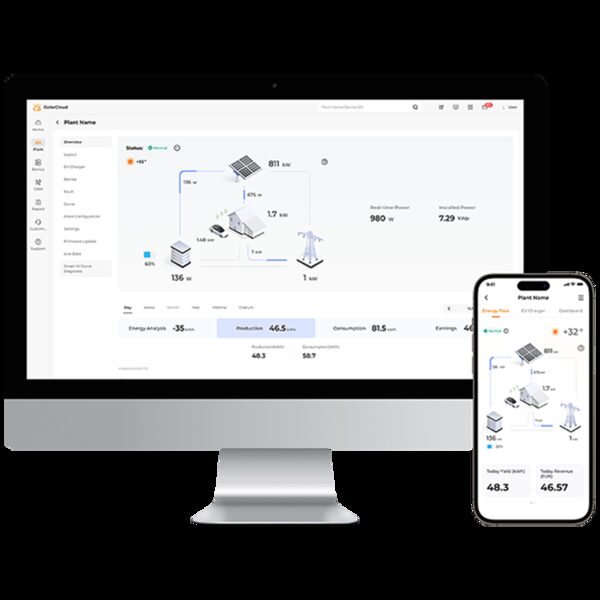
Monitoring runs through Sungrow's iSolarCloud platform, which the company presents as one of the reasons to choose its systems9. The 5kW hybrid inverter is described as coming with intelligent monitoring and control systems that let a household optimise consumption and track performance in real time16. The dependence this creates is worth naming: the data lives on the manufacturer's platform, reached over a home broadband connection, and the app is the maker's. Local operation of the inverter continues without it, but the visibility does not. More on this at monitoring a solar PV system and on the safety rules at solar PV fire and electrical safety.
Cost and what owning one means for energy independence
There is no published Sungrow list price for a domestic inverter, and prices are installer-quoted as part of a whole system. The figures that exist are for replacement rather than purchase.
| Source | Figure | Basis |
|---|---|---|
| Centre for Sustainable Energy17 | about £500 to £1,000 | Inverter replacement |
| Energy Saving Trust18 | around £800 | Size and manufacturer of the system |
| Energy Saving Trust maintenance guidance19 | around £800 | Replacement |
What the inverter does for independence is convert and manage the output of a household's own array. Sungrow states that its solar power inverter system will feed unused energy back into the grid, helping to offset the electricity bill7, and that a hybrid inverter allows excess solar energy to be stored in batteries16. The company frames the residential benefit as reduced electricity bills, energy independence and a smaller carbon footprint16.
The limits are as real as the benefits. A grid-tied inverter needs a live network connection to operate, so a power cut takes the system down unless there is battery backup and a means of islanding. Export depends on a supplier and a metered connection. The self-consumption case is strong on its own terms: one supplier's guidance notes that self-consumed solar power locks in a portion of energy costs at 0p per kWh for the next 25 years20. The wider argument is set out at solar panels and household energy independence and the export side at getting paid for solar export.
Sungrow in the UK: availability and distributors
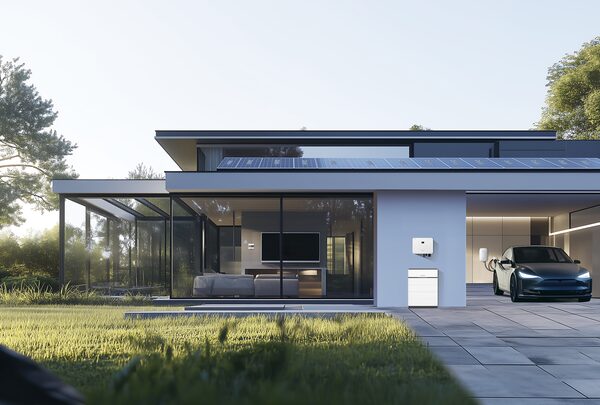
Sungrow sells into the UK through a trade channel. One UK distributor lists the SG6.0RS single-phase string inverter with dual tracker3, and the same distributor lists a bundle pairing the SBH high-voltage storage system with the SH6.0RS single-phase hybrid inverter, supplied with a Sungrow SBH battery accessory kit4. That bundle is the clearest example of a complete Sungrow residential package available in the UK.
Availability is not uniform across the range. Sungrow notes that some products may only be available in specific regions, and its SBS050 residential storage system is listed for the EU, Middle East, Africa and South East Asia regions21. A householder specifying a particular model should confirm with the installer that it is stocked for the UK market rather than assuming the whole catalogue is available.
Support runs through the maker and the supply chain together. Sungrow publishes a global email address for its energy technology service and an online chat channel staffed by its own experts13, and describes its customer service as exceptional8. In practice a UK household reaches the company through the distributor or installer who supplied the unit, which is also the route for a warranty claim. The choice of installer therefore shapes the support experience as much as the choice of brand does, a point developed at how to choose a good solar installer and at MCS certification for solar PV installations.
The company: founded 1997, world No.1 in PV inverter shipments
Sungrow Power Supply Co., Ltd. was established in 1997 by Cao Renxian, a university professor22. The company describes itself as specialising in research and development, production, sales and service of new energy equipment including solar inverters and storage equipment22, and its product scope now runs from PV inverter solutions and energy storage systems for utility-scale, business and residential applications through to floating PV plant solutions, EV charging and renewable hydrogen production7.
The scale claims are consistent across the company's own pages. Sungrow states it is the world's number one in PV inverter shipments5, and a 2025 press release attributes the same ranking to S&P Global Commodity Insights1. The company also cites a number one position in global PV inverter bankability2, and reports that its products power more than 150 countries23. Its track record in the PV industry is given variously as 26 years7 and, in a 2024 release, 27 years24.
For a household, the significance of scale is continuity: a manufacturer with a large installed base and a long trading history is more likely to be able to honour a 10 year warranty than a smaller entrant. It is not a guarantee, and it does not change the fact that the warranty is a contract with a company rather than a physical property of the equipment. A side-by-side comparison with a European competitor is at Sungrow vs Fronius inverters, and the general case for string inverters at string inverters for home solar.
Sources24 cited
- Sungrow retains No.1 position in 2025 S&P Global PV inverter shipments rankings, Sungrow, 2026-08-06
- PV inverter, Sungrow
- SG6.0RS Sungrow 6kW single phase string inverter dual tracker, Alternergy
- SH6.0RS bundle with Sungrow SBH 10kWh HV storage system, Alternergy
- Benefits of choosing Sungrow solar power inverter for your home, Sungrow
- Sungrow SG125CX-P2, Sungrow
- The top reasons why Sungrow solar inverter systems are the best choice for your home, Sungrow
- Inverter technologies compared: off-grid, on-grid and hybrid systems, Sungrow, 2025-01-07
- Top 3 reasons to choose Sungrow solar operating and monitoring platform iSolarCloud, Sungrow
- What are the optimal configurations for a hybrid inverter, Sungrow, 2025-04-23
- Residential PV solution, Sungrow
- Maximizing solar power efficiency with our multi string inverters, Sungrow
- Warranty terms and conditions list by country, Sungrow
- How to choose a good solar installer, Low Carbon Hub, 2025-10-20
- Deye warranty terms, Deye
- Sungrow revolutionizing solar energy with the 5kW hybrid inverter, Sungrow
- A complete guide to solar PV, Centre for Sustainable Energy, 2025-11
- Solar power facts, Energy Saving Trust, 2026-08-13
- Solar panel cleaning and maintenance, Energy Saving Trust, 2026-08-25
- Solar panels, Uswitch, 2026-09-16
- SBS050 residential energy storage system, Sungrow
- Sungrow Power Supply Co., Ltd. company profile, Sungrow, 2024-12-06
- Sungrow unveils new microinverter solutions at Intersolar Europe 2024, Sungrow, 2024-06-20
- Is hybrid inverter better than normal inverter: FAQs about Sungrow hybrid inverters, Sungrow
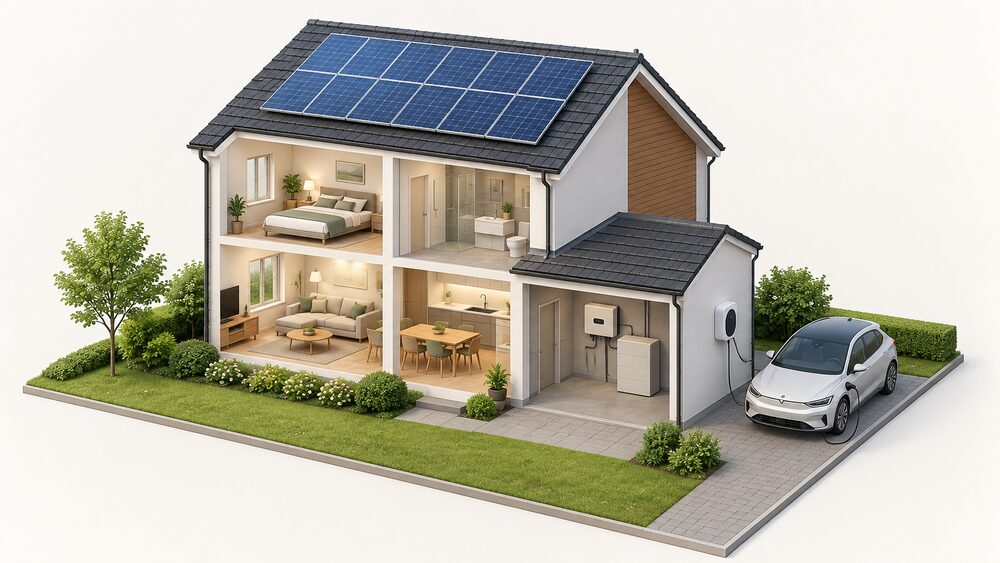 Sungrow EV chargersWill a Sungrow charger use your spare solar electricity to fill the car?
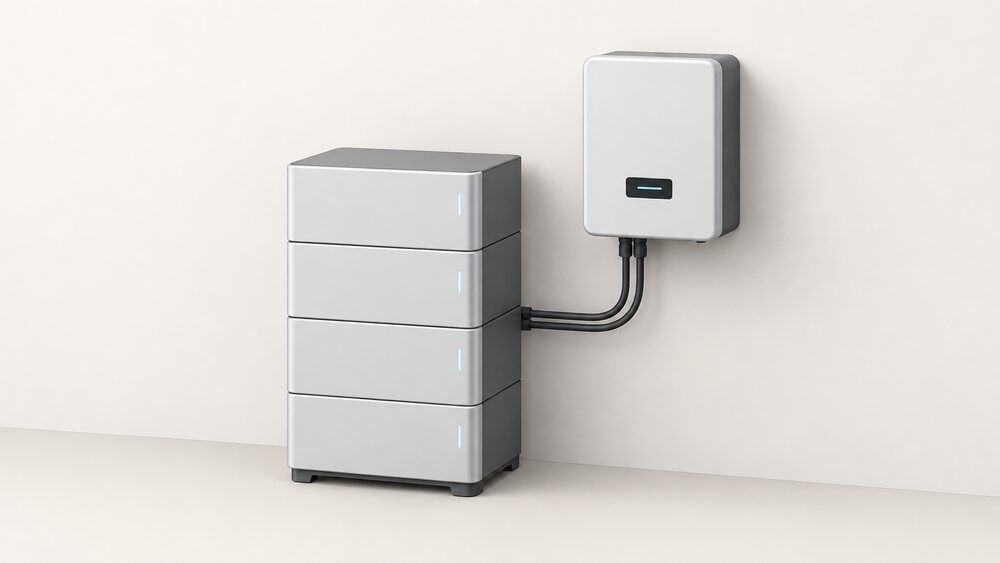 Sungrow Home Battery StorageHow much power can a Sungrow home battery store, and will it fit your house?
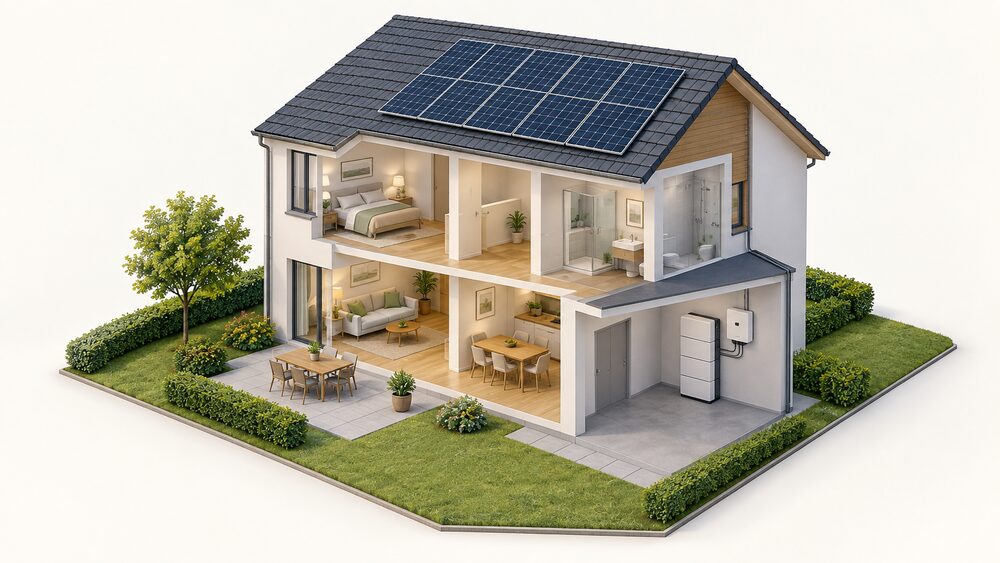 Sungrow home batteries and solar invertersSungrow makes solar inverters and home batteries, and it is one of the biggest names in the world at it.