
In this comparison
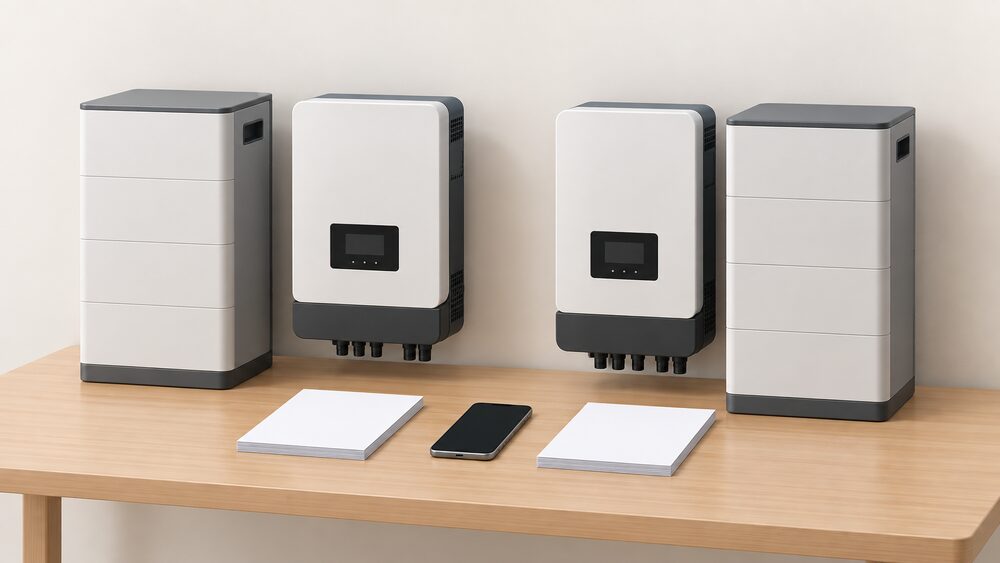
Sunsynk and Growatt both sell hybrid inverters into the UK home storage market, but they are very different companies with different histories, different monitoring platforms and different battery ecosystems. Sunsynk describes itself as drawing on over 20 years of engineering experience to develop hybrid inverters and battery storage systems, and says it is trusted by installers and energy professionals in over 40 countries1. Growatt reports systems installed in 180+ countries, 43+ representative offices worldwide and 1.7M+ end users connected to its cloud platform2.
For a household, the practical difference is not the headline scale but what each brand supports: which batteries pair with which inverter, how monitoring works, where support sits, and what happens when a product is discontinued. Sunsynk's UK base is in Widnes, Cheshire, with a direct technical support line3. Growatt's UK-facing sales and support run through its European distribution operation at growatt.tech4.
Sunsynk and Growatt at a glance: two very different makers
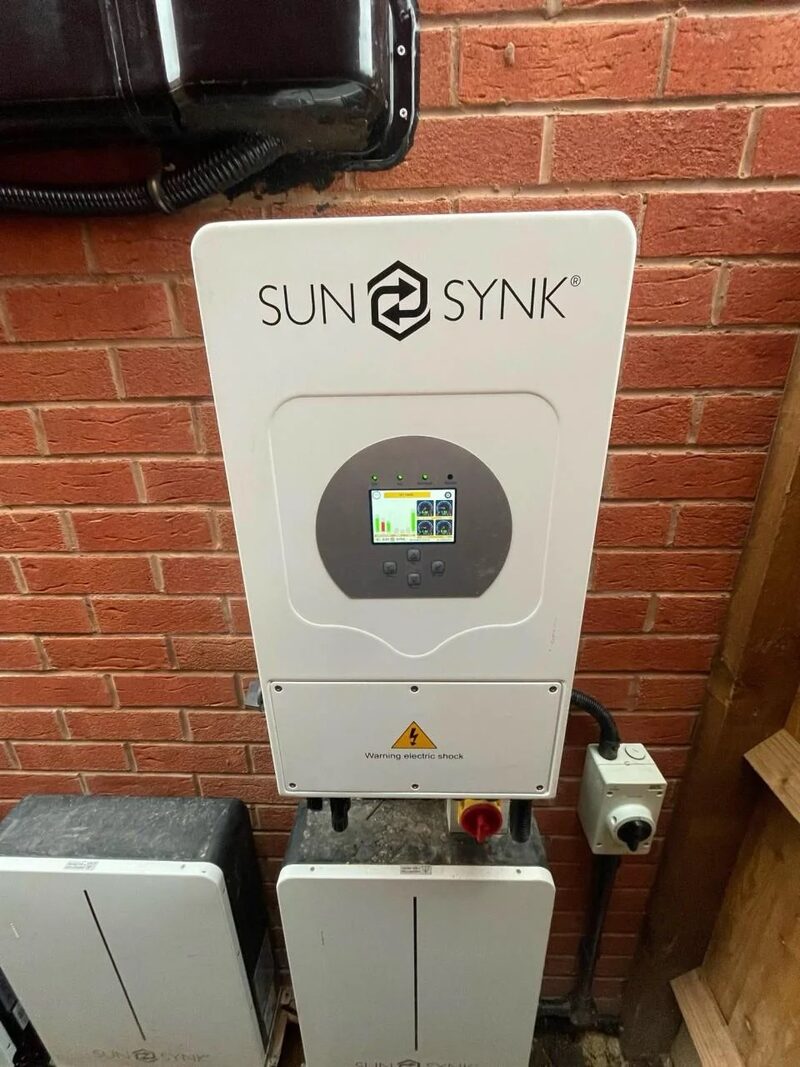
Sunsynk positions itself as a specialist in hybrid inverters and battery storage, with a product range that spans single-phase hybrid inverters, high-voltage battery systems, low-voltage battery systems, energy management accessories and emergency lighting kits6. Its inverter range is G98 or G99 compliant depending on the model, which matters for UK grid connection6. The company also states that its single-phase hybrid inverters ship with full remote monitoring via the Sunsynk Connect app and over-the-air firmware updates9.
Growatt's range is broader and more fragmented, covering off-grid inverters, hybrid inverters, battery-ready PV solutions, backup boxes and monitoring accessories. Its SPF 6000ES is an off-grid inverter available at growatt.tech4. Its battery-ready PV solutions are listed for the MIN and MOD-XH series, and its hybrid systems for the SPH, SPM, SPE and WIT-HU series10. A separate microgrid solution covers the SPM, SPE, WIT and SPH 10000HU series10.
The two makers also differ in how they present their engineering heritage. Sunsynk leads with its 20-plus years of experience and its installer network1. Growatt leads with volume: 1.7M+ cloud users, 180+ countries and 43+ offices2. Neither figure is independently audited in the material available here, and both are maker statements.
Company background: who stands behind each brand

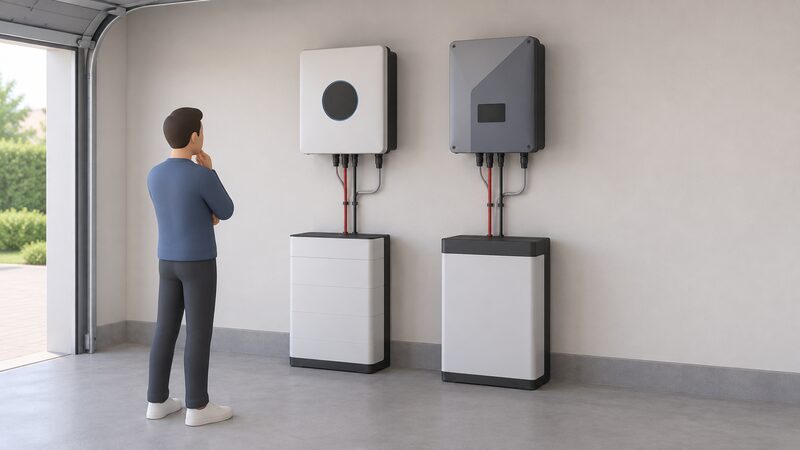
Sunsynk operates a UK office at Unit 8, Total Park, Bennetts Lane, Shell Green, Widnes WA8 0GW, with a UK technical support team reachable on +44 151 832 43003. The company also lists offices in Australia, South Africa, Poland, the USA, Hong Kong and the Canary Islands12. Its warranty registration process is split by territory, with separate requirements for UK-based and South Africa installations15.
Growatt's UK-facing operation runs through growatt.tech, which describes itself as a European distributor and service operation. Its SYN-100-XH-30 backup box is listed as a genuine accessory with European service warranty, with compatibility confirmed before purchase via info@growatt.tech16. That distributor model means UK households deal with a European distribution entity rather than a UK-registered manufacturer office for some products.
The distinction matters for energy independence in a practical way. A UK office with a direct support line gives a household a named point of contact for warranty claims, firmware requests and spare parts. A distributor model can work well, but the support chain runs through the distributor rather than the factory. Sunsynk's support pages direct owners to raise a ticket for firmware upgrades and to contact customerservices@sunsynk.com for warranty registration queries3.
Scale and reach: 40-plus countries versus 180-plus
Sunsynk states that it is trusted by installers and energy professionals in over 40 countries1. Growatt states 180+ countries with systems installed, 43+ representative offices worldwide and 1.7M+ end users connected to its cloud platform2. The two figures are not directly comparable: Sunsynk's count refers to installer and energy professional reach, while Growatt's refers to countries with systems installed and cloud-connected end users.
For a UK household, the relevant question is not global scale but local support density. A brand with 180+ countries of installed systems may have deeper spare parts logistics, but a brand with a UK office and a direct support line may resolve a warranty claim faster. Sunsynk's UK address and phone number are published on its support pages3. Growatt's UK-facing support runs through its European distribution operation, with compatibility queries directed to info@growatt.tech16.
Scale also affects firmware and app support. Sunsynk states that firmware updates are occasionally required and that owners should raise a support ticket to request an upgrade3. Growatt's ShinePhone app and ShineServer portal provide monitoring and remote management across its product range5. A larger installed base can mean more frequent app updates and a longer support tail, but it can also mean slower individual case handling.

Monitoring and control: Sunsynk Elite versus the ShinePhone ecosystem
Sunsynk's monitoring runs through the Sunsynk Connect app, with the Acure series paired to Sunsynk Connect Pro, described as a cloud-based energy management platform with mobile app18. Single-phase hybrid inverters ship with full remote monitoring via the Sunsynk Connect app and over-the-air firmware updates9. Sunsynk data loggers also support over-the-air firmware updates19.
Growatt's monitoring ecosystem is built around ShinePhone and ShineServer. ShinePhone is described as a system monitoring app for users, and as one app for all Growatt products5. ShineServer is the web version monitoring platform for users5. The Shine WiLAN-X2 is designed to work with Growatt inverters and energy storage systems that support ShinePhone and ShineServer monitoring, allowing production, consumption and battery state to be monitored remotely20. The ShinePhone app also supports remote management of devices integrated into the photovoltaic system17.
The practical difference is in the depth of control. Sunsynk's platform is presented as an energy management platform, which suggests time-of-use optimisation and battery scheduling alongside monitoring. Growatt's platform is presented primarily as monitoring and remote management. Both rely on a cloud connection and a smartphone app, which means both introduce a dependence on the manufacturer's servers and app support for full functionality.
Battery compatibility: Pylontech protocol versus Growatt protocol
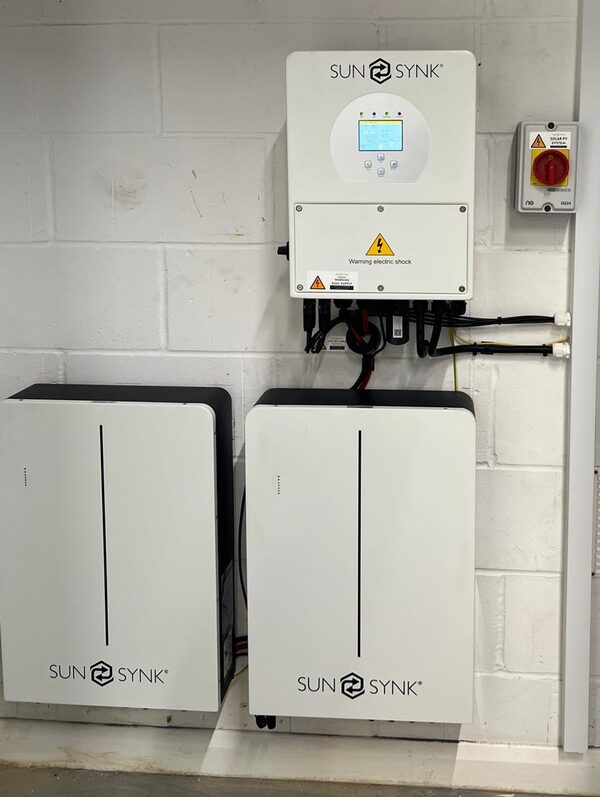
Battery compatibility is where the two brands diverge most sharply. Sunsynk states that all models in its single-phase inverter range include Wi-Fi monitoring and are compatible with Sunsynk LV batteries6. Its LP range is described as offering flexible battery compatibility7. The Sunsynk-W high-voltage range is presented under a global compatibility heading21.
Growatt's battery-ready PV solutions are listed for the MIN and MOD-XH series, and its hybrid systems for the SPH, SPM, SPE and WIT-HU series10. Its microgrid solution covers the SPM, SPE, WIT and SPH 10000HU series10. These are Growatt's own pairings, and the company does not publish cross-brand compatibility with Sunsynk batteries.
For a household, this means a mixed Sunsynk inverter and Growatt battery, or the reverse, is not supported by either manufacturer's documentation. Sunsynk's own battery line includes the L Series low-voltage LiFePO₄ unit in white22, and the X Series 5.12kWh battery, also low voltage and IP65 rated23. Sunsynk batteries are described as offering scalable capacity with IP65-rated protection for indoor and outdoor use1.
| Feature | Sunsynk | Growatt |
|---|---|---|
| Stated battery pairing | Sunsynk LV batteries6 | MIN, MOD-XH, SPH, SPM, SPE, WIT-HU series10 |
| Low-voltage battery example | L Series, LiFePO₄22 | Not specified in this material |
| High-voltage battery example | X Series 5.12kWh, IP6523 | Not specified in this material |
| Cross-brand mixing | Not documented | Not documented |
Product range and UK availability
Sunsynk's UK product range includes single-phase hybrid inverters, the Acure series, the GM series of energy-management accessories and gateway devices, the G Series batteries, the LP range, the W high-voltage range, the Verlinkt all-in-one home battery storage system, the LifeLynk cabinet, the 2&4 Light Kit and data loggers6. The Acure series is initially available in the UK and South Africa, with product availability varying by region18. The GM series is described as compact and DIN-rail mountable, suitable for residential installations and light-commercial and agricultural energy projects24.
Growatt's UK-facing range includes the SPF 6000ES off-grid inverter, available at growatt.tech4, the Shine WiLAN-X2 monitoring accessory20, the SYN-100-XH-30 backup box for the MID-XH series16, and residential storage systems with 24h self-consumption monitoring10. The SYN-100-XH-30 is listed as a genuine accessory with European service warranty, with compatibility confirmed before purchase via info@growatt.tech16.
One availability issue stands out. Sunsynk's data logger product page returns no products match, suggesting the listing is empty or the product is not currently offered through that page19. Separately, the Sunsynk L5.3 battery is listed as discontinued by at least one UK trade distributor28. Households with an existing L5.3 installation should check spare availability before assuming like-for-like replacement.
Secondhand cells and battery quality: a warning from Sunsynk
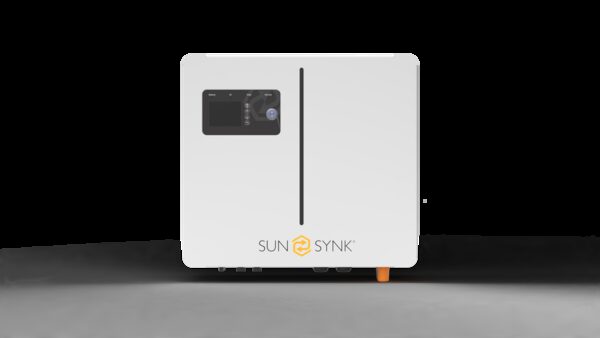
Sunsynk's battery range includes intelligent battery management on the G Series, available in 5.12kWh and 5.32kWh capacities8. The G Series is described as having a slim space-saving design suitable for homes and commercial setups8. Sunsynk batteries are described as offering scalable capacity with IP65-rated protection for indoor and outdoor use1. The LifeLynk Cabinet is described as shielding inverter and battery electronics from dust, moisture and direct sunlight, with pre-fitted earthing bars25.
Sunsynk also states that firmware updates are occasionally required for its batteries3. This matters because battery management firmware governs how cells are balanced, how state of charge is reported and how the battery responds to inverter commands. A firmware issue can affect whether a battery reaches full charge, as the 28 September 2024 release demonstrates: it fixed a Sunsynk issue where the battery would not consistently reach 100 percent SOC, raised the 15.5kWh Gen 1 charge current limit with Sunsynk from 95A to 195A, and corrected a Growatt communication error29.
The warning about secondhand cells is implicit in the product design. Sunsynk's 2&4 Light Kit requires a compatible Sunsynk low-voltage battery25, and the company's accessories range is described as selected to work seamlessly with Sunsynk inverters and batteries, removing the guesswork from component selection11. Mixing in secondhand or unmatched cells bypasses that selection process and the battery management assumptions behind it.
"Occasionally, firmware updates are required"
Which suits which home
The choice between Sunsynk and Growatt depends less on brand preference than on the battery ecosystem a household is committing to. Sunsynk's range is built around its own LV and HV batteries, with a UK office and direct support line3. Growatt's range is built around its own battery-ready and hybrid series, with a European distribution operation and the ShinePhone monitoring ecosystem10.
For a home wanting a single-brand system with UK-based support, Sunsynk's structure is more direct: a Widnes office, a UK phone number and a territory-specific warranty registration process3. For a home wanting a broader inverter range with off-grid options and a large installed base, Growatt's range includes the SPF 6000ES off-grid inverter and a wide set of hybrid and battery-ready series4.
Neither brand removes the household's dependence on the grid, a supplier or a cloud platform. Both monitoring systems rely on manufacturer servers and apps18. Both battery ecosystems are proprietary in the sense that cross-brand pairing is not documented6. A household choosing either brand is choosing a support chain and a battery protocol as much as an inverter.
Sources29 cited
- Sunsynk homepage, Sunsynk, 2026-09-17
- Growatt, Growatt, 2025-09-15
- Sunsynk support, Sunsynk, 2026-09-17
- Growatt SPF 6000ES, Growatt, 2026-09-17
- Growatt monitoring platform, Growatt, 2026-09-17
- Sunsynk inverters, Sunsynk, 2026-09-17
- Sunsynk LP range, Sunsynk, 2026-09-17
- Sunsynk G Series, Sunsynk, 2026-09-17
- Sunsynk single-phase hybrid inverters, Sunsynk, 2026-09-17
- Growatt residential storage system, Growatt, 2026-09-17
- Sunsynk accessories, Sunsynk, 2026-09-17
- Sunsynk.com, Sunsynk, 2026-09-17
- Sunsynk 8kW hybrid inverter, Sunsynk, 2026-09-17
- Sunsynk 10-12kW hybrid inverter, Sunsynk, 2026-09-17
- Sunsynk warranty registration, Sunsynk, 2026-09-17
- Growatt SYN-100-XH-30, Growatt, 2026-09-17
- ShinePhone app, Growatt, 2024-01-29
- Sunsynk Acure, Sunsynk, 2025-10-06
- Sunsynk data logger, Sunsynk, 2026-09-17
- Growatt Shine WiLAN-X2, Growatt, 2026-09-17
- Sunsynk-W HV, Sunsynk, 2026-09-17
- Sunsynk L Series, Sunsynk, 2026-09-17
- Sunsynk X Series 5.12kWh, Sunsynk, 2026-09-17
- Sunsynk GM series, Sunsynk, 2026-09-17
- Sunsynk 2&4 Light Kit, Sunsynk, 2026-09-17
- Sunsynk Verlinkt, Sunsynk, 2026-09-17
- Sunsynk Fusion inverter, Sunsynk, 2023-09-23
- Sunsynk L5.3 battery discontinued, TradeSparky, undated
- Firmware updates, Fogstar, 2024-09-28
 Hybrid InvertersA hybrid inverter lets you store solar power in a battery and use it later, all through one unit instead of two separate boxes.
 Monitoring a Solar PV SystemHow do you keep an eye on what your solar panels are actually generating?
 AC-Coupled vs DC-CoupledCan you add a battery to your existing solar panels without swapping the inverter, and does one kind waste more of your solar power than the other?
 Inverters and Inverter-ChargersIf the power goes off, what actually keeps your fridge and boiler running?
 Grid-Scale Battery StorageConnected and pipeline battery capacity in Great Britain, what these assets are paid to do, how long they can run, and how grid batteries differ in purpose and scale from a home battery.
 How They Perform in UK HomesHow well do heat pumps really work in UK homes, and why do some run far better than others?