
In this guide
Great Britain's grid-scale battery fleet is the fastest-growing part of its flexible capacity. UK grid-scale battery storage power capacity reached 7.5 GW by the end of 2025, with a record 2.3 GW energised in 2025 alone1. Published figures differ depending on when they were compiled and what they count: the same official roadmap gives 7.3 GW for June 20261, while the Statutory Security of Supply Report of December 2025 described "just over 6GW that is currently on the grid"2, and an industry estimate in April 2026 put the UK's total installed battery capacity at around six gigawatts3. These documents disagree, and no single number can be treated as definitive.
What these assets do is not the same as what a home battery does. A grid battery exists to move energy across hours and to hold the system's frequency steady, selling those capabilities into balancing markets. Batteries, both domestic and grid-scale, store electricity for up to eight hours2, which places them firmly in the short-duration category: fast, but limited in total energy compared with pumped storage, where the electricity a battery can deliver is much more limited4. Against that, in 2025 the battery sector output more than pumped storage for the first time5, and the UK's existing pumped hydropower storage stands at 2.8 GW, the majority contributed by Ffestiniog and Dinorwig6.
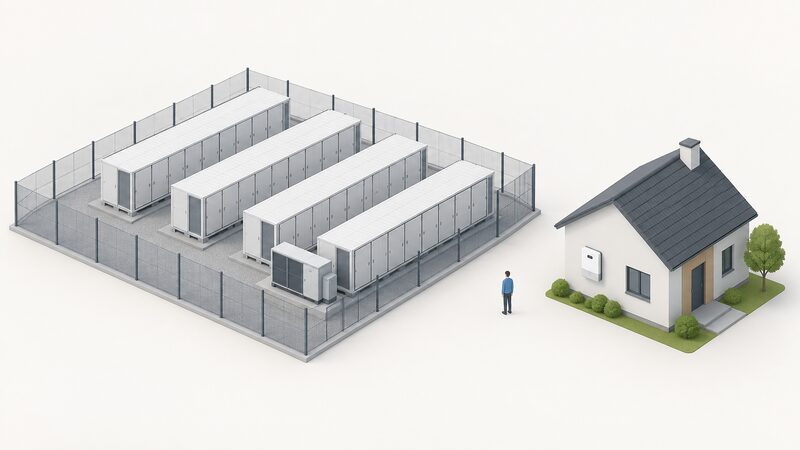
For a household, the honest position is that grid-scale batteries do nothing directly for independence. They are owned by developers, connected to the transmission and distribution networks, and paid by the system operator. They make the grid a home depends on more reliable and more able to absorb renewable output. Independence at the property boundary comes from a different machine entirely: a domestic system of roughly 10 kWh7, which lifts solar self-consumption from 30 to 40 per cent up to 70 to 80 per cent8.
What a grid-scale battery does for the system
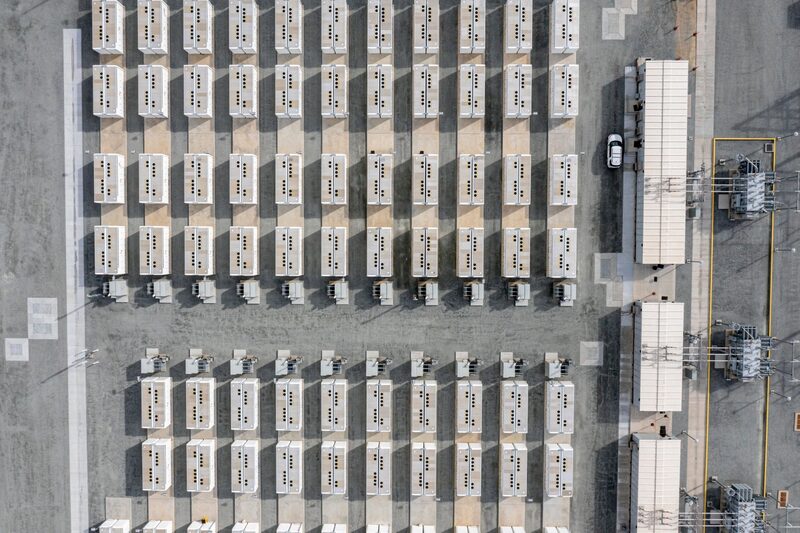
A grid-scale battery does three things the rest of the fleet does badly. It responds in fractions of a second to a frequency deviation, it soaks up generation the system cannot otherwise use, and it discharges into the evening peak. None of that requires fuel, and none of it requires notice.
The need for these services grows as the generation mix changes. The grid has to become smarter and more flexible11 as inflexible thermal plant retires and weather-driven output rises. Storage is one of several tools: GB interconnection capacity stands at 10.3 GW1, pumped hydro adds 2.8 GW6, and hot water storage represents around 27 GW of existing installed capacity in the UK12. Batteries are distinctive because their response is near-instant and because they can be sited close to where the constraint is.
Vehicle batteries sit alongside them. Vehicle to grid technology is defined as the use of vehicle batteries as storage to help balance supply and demand on the electricity network, applying at scales from individual batteries up to aggregation of multiple batteries across one or multiple carparks13. Official analysis has estimated that if 50 per cent of the UK's EVs were V2G enabled, they could provide around 16 GW of daily flexible capacity to the grid14. Even heat batteries are described as able to help balance the electricity grid15. The common thread is that the system is learning to treat stored energy, wherever it sits, as a resource.
The economic footprint is now material. Utility-scale battery storage supported £354 million of GVA and 3,360 jobs in 2024, with battery storage installations accounting for a further £115 million of GVA and 1,720 jobs16. Across solar and storage together, the sectors contribute around £1.9 billion in Gross Value Added to the UK economy each year16.
Capacity in Great Britain: from 6 GW to 7.5 GW depending on the count
| Measure | Figure | Date | Source type |
|---|---|---|---|
| UK grid-scale battery power capacity | 7.5 GW | end of 2025 | official1 |
| UK grid-scale battery power capacity | 7.3 GW | June 2026 | official1 |
| On the grid, security of supply report | just over 6 GW | Dec 2025 | official2 |
| Total installed battery capacity, industry estimate | around six gigawatts | Apr 2026 | independent3 |
| New capacity energised | 2.3 GW | during 2025 | official1 |
| Total storage serving the GB system | 35 GWh | 2026 | independent9 |
The spread between roughly 6 GW and 7.5 GW reflects different counting conventions and different publication dates rather than a sudden change on the ground. The direction is not in doubt: 2.3 GW energised in a single year is the largest annual addition recorded1.
Energy, rather than power, tells the other half of the story. Total storage serving the GB system is put at 35 GWh9, against modelled totals of 28 GWh in 2021 rising to 42 GWh by 2030 and 63 GWh by 2050, with total storage power capacity modelled at 27 GW in 2050 within a total installed generation capacity of 276 GW, up from 107 GW in 202117. A modelled pathway is not a forecast of what will be built, and the 2050 figures carry the uncertainty of any long-horizon scenario.
Independent projections run higher still. Utility-scale battery storage is projected at 33 GW by 2035, with commercial battery storage a further 8 GW, and battery storage overall at 50 GW by 203516. By 2040 small battery storage, domestic and commercial combined, was forecast at 1.5 GW, around a third of total battery storage deployment capacity18. Separately, an industry body has described a storage capacity gap of up to 6 GW in the lead up to 203015.
Storage duration: minutes at the fast end, eight hours at the long end
Duration is what separates a battery from a power station. Batteries on the GB system, domestic and grid-scale, store electricity for up to eight hours2, and most units built so far are considerably shorter. Modelling of domestic flexibility has assumed a battery of 5 kW capacity with a two-hour duration, lithium-ion19, which is representative of the short end.
Duration determines which jobs a battery can take. A unit holding 15 minutes of energy at full power can provide fast frequency response but cannot cover an evening peak. A four to eight hour asset can shift midday solar into the evening. Neither substitutes for seasonal storage: the electricity batteries can deliver is much more limited than pumped storage4, and the longest-duration technologies have been given their own support route, a cap and floor revenue support scheme for long duration energy storage technologies such as pumped storage hydro, compressed air energy storage, liquid air energy storage and flow batteries, announced in March 202520. That scheme is covered in more detail on long-duration electricity storage and the pumped hydro fleet on hydropower and pumped storage.
Scale at the top end is now substantial. Some pipeline systems are able to handle a gigawatt of power or more, around the capacity of two nuclear power stations3. That is power, not energy: such a unit would still empty within its rated duration.
Household-scale durations are shorter again but serve a different purpose. A typical home system might be 10 kWh7, which at a normal household draw covers an evening rather than a day, and domestic batteries are used during peak hours, typically 4pm to 8pm21.
Dynamic Containment and how batteries earn
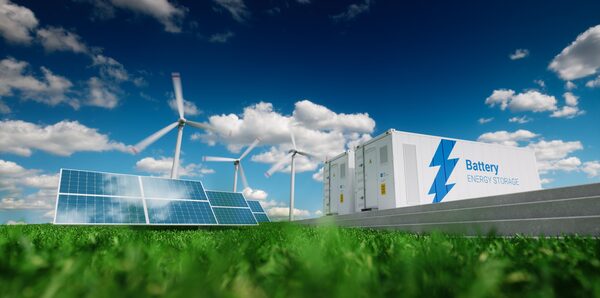
Dynamic Containment is a fast frequency response service, and it is the clearest illustration of how a battery earns without moving much energy. Trial data recorded an availability price of £17/MW/h, a utilisation percentage of 0.55 per cent, a requirement to hold capacity headroom of 10 per cent of declared power, and a minimum delivery volume equivalent to 15 minutes at full power22. The revenue therefore comes overwhelmingly from standing ready, not from delivering energy: utilisation below one per cent means the battery is almost never called.
Those numbers date from May 2025 trial reporting and should not be read as current market prices. Documents disagree on one point of the service specification: one record gives the minimum delivery volume as the equivalent of 15 minutes at full power, another describes a requirement for 20 Hz settlement metering, and the conflict is not resolved22.
The same trial showed what the service is worth to small assets. Vehicle-to-grid revenue including Dynamic Containment was reported to rise to £725 a year, an increase of £64/kW22. Ofgem's case study work on V2G charging sits behind the broader picture of vehicle batteries as a grid resource14.
Availability revenue of this kind is why grid batteries are often not fully charged. Holding 10 per cent headroom means deliberately leaving room in both directions, which is a cost borne against the arbitrage a fully free battery could earn. Frequency response and balancing are set out in more depth on balancing services and frequency response.
Projected to 2035, battery storage is estimated to support £1.6 billion of GVA and 13,900 jobs, within utility-scale solar and battery storage developments contributing £2.8 billion of GVA and 28,540 jobs16. Jobs in the solar and storage supply chain contribute an average GVA of nearly £90,000 per year, over 40 per cent higher than the UK national average [22 is solar-economic; see note].
Why around 35% of battery bids are skipped
A battery skip rate of 35 per cent was recorded for May 20261. A skip occurs when a battery offers into a balancing action and the offer is passed over in favour of another unit, often a larger thermal plant that is simpler to dispatch or better placed on the network. The effect is that a third of the fleet's offered flexibility, in that month, went unused despite being available and priced.
Several things sit behind it. Batteries are numerous, individually small and spread across distribution networks, which makes them harder to schedule than a handful of large plant. Contractual headroom held for frequency services, 10 per cent of declared power in the Dynamic Containment specification22, limits how much a unit can offer elsewhere. And location matters: a battery on the wrong side of a constraint cannot resolve it.
The skip rate is not a statement about battery quality. It is a measure of how well the dispatch process uses what is connected, and it is one of the reasons capacity figures alone overstate what storage currently delivers. The connection side of the problem is dealt with on the grid connection queue.
Costs, meanwhile, have moved in favour of deployment. The turnkey cost of battery energy storage systems fell by around 40 per cent between 2017 and early 2025, according to BloombergNEF5. Falling capital cost with imperfect dispatch is the current shape of the sector: more capacity arriving than the system is yet fully using.
Grid-scale versus home batteries: what each does for independence
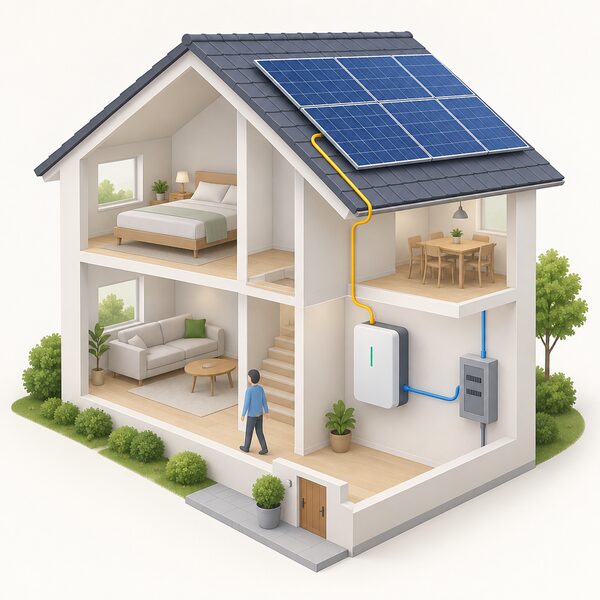
| Grid-scale battery | Home battery | |
|---|---|---|
| Typical size | Megawatts; pipeline systems of a gigawatt or more3 | Around 10 kWh7 |
| Primary purpose | Balancing, frequency response, arbitrage22 | Raising solar self-consumption8 |
| Who benefits | The system, via more reliable supply | The household, via lower import23 |
| Revenue | Balancing market contracts22 | Bill savings, reported £150 to £450 a year8 |
| Life | Not stated in these figures | 10 to 15 years8; 8 to 12 years21; 10 to 12 years10 |
| Cost | Fell around 40% 2017 to early 20255 | £1,500 to £10,000; 5 kWh around £4,6007 |
Home storage is the only one of the two that changes a household's own dependence. Home storage batteries store electricity to use later, making the energy system more independent from the National Grid23, and combining solar panels with a home battery lets a household store free, renewable electricity, reducing reliance on grid electricity for a heat pump. Less electricity is drawn from the grid, reducing the amount paid in bills [17 context]. Adding a battery to a solar installation increases self-consumption from 30 to 40 per cent to 70 to 80 per cent8.
The limits are real. Batteries can be charged with cheap electricity from a supplier, typically on certain tariffs at night or in the middle of the day24, which is a dependence on a tariff and a supplier rather than an escape from them. Installing battery storage lowers the amount exported, meaning less money from export payments, though overall savings are reported as greater than relying on export payments alone24. One independent view is blunter: in a grid-connected house this may not be worthwhile at present, given that batteries are still quite expensive and carry environmental impacts in manufacture and disposal [18 note]. Domestic payback periods are reported in the region of 8 to 12 years, similar to the reported lifespan21.
Household systems can also act like miniature grid assets. Residential battery energy storage systems can be set up to respond automatically to signals from the grid, maximising the economic benefits of contributing3, and domestic-scale batteries have been described as tools for balancing the local distribution network, responding to extremes of load, local renewable generation levels, or aiding control of AC frequency25. That is the bridge between the two worlds, and it is explored on household demand flexibility.
Connecting storage to the networks
Grid batteries connect either to the transmission system or, more often for smaller units, to a distribution network. That is why distribution network operators have become central to storage growth, and why they are moving towards distribution system operator roles, covered on electricity distribution networks.
Connection capacity is the binding constraint for much of the pipeline. The Feed-in Tariffs scheme applied up to a total installed capacity of 5 MW in Great Britain27, a reminder that small-scale and grid-scale connections have long been treated under separate regimes. Small battery storage, domestic and commercial, was forecast at 1.5 GW by 2040, around a third of total battery storage deployment capacity18, so the distribution networks carry a growing share of the fleet.
On data about local sites, official statistics on domestic retrofit battery installations group results by capacity, with bands chosen to cover distinct groupings in the data: batteries approximately smaller than 6 kWh, approximately larger than 11 kWh, and a grouping in between [19 stats]. The Energy Storage Association (UK) is working with industry, industry partners, manufacturers and the Department for Energy Security and Net Zero [24 esa].
Barriers to household adoption are documented. Low awareness is a significant obstacle to adopting home battery storage [22 ofgem], and 46 per cent of tenants believed their landlord would refuse home battery storage [23 catapult]. Both point to the same conclusion: grid-scale growth is a planning and connections question, while household storage growth is largely a cost, awareness and tenure question.
Where Britain sits against the wider picture
Against the projected 33 GW of utility-scale battery storage by 203516, today's 7.5 GW at end-20251 represents roughly the opening fifth of the build. The pace of 2.3 GW in 20251 suggests the trajectory is not implausible, but the skip rate of 35 per cent1 shows that connected capacity and useful capacity are not the same thing.
Storage sits inside a wider flexibility picture. Interconnection stands at 10.3 GW1, pumped hydro at 2.8 GW6, and hot water storage at around 27 GW of installed capacity12. Modelled GB totals reach 27 GW and 63 GWh of storage by 2050 within 276 GW of installed capacity17. Vehicle batteries could add around 16 GW of daily flexible capacity if half the UK fleet were V2G enabled14.
Manufacturing is a separate question from deployment. The UK Government does not expect to compete in large-scale manufacturing of conventional silicon PV but has identified potential roles in associated electrical equipment8. The cells in a British grid battery are imported, and that supply chain dependence does not disappear because the asset stands on UK soil. For a household weighing its own position, the same applies at a smaller scale, and the wider question is set out on energy security and household independence and across /national-supply/.
Sources27 cited
- Clean Flexibility Roadmap, July 2026 update, GOV.UK, 2026
- Statutory Security of Supply Report 2025, GOV.UK, 17 December 2025
- Homes with batteries to cash in from free power offer, Solar Energy UK, 14 April 2026
- How does storage help us balance the grid, NESO, 2026
- July smashes solar generation record, Solar Energy UK, 2025
- Energy generation in Wales 2021, Welsh Government, October 2022
- Battery storage advice, Energy Saving Trust, 19 August 2026
- Solar power and storage, POSTnote, UK Parliament POST, 25 June 2026
- Vehicle to Grid Britain, Cenex, 2026
- Battery storage, England, Energy Saving Trust, 19 August 2026
- Trading sunlight, Solar Energy UK, 2026
- Written evidence on heat and storage, UK Parliament, 2026
- Electric vehicle infrastructure national standards, Welsh Government, June 2023
- Case study: UK electric vehicle to grid charging, Ofgem, 2026
- Accelerating heat electrification by providing customer choice, BEAMA, 22 September 2025
- Economic impact of solar and battery storage, Solar Energy UK, April 2025
- Future Energy Scenarios data tables, NESO, 2022
- The future for small-scale low-carbon generation, GOV.UK, 2019
- Domestic heat pump flexibility modelling, Nesta, 19 November 2024
- Long duration energy storage cap and floor, House of Commons Library, March 2025
- Battery storage advice, Centre for Sustainable Energy, October 2025
- Project Sciurus trial insights report, Cenex, May 2021
- Solar panel battery storage, Which?, 14 May 2026
- Battery storage, Home Energy Scotland, 20 September 2026
- Domestic batteries best practice guide, National Energy Action, 16 March 2019
- Plug-in solar consumer guide, Electrical Safety First, August 2026
- Feed-in Tariffs guidance for licensed electricity suppliers, Ofgem, 3 April 2023
 Batteries and IndependenceHow far home battery storage moves a UK household away from the grid and supplier pricing, covering self-sufficiency, winter limits, cost, lifespan, backup, export payments and flexibility earnings.
 Planning Permission in EnglandWhen a domestic battery or its enclosure falls within permitted development in England, when an application is needed, and how the position differs for outbuildings, listed buildings and conservation areas.
 The Full Home Batteries GuideA home battery stores cheap or solar power for later, but will it really cut your bills enough to be worth it?
 Hydropower and Pumped StorageExplains the UK's conventional hydro fleet, concentrated in Scotland and Wales, and the pumped storage schemes that store energy at scale.
 Off-Grid Battery SystemsHow many days of power do you need when there is no sun?
 UK Gas StorageHow much working gas storage Great Britain holds, what the eight remaining sites do, how storage is filled and drawn down across a winter, and how Britain's position compares with continental Europe.