
In this guide
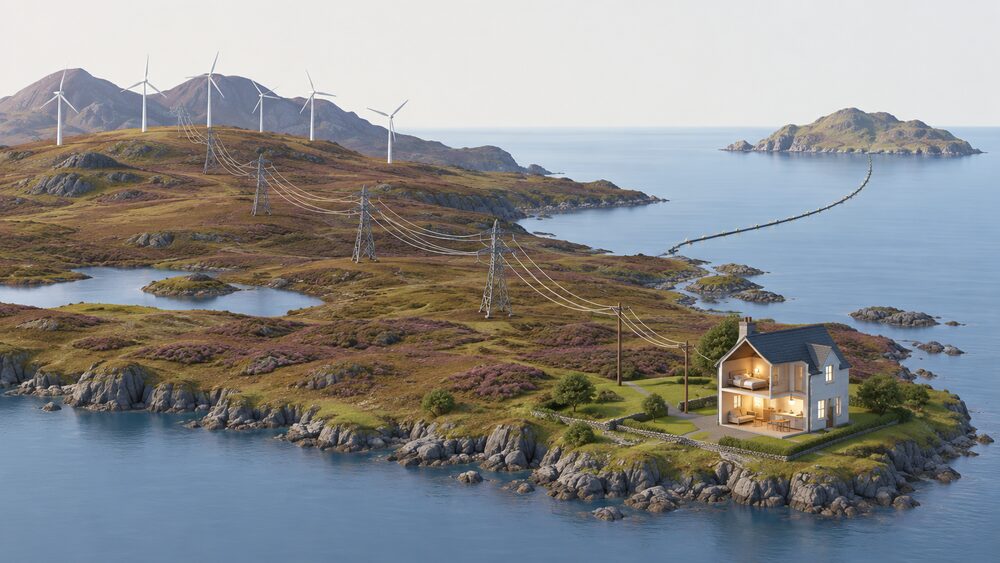
Scotland's electricity supply has been almost completely decarbonised, with emissions in 2024 96% lower than in 19901. That single figure explains most of what follows: the country generates far more low-carbon electricity than it consumes, exports the surplus south, and runs a transmission network built for a different era of centralised fossil generation. In 2024, 91.5% of Scottish electricity generation, or 47.4 TWh, came from low carbon sources2.
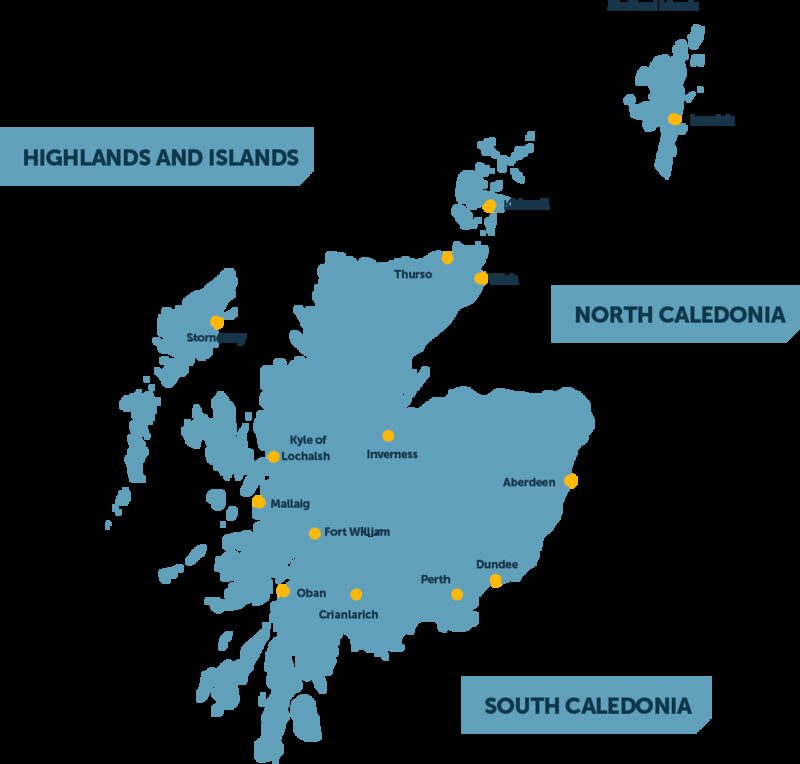
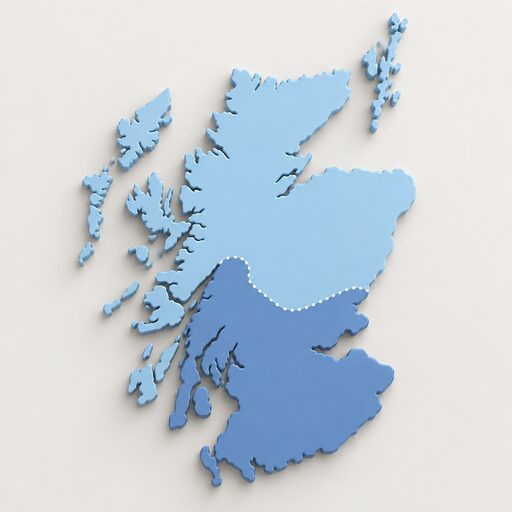
For a Scottish household, the practical consequences are threefold. First, the carbon intensity of the power in the wires is low, so electrifying heat and transport delivers real emissions savings. Second, the network that delivers that power is split between two licence areas, with SSEN responsible for the north of Scotland and central and southern England3. Third, the parts of Scotland furthest from the demand centres, the islands and the north west, face the highest connection costs and the greatest dependence on a small number of subsea links.
Scotland's electricity supply: what the network covers and how far it reaches
Scotland's electricity system is not one network but two licence areas. Scottish and Southern Electricity Networks (SSEN) is responsible for powering homes in the north of Scotland and central and southern England3. The central belt and southern Scotland fall under SP Energy Networks. This split matters because the two areas have different network characteristics, different constraint patterns and different connection queues.
The generation mix is dominated by wind, with hydro and pumped storage providing the firm, flexible element. The average capacity of installations in Scotland is higher than elsewhere in Great Britain, due primarily to the significance of onshore wind in the country compared to other regions7. That single fact drives much of the network's behaviour: large wind farms in the north and west, demand concentrated in the central belt and further south, and a transmission system that must move power across that distance.
Beyond electricity, Scotland's heat supply is beginning to shift. Heat networks supplied approximately 1.18 terawatt-hours of heat to around 30,000 homes and 3,000 non-domestic properties in 20228. By 2025 that had grown to an estimated 1.57 TWh9.
For households, the network's reach is the practical question. Non-motorway charge points in Scotland are operated by ChargePlace Scotland, a public charging network10. That is a reminder that in much of rural Scotland, the infrastructure a household depends on is publicly or collectively provided rather than commercially duplicated.
Emissions: 96% lower than 1990, and what that means for the supply mix
The headline decarbonisation figure is striking, and it is worth understanding what sits behind it. Scotland's electricity supply has been almost completely decarbonised, with emissions in 2024 96% lower than in 19901. The previous year's figure was 95% lower than 199011, so the trend is consistent rather than a single-year anomaly.
Across the whole economy, emissions in Scotland have fallen by 50% since 1990, which is faster than those in Wales or Northern Ireland12. The Climate Change Committee's 2026 assessment put it plainly: emissions are now less than half the levels seen in 19901. Since the introduction of the Act in 2009, over 70% of the emissions reduction seen in Scotland has been in the energy supply sectors13.
The electricity supply sector across the UK has fallen by 81% since 1990, with most of this reduction coming since 200814. Emissions in the sector are now 82% lower than 2008 levels1. Fuel supply emissions have fallen by 60% since 1990, primarily driven by a reduction in coal mining and the associated methane emissions14.
What does this mean for a household's supply mix? The carbon intensity of Scottish electricity is low enough that the emissions case for switching heating and transport to electricity is settled. The Climate Change Committee's projection is that renewables provide 98% of electricity generation in Scotland in 20354. That is a projection, not a commitment, and it depends on build rates that have historically slipped. But it indicates the direction: a system increasingly built on variable renewables, with the firming role played by hydro, pumped storage and interconnection rather than gas.
"Scotland's electricity supply has been almost completely decarbonised, with emissions in 2024 96% lower than in 1990."
Who runs the network in the north of Scotland: SSEN's role
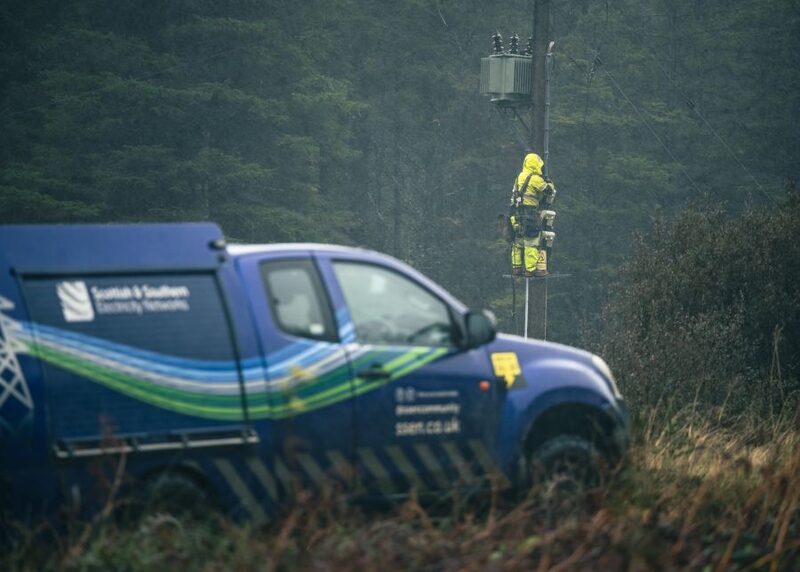
Scottish and Southern Electricity Networks is the distribution network operator for the north of Scotland, and also operates in central and southern England3. For households north of the central belt, SSEN is the company that restores supply after a storm, maintains the poles and wires, and runs the Priority Services Register for its area.
The distinction between transmission and distribution matters here. The transmission network, the high-voltage backbone, is owned and operated separately from the distribution networks that connect individual properties. SSEN's role is at the distribution level: the lower-voltage network that runs down streets and across moorland to individual homes. When a fault occurs, it is SSEN that responds.
SSEN's responsibilities extend beyond restoration. The company operates the Electricity Supply Emergency Code arrangements for its area, which govern how supply is rationed in a genuine national emergency5. It also runs the Power Track app and the powercut105.com service, and it publishes information on preparing for a power cut15.
For a household in the north of Scotland, the practical implication is that SSEN is the first point of contact for anything to do with the physical supply: a power cut, damage to equipment, or a planned interruption. The supplier, the company that bills for electricity, is a separate entity. This split is a common source of confusion, and it is worth being clear about which company does what.
Priority Services Register: free extra help during a power cut
The Priority Services Register is a free service provided by utility suppliers and network operators16. It exists because some households are more vulnerable to a loss of supply than others, and because a power cut that is an inconvenience for most people can be a genuine risk for some.
SSEN's own register offers tailored support, live updates and more during unplanned outages15. The company's Priority Services team can be contacted on 0800 294 32593. For reporting a power cut or damage to equipment, the national number is 105, with phone lines open 24 hours a day, 365 days a year5.
The register is not a compensation scheme. It is a support service, and what it provides is practical help rather than money. The benefits include priority support with heating and cooking facilities if supply is cut off, advanced notice of power cuts, and an identification and password scheme for home visits17. SSEN's Priority Services adds accessible communication, early warning of planned power cuts, extra support during interruptions and a password scheme3.
For households in the north of Scotland, the register is the main formal mechanism through which the network operator acknowledges and plans for vulnerability. It is worth understanding what it does and does not cover before relying on it.
Who qualifies for Priority Services and what the register includes

Eligibility is broader than many households assume. The register is intended for people who are elderly, have a disability or long-term health condition, have young children, or need extra help during power cuts19. That last category is deliberately open, and it captures households that depend on powered medical equipment, for example, without requiring a specific diagnosis.
The legal basis is set out in the supply and distribution licences. Energy companies must establish and maintain a Priority Services Register of domestic customers who may need priority support18. Under their licences, suppliers and electricity distributors must maintain a register and put consumers from certain eligible groups on it when they request it20. The relevant conditions are Supply licence condition 26 for suppliers and Electricity distribution licence standard condition 10 for distribution network operators20.
The services required by licence include specified sets of services for disabled, chronically sick and pensionable age customers and for blind, partially sighted, deaf and hearing impaired customers20. In practice this means accessible communication formats, advance warning of planned interruptions, and additional support during an outage.
| What the register provides | Detail |
|---|---|
| Priority support | Heating and cooking facilities if supply is cut off17 |
| Advance notice | Early warning of planned power cuts17 |
| Password scheme | Identification for home visits17 |
| Accessible communication | Formats for customers who need them3 |
| Extra support | During interruptions3 |
To sign up, households need to contact all their utility suppliers directly21. There is no single central register that covers every utility, which is a practical wrinkle worth knowing: a household that signs up with its electricity supplier has not automatically signed up with its water supplier or its gas supplier.
Scottish Hydro Electric Community Trust: grants for new connections
The Scottish Hydro Electric Community Trust is the main source of grant support for new electricity connections in the north of Scotland. Its grants are aimed at homes and community projects in its operating area that need help with the cost of a connection.
The Trust pays up to 75% for community projects and up to 50% for individuals. These are the headline figures, and they reflect the Trust's assessment of the different capacities of community organisations and individual households to fund a connection. The percentages apply to the eligible costs of the connection, and the Trust assesses applications against its own criteria.
Where the Trust operates is defined by its historical connection to the north of Scotland, the area served by the former North of Scotland Hydro-Electric Board. Applications are assessed at the Trust's regular meetings, and the timing of an application therefore matters: a household that submits just after a meeting may wait some weeks for a decision.
It is important to be clear about what the Trust is not. It is not a general energy efficiency grant scheme, and it is not the same as the Home Energy Scotland Grant and Loan scheme. The Trust exists specifically to help with the cost of connecting a property to the electricity network, which in remote areas can be a substantial sum.
How much the Trust pays: up to 75% for community projects, up to 50% for individuals
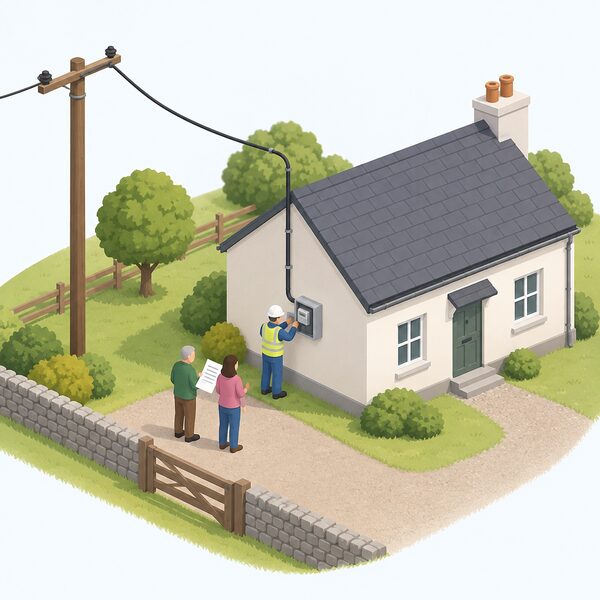
The Trust's contribution is capped by percentage rather than by a fixed cash sum. Community projects can receive up to 75% of the cost, and individuals up to 50%. The difference reflects the Trust's view that community projects deliver wider benefit and often have less access to other funding.
For households, the 50% figure is the relevant one. A connection costing several thousand pounds would therefore require the household to fund the remainder, and the Trust's grant does not cover the cost of work inside the property or the cost of appliances.
Separately, the Home Energy Scotland Grant and Loan scheme offers support that can be combined with other measures. Grant funding for energy efficiency improvements covers up to 75% of the combined cost of the improvements and up to the maximum grant amount of £7,50022. For renewable heating systems, the scheme has offered up to 75% cashback, up to £7,50023. People living in rural areas can apply for extra grant funding and could get up to £1,500 extra for energy-efficiency improvements and up to £1,500 extra for clean heating systems6.
For households in island and remote rural areas connecting to local district heat networks, grants of up to £9,000 together with loans are available24. Applications for that heat network connection grant support opened in December 20259.
| Support | Amount | Who it is for |
|---|---|---|
| Scottish Hydro Electric Community Trust | Up to 75% for community projects, up to 50% for individuals | Connections in the Trust's area |
| Home Energy Scotland rural top-up | Up to £1,500 extra for energy efficiency, up to £1,500 extra for clean heating | Rural areas6 |
| Home Energy Scotland energy efficiency grant | Up to 75% of combined cost, up to £7,500 | Homeowners in Scotland22 |
| Heat network connection support | Grants up to £9,000 with loans | Island and remote rural households24 |
Where the Trust operates and how applications are assessed
The Trust's operating area covers the north of Scotland, and applications are assessed against criteria that include the nature of the connection, the costs involved and the applicant's circumstances. The assessment is not automatic, and a household should expect to provide details of the connection quote and the property.
The wider support landscape in Scotland is administered by the Energy Saving Trust. The Home Energy Scotland Grant and Loan Scheme is run by the Energy Saving Trust on behalf of the Scottish Government25. The Energy Saving Trust, in partnership with advice providers and energy companies, manages these schemes on the Scottish Government's behalf6. Home Energy Scotland is administered by the Energy Saving Trust on behalf of the Scottish Government6. Business Energy Scotland is also administered by the Energy Saving Trust26.
There is a quality assurance dimension. Applicants to the Home Energy Scotland loans and cashback scheme must use approved suppliers through Scotland's TrustMark scheme for energy efficiency work26. The requirements relate to Scottish Government programmes only, including the Home Energy Scotland loans and cashback, and not to energy efficiency work that is entirely self-funded27.
For a household applying to the Trust, the practical steps are to obtain a connection quote, confirm the property is in the Trust's area, and prepare the application for the next meeting. The Trust's assessment is separate from the Home Energy Scotland process, and a household may be eligible for support from more than one source.
Island and remote connections: why costs are higher and where help fits in
Connection costs in the islands and remote mainland are higher for reasons that are structural rather than administrative. A property at the end of a long single-track road requires more cable, more poles and more labour per connection than a property on a housing estate. The cost is driven by distance and terrain, and no grant scheme changes that underlying arithmetic.
The Feed-in Tariffs scheme data illustrates the pattern. The average capacity of installations in Scotland is higher due primarily to the significance of onshore wind in the country compared to other regions7. That reflects the resource, but it also reflects the scale of installations that make economic sense in remote areas, where a connection is expensive and a larger installation spreads the fixed cost.
There has been targeted support for renewable heat networks. A 90% relief from non-domestic rates until 31 March 2024 was introduced for new networks run from renewable sources28. That relief has expired, and its successor arrangements are a matter for current policy.
For households, the practical position is that connection costs in the islands and remote areas are installer-quoted and vary widely with distance and terrain. The Trust's grant and the Home Energy Scotland rural top-up are the main sources of support, and neither covers the full cost. The dependence that remains is on the network operator to provide a connection at a price the household can fund, and on the grant bodies to assess the application favourably.

Planning ahead: spatial plans and the grid changes households should know about
The Scottish Government published its Climate Change Plan on 6 November, setting out the policies and proposals it will take forward to enable its carbon budgets to be met. The plan covers the period 2026 to 2040. The Climate Change Committee's response noted that Scotland's plan means immediate climate targets are now within reach.
For households, the plan's relevance is indirect but real. It sets the direction for heat decarbonisation, which determines whether a household that installs a heat pump or connects to a heat network is moving with policy or against it. The Heat Networks Delivery Plan commits Scotland to the wider deployment of heat networks via the inclusion of statutory targets. Scotland's Heat Network Fund provides capital grant funding to public and private sector organisations. Grant support for homeowners to enable connections to heat networks is being introduced through the Home Energy Scotland Grant and Loan scheme24.
The Scottish Government has also committed to a net zero greenhouse gas emissions target by 2045. That is a legal commitment, and it implies continued electrification of heat and transport, continued growth in renewable generation, and continued pressure on the transmission network to move power from where it is generated to where it is used.
For a household, the changes to watch are the ones that affect the connection at the property: the availability of grant support for heat network connections, the timing of any connection offer, and the reliability of the supply. The wider grid changes, the new transmission lines and the spatial plans, determine the context but not the day-to-day experience.
Sources28 cited
- Progress in Reducing Emissions 2026 Report to Parliament, Climate Change Committee, 2026
- Energy Statistics for Scotland Q3 2025: Electricity Generation and Supply, Scottish Government, 2025
- SSEN Priority Services: Sight, SSEN, 2026
- Electric technologies will help Scotland decarbonise, Climate Change Committee, 2025
- Electricity Supply Emergency Code (ESEC), SSEN, 2026
- Enhanced Support to Make Homes Warmer and Greener, Scottish Government, 2026
- Scotland's Climate Change Plan 2026-2040, Scottish Government, 2025
- Heat Networks Delivery Plan Review Report 2026, Scottish Government, 2026
- Draft Heat Buildings Strategy: Achieving Net Zero Emissions in Scotland's Buildings, Scottish Government, 2021
- Progress in Reducing Emissions 2025 Report to Parliament, Climate Change Committee, 2025
- Progress in Reducing Emissions 2024 Report to Parliament, Climate Change Committee, 2024
- Scotland's Carbon Budgets, Climate Change Committee, 2025
- Heat Buildings Strategy: Achieving Net Zero Emissions in Scotland's Buildings, Scottish Government, 2021
- The Seventh Carbon Budget, Climate Change Committee, 2025
- Preparing for a Power Cut, SSEN, 2026
- What to Do in a Power Cut, Met Office, 2026
- Support Schemes, Cheshire West and Chester Council, 2026
- Final CVS 15042025, Ofgem, 2025
- Worried About Your Energy Bills, Energy Ombudsman, 2026
- Priority Services Register Review Consultation, Ofgem, 2014
- Home Energy Scotland Grant and Loan Scheme: Application and Claim Processing Times, Scottish Government, 2026
- Heat Buildings Strategy: Scottish Government Quality Assurance Policy Statement, Scottish Government, 2022
- Domestic Quality Assurance: Heat Buildings Programme, Scottish Government, 2022
- Heat Networks Delivery Plan, Scottish Government, 2022
- Energy Saving Home Improvements, Scottish Government, 2026
- Feed-in Tariffs Annual Report Scheme Year 13, Ofgem, 2023
- Response to the Scottish Government's Climate Change Plan, Climate Change Committee, 2025
- Scotland's Plan Means Immediate Climate Targets Are Now Within Reach, Climate Change Committee, 2026
 Tariffs in ScotlandWhy do Scottish electricity bills differ from the rest of Great Britain, and why do standing charges cost more in the north?
 Housing Stock Data for ScotlandScotland's housing is measured differently from England's, so the numbers you see may not compare directly.
 Renewable Generation by NationHow much of our electricity comes from renewables, and why do the figures keep changing?
 Housing Stock and EPCsHow energy efficient are Scottish homes, and how many reach a good rating?
 Energy Policy in ScotlandWho decides how your home in Scotland is heated and improved?
 Microgeneration UptakeScotland has more solar panels and heat pumps per household than England, while Wales has built larger solar schemes and Northern Ireland lags behind.