
In this answer
Short answer
The Home Energy Scotland rural uplift is an extra £1,500 of grant funding added to both the clean heating grant and the energy efficiency grant for households in eligible rural and island postcodes1. It is not a separate scheme and it is not a loan: it is an increase to the grant element of the Home Energy Scotland Grant and Loan Scheme, applied on top of the standard amounts.
The effect on the headline figures is straightforward. The standard clean heating grant is £7,500, and the uplift takes it to £9,0002. The energy efficiency grant maximum moves from £7,500 to £9,000 on the same basis, giving a combined grant maximum of £16,500 where a household qualifies for both elements with the uplift applied3. The Scottish Government describes the uplift as available to remote rural and island homes, and to both the energy efficiency and clean heating grants1.
The uplift exists because rural and island properties often cost more to improve. Home Energy Scotland states that it provides extra support to rural and island homeowners, who can face increased costs when installing home improvements4. For a household off the gas grid, that difference is the whole point of the policy: the grant is sized to the installation, not to a mainland average.
What the rural uplift is: an extra £1,500 on top of the standard grant
The uplift is a flat addition rather than a percentage or a means-tested top-up. The Scottish Government's progress reporting on heat in buildings records an uplift of £1,500 available for remote rural and island homes to both the energy efficiency and clean heating grants1. Home Energy Scotland's own funding pages describe the same £1,500 uplift for rural and island homes, again to both grants2.
Parliamentary research briefing material sets out the shape from the household's side: people living in rural areas can apply for extra grant funding and could get up to £1,500 extra for energy-efficiency improvements and up to £1,500 extra for clean heating systems3. That phrasing matters, because it confirms the uplift is applied twice where a household takes both kinds of measure, rather than being a single £1,500 pot shared between them.
The Scottish Government's response to the Green Heat Finance Taskforce repeats the figure in the context of scheme design, describing an uplift of £1,500 available for rural and island homes to both the clean heating and energy efficiency grants6. Earlier progress reporting described an additional rural uplift of £1,500 applied to both clean heating, such as heat pumps, and energy efficiency grants7. The consistency across official documents from 2024 through to 2026 is unusual in grant policy and is worth noting: the £1,500 figure has not moved.
What the uplift does not do is change the underlying eligibility rules for the scheme itself. It changes the amount, not the qualifying conditions. A household that does not meet the scheme's conditions for the clean heating grant does not become eligible for it by living in a rural area; it simply receives more if it does qualify.
Who qualifies: remote rural and island homes
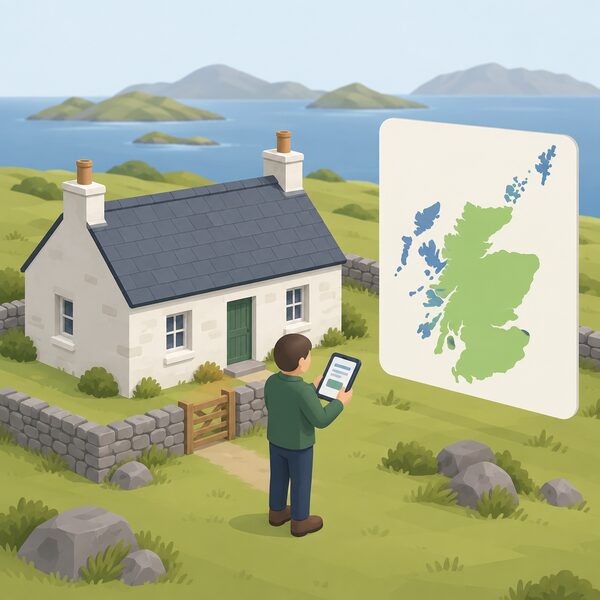
Eligibility for the uplift turns on geography, defined by the Urban Rural Classification. The scheme's terms and conditions state that the uplift applies if a household lives in a remote rural and island area, or an off-gas accessible rural area, as defined by that classification8. The inclusion of off-gas accessible rural areas is significant: it means the uplift is not confined to the islands and the furthest mainland peninsulas, but extends to rural areas where a property has no gas connection.
The same classification underpins other Scottish schemes. ECO4 rules for Scotland define a rural area by reference to the Scottish Government Urban Renewal Classification 2022, published in December 20249. That gives a household a way to reason about the boundary, though the practical answer comes from Home Energy Scotland, which confirms whether a property sits in an eligible rural and island postcode10.
The wider scheme is open to all domestic owner-occupiers in Scotland, providing grants and loans to install clean heat and energy efficiency measures11. The Scottish Government describes the scheme as providing grants and loans to all domestic owner-occupiers in Scotland for that purpose12. Funding covers existing Scottish homes only, and is directed at energy efficiency improvements, low and zero emission heat, other renewables systems, or connections to a heat network8.
How it works with the clean heating and energy efficiency grants
The scheme funds two distinct categories of work, and the uplift attaches to each. Clean heating systems and energy efficiency measures are both supported13, and the scheme exists to support the installation of clean heating systems and energy efficiency measures14. The Scottish Government's headline figure for the clean heating grant is £7,500 for homeowners in Scotland1.
The uplift then raises the ceiling on both sides. Home Energy Scotland's terms and conditions describe the maximum combined grant as £7,500, or £9,000 if a household qualifies for the rural uplift8. The same document records that the uplift increases the heat pump and heat network connection grant flat rate and the maximum limit of the energy efficiency grant8. Independent scheme guidance puts the numbers side by side: the Home Energy Scotland Grant and Loan with rural uplift at £9,000 for clean heating, £7,500 for energy efficiency, and £16,500 in total3.
| Element | Standard | With rural uplift |
|---|---|---|
| Clean heating grant | £7,5001 | £9,0002 |
| Energy efficiency grant maximum | £7,5008 | £9,0008 |
| Combined grant maximum | £7,5008 | £16,5003 |
The scheme has also been extended to heat network connections. The Scottish Government has introduced grant support for homeowners to enable connections to heat networks through the Home Energy Scotland Grant and Loan scheme, with grants of up to £9,000 together with loans for households in island and remote rural areas connecting to local district heat networks15. That £9,000 figure matches the uplifted clean heating grant, and the uplift is described as applying to heat pump installations, heat network connections and energy efficiency grants8.
One limit is worth stating plainly. Funding is only available for eligible improvements, such as insulation or heating technologies, and does not cover separate fees charged by a retrofit service for advice, planning, design or project management5. The uplift increases the grant for the work itself; it does not turn professional fees into eligible costs.
The Grant and Loan scheme behind the uplift

The uplift sits inside the Home Energy Scotland Grant and Loan Scheme, which combines grant funding with optional borrowing. The scheme provides grants and loans to install clean heat and energy efficiency measures11, and is open to all domestic owner-occupiers in Scotland12. Independent guidance describes it as designed to help homeowners improve the energy efficiency of their homes16.
The loan element is separate from the uplift and is repaid. The Scottish Government's consultation material on heat networks describes grants of up to £9,000 together with loans for households in island and remote rural areas connecting to local district heat networks15. That combination of grant and loan in one scheme is why the rural uplift is sometimes confused with borrowing: it is grant funding, and it does not add to any repayment obligation.
The scheme's role in the wider heat transition is well documented. The Energy Saving Trust describes the Home Energy Scotland Grant and Loan Scheme as playing a significant role in making heat pumps more affordable for households, alongside the UK Government's Boiler Upgrade Scheme17. For households weighing the two, the Boiler Upgrade Scheme operates on a different basis and a different grant amount, and the two are not interchangeable.
The Scottish Government has also signalled that the scheme will carry grant support for heat network connections, describing it as a long running scheme being used to enable those connections15. That extension matters for rural households in areas where a district heat network is planned, because it gives a route to connect that does not depend on a standalone heat pump.
How to apply through Home Energy Scotland
Applications run through Home Energy Scotland rather than directly to the Scottish Government. Households apply for Warmer Homes Scotland via Home Energy Scotland18, and the same organisation is the entry point for the Grant and Loan Scheme. The Energy Saving Trust advises households in Scotland to check with Home Energy Scotland to see what financial support might be available19.
The application process has a firm rule attached. You can only apply using the application form provided to you by Home Energy Scotland20. That means a household cannot download a generic form or apply through a third party's paperwork; the form is issued by the scheme.
Home Energy Scotland also offers free and impartial advice on saving energy, making a home warmer, exploring heating options for off-gas homes, and funding for energy-saving home improvements21. The same advisory service is described in the organisation's winter preparation guidance22 and its seasonal energy advice23. For a rural household unsure whether a property qualifies for the uplift, that advice service is the practical first step, and the organisation's funding finder is the tool for matching a property to available support4.
"You can only apply using the application form provided to you by Home Energy Scotland."
A household that is not eligible for Warmer Homes Scotland may qualify for the Home Energy Scotland Grant and Loan or an area-based scheme through its council24. Council area-based schemes are a separate route, and the Home Energy Scotland Grant and Loan vs Warmer Homes Scotland comparison sets out how the two differ. For the application itself, the guide to applying for the Home Energy Scotland grant covers the steps in order.
Why the uplift matters for off-gas households
The uplift is aimed at a specific problem: the cost of improving a home that has no gas connection. Home Energy Scotland states that the rural uplift provides extra support to rural and island homeowners, who can face increased costs when installing home improvements4. Remote and island properties are frequently off the gas grid, which changes both the heating options and the cost of installing them.
The Scottish Government frames the wider programme as including targeted support for those in rural areas25. That targeting is visible in the uplift's design: it applies to off-gas accessible rural areas as well as remote rural and island areas8, which brings in rural mainland households without a mains gas connection.
For households off the gas grid, the practical alternatives to a heat pump are oil or LPG. The Scottish Emergency Heating Oil Scheme aims to support vulnerable households with the increased cost of oil or LPG for heating26. That scheme addresses running costs for households in difficulty; the rural uplift addresses capital costs for households installing a replacement system. They operate on different sides of the same problem.
It is worth being clear about what the uplift does and does not change for a household's energy independence. A heat pump installed with the uplifted grant reduces reliance on delivered fossil fuel, and a well-insulated rural home reduces the amount of energy it needs in the first place. What remains is the electricity supply itself: a heat pump runs on grid electricity from a supplier, so the household's exposure shifts from oil deliveries and price volatility to electricity prices and the grid connection. The grant lowers the cost of making that shift; it does not remove the dependence on the network.
The same logic applies to the energy efficiency side. Insulation funded through the scheme reduces demand, which is the most durable form of independence available to a rural household, because it works regardless of which fuel or supplier is in place. The Energy Saving Trust's guidance on where to add insulation in a home sets out the areas that typically matter27, and the Home Energy Grants in Scotland page covers the wider landscape of Scottish support.
Sources27 cited
- Heat in Buildings progress report 2025, page 10, Scottish Government, 2025-10-02
- Home Energy Scotland grants and loans, Home Energy Scotland, 2026-09-17
- Home Energy Scotland Grant and Loan with rural uplift, UK Parliament research briefing, 2026-05-13
- Find funding, Home Energy Scotland, 2026-09-20
- Simple guide to retrofit services, Home Energy Scotland, 2026-08
- Scottish Government response to the Green Heat Finance Taskforce, Scottish Government, 2025-12-17
- Heat in Buildings progress report 2024, page 9, Scottish Government, 2024-10-10
- Home Energy Scotland Grant and Loan terms and conditions, Home Energy Scotland, 2026-09-17
- The Energy Company Obligation (ECO4) regulations, legislation.gov.uk, 2025-07-31
- Funding for heat pumps, Energy Saving Trust Green Heat Toolkit, 2026-07-10
- Heat in Buildings progress report 2025, page 8, Scottish Government, 2025-10-02
- Heat in Buildings progress report 2024, page 7, Scottish Government, 2024-10-10
- Local and small scale renewables, Scottish Government, 2026-09-17
- Energy saving home improvements, Scottish Government, 2026-09-17
- Heat in Buildings Bill update from the Cabinet Secretary, Scottish Parliament, 2025-11-18
- Home Energy Scotland Grant and Loan, Flexi-Orb, 2024-06-19
- Supporting households with low carbon technology combinations, Energy Saving Trust, 2026-07-15
- Government funded schemes and ECO4, Energy Saving Trust Green Heat Toolkit, 2025-04-02
- Stay warm in winter: five areas to add insulation in your home, Energy Saving Trust, 2025-02-07
- Heat pump installation checklist guide, Home Energy Scotland, 2024-02
- Discover advice hub, Home Energy Scotland, 2026-01
- How to prepare your home for winter, Home Energy Scotland, 2026-08
- Save energy while cooking at Christmas, Home Energy Scotland, 2025-12
- Warmer Homes Scotland, Home Energy Scotland, 2026-09-20
- The Heat in Buildings programme, Scottish Government, 2026-09-17
- Home Heating Advice Scotland, Home Heating Advice Scotland, 2026-09-17
- Warmer Homes Scotland scheme headline data, Scottish Government, 2025-10-29
 Community Energy in ScotlandCommunity energy in Scotland lets you join a local scheme for cheaper, greener heat and power, or get advice and funding to make your own home warmer and cheaper to run.
 Ground Source Heat Pump CostWhat a ground source heat pump costs in the UK, splitting groundworks and drilling from the heat pump and internal works, and how the £7,500 Boiler Upgrade Scheme grant and the £9,000 off-gas-grid uplift change the figure.
 The Full Where to Start GuideWhich home improvements actually cut your bills, and which should you do first?
 Energy Policy in ScotlandWho decides how your home in Scotland is heated and improved?
 Why Energy Grants DifferWhere you live in the UK changes which home energy grants you can get.
 Housing Stock Data for ScotlandScotland's housing is measured differently from England's, so the numbers you see may not compare directly.