
In this comparison
Growatt and Solis are the two names a UK householder meets most often when pricing a budget solar inverter, and the comparison is not symmetrical. Growatt publishes a very wide catalogue of hybrid, off-grid and three-phase machines, a single monitoring app across the whole range, and a set of fault codes that owners search for by number. Solis, the trading name of Ginlong Technologies, describes itself as a top 3 global manufacturer of solar inverters and a leading provider of energy storage solutions, and its UK documentation concentrates on how its inverters handle high-power modules and storage scenarios1.
The practical difference for a household is what each brand gives you to work with after installation. Growatt states that its systems are installed in more than 180 countries, that it runs more than 43 representative offices worldwide, and that more than 1.7 million end users are connected to its cloud platform1. That scale is why Growatt fault codes, WiFi dongle settings and app behaviour are so widely documented, including by Growatt's own European distributor.
Both brands sit in the value end of the UK inverter market. Neither is sold on the high street, both reach most homes through an installer, and both depend on a cloud platform for the monitoring that makes a battery or an export tariff worth watching. What follows sets out the ranges, the monitoring, the connectivity limits and the faults, and what each means for a household's energy independence.
Growatt vs Solis: what the comparison covers
This page compares the two brands on the things a UK buyer can actually check before signing: the shape of each range, what each inverter will connect to, how monitoring works, what happens when a fault appears, and how much of the system depends on the manufacturer staying online. It does not rank them, and it does not price them, because neither brand publishes a UK retail price for its inverters and both are quoted by installers.
The two companies come at the market from different directions. Growatt describes itself as one of the world's largest manufacturers of PV inverters and energy storage systems, present in the PV market for well over a decade, supplying residential, commercial and industrial installations in dozens of countries6. Solis presents itself as a top 3 global manufacturer of solar inverters and a leading provider of energy storage solutions, and its UK site carries technical guidance on module compatibility and storage scenarios rather than a broad consumer catalogue4.
That difference shows in what is easy to find. Growatt's UK-facing shop lists individual models with their phase, ingress protection and monitoring method, so a householder can read a specification before an installer quotes. Solis publishes less model-level detail in the UK material available, and its documented strengths are technical: adapting residential inverters to 182mm and 210mm modules at a DC ratio above 1.6 times, and a history of compact mini inverter designs5.
For a household, the comparison matters most at three points: whether the inverter can take a battery later, whether the monitoring survives a change of broadband or router, and whether a fault code has a published answer. Growatt has the deeper public fault library. Solis has the clearer published position on module matching. Both leave the household dependent on a manufacturer's cloud service for anything beyond the inverter's own display.
Growatt: scale, reach and company background
Growatt's own figures put it among the largest inverter makers by volume. The company states that its systems are installed in more than 180 countries, that it maintains more than 43 representative offices worldwide, and that more than 1.7 million end users are connected to its cloud platform1. It describes itself as one of the world's largest manufacturers of PV inverters and energy storage systems, present in the PV market for well over a decade6.
That scale has a practical consequence for a UK household: documentation. Growatt's European distributor publishes support articles on specific fault codes, WiFi behaviour and firmware, dated December 2025, which is unusual at this price point and is the main reason Growatt faults are easier to diagnose than most3. The same distributor sells accessories directly, including the BDC 95045-A1 base and the SYN-100-XH-30 backup box for the MID-XH range, both carrying a European service warranty and both requiring compatibility to be confirmed by email before purchase7.
The dependence that comes with Growatt is the cloud. Monitoring, fault notification and firmware upgrade all run through Growatt's platform rather than locally, so the household's visibility of its own system rests on a manufacturer's servers and on a WiFi dongle staying connected2. The inverter will still generate without that link, but the data, the history and the fault alerts will not reach the app.
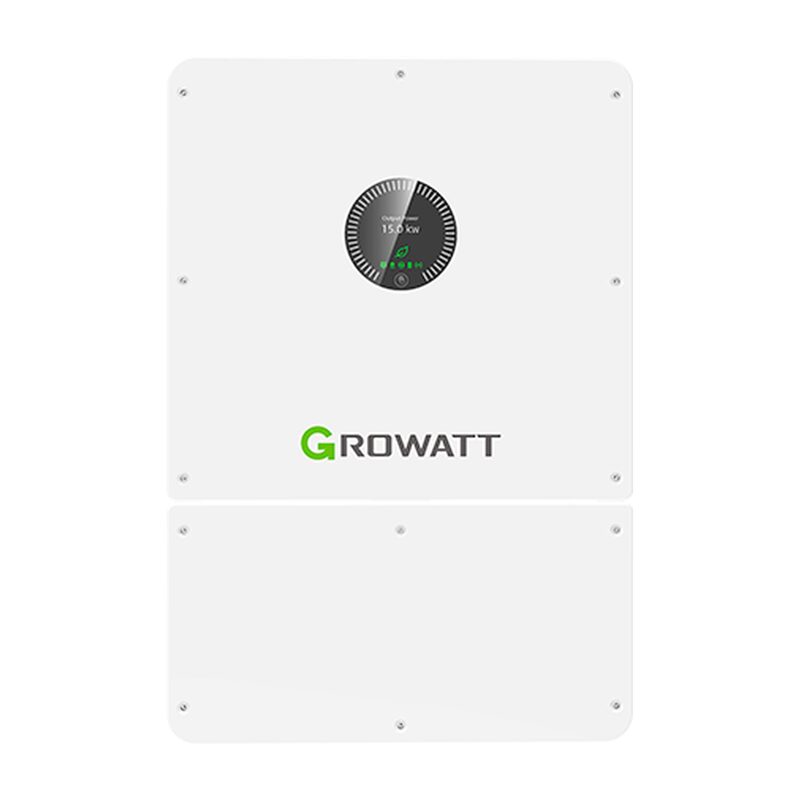
Growatt's range: from plug-in units to three-phase storage
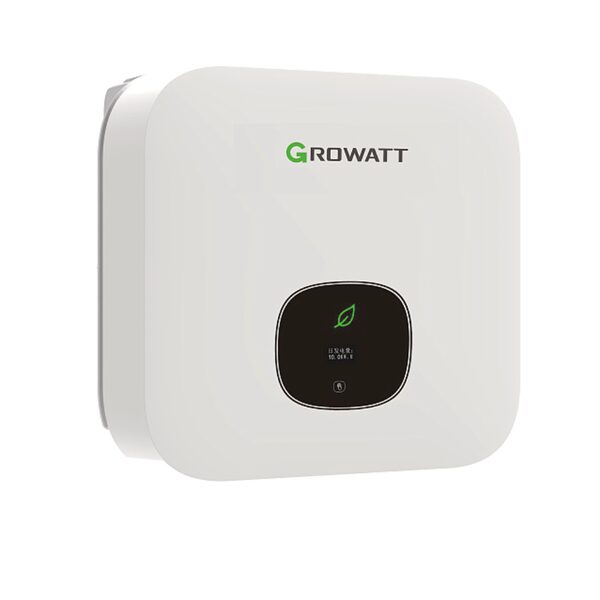
Growatt's catalogue spans single-phase off-grid machines, single-phase hybrid inverters, three-phase hybrid inverters, microinverters and high-voltage battery modules. The phase and rating decide which home each suits, and the maker publishes both for every model.
| Model | Phases | Notable specification |
|---|---|---|
| SPF 6000ES Plus | Single-phase (230 V) | Off-grid, parallel ready, IP65, ShinePhone/ShineServer monitoring10 |
| MIN 5000 TL-X | Single-phase | ShinePhone/ShineServer monitoring11 |
| MIN 2500-XH2 | Single-phase | ShinePhone/ShineServer monitoring12 |
| MOD 6000TL3-HU | Three-phase (230/400 V) | Hybrid, battery ready13 |
| Smaller WIT hybrids | Three-phase (230/400 V) | Transformerless, smart air cooling, low-voltage battery, IP6614 |
| WIT hybrid with EPS module | Three-phase (230/400 V) | Built-in EPS backup module, IP6617 |
| WIT hybrid, parallel capable | Three-phase (230/400 V) | Parallel operation of multiple units18 |
| WIT 25K-HU | Three-phase (230/400 V) | Parallel operation of multiple units, IP6620 |
| SPH 7000TL3 | Three-phase (230/400 V) | Natural cooling21 |
| SPH 10000TL3 | Three-phase (230/400 V) | Natural cooling, IP65, start-up voltage 120 V22 |
| NEO 800M-X | Microinverter | WiFi, per-panel data in ShinePhone and ShineServer23 |
| SPE 10000ES | Off-grid | Wi-Fi or 4G communication24 |
The battery side is built in modules rather than single fixed sizes, and the same reporting runs across the range. The AXE high-voltage kit, the ALP kit and the ARK modules all report state of charge, charge and discharge power and operating history through the ShinePhone app and the ShineServer portal, with fault notifications25. The ALP kit pairs with the WIT and SPF inverters, so a household that starts with an off-grid or hybrid inverter can add storage to the same monitoring account later26.
For a household, the range matters because it decides whether a battery can be added later without replacing the inverter. The WIT and MOD three-phase hybrids and the SPH series are battery ready; the MIN single-phase models are not presented as hybrid units. A home with a three-phase supply and a large roof has more Growatt options than a single-phase home, and the WIT 25K-HU sits well beyond typical domestic demand.
Monitoring: ShinePhone, ShineServer and the cloud platform
Growatt runs one monitoring ecosystem across its whole catalogue. ShinePhone is described as the system monitoring app for users, ShineServer as the web version monitoring platform, and ShineTools as a lite operations and maintenance app2. The maker states that ShinePhone is one app for all Growatt products, with simple WiFi configuration and a self-consumption and energy trend display2.
Almost every Growatt model lists the same monitoring line: ShinePhone and ShineServer over WiFi. That covers the SPF 6000ES, the MIN 5000, the MIN 2500-XH2, the WIT hybrids including the WIT 25K-HU, and the SPE 10000ES, which adds 4G as an alternative to WiFi10. The NEO 800M-X microinverter reports per-panel production, history and alarms through the same app and portal23.
What the app shows depends on the hardware attached. On the ALP battery kit and the AXE kit, the ShinePhone app and ShineServer portal display state of charge, charge and discharge power and operating history, with fault notifications26. The ARK modules report the same set of values through the connected inverter25. The SYN-100-XH-30 backup box becomes part of a system monitored in the app and portal once connected27.
The independence question here is straightforward. Growatt's monitoring is cloud-first: the data leaves the house, and the household's view of its own generation depends on Growatt's platform, the dongle and the broadband connection all working. There is a local route, covered below, but it is a configuration and diagnostics interface rather than a substitute for the app. A household that wants its solar data to stay on its own network will find that Growatt does not offer it as standard.
UK availability and where to buy

Growatt sells some of its range directly through its own UK-facing shop. The SPF 6000ES, the MIN 5000, the MIN 2500-XH2 and the MOD 6000TL3-HU are all listed as available at Growatt's site, and a WIT three-phase hybrid carries the same availability line10. Accessories follow the same route: the BDC 95045-A1 is sold through the shop with compatibility confirmed before purchase, and the SYN-100-XH-30 is described as a genuine accessory with a European service warranty, again with compatibility checked by email before buying7.
Beyond the manufacturer's own shop, Growatt hardware reaches UK households mainly through installers and electrical wholesalers. Neither brand publishes a UK retail price for its inverters, so any figure a household sees will be installer-quoted as part of a fitted system rather than a shelf price. That is normal for this end of the market and applies equally to Solis.
Solis's UK presence is documented differently. Its UK site carries technical documentation and news rather than a consumer shop, including guidance on module compatibility and a 2026 Intersolar Europe announcement on full-scenario energy storage solutions4. Its energy storage inverters are described as supporting remote upgrade and parameter adjustment, and its storage solutions are presented as powering homes29.
For a household, the availability picture means the choice is usually made by the installer, not the homeowner. A buyer who wants a specific model should expect to ask which inverter is being quoted and to check the phase, the battery compatibility and the monitoring method against the maker's own page before agreeing.
Data security and connectivity: WiFi, protocols and staying online
Growatt's connectivity is a WiFi dongle on most models, with 4G as an option on the SPE 10000ES24. The dongle has published defaults that a householder or installer will need: the local configuration page sits at 192.168.10.100 with the username and password both set to admin, the hotspot SSID is typically the dongle serial number in the form XGDxxxx, and the default hotspot password is 123456783. In hotspot mode the local settings interface is reached by connecting to the AP_ SSID, and it exposes tabs for WiFi configuration, inverter parameters and diagnostics4.
The 5GHz problem is a hardware limit, not a settings error. Growatt's ShineWiFi-S and ShineWiFi-X dongles use chipsets that support only the 2.4GHz band, so they cannot see a 5GHz network at all; Growatt published an explanation of the incompatibility with diagnostic and resolution steps in December 202531. A household whose router broadcasts only 5GHz, or which has band steering enabled, will see the inverter as offline until a 2.4GHz network is available to it.
On the inverter side, the hardware is built for outdoor and semi-outdoor mounting. The WIT hybrids, including the WIT 25K-HU, carry IP66, the SPF 6000ES and SPH 10000TL3 carry IP65, and the ALP battery kit carries IP6610. The WIT hybrids use transformerless topology with smart air cooling, and the SPH 10000TL3 and SPH 7000TL3 use natural cooling15.
The independence point is that Growatt's data path runs through the manufacturer's cloud, and the local interface exists mainly for commissioning and diagnosis. A household keeps generating if the cloud goes down, but loses the record of what it generated, which is the evidence base for checking performance against an installer's estimate.
Common Growatt faults and troubleshooting
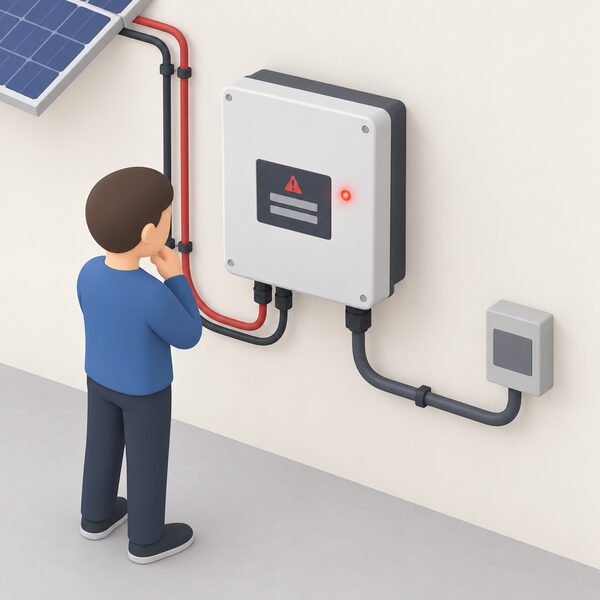
Growatt's fault codes are well documented, which is the practical advantage of the brand's scale. Two codes account for most of the searches.
Error 203 is a PV isolation fault. The inverter displays it on screen, typically during startup or in the morning hours, with the fault LED illuminated and no connection to the grid5. Growatt's guidance attributes it to damaged PV cables, connectors or modules causing a ground fault. The stated resolution is to repair or replace the damaged components, ensure junctions are properly sealed, and restart the inverter once resistance returns to normal5.
Error 300 is an AC voltage out of range fault. The inverter shows it on screen or in the app with the fault LED lit, disconnects from the grid and enters a reconnection delay6. Growatt lists three causes: grid voltage exceeding the permissible range defined by the selected safety standard, voltage rise from high export combined with AC cable impedance, and incorrect safety standard configuration. Diagnosis involves measuring AC voltage at the inverter terminals during the fault and comparing it against the limits of the active safety standard, and checking for grid fluctuations or local impedance issues. The stated resolution is to wait for grid voltage stabilisation, adjust the safety standard or voltage limits where regulations allow, and optimise AC cabling or reduce export if the cause is impedance6.
"The inverter displays Error 300 on the screen or app, with the fault LED illuminated. The inverter disconnects from the grid and enters a reconnection delay."
Firmware is the third recurring topic. Growatt states that remote firmware upgrade is available for both inverter and battery through its residential storage platform, and Solis states that its energy storage inverters support remote upgrade and parameter adjustment9. Growatt's distributor published a procedure for updating inverter firmware via USB or remote tools in December 2025, carrying warnings on warranty and on the need for qualified personnel32.
Which inverter suits which home
The choice between the two brands comes down to the shape of the installation rather than the badge.
A single-phase home with a modest array and no battery plans is served by the simpler end of either range. Growatt's MIN 5000 TL-X and MIN 2500-XH2 are single-phase units with ShinePhone and ShineServer monitoring11. Solis's mini inverter line has a long history in this segment: the maker described four models at 700W, 1000W, 1500W and 2000W, with a dual CPU design, a 50V start-up voltage, high efficiency and a weight of 5.6 kg in dimensions of 270mm by 417mm by 124mm7.
A home with a three-phase supply and a battery in the plan has more Growatt options than Solis ones documented here. Every WIT model is three-phase at 230/400 V, one carries a built-in EPS backup module, and others support parallel operation of multiple units, including the WIT 25K-HU14. The MOD 6000TL3-HU is a three-phase hybrid, and the SPH 7000TL3 and SPH 10000TL3 are three-phase hybrids with natural cooling13.
A home with a large roof and high-power modules should look at the module matching question. Solis states that its residential products can adapt to 182mm and 210mm PV modules and achieve a DC ratio of more than 1.6 times, and its three-phase 4G range carries integrated AFCI modules with ultra-low start-up at 180V5. That is a technical claim about array design rather than a household feature, and it matters when a designer is trying to fit a large array onto a limited number of strings.
An off-grid or backup-first property is a Growatt strength on paper. The SPF 6000ES Plus is a single-phase off-grid inverter, parallel ready, with IP65 protection and ShinePhone and ShineServer monitoring, and the SPE 10000ES is an off-grid unit with Wi-Fi or 4G communication10. The AXE and ALP battery kits are built around the SPF 6000ES Plus inverter28.
For energy independence, the honest summary is that both brands reduce dependence on imported grid electricity and neither removes dependence on a manufacturer. Growatt's cloud platform, its dongle and its app sit between the household and its own data, and the published defaults on that dongle are the same on every unit until changed. Solis's documented strengths are in module matching and storage scenarios rather than in local data ownership. A household weighing the two should treat the monitoring architecture and the fault documentation as equal in importance to the inverter's rating, because those are what it will live with for the next decade.
Sources33 cited
- Growatt corporate site, Growatt, 2025-09-15
- Growatt Monitoring Platform, Growatt, 2026-09-17
- Default password for Growatt ShinePhone and WiFi setup, Growatt, 2025-12-19
- Accessing Growatt local settings via 192.168.10.100, Growatt, 2025-12-19
- Growatt Error 203: PV isolation low, morning leakage current, Growatt, 2025-12-19
- Growatt Error 300: AC voltage out of range, Growatt, 2025-12-19
- Growatt BDC 95045-A1 base, Growatt, 2026-09-17
- Growatt SYN-100-XH-30 backup box for MID-XH, Growatt, 2026-09-17
- Growatt residential storage system, Growatt, 2026-09-17
- Growatt SPF 6000ES Plus 6kW off-grid inverter, Growatt, 2026-09-17
- Growatt MIN 5000 TL-X single-phase inverter, Growatt, 2026-09-17
- Growatt MIN 2500-XH2, Growatt, 2026-09-17
- Growatt MOD 6000TL3-HU 6kW hybrid inverter, Growatt, 2026-09-17
- Growatt WIT 4kW-HU hybrid inverter, Growatt, 2026-09-17
- Growatt WIT 5kW-HU hybrid inverter, Growatt, 2026-09-17
- Growatt WIT 6kW-HU hybrid inverter, Growatt, 2026-09-17
- Growatt WIT 12kW-HU three-phase hybrid inverter, Growatt, 2026-09-17
- Growatt WIT 8kW-HU three-phase hybrid inverter, Growatt, 2026-09-17
- Growatt WIT 10kW-HU three-phase hybrid inverter, Growatt, 2026-09-17
- Growatt WIT 25K-HU hybrid inverter, Growatt, 2026-09-17
- Growatt SPH 7000 TL3 BH-UP three-phase hybrid inverter, Growatt, 2026-09-17
- Growatt SPH 10000TL3 BH, Growatt, 2026-09-17
- Growatt NEO 800M-X 800W microinverter, Growatt, 2026-09-17
- Growatt SPE 10000ES, Growatt, 2026-09-17
- Growatt APX 5.0H high-voltage battery module, Growatt, 2026-09-17
- Growatt ALP 5kWh battery kit for WIT and SPF, Growatt, 2026-09-17
- Growatt MOD 8000TL3-HU 8kW hybrid inverter, Growatt, 2026-09-17
- Growatt AXE 5kWh off-grid kit, Growatt, 2026-09-17
- Solis energy storage solutions, Solis, 2026-09-17
- Solis at Intersolar Europe 2026, Solis, 2026-06-18
- Why Growatt WiFi modules do not support 5GHz networks, Growatt, 2025-12-19
- How to update Growatt inverter firmware safely, Growatt, 2025-12-19
- Solis 5-20kW three-phase 4G inverter range, Solis, 2018-08-10
 Panel TypesWhich solar panels are best for a UK home, and how much do they cost?
 The Full Home Batteries GuideA home battery stores cheap or solar power for later, but will it really cut your bills enough to be worth it?
 Perovskite Solar CellsPerovskite solar panels are a newer kind of panel that could be cheaper and more efficient than the ones sold today.
 AC-Coupled vs DC-CoupledCan you add a battery to your existing solar panels without swapping the inverter, and does one kind waste more of your solar power than the other?
 Solar Panel Manufacturers UKWhich solar panel brands are actually worth buying in the UK, and who really makes them?
 The Full Brands GuideWhich boiler, heat pump or solar brand can you trust, and who actually owns it?