In this guide
A Solis inverter is the box on the wall that turns the direct current from a solar array into the alternating current a home uses, and it is one of the brands most often named on UK solar quotes. The company behind it, Ginlong Technologies, describes itself as "a top 3 global manufacturer of solar inverters and a leading provider of energy storage solutions"1. It reached more than 100GW in cumulative global shipments by September 20242, and was recognised in the 2024 Global Top 500 New Energy Enterprises ranking for the fourth consecutive year3.
For a household, the practical questions are narrower than the company's global position. What does the inverter do when the grid goes down? Which batteries can be paired with it? What do the fault codes and the fan noise mean? And how much of the system still depends on the grid, a supplier and the maker's own platform?
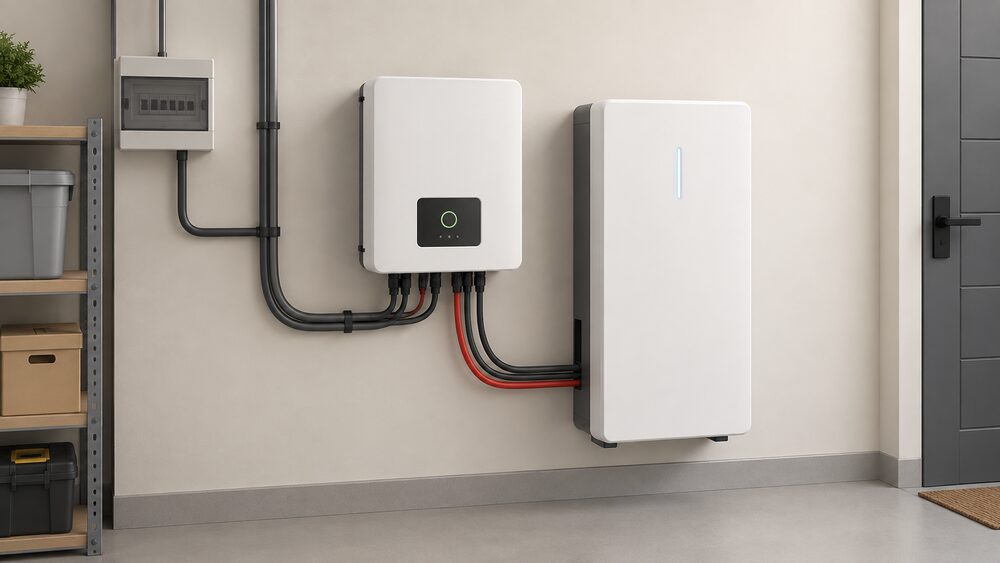
The short answer is that Solis makes both straightforward grid-tied solar inverters and hybrid storage inverters that can run a home's essential circuits from a battery when the grid fails4. The range is deliberately open on batteries, which gives an installer flexibility but also puts the responsibility for checking compatibility on the buyer. Remote features and firmware upgrades run through the Solis monitoring platform, so they depend on a working internet connection.
Solis at a glance: a top-three global inverter maker
Solis is the trading name used by Ginlong Technologies for its inverter business, and the company has been supplying inverters under that name since at least 20167. Its own description of its market position is a top three global manufacturer of solar inverters and a leading provider of energy storage solutions1. The shipment milestone is the more concrete figure: more than 100GW cumulative globally by September 20242, with the company also recognised in the 2024 Global Top 500 New Energy Enterprises ranking for a fourth consecutive year3.
The company has been building out its product generations steadily. It launched its sixth-generation products in the year to September 20243, and in February 2024 announced the S6-EH3P three-phase high-voltage energy storage inverters for residential and small commercial use8. In June 2026 it entered a strategic partnership with JA covering solar and energy storage technologies, system integration, market development and supply chain coordination9. It also holds Environmental Product Declarations for its sixth-generation 80 to 125kW commercial inverter series, handed over by TÜV SÜD in June 202510, and was awarded "Committed" status by EcoVadis in November 202410.
For a UK householder, the relevant point is scale and continuity rather than the awards. A manufacturer with a large installed base and an active product cycle is more likely to keep supporting firmware and spares than a small entrant. Solis also earned a high ranking in the 2023 inverter bankability survey11, which is the kind of assessment installers and financiers use when deciding whether a brand is a safe specification. The wider context on how these ratings work is at tier 1 and bankability ratings, and the brand sits alongside others in the solar inverter manufacturers guide.
The range for UK homes: residential PV and storage inverters
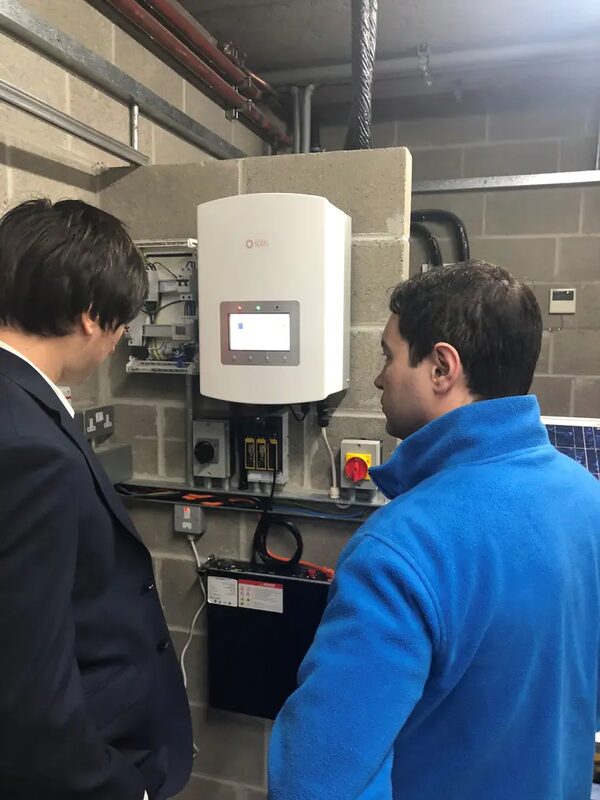
Solis splits its residential offer into two families. The residential PV solution is the straightforward grid-tied side, described as a flexible design that can be installed in multiple directions and at different inclinations, and compatible with high-power PV modules6. The energy storage side is the hybrid range, which pairs with a battery and can discharge it during a power failure to keep home appliances running4.
The storage range is broad by design. Solis states it has a wide range of residential energy storage inverter products and can provide targeted solutions for each type of energy storage system12, and that its products support multiple parallel expansion, increasing the capacity of the energy storage system and its load-carrying capacity12. That matters for a household planning to add a second battery later rather than replace the inverter.
There is also an upgrade path for homes that already have solar. Solis describes the RAI as an AC coupled battery inverter intended for someone who already owns a grid-tied solar system and wants to add storage without replacing the existing inverter13. That is a different proposition from a hybrid inverter, which handles both the panels and the battery in one unit.
On the DC side, one Solis storage inverter is listed with dynamic MPPT, two MPPTs and two DC inputs14. The company also states that its upgraded inverters with higher input currents are compatible with all high power and bifacial modules15, which matters as panel wattages rise. The general question of matching inverter size to array is covered at solar inverter manufacturers.
| Family | What it does | Key stated feature |
|---|---|---|
| Residential PV solution | Grid-tied solar only | Flexible design, multiple directions and inclinations, high-power module compatible6 |
| Energy storage inverters | Solar plus battery, with backup | Battery discharge in a power failure4 |
| RAI AC coupled | Adds storage to an existing solar system | Installed alongside batteries, connected to panel or mains13 |
| S6-EH3P three-phase | Residential and small commercial storage | Launched February 20248 |
Battery compatibility: a wide range of brands for flexibility
Solis takes an open approach to batteries. Its energy storage inverters are described as compatible with a wide range of battery brands for flexibility4, and one Solis storage inverter is listed as compatible with LGChem, BYD, PylonTech, Aboet and other 42 to 58V lithium-ion or lead-acid battery energy storage products14. That is unusual in a market where several makers tie the inverter to their own battery.
The flexibility comes with a condition. Solis states plainly that the compatibility of specific battery models with its energy storage inverters varies across different markets4, and directs buyers to reach out to the Solis product and technical team in their specific country or market to confirm4. In other words, the approved list is not global and not fixed.
The battery reserve function, which keeps a set amount of charge back for backup use, is available in Solis energy storage inverters from the fifth generation onwards. That is a useful dividing line when looking at a second-hand unit or an older quote. The wider picture on which battery brands are sold in the UK is at home battery manufacturers, and the compatibility question in general is covered at comparing manufacturer specifications.
SolisStorage: the maker's own battery range
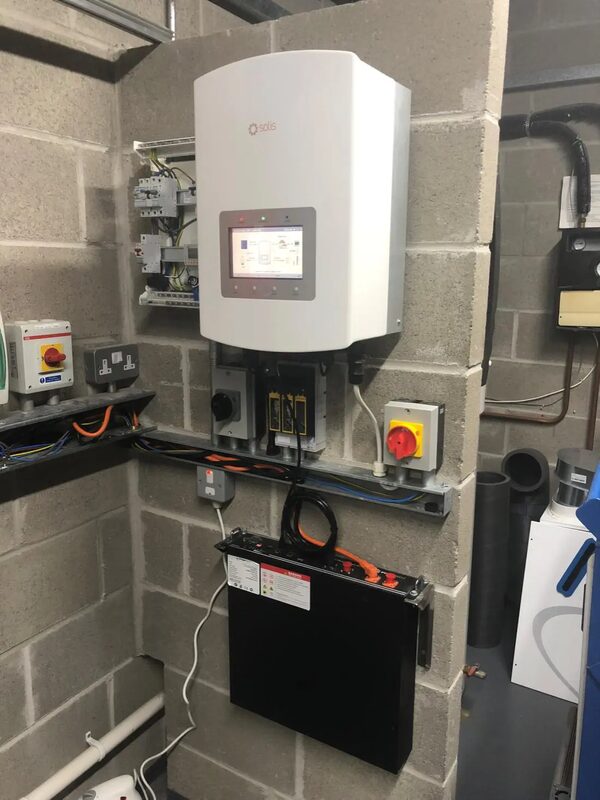
Solis now sells its own batteries as well as inverters. The SolisStorage residential battery portfolio launched in March 2026, with two lines built on lithium iron phosphate (LiFePO₄) chemistry16. Both are stated to support a depth of discharge of 90% or more and more than 6,000 cycles, which the supplier describes as equivalent to an average 10-year service life16.
The two lines are IntelliHome, a wall or floor mounted unit from 5.1kWh to 16kWh with indoor (IP20) and outdoor (IP66) variants, and FlexHome, a low-voltage stackable unit from 5kWh to 40kWh that expands in 5kWh steps16. The batteries are paired with Solis S6 hybrid inverters, which gives access to the SolisCloud energy management platform16. That platform manages charging and discharging around time-of-use tariffs, and the stated switching time to backup power is under 10ms16.
For a household, this changes the battery question. The open compatibility described above still applies to Solis energy storage inverters generally, but a SolisStorage battery is the maker's own pairing and is bought as a system rather than matched to a third-party battery. The range was available for pre-order from March 202616.
The mini inverter: compact, dual-CPU and highly efficient
The mini inverter is Solis's small-scale line, and it is the model most likely to appear on a small domestic array. Solis describes it as having a dual CPU design, easy installation, high efficiency, numerous protection functions and a precise MPPT algorithm14. It was selected as one of the "world 100 brilliant PV products"14.
The headline technical figure is the start-up voltage: an ultra low 50V14. A low start-up voltage means the inverter begins generating earlier in the morning and keeps going later in the evening, and it also helps on arrays where shading or orientation limits the voltage the string can reach. The range covers four models at 700W, 1000W, 1500W and 2000W14, with dimensions of 270mm wide, 417mm high and 124mm deep14.
Two caveats sit alongside the specification. The mini inverter was designed with a special design for 127V low voltage areas14, which is not the UK supply, so the UK-relevant variants are the ones an installer would specify. And the model attracted customers from the US, Canada, Mexico and Asia14, which tells you where it was first sold rather than where it is supported now. WiFi and a monitoring app are available14, which is the route to the remote features described below.
For a household, the mini inverter's relevance is mostly on smaller or awkward roofs where a full-size string inverter would be oversized. The trade-off is that a small inverter clips output on a large array, so the matching question matters more than the badge. The general sizing discussion is at solar inverter manufacturers.
Smart features: remote upgrades, CT interface and monitoring
Solis builds a set of monitoring and control features into its residential range. The residential PV solution and the energy storage inverters both support remote upgrade and parameter adjustment6, meaning firmware and settings can be changed without a site visit, provided the inverter is online. One Solis hybrid model is described as offering one-touch remote control and upgrade through the Solis Monitoring platform17.
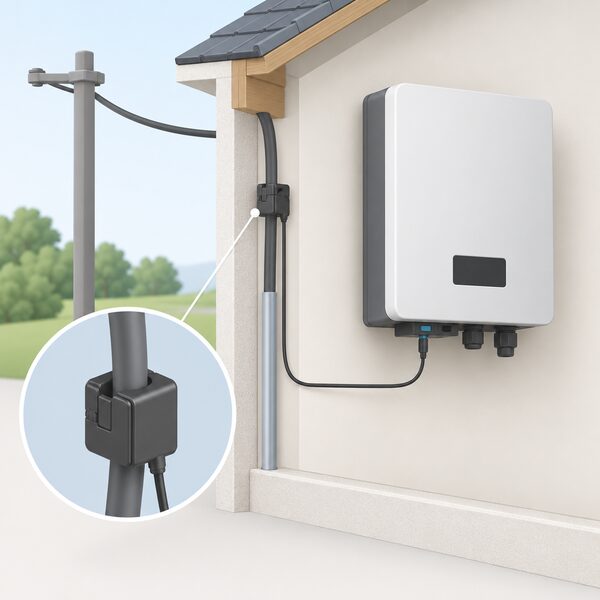
The CT interface is the other significant feature. Solis states that its inverter has a CT interface reserved for communication with a current transformer18, and that inverters with CT support can control export power dynamically, adjusting inverter output to prevent unwanted export, improve system stability and comply with local export-limit rules18. The same CT arrangement monitors load consumption 24 hours a day, even at night18. For a household on an export-limited connection, that is the mechanism that keeps the system within its agreed limit.
The storage side adds an intelligent EMS system with 24-hour online monitoring and self-adaptive adjustment and management of the battery, which Solis says improves battery reliability4. Solis inverters can also be integrated with various VPP platforms19, which is the route by which a home battery can be paid for providing grid services. That is a dependence as much as a feature: it relies on the platform, the aggregator and the household's broadband. The general position on app and firmware support life is at firmware updates and product support life.
Noise: fan and other sounds, and what is normal
Solis has published its own troubleshooting guidance on abnormal noise, and it divides the causes into two groups: fan noise and other sources5. Fan noise, in Solis's description, often occurs when the inverter is running at high power or full power and the fan needs to dissipate heat5. That is normal behaviour, not a fault.
The abnormal cases are more specific. Solis lists problems with the fan itself or insecure installation as causes of noise5, along with blade breakage, loose fan fastening screws and loose protective-cover screws5. Foreign objects can collide with the rotating fan and cause noise or stop it turning5. A blocked heat dissipation duct reduces cooling performance and makes the fan run at high speed for extended periods, increasing abnormal noise5. Loose or unlocked back-plate screws cause vibration and significant noise during operation5.
Inadequate spacing is a contributing cause rather than a separate one. Solis states that high temperature makes the fan start frequently, the fan rotation shaft loses lubrication, and the operating condition deteriorates5. The remedy for a damaged fan is replacement, and for an abnormal one, ensuring screws are securely tightened and performing a fan test after adjustments5. Regular cleaning of the external fan with a soft brush is the stated maintenance step5.
The second category is inductance noise. Solis describes this as primarily caused by internal inductance vibrations or unsteady inverter installations5, and states that the main cause of inductance whistling is poor quality power from the local grid5. That is worth knowing because it is not a fault in the inverter: it is the inverter responding to the supply. Solis's suggested diagnostic route is an oscilloscope and power quality tester, or assistance from Solis technical support5.
Installation basics: spacing, siting and the serial number
Solis guidance gives a normal installation spacing of 0.5m5. That figure is the maker's own, and it is the one to work from for a Solis unit. Clearance figures published by other manufacturers are not transferable: one maker specifies 200mm on the left and 350mm on the right for its own inverters20, which shows how much the requirement varies between designs. The reason spacing matters is set out above: inadequate spacing raises temperature, makes the fan start more often and is listed by Solis as a cause of noise5.
Siting follows from the same logic. An inverter needs airflow, and a blocked heat dissipation duct reduces cooling performance5. Loose back-plate screws cause vibration and noise5, so the mounting surface and the fixing matter as much as the position. For an AC coupled unit such as the RAI, Solis describes it as installed alongside batteries and then connected directly to the panel or mains13, which means the battery location and the inverter location are decided together.
The serial number is the practical detail that catches people out later. It is needed for warranty claims, firmware requests and technical support, and it is printed on the inverter casing and recorded on the monitoring platform once the unit is registered. Photographing it at installation, along with the installer's commissioning paperwork, avoids a search behind a mounted unit years later. The general process is covered at registering a warranty and keeping it valid.
Faults and protection: what the inverter does when something goes wrong
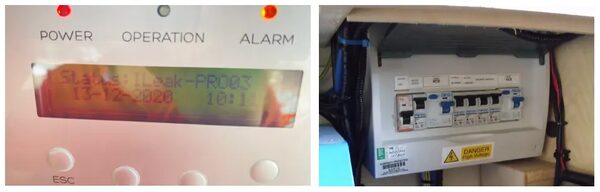
Solis inverters monitor the grid continuously. The company states that all Solis inverters have the ability to monitor the state of the grid21, and that when a grid surge or similar event occurs, the inverter LCD display and monitoring equipment show corresponding fault information and the unit disconnects from the grid in time, waiting for the fault to recover21. The residential PV solution will alarm if any AC or DC wiring faults are identified6.
The leakage current fault is the one most often searched for. Solis states that when it occurs, the inverter is disconnected from the grid, entering the protection mode with the inverter screen displaying the error message "ILeak-PRO 01/02/03/04"22. The underlying rule is that the inverter must stop generating and enter the protection mode to protect the safety of people and equipment22. The setting path for the leakage protection value is Advanced settings, then special settings, then IgZero_COPM.Set, then Setting ILeak.-L value22, and Solis states that the specific value depends on the working conditions on site22. That makes it an installer decision, not a householder one.
On the DC side, Solis lists a set of protection mechanisms including AFCI function, DC breakers, anti-reverse connection protection, in-line group string monitoring and I-V curve scanning15. Its energy storage inverters offer optional AFCI DC arc protection with active switching within 0.3 seconds to prevent fires4. The three-phase 4G range uses integrated AFCI modules and detects arc faults through Fourier analysis23, and the same range has integrated automatic voltage stabilizer technology23.
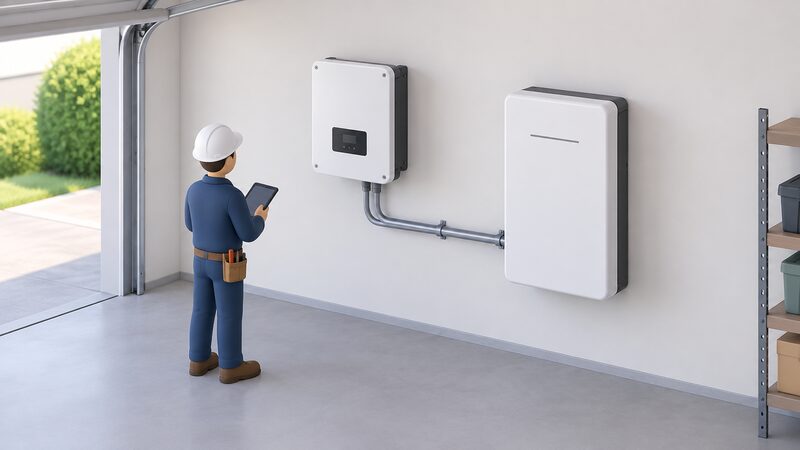
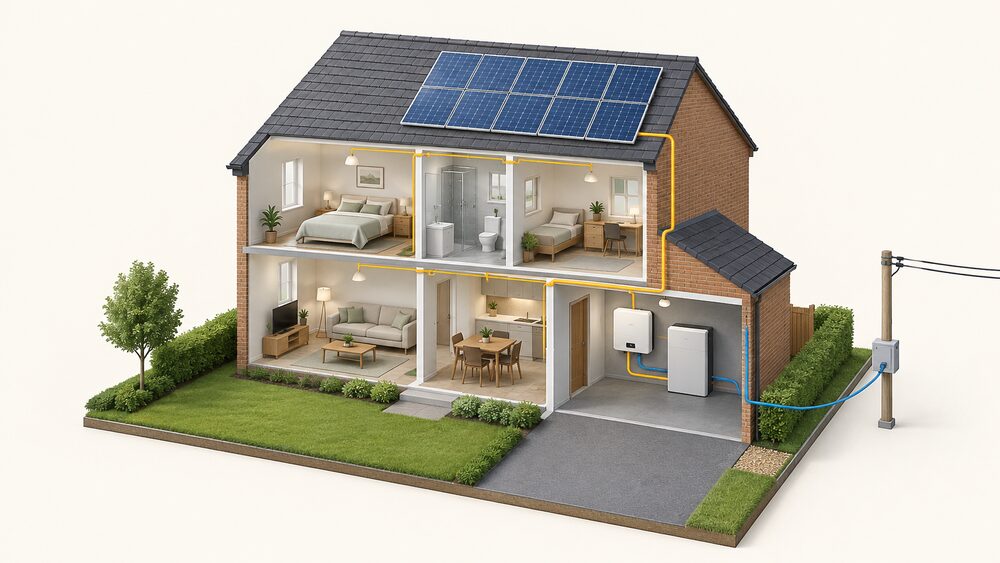
Backup behaviour is the part that matters most for independence. Solis states that its energy storage inverters discharge the battery in case of power failure to ensure the uninterrupted operation of home appliances4, and that there is fast switchover of back-up power generation equipment to ensure power supply to critical equipment4. One Solis hybrid inverter is described as able to operate independently to provide continuous power for residential applications if the grid is interrupted24. The limits are worth stating as firmly as the benefit: this is a battery-backed supply for the circuits wired to it, sized by the battery and the inverter, not a replacement for the grid. The company's own framing of storage as essential for regions with unstable grids and frequent natural disasters describes a different market from the UK, where the grid is stable and the value of backup is resilience rather than survival.
"the inverter must stop generating and enter the protection mode to protect the safety of people and equipment."
Sources24 cited
- Solis to showcase full scenario energy storage solutions at Intersolar Europe 2026, Solis, 2026
- Solis surpasses 100GW in global shipments, Solis, 2024
- Solis ranks in 2024 Global Top 500 New Energy Enterprises for fourth consecutive year, Solis, 2024
- Energy storage solutions, Solis, 2026
- Troubleshooting guide: abnormal noise from inverter, causes and solutions, Solis, 2024
- Residential solutions, Solis, 2026
- Ginlong Technologies Solis, Solis, 2016
- Solis launches residential and small C&I three phase high voltage energy storage inverter, Solis, 2024
- Solis and JA establish strategic partnership at Intersolar Europe 2026, Solis, 2026
- Solis release of electronic product declarations at SNEC 2025, Solis, 2025
- Ginlong Solis earns high ranking in 2023 inverter bankability survey, Solis, 2024
- Types of residential energy storage systems, Solis, 2022
- Upgrade a grid-tied solar PV system to an energy storage system, Solis, 2021
- Solis storage inverter press release, Solis, 2020
- How do inverters adapt to high-power PV modules, Solis, 2021
- SolisStorage Launch Their Residential Solar Battery Portfolio, segen.co.uk
- Solis RHI-(3-6)K-48ES-5G, Solis, 2020
- Export power management and load monitoring by CT, Solis, 2026
- AI-driven dynamic tariff optimization, Solis, 2025
- How much physical space do I need to install a Dura-i inverter, Duracell Energy, 2026
- Solis inverters provide for a more reliable solar PV system, Solis, 2021
- Leakage current failure, Solis, 2021
- Solis 5-20kW three-phase 4G inverter range, Solis, 2018
- How to use peak shaving to save on electricity costs, Solis, 2023
 Solis Storage Inverters and Home BatteriesWhich batteries work with a Solis inverter, and what happens if you pair it with the wrong one?