
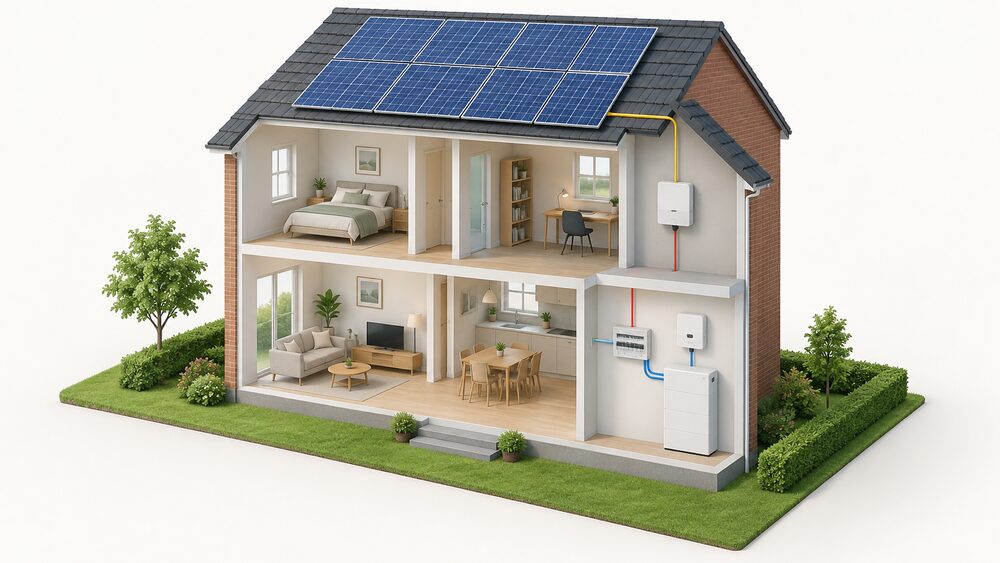
In this guide
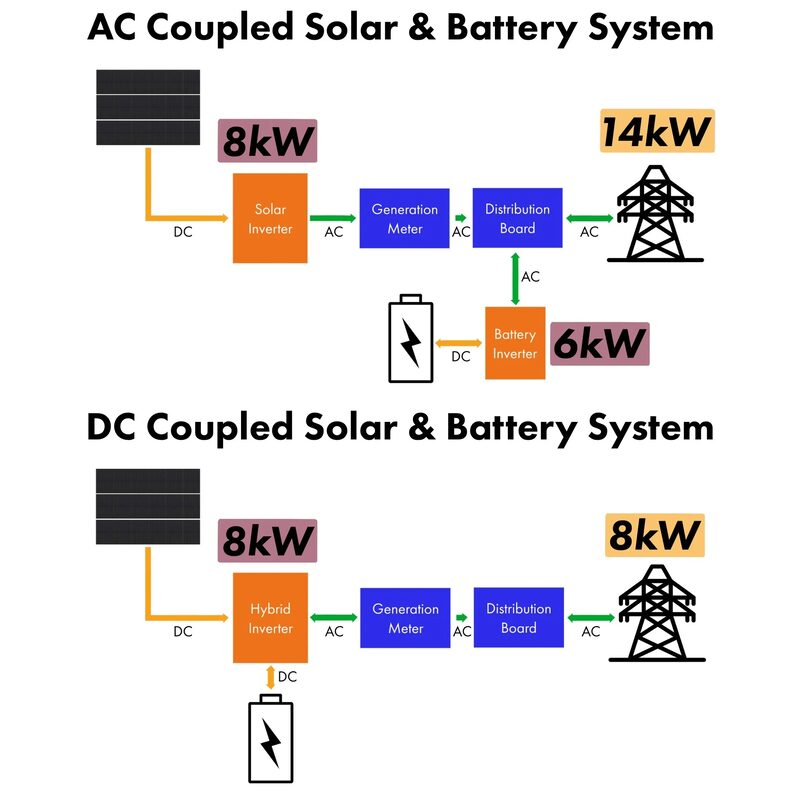
The difference between an AC-coupled and a DC-coupled home battery is where the battery joins the circuit. An AC-coupled battery has its own inverter and sits on the AC side of the house, after the solar inverter, connecting into the home's AC network and the consumer unit while the original solar inverter is left untouched1. A DC-coupled battery joins the system on the DC side, before inversion, so electricity generated by the panels is stored as direct current and passes through a single hybrid unit that acts as both PV inverter and battery charger1.
That difference decides where the conversion losses fall. In an AC-coupled system, solar DC is inverted to AC, then converted back to DC to charge the battery, then inverted again to AC to supply the house: electricity directed to a battery undergoes conversion to DC by an inverter before being converted back to AC4. A DC-coupled system requires only one energy conversion in the PV to battery to household path, DC to AC, which is why it is described as highly efficient5. One maker puts the gap at approximately 8% more energy lost by AC-coupled systems5; another describes the difference as minimal and unlikely to affect everyday use3. A third states that swapping to a DC-coupled hybrid improves round-trip efficiency by about 5% by avoiding double AC-to-DC conversion losses6.
For most UK households the practical question is not efficiency but what is already on the roof. The Centre for Sustainable Energy states that AC-coupled batteries are probably better where PV is already installed because they are easier to retrofit, while a DC-coupled battery fitted at the same time as the panels is typically more efficient and tends to be cheaper, though it might not be able to charge from the grid7.
AC-coupled and DC-coupled: what the terms mean
The terms describe which side of the inverter the battery charger is wired to. AC coupling connects the battery charger to the AC side of the network, with the battery inverter or charger separate from the PV inverter1. DC coupling connects the battery charger to the DC side of the PV system, so electricity generated by the panels can be stored before inversion to AC1. Put another way: it is DC coupling to charge the battery through DC power conversion, and AC coupling to convert AC power to DC power11.
An AC-coupled connection means the storage system is coupled with an AC power source such as the grid or a PV inverter12. That AC source can be either, which is the origin of the most useful practical distinction between the two layouts. AC-coupled storage is capable of bi-directional power conversion, DC to AC and AC to DC3, so it can take energy in from the mains as well as push it out.
In an AC-coupled energy storage system the PV array and the battery storage system each have their own inverters, tied together on the AC side5. In a DC-coupled system the array and the battery are tied together on the DC side of a single hybrid inverter5. Counting inverters is the quickest way to tell which you are looking at.
AC-coupled systems: the battery sits after the inverter
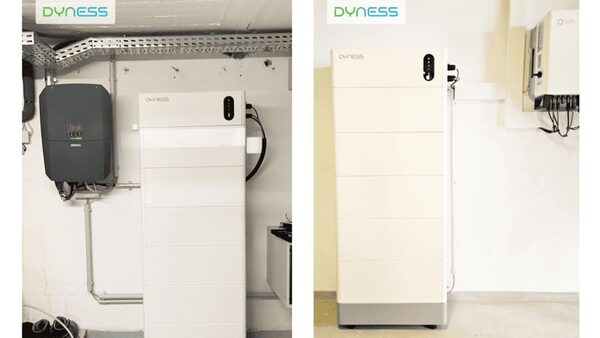
An AC-coupled battery is a separate unit next to the existing inverter, connecting into the home's AC network2. It runs on its own dedicated inverter and connects directly to the consumer unit, leaving the original solar inverter untouched13. The system typically consists of a battery, an inverter, and a connection to the AC grid14. In a microinverter installation the battery sits on the grid or AC side, where the microinverter feeds AC power that has already been inverted3.
Because the battery is on the AC side, it relies on available AC capacity to charge, sharing the inverter's output between the home and the battery15. That has a consequence for homes whose array is large relative to its inverter. Where output is clipped at the inverter, AC-coupled batteries are unable to capture the excess DC energy generated by the panels, and cannot solve clipping15. Capturing clipped solar requires a DC-coupled battery15.
The compensating strengths are flexibility and independence from the PV equipment. AC coupling allows the integration of different types of inverters and batteries16, and AC-coupled products are described as compatible with a wide range of solar systems and battery technologies14. Even if the PV system fails, the batteries can still provide power during outages17. An AC-coupled system can also be added to an existing DC-coupled system16, which matters for households that want to expand years later. Compare that with the modular and stackable approach to adding capacity within one product family.
DC-coupled systems: the battery connects before the inverter
A DC-coupled battery is installed with the solar panels rather than on the AC or grid side3. DC power from the panels directly charges the battery without intermediate AC conversion4, and the system has an integrated charge controller that feeds the current into the battery18. Hybrid, DC-coupled batteries are intended for new installations, with the photovoltaic panels connected directly to the inverter19.
The single-unit arrangement is what makes it suit new build. DC-coupled systems have a single unit acting as PV inverter and battery charger, making them ideal for new PV installations1, and the system uses fewer components, which is described as easier for new solar homeowners to start out3. One maker states plainly that DC coupling is generally more efficient and preferred for new installs20. Batteries in these systems are commonly lithium iron phosphate with an integrated monitoring system18; the chemistry page sets out how LFP differs from the alternatives.
The costs of the arrangement are directional and dependence-related. A DC-coupled solution operates one way, DC to AC, so it cannot draw power from the grid for home use3. Where DC-coupled storage is retrofitted rather than fitted new, extension cables must be run on either the DC or the AC side depending on where the storage unit goes, and too many cables can cause wiring mistakes3. Compatibility is also tighter: no manufacturer can ensure a 100% algorithm match between a storage unit and different microinverter brands, so compatibility issues are described as inevitable3.
Efficiency: where the conversion steps fall
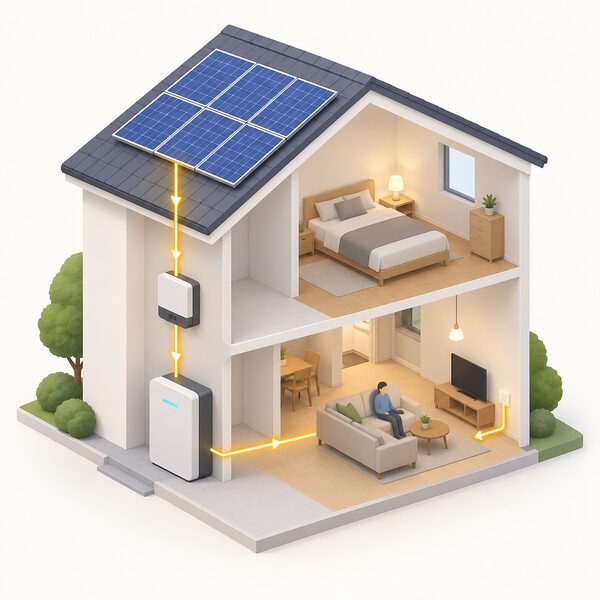
The efficiency case for DC coupling is structural rather than a matter of better components. Solar energy goes directly into the battery without needing to be converted through the inverter21, which minimises conversion steps and reduces power loss22. Counting them: a DC-coupled system requires one energy conversion on the PV to battery to household path5, where an AC-coupled system performs multiple AC/DC conversions5.
How big the gap is depends on which maker is asked, and the figures are not consistent.
| Claim | Figure | Source type |
|---|---|---|
| AC-coupled loses more than DC-coupled | approximately 8% more energy5 | maker guidance, 2024 |
| Hybrid swap improves round-trip efficiency | about 5%6 | maker guidance, 2026 |
| Difference between the two | "minimal and wouldn't impact" everyday use3 | maker guidance, 2025 |
These are manufacturer statements from companies selling one arrangement or the other, and they disagree on how much the coupling method matters. What is not in dispute is the direction: AC coupling features multiple energy conversions, so overall efficiency is a bit lower3, and more energy is lost during the conversion processes compared with DC coupling23. Modern inverters are highly efficient and minimise the loss, though conversion always causes some14. The loss in an AC-coupled retrofit is characterised by one maker as minor24. For how losses are measured and reported across a whole system, see round-trip efficiency.
In practice, the efficiency difference is rarely the deciding factor. The cost of replacing a working solar inverter to gain a few percent of round-trip efficiency is usually larger than the energy saved, which is why the independent advice favours AC coupling on existing arrays7.
Retrofit or new install: which coupling fits which home
This is where the choice is usually made. AC-coupled systems connect the battery after the solar inverter and are often easier to retrofit to existing solar PV installations25. AC-coupled batteries retrofit easily and work with the existing inverter26, adding storage without replacing or interfering with the existing solar inverter14, and generally without interfering with the original solar panel or inverter warranties24. One maker describes the retrofit effort as a few plugs to complete the battery addition3. Beyond the AC-coupled inverter and the battery itself, no additional equipment or cost is required27.
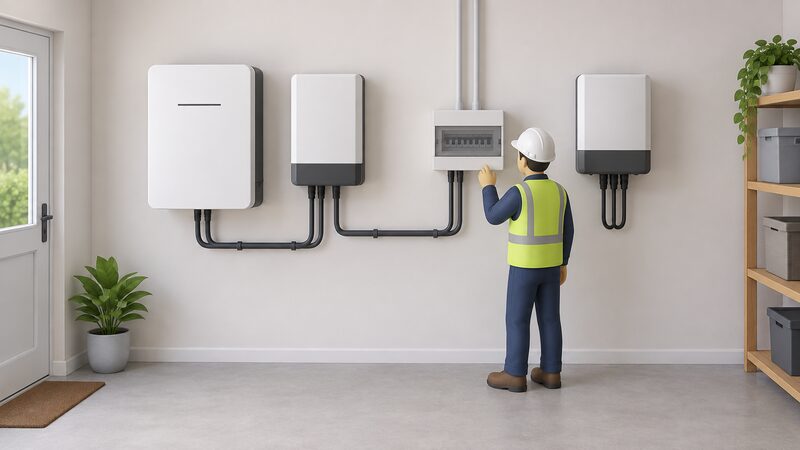
A DC-coupled battery connects before the inverter, which usually means replacing the existing inverter with a hybrid model28. That can be a good option where the inverter is already nearing the end of its life, but it is generally a larger upgrade than an AC-coupled system28. Retrofitting a battery-ready DC system requires additional installation, upgrades, and more batteries, each needing its own DC/DC module29.
| Situation | Typically suited |
|---|---|
| Existing PV, inverter working | AC-coupled, easier retrofit7 |
| New PV and battery together | DC-coupled, single hybrid unit1 |
| Existing inverter near end of life | DC-coupled hybrid swap28 |
| Mixed-brand or microinverter array | AC-coupled, wide compatibility14 |
One UK-specific point concerns legacy Feed-in Tariff systems. Where DC coupling would reduce measured generation and so tariff income, an AC-coupled retrofit battery may make more financial sense1. Where the inverter is replaced for a hybrid, the FIT provider must be notified28.
Cost: what each arrangement adds
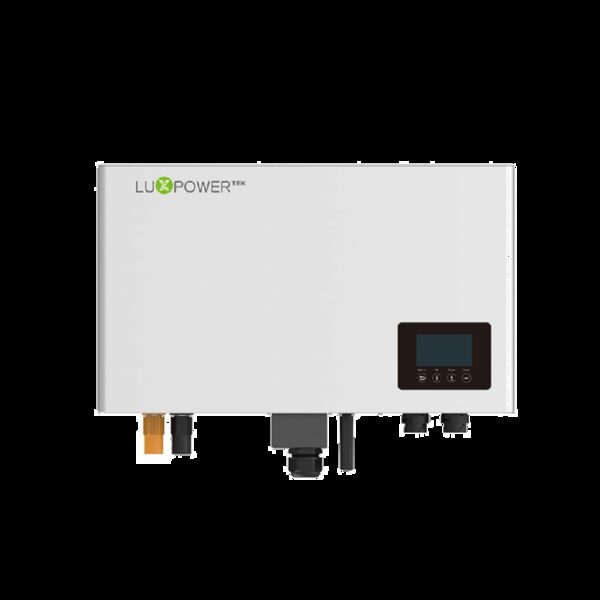
There is no single published price for either coupling method, and quotations depend on the battery size, the existing equipment and the labour involved. The figures below come from maker guidance and should be read as indicative rather than as a market survey.
The Energy Saving Trust, as reported by Which?, states that AC systems are more expensive than DC systems32. That is a comparison of complete systems. Looked at from the position of a household that already owns working panels, the arithmetic reverses: with an AC-coupled retrofit the upfront hardware cost is lower because only the battery is bought, where a DC-coupled hybrid means paying for the battery plus a new inverter24.
| Item | Figure | Basis |
|---|---|---|
| AC-coupled system, 4 kWh to 15 kWh, installed | £3,000 to £6,000, including 0% VAT relief6 | maker guidance, 2026 |
| AC-coupled retrofit, 5 kWh, installed | £3,000 to £5,50033 | maker guidance, 2026 |
| Worked example, retrofitted 5 kWh AC-coupled battery | £4,20033 | maker guidance, 2026 |
| DC-coupled hybrid swap, 5 kWh | £4,000 to £7,000+6 | maker guidance, 2026 |
| Equipment saving from one hybrid inverter versus two separate inverters | £800 to £1,5008 | maker guidance, 2026 |
VAT is the same for both routes. Battery storage installed with solar PV carries 0% VAT9, a zero rate that has applied to domestic battery storage systems since February 202434 and is set to remain in effect until 31 March 202710, after which it is due to increase to 5%35. One maker notes the rate may return to 5% or 20% after expiry36; the documents differ on what follows, so both possibilities are stated here. See the VAT rate on home battery storage and what a home battery costs for the wider picture.
Battery voltage: 48V low-voltage against 100V to 500V high-voltage
Coupling and battery voltage are separate choices, but they interact. DC-coupled systems are built around either standard low-voltage 48V or high-voltage 100V to 500V+ DC battery architectures8.
Low-voltage batteries generally sit below 100V, such as 12V or 48V38. For 48V systems the rated battery voltage should be 48V or 51.2V, whether lithium or lead-acid39. Common nominal voltages include 12V, 24V, 48V and 51.2V, with modern home energy storage often using 48V or 51.2V40. Off-grid battery banks are normally 24 or 48 VDC rather than 12 VDC, to reduce cable sizes41.
High-voltage batteries typically operate above 100V, such as 300V to 500V38, and may run from around 100V to several hundred volts DC42. Some DC-coupled inverters advertise compatibility with 100 to 700V high-voltage batteries4. One high-voltage product uses a built-in DC-DC boost to 400V, which the maker states avoids overheating caused by high currents43.
The current argument runs the same way in AC-coupled products. One maker states that an AC-coupled storage system has the advantage of using high voltages, keeping charging and discharging currents low to minimise temperature cycles in the battery and extend battery life44. Lower current at a given power means thinner cable and less heat. See battery power ratings and C-rate for how current limits translate into usable kW.
Backup power: what keeps running in a cut
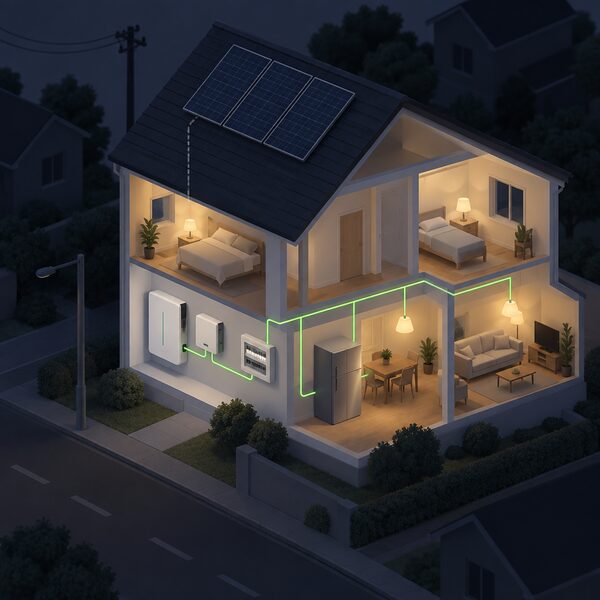
Neither coupling method gives backup by default. Backup is a separate function that has to be specified, wired and approved.
AC-coupled storage with a backup function allows operation of critical loads in the event of a power cut, either to a dedicated circuit or a complete house, and requires DNO approval31. AC coupling is described as providing backup power during grid outages14, and one AC coupler plus storage battery arrangement is stated to provide power for key loads of about 3 kW without interruption when off-grid27. Because the battery inverter is independent of the PV inverter, the batteries can still provide power during outages even if the PV system fails17.
DC-coupled energy storage, by contrast, usually has no operation in the event of a power cut31, though DC-coupled products with an explicit grid backup function exist and one maker rates the resulting degree of self-sufficiency as very high45.
"Several owners told us that their batteries don't work in a power cut, as the PV and battery also shut down if this happens"
The Centre for Sustainable Energy notes that the more expensive battery systems can also provide electricity during a power cut47, which frames backup as a paid-for upgrade rather than an inherent property of storage. In a full off-grid AC-coupled installation, a backup diesel generator can be controlled to charge the battery if it runs low48; the same source warns that generation connected directly to the battery must pass through the battery to power loads, incurring a large loss of energy48. AC-coupled storage can also serve as a battery bank or emergency power supply in off-grid settings such as camping3, while DC coupling is described as suiting new and off-grid installations in both residential and commercial applications12. Backup in a power cut and off-grid battery systems cover the wiring and standards involved.
Faults and commissioning: what the coupling changes
Coupling affects which faults a household is likely to meet. Storage inverters report a BMS COM fault, error 500, when battery communication fails: in lithium battery mode the machine communicates with the battery through a network cable, so the check is whether the wiring between the energy storage machine and the battery is normal49. Error 505 indicates the positive and negative battery terminals do not correspond to the terminals marked on the machine, and error 506, battery open, calls for a check that those terminals are firmly connected49.
Other codes belong to the AC side, and so appear more often in AC-coupled and hybrid installations tied to the mains. Error 302 means the machine has no mains connection49. Errors 300 and 304 occur when the connected mains voltage or frequency exceeds the rated range under the set safety regulations, and the check is whether voltage or frequency is above the upper limit or below the lower limit49. Warning 401 appears when the electricity meter is not connected, which matters because under some safety regulations the machine must be connected to the electricity meter to work normally49. Error 418 occurs when the programmed firmware does not match, resolved by confirming the correct software version49.
In lead-acid mode, the upper and lower limits of battery voltage must be set, and the machine must be connected to the NTC terminal at the corresponding terminal block49. That reflects a chemistry difference covered in lead-acid, AGM and gel batteries. More on diagnostics sits in maintenance, alarms and common faults.
What coupling means for household energy independence
Coupling determines how much of a home's generation it can keep, and what it stays tied to. A DC-coupled system stores surplus daytime PV generation in the battery for night-time use, reducing electricity bills over time5, and captures clipped output that an AC-coupled battery cannot reach15. On raw solar self-consumption it is the tighter arrangement.
But independence is not only about solar. An AC-coupled battery can charge from the grid or from solar3, which opens the door to cheap overnight charging and to running the house through peak-price hours. Where the grid is used for charging, an installer may recommend additional metering so imported electricity is not confused with solar generation28. Hybrid systems bridge both, charging directly from panels during the day like DC coupling and from the grid at night like AC coupling22. A DC-coupled system that cannot draw from the grid for home use3 is more solar-dependent by design: in a dark UK December that is a real constraint. Stacking a battery with smart tariffs sets out what grid charging is worth.
The dependencies that remain are the same in both cases. The home is still connected to a distribution network operator whose approval is needed for backup31, still reliant on a manufacturer for battery communications and firmware49, and still tied to a supplier unless the system is genuinely off-grid with its own generator48. AC coupling preserves one form of independence that DC coupling gives up: the battery inverter and the PV inverter are separate, both AC-coupled and hybrid-coupled methods allow equipment reuse when upgrading a PV system into a storage system5, and AC-coupled products work with a wide range of battery types and capacities14 and compatible battery brands50. A household that DC-couples ties its solar, its storage and its future expansion to one hybrid unit and one maker's ecosystem. That is efficient, and it is also a single point of failure and a single supplier. Neither answer is right for every home. The wider question is set out in home batteries and household energy independence and the main guide to home battery storage.
Sources50 cited
- Batteries, inverters and chargers knowledge base, Spirit Energy, 2026
- Solar panels combined with a home battery, Homey, 2026-09-20
- DC-coupled vs AC-coupled vs hybrid solar battery storage, Hoymiles, 2025-09-23
- AC and DC inverter FAQ, LuxPower, 2024-08-01
- Understanding PV-BESS coupling methods, Alpha ESS, 2024-07-23
- Adding batteries to an existing solar system, Jackery UK, 2026-08-26
- Battery storage advice, Centre for Sustainable Energy, 2025-10
- Micro inverter guide: AC-coupled vs DC-coupled storage, Jackery UK, 2026-08-28
- Zero carbon, zero VAT, MCS Foundation, 2026-09-20
- Support with energy costs, Consumer Council for Northern Ireland, 2026
- Introduction of DC coupling for home energy storage, Dyness, 2024-01-15
- Understanding solar terminology: AC-coupled vs DC-coupled, Alpha ESS, 2022-08-03
- Home battery storage and energy independence, Jackery UK, 2026-06-25
- AC-coupled battery storage: enhancing energy efficiency, Alpha ESS, 2023-11-10
- Understanding solar clipping and how home batteries can help, Alpha ESS, 2025-07-30
- Key benefits of AC-coupled systems, Alpha ESS, 2023-05-19
- Decoding AC-coupled vs DC-coupled batteries, Alpha ESS, 2023-05-31
- DC-coupled storage system, RCT Power, 2026-09-19
- Energy storage FAQ, Eaton, 2026-09-17
- Hybrid inverters, Sunsynk, 2026-09-17
- Choosing a battery for your home, SolarEdge, 2023-12-05
- DC coupling vs AC coupling: which solar system to choose, Sungrow, 2025-01-07
- DC coupling vs AC coupling, Sungrow, 2025-01-07
- Adding a battery to an existing solar system, SolaX Power, 2026-06-05
- Solar panel battery storage, Fuse Energy, 2026-08-13
- Why home battery storage will be key in the UK in 2026, Spirit Energy, 2025-11-07
- Prepare for backup power this winter, Solis, 2022-01-17
- How to add battery storage to a Feed-in Tariff solar system, Good Energy, 2026-07-24
- Battery-ready versus hybrid systems, SolaX Power, 2024-09-27
- Advantages of combining PV systems with energy storage, SolaX Power, 2025-01-21
- Grid connect system with battery storage, Wind and Sun, 2026-09-20
- Solar panel battery storage, Which?, 2026-05-14
- Adding batteries to an existing solar system, Jackery UK, 2026-06-10
- Balancing investment in clean heat and energy efficiency in Scottish housing retrofit, ClimateXChange, 2024
- Solar panel installation in East Anglia, Fuse Energy, 2026-09-12
- Are solar batteries worth it?, Jackery UK, 2026-06-04
- Micro inverter guide, Jackery UK, 2026-06-16
- High voltage versus low voltage batteries, Alpha ESS, 2024-08-30
- Essential battery tips for home PV energy storage, Solis, 2024-10-23
- Low voltage battery, SolaX Power, 2026-09-11
- Medium off-grid AC system, Wind and Sun, 2026-09-20
- High voltage vs low voltage solar battery, SolaX Power, 2026-09-07
- High Voltage Battery Storage ESS (HV), Haier HVAC, 2026-09-17
- AC-coupled storage system, RCT Power, 2026-09-19
- Residential storage solutions, Fronius, 2026-09-17
- Solar panel battery popularity is booming: should you buy one?, Which?, 2019
- Making the most of your solar PV panels, Centre for Sustainable Energy, 2026-08
- AC-coupled off-grid system, Wind and Sun, 2026-09-20
- Storage inverter FAQ, Growatt, 2026-09-17
- AC-coupled inverter series, LuxPower, 2022-03-24
 Adding Battery StorageCan you add a battery to solar panels you already have, or does the whole system need replacing?
 Solar and Energy IndependenceHow far domestic solar cuts dependence on suppliers and the grid, what self-consumption really looks like across the year, what a battery, diverter or EV adds, and the grid-outage limit of ordinary inverters.
 Types of Home EV ChargerWhich home charger suits your car and your driveway?
 All-in-One Battery SystemsA single unit holding your battery and the equipment that turns its power into usable electricity.
 Home Battery Install StatisticsHow many homes in the UK actually have a battery, and is that number growing quickly?
 What Size Battery?How much electricity does your home use in a day, and how much of that falls in the hours when power is cheap or your solar panels are generating?