In this guide
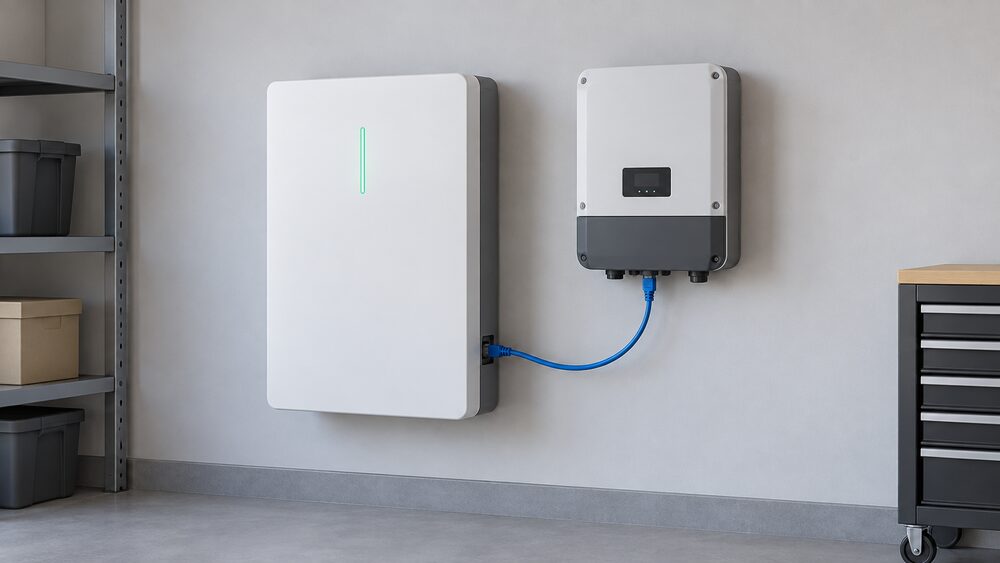
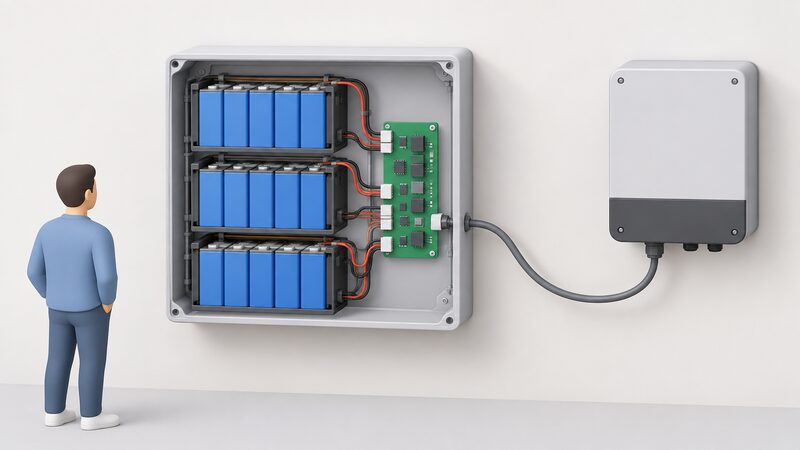
A battery management system, or BMS, is the electronics inside a home battery that monitors and protects the individual cells. It manages voltage, current, temperature and cell balancing, and it is the layer that decides what the battery can safely accept and deliver1. On a lithium home battery it is also the part that talks to the inverter, and when that conversation stops, the system stops.
That communication link is why a BMS fault so often looks like an inverter fault. In lithium battery mode the inverter needs to communicate with the battery through a network cable, and when that communication fails the machine displays "BMS COM Fault"2. The household sees an error code on an app; the cause is usually a cable, a setting or an approval question rather than a failed cell.
The BMS is also the component that carries most of a household's energy independence, because it is what allows a battery to be cycled daily for years without being damaged. It enforces the floor below which the battery must not discharge, it prevents overcharging, and it reports state of charge so the system knows when to stop. Where it fails, the household falls back on the grid and on whatever the inverter can do without a battery.
What a battery management system actually does
A BMS has four jobs, and they run continuously. It measures the voltage of the battery and, in a proper lithium system, of individual cell groups. It measures current in and out. It measures temperature. And it acts on those measurements, cutting the battery out of circuit if any of them leaves the safe window1. The maker description of the function is deliberately broad: a battery management system monitors and protects battery cells, managing conditions such as voltage, current, temperature and cell balancing1.
The protection side is what a household notices when it works. A home battery storage system should never be allowed to discharge to zero, because doing so can significantly reduce the life of the battery, and in normal operation the system stops taking electricity out at a set level, perhaps 20% of total storage capacity1. That floor is not a physical limit of the cells; it is a decision enforced by the BMS and the inverter together, and it is the single most important protection for longevity.
The management side is less visible. A BMS manages how energy is distributed and used so that the battery delivers maximum performance without compromising safety or lifespan, which in practice means reducing capacity loss, slowing cell ageing and extending usable life6. It also feeds the monitoring that households rely on: most battery storage systems monitor battery health and will alert the owner when a replacement is needed4.
For a household, the practical consequence is that the BMS is the difference between a battery that is a durable asset and one that is a consumable. It is also the component that makes a lithium battery safe to keep inside or beside a home, which is why fault management appears in the standards that govern installation. PAS 63100:2024 covers requirements such as battery and fault management and installation locations5, and it applies to battery systems within the low voltage limits defined in BS 7671, excluding systems whose nominal voltages on the AC or DC side exceed low voltage7.
Why a BMS matters for battery lifespan and effectiveness
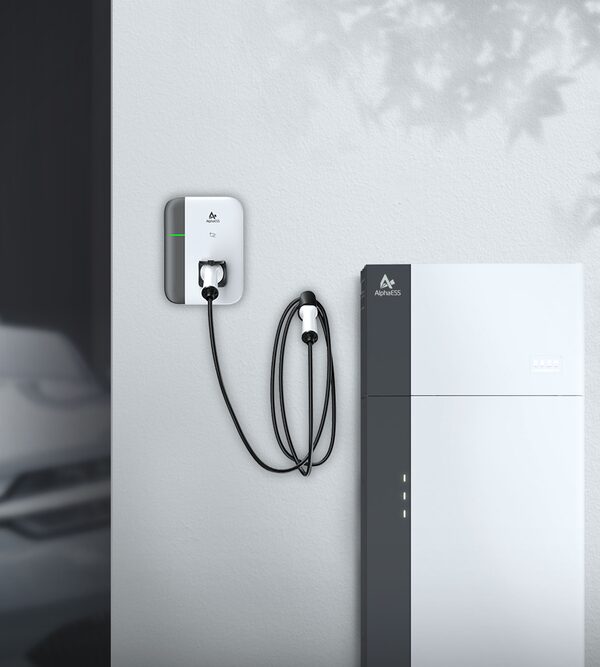
The commercial case for a home battery rests on cycling it hard for a decade or more. That is only possible if every cell stays inside its voltage window, because a lithium cell that is overcharged or over-discharged degrades faster and, in the worst case, becomes a safety risk. The BMS is the mechanism that prevents both, and the maker literature is explicit that it helps reduce capacity loss, slows down cell ageing and extends the usable life of the battery6.
The independent guidance points the same way from the household side. Energy Saving Trust states that a system should never let the battery discharge to zero, as this can significantly reduce the life of the battery, and describes the set floor, perhaps 20% of capacity, at which discharge stops1. That floor is a BMS and inverter setting, and it is the reason a battery's nominal capacity is not the same as its usable capacity. The gap between nominal and usable capacity is covered in more detail in battery capacity and usable capacity.
Effectiveness is the second half of the argument. A battery is only useful if it charges when electricity is cheap or free and discharges when it is expensive, and that requires the system to know its own state of charge accurately. A BMS that misreports state of charge will either leave capacity unused or push the battery too far. The independent consumer guidance describes the intended pattern: electricity generated by solar panels during the day is stored in a household battery so that free electricity generated during the day can be used at night8.
There is a safety dimension that has become more prominent. The government's review of domestic battery energy storage systems was a review of the safety risks of domestic battery energy storage systems and measures to mitigate these, focused on lithium-ion technology because it now dominates new designs9. Fault management, which is a BMS function, is central to that mitigation. The wider picture of how cells degrade over time is set out in battery cycle life and degradation.
Cell monitoring, balancing and protection: the BMS's core jobs
Cell balancing is the job that most distinguishes a BMS from a simple protection circuit. A pack is made of many cells in series, and no two cells are identical. Over hundreds of cycles, small differences in capacity and internal resistance cause some cells to sit at a higher voltage than others. Without balancing, the weakest cell limits the whole pack, and the strongest cell is pushed towards overvoltage on every full charge.
Balancing brings the cells back into line, usually by bleeding a small amount of charge from the higher cells so that the battery finishes a charge with all cells at a similar voltage. It is slow, it happens near the top of the charge, and it is one of the reasons a BMS needs to know individual cell voltages rather than just the battery total. The maker description of the BMS function lists cell balancing alongside voltage, current and temperature as the conditions managed1.
Protection is the second core job, and it operates on three variables. Voltage protection stops a cell going above or below its limits. Current protection stops the battery delivering or accepting more than its rating, which matters when a heavy load is applied. Temperature protection stops charging or discharging when the battery is too hot or too cold, because lithium cells accept charge poorly at low temperature and are at greater risk at high temperature. The same protection logic appears in the inverter's own fault list: a heavy load that the battery cannot supply enough power for is a common cause of a fault on off-grid equipment10.
The third job is state estimation. The BMS calculates state of charge and, in better systems, state of health, and reports both. This is what allows a system to reserve capacity for backup, and it is what allows the household to see whether the battery is still performing as it did when installed. The independent guidance that most systems monitor battery health and alert when replacement is needed4 describes the output of this function rather than the function itself.
Communication with the inverter: why the BMS-inverter link matters
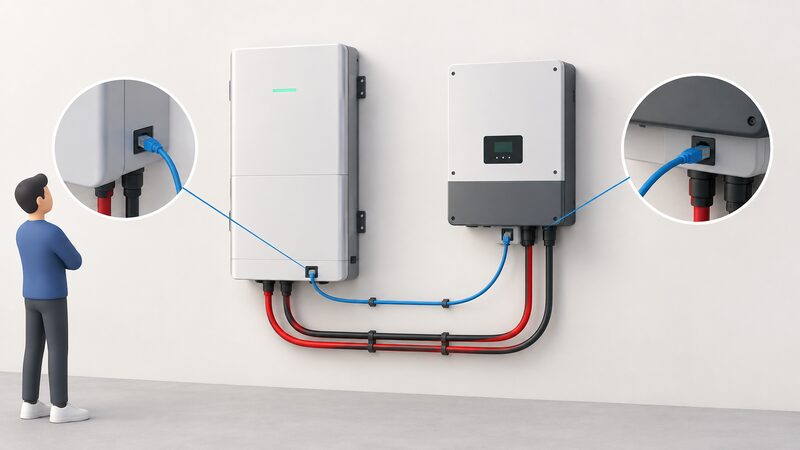
In a lithium system the BMS and the inverter are two computers that must agree. The inverter needs to know the battery's state of charge, its voltage limits, its maximum charge and discharge current, and its temperature, because those determine how hard the inverter can push. The BMS needs to be able to tell the inverter to stop. That exchange runs over a dedicated communications cable, described in the maker documentation as a network cable: in lithium battery mode, the machine needs to communicate with the battery through the network cable2.
The direction of data matters. Where the battery operates in lithium mode with communication, voltage data originates from the battery's BMS rather than from the inverter's own measurement11. That is a meaningful shift of authority: the inverter stops deciding what the battery voltage is and starts taking the BMS's word for it. It is also why a communications failure is treated as a fault rather than a warning, because the inverter has lost the information it needs to charge safely.
Compatibility is therefore a system-level question, not a battery-level one. A battery and an inverter that are both perfectly good products may not talk to each other unless the combination has been tested and listed. One maker's documented remedy for a communication warning is to replace the BMS cable, or check whether the battery has been approved and appears on the compatibility list12. That second option is the one households most often overlook: the cable can be perfect and the pairing still unsupported.
The practical implication for a household is that the battery and inverter should be chosen as a pair, and that the communications protocol is part of the specification. This is one of the reasons all-in-one systems exist, where battery, inverter and communications are designed together, as described in all-in-one battery systems. It also means that adding a battery to an existing inverter later is a compatibility question first and a capacity question second, covered in adding more batteries later.
BMS communication faults: error 500, error 506 and related codes
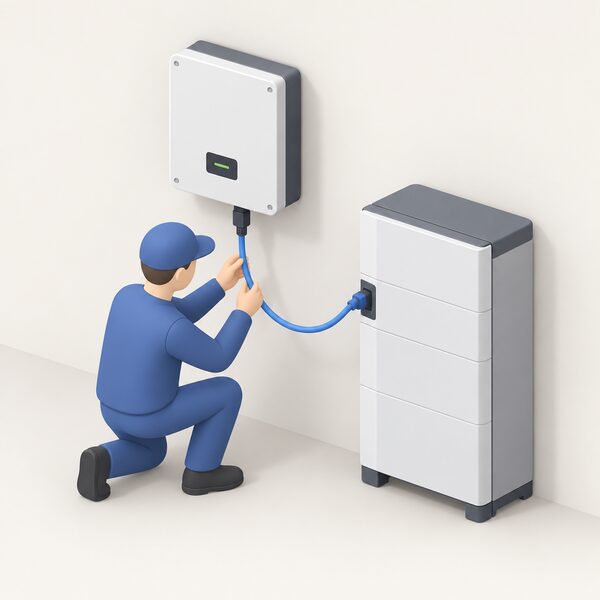
The fault codes a household is most likely to see on a storage inverter cluster around the battery link. Error 500, displayed as BMS COM Fault, occurs when battery to battery communication fails2. The documented first check is whether the wiring between the energy storage machine and the battery is normal2. In lithium battery mode the machine needs to communicate with the battery through the network cable, and the fault appears when that communication fails13.
Error 506, Battery Open, is the more confusing one because it appears when communication is working. It occurs when the communication between the machine and the battery is good in lithium battery mode but the battery is not connected2. In other words, the data link is fine and the power link is not. The documented check is whether the positive and negative terminals of the battery are firmly connected to the machine2. A household seeing 506 should understand that the BMS is alive and talking; the problem is downstream of it.
Error 505, Battery reversed, is a connection fault with a clear cause: the positive and negative terminals of the battery do not correspond to the terminals marked on the machine, and the documented check is whether those terminals are reversed2. It is not a software problem and it is not something to investigate by trial and error.
Other codes in the same family are worth knowing because they are often mistaken for BMS faults. Error 302, No AC Connection, occurs when the machine has no mains connection, and the check is whether the wiring between the mains and the machine is correct and reliable2. Errors 300 and 304, AC V Outrange and AC F Outrange, occur when the connected mains voltage or frequency exceeds the rated range under the set safety regulations2. Error 418 occurs when the firmware programmed by the machine does not match, and the check is whether the software is the correct version2. Warning 401 occurs when the electricity meter is not connected, and the check is whether the meter is connected or whether communication between the meter and the machine is normal2.
| Code | Displayed as | Documented cause | Documented check |
|---|---|---|---|
| 500 | BMS COM Fault | Battery to battery communication fails2 | Wiring between machine and battery2 |
| 505 | Battery reversed | Terminals do not match those marked on the machine2 | Whether positive and negative are reversed2 |
| 506 | Battery Open | Communication good but battery not connected2 | Whether terminals are firmly connected2 |
| 302 | No AC Connection | Machine has no mains connection2 | Wiring between mains and machine2 |
| 300 / 304 | AC V Outrange / AC F Outrange | Mains voltage or frequency outside rated range2 | Whether mains is outside the rated range2 |
| 418 | Firmware mismatch | Programmed firmware does not match2 | Whether software is the correct version2 |
| 401 | Meter warning | Electricity meter not connected2 | Meter connection and communication2 |
A separate family of codes appears on off-grid equipment. Warning 20 means BMS communication error, and the documented remedy is to replace the BMS cable, or check with the maker whether the battery has been approved and appears on the compatibility list12. Fault 09 is diagnosed by connecting the battery only, without utility input and without PV input10. Fault 52 is most often caused by heavy load, because the battery cannot supply enough power for the load10. Fault 56, Battery Connection Is Open, has its own settings rules: for a lithium-ion battery only US2 or Li can be used, and for a lead-acid battery the usual charging current is 0.2 to 0.3C, where C means battery capacity14.
Voltage limits and sensor faults in lead-acid systems: errors 502, 503 and NTC open
Lead-acid banks do not have a per-cell BMS in the way a lithium pack does. Instead, the inverter is configured with voltage limits and a temperature sensor, and it is the inverter's job to keep the bank inside them. In lead-acid mode the upper and lower limits of the battery voltage need to be set, and when the battery voltage exceeds the range, error 502 or 503 occurs13. The documented remedy is to set the battery voltage range of the energy storage machine2.
That configuration step is where most lead-acid faults originate, because the correct limits depend on the battery type, the number of cells in series and the temperature. Warning 03, Battery Is Overcharged, is caused by incorrect settings for a lead-acid or lithium-ion battery, or by a battery voltage sample circuit fault, and for a lead-acid battery the documented check is the 19th and 20th option on the LCD, with the issue possibly caused by too high a bulk charging voltage or float voltage12.
The NTC terminal is the temperature input. In lead-acid mode the energy storage machine needs to be connected to the NTC terminal at the corresponding terminal block, and an NTC OPEN fault occurs if the NTC is not connected13. The documented check is whether the NTC terminal is properly connected with the energy storage machine2. This matters because lead-acid charging voltage must be adjusted for temperature: a bank charged at a voltage correct for one temperature will be overcharged at a higher temperature if the inverter does not know the temperature.
Lead-acid remains a real part of the UK picture. Independent guidance describes lithium-ion and lead-acid as the main types for domestic use15, and domestic battery storage uses principally lithium, the most common material for domestic batteries, but also cobalt and nickel16. The chemistry differences, and why lead-acid banks rely on inverter settings rather than a BMS, are set out in lead-acid, AGM and gel batteries and home battery chemistries.
BMS products on the UK market: Victron smallBMS NG and VE.Direct connectivity
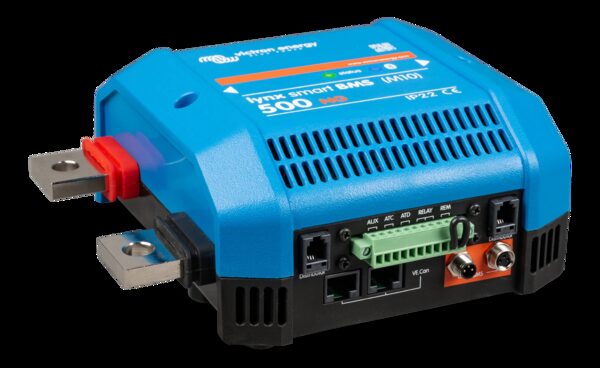
Victron Energy sells a family of BMS units for its own lithium batteries, and the naming is worth understanding because the units are not interchangeable. The VE.Bus BMS NG is a battery management system for Victron Energy Lithium NG batteries17. It is designed for Victron Lithium NG batteries, is not compatible with Lithium Battery Smart batteries, and is intended for systems with Victron inverters or inverter/chargers using VE.Bus communication18. It includes Bluetooth Smart for wireless configuration, monitoring and firmware updates via the VictronConnect App17.
The smallBMS NG with pre-alarm is an all-in-one battery management system for Victron Lithium NG batteries19, and it includes Bluetooth Smart for wireless configuration, monitoring and firmware updates via the VictronConnect App19. The Lynx Smart BMS NG is an advanced battery management system specifically designed for Victron Energy Lithium NG batteries20. It should not be confused with the Lynx Smart BMS, which is designed for Victron Lithium Battery Smart batteries21. The Lynx Smart BMS NG is not compatible with Victron Lithium Battery Smart batteries, which use the Lynx Smart BMS instead20.
| Product | Compatible batteries | Communications |
|---|---|---|
| VE.Bus BMS NG | Victron Lithium NG batteries17 | Bluetooth Smart, VictronConnect App17 |
| smallBMS NG | Victron Lithium NG batteries19 | Bluetooth Smart, VictronConnect App19 |
| Lynx Smart BMS NG | Victron Energy Lithium NG batteries20 | Maker product page20 |
| Lynx Smart BMS | Victron Lithium Battery Smart batteries21 | Maker product page21 |
The VE.Direct side of the range is separate again. Victron Energy VE.Direct inverters use screw terminals for the battery connection and provide a VE.Direct communication port22. VE.Direct is a data port rather than a BMS, and it is the interface through which those inverters report and are configured. A household specifying a Victron system therefore has to match three things: the battery generation, the BMS that supports it, and the inverter's communications bus. The wider Victron range for off-grid and home use is described in Victron home batteries.
What a BMS fault means for your home's energy independence
A BMS fault is the clearest demonstration of where a home battery's independence ends. The household is not independent of the grid in the first place: a battery storage system does not normally provide power in a power cut unless additional equipment and configuration is included23. So a BMS fault does not remove backup that was never there; it removes the daily cycling that the household was relying on to shift cheap or solar electricity into the evening.
What remains depends on the system. A battery without solar can still store cheap off-peak electricity from a time of use tariff and provide blackout protection, and there are significant benefits to having a home energy storage system even without solar or other renewables3. But that function depends on the battery being available, and a battery held offline by a communications fault is not available. The household falls back on importing at the prevailing rate, which is precisely the cost the battery was bought to avoid.
There is a second dependency that a BMS fault exposes: the manufacturer's own systems. Configuration, monitoring and firmware updates for the Victron BMS units run through the VictronConnect App over Bluetooth17, which means the household's ability to see and manage the battery depends on a phone app and the maker's software. That is a form of dependence that sits alongside the grid, the supplier and the gas network, and it is worth naming plainly. The wider picture of what a battery can and cannot deliver is set out in home batteries and household energy independence and battery monitoring and apps.
A BMS fault also has a safety dimension that should not be dismissed. The government review of domestic battery energy storage systems examined the safety risks and the measures to mitigate them, with a focus on lithium-ion technology9. Fault management is one of the requirements PAS 63100:2024 covers5, and the standard excludes systems whose nominal voltages exceed low voltage as defined in BS 76717. The standards that govern installation more broadly are covered in battery installation standards, and the fire safety picture in home battery fire safety.
"The blue product does not contain a battery management system nor have a fuse on the output."
That recall notice is the sharpest illustration of why the BMS is not optional on a lithium pack. A lithium battery sold for household or leisure use without one has no cell-level protection and no fuse on its output, and the safety body's own notice says so. For a household, the BMS is not an accessory to the battery; on a lithium system it is part of what makes the battery a battery rather than a collection of cells.
Sources24 cited
- Battery storage, Energy Saving Trust, 2026-08-19
- Storage inverter FAQ, Growatt, 2026-09-17
- Powervault for home, Powervault, 2026-09-19
- Battery storage, MCS Certified, 2026-09-17
- PAS 63100: protection against fire of battery energy storage systems, BSI, 2026-09-17
- Unlocking the secret weapon behind battery systems: BMS, AlphaESS, 2025-08-27
- Electrical installations: protection against fire of battery energy storage systems for use in dwellings, BSI, 2024-03-20
- Getting smarter with energy, Centre for Sustainable Energy, 2026-07
- Domestic battery energy storage systems, BEIS, 2020-10-02
- Off-grid inverter FAQ, Growatt, 2026-09-17
- Off-grid inverter FAQ, LuxPowerTek, 2024-07-04
- Off-grid inverter FAQ, page 2, Growatt, 2026-09-19
- Storage inverter FAQ, page 1, Growatt, 2026-09-19
- Off-grid inverter FAQ, page 1, Growatt, 2026-09-19
- Electrical energy storage systems, Ivie, 2025-04-22
- Battery storage advice, Centre for Sustainable Energy, 2025-10
- VE.Bus BMS NG datasheet, Victron Energy, 2026-09-17
- VE.Bus BMS NG, Victron Energy, 2026-09-19
- smallBMS NG datasheet, Victron Energy, 2026-09-17
- Lynx Smart BMS NG, Victron Energy, 2026-09-19
- Lynx Smart BMS NG product page, Victron Energy, 2026-09-19
- VE.Direct inverter datasheet, Victron Energy, 2026-09-17
- Solar power facts, Energy Saving Trust, 2026-08-13
- BOOW LiFePO4 leisure battery recall, Electrical Safety First, 2026-09-17
 Maintenance and FaultsWhat does it mean when your home battery starts beeping or showing a warning, and can you fix it yourself?
 What a HEMS DoesWhat does a home energy management system actually do, and is it worth having one?
 Monitoring and AppsIf the internet goes down, does the app still show what the battery is doing?
 Solar and Battery MonitoringWhat does your solar and battery app actually show you, and can you trust it?
 DIY Home Battery BuildsBuilding your own home battery?
 Smart Meter Faults and FixesYour smart meter has stopped working.