
In this answer
Short answer
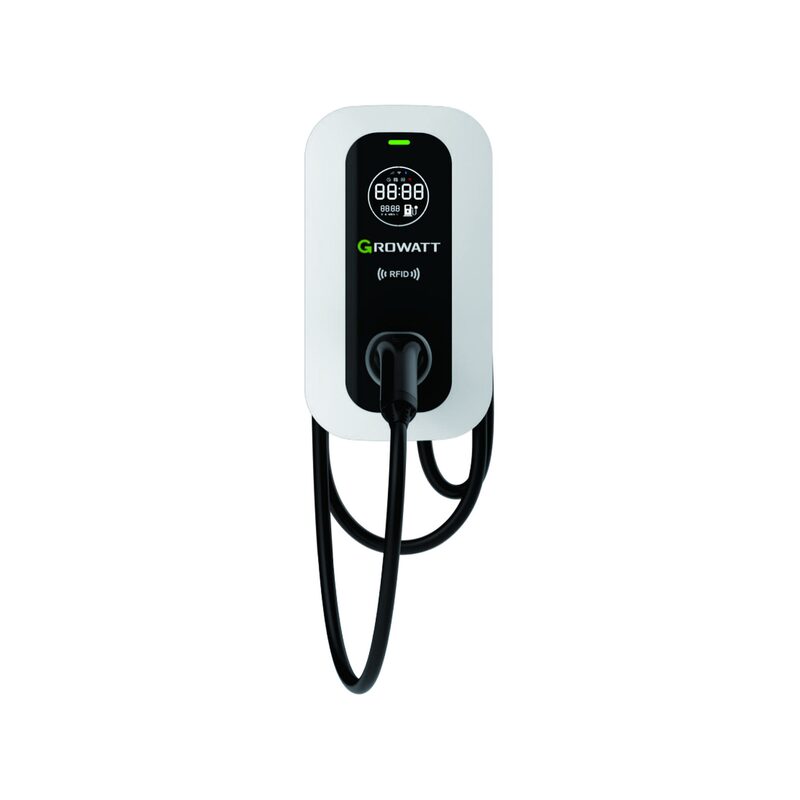
Growatt's EV charger line divides into two families by current type. The AC chargers run from 7 to 22 kW, and the DC chargers run from 20 to 200 kW1. That single split answers most capacity questions: a household looking at a Growatt charger is choosing within the 7 to 22 kW AC band, while the 20 to 200 kW DC units belong to commercial and rapid charging work.
The AC band is where UK homes sit. Most home chargers are 7 kW, which the maker describes as a good balance between charging speed and household electrical supply, and for a typical UK home the maximum EV charger power is 7.4 kW2. An 11 kW or 22 kW unit only delivers its full rate where the property has a three-phase supply and the vehicle's onboard charger accepts that rate.
The DC band is a different category of equipment. Growatt's DC chargers span 20 to 200 kW, and the maker describes the range as usable in residential and commercial scenarios4. In practice, public rapid DC chargers deliver 50 kW up to 350 kW or more, and rapid and ultra-rapid charge points can put 80% of an EV battery in 30 to 60 minutes5.
Growatt's EV charger range at a glance
The range is best read as two product lines rather than one ladder of speeds. On the AC side, Growatt's smart EV charger is quoted with a capacity range of 7 to 22 kW AC, and the same figure appears across the maker's product pages for the AC models1. On the DC side, the same pages quote 20 to 200 kW DC1. The two figures are the whole of the published capacity story.
That shape matches the wider market. AC chargers typically run 7 to 22 kW and are the ones found at home, workplaces or on streets, suited to overnight charging9. Destination charging is usually AC at 7 to 22 kW, though faster chargers may be encountered10. Independent guidance puts the ceiling for specific EV chargers at up to 22 kW, noting that most suppliers offer 3 kW or 7 kW as standard11.
| Family | Published capacity | Typical setting |
|---|---|---|
| Growatt AC chargers | 7 to 22 kW AC1 | Home, workplace, destination |
| Growatt DC chargers | 20 to 200 kW DC1 | Commercial, rapid charging |
| Public rapid DC (market context) | 50 kW up to 350 kW or more5 | Motorway services, hubs |
The practical reading is that Growatt covers the domestic band fully and reaches into the commercial band with DC equipment. A household is not choosing between 7 kW and 200 kW; it is choosing a point in the AC band, and the DC figures describe what the same maker offers to sites with three-phase or higher supply and commercial charging demand.
AC chargers: 7 to 22 kW for home and workplace charging
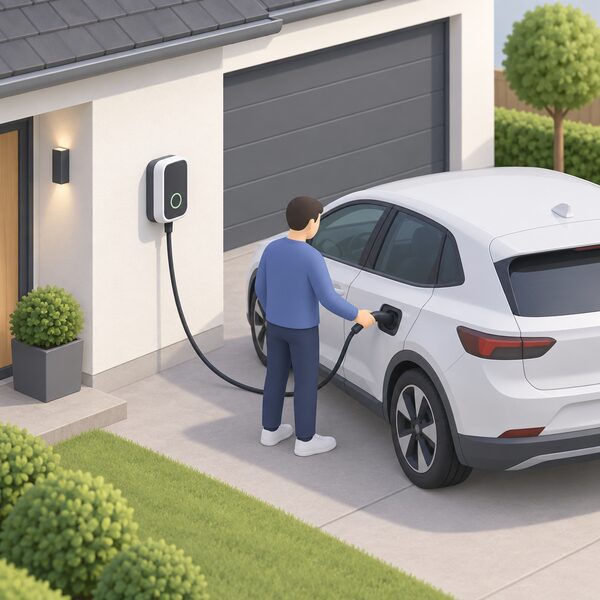
The AC range is the part of Growatt's line that a household will actually consider. Growatt's smart EV charger is quoted at 7 to 22 kW AC and described as suitable for residential and commercial scenarios8. The same 7 to 22 kW figure appears on the maker's AC product pages, so the band is consistent across the line rather than varying by model1.
What drives the choice within that band is the supply and the car, not the charger alone. Most home chargers are 7 kW, described as a good balance between charging speed and household electrical supply2. For a typical UK home, the maximum EV charger power is 7.4 kW3. Independent guidance recommends 3.6 kW, 7 kW or 22 kW AC for daily home charging in the UK, and notes that fast chargers ranging from 7 kW to 22 kW are the most common type of home EV charger12.
The gap between 7 kW and 22 kW is therefore about what the property can deliver and what the vehicle can accept. A single-phase domestic supply supports the 7 kW class; an 11 kW or 22 kW charger needs a three-phase supply to run at its rated output, and the vehicle's onboard charger must accept that rate. Where either condition is missing, the charger runs below its nameplate figure.
For a household's energy independence, an AC charger is the point where driving stops being a fuel purchase and becomes an electricity purchase. It does not remove dependence on the grid: the charger draws from the supply, and the household still buys units from a supplier unless it has its own generation. What it changes is the fuel, and what it enables is charging from a home solar and battery system rather than a forecourt.
DC chargers: 20 to 200 kW for commercial and rapid charging
Growatt's DC chargers are quoted at 20 to 200 kW DC, and the maker describes the range as usable in various scenarios including residential and commercial4. The DC line sits in the same published capacity statement as the AC line, which is why the two figures are usually quoted together1.
The market context for DC charging is faster still. Rapid and ultra-rapid chargers run 50 kW to 300 kW according to official guidance, and CCS connectors support rapid and ultra-rapid charging at power levels from 25 kW to 400 kW+14. Ultra rapid chargers are defined as 100 kW and more on DC, and public network rapid DC chargers run from 50 kW up to 350 kW or more16. DC rapid chargers on the public network are quoted at 50 to 350 kW9.
Charging time scales with that power. At 240 kW DC, an electric vehicle can add 25 kWh in 6 minutes, 50 kWh in 12 minutes, 75 kWh in 17 minutes and 100 kWh in 22 minutes, assumed from 20% charged17. Rapid and ultra-fast charge points can charge 80% of an EV battery in 30 to 60 minutes6.
Where two vehicles share a charger, the split is not always even. Some EV chargers divide power 50:50 between two vehicles: a 250 kW-maximum car and a 50 kW car sharing a 150 kW device receive 75 kW and 50 kW respectively, a total of 125 kW18. That behaviour matters for anyone reading a headline capacity figure on a shared unit.
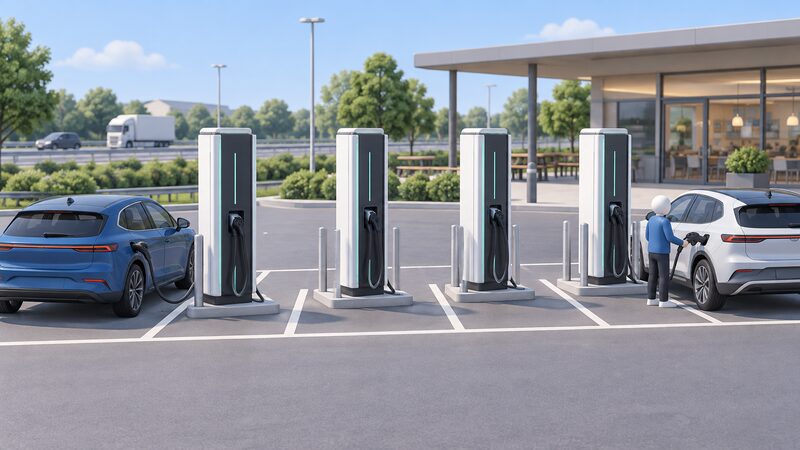
For a household, the DC band is context rather than a purchase. DC rapid chargers run from 50 to 350 kW and are what you will find on the public network, at motorway services or dedicated charging hubs7. A DC charger is commercial equipment, and the domestic case sits with AC. The relevance to energy independence is indirect: DC charging is what makes long journeys possible without petrol, but it depends on a public network and a charge point operator, not on the home.
Charging with 100% renewable energy: how the claim works
Growatt states that its EV charger can charge your car with 100% renewable energy, and the same claim appears on the maker's EV charger solution page4. The mechanism behind it is a PV linkage charge mode that is driven by solar4. In other words, the claim rests on linking charging to a solar array rather than on the charger itself generating anything.
That distinction matters for how a household reads the claim. A charger connected to a solar array and a battery can direct generation into the car, which is the sense in which the energy is renewable. A charger connected only to the grid draws whatever the grid supplies. The claim describes a system configuration, not a property of the box on the wall.
Comparable approaches exist elsewhere in the market. One charger maker describes a system that checks for surplus solar energy and starts charging the EV immediately if the surplus is more than 25% of the charger's rated capacity, working with solar and home consumption monitoring20. A green energy tariff supplier describes powering the grid with 100% renewable electricity21. These are different routes to a similar headline: matching charging to renewable generation, or buying renewable electricity.
The limit is worth stating plainly. A solar-linked charge mode reduces the amount of grid electricity a car uses, and it depends on sunshine, array size and the car being plugged in when generation is available. It does not make the household independent of the grid, and it does not remove the need for a grid connection for the majority of charging hours. What it does is shift some charging from purchased units to self-generated ones, which is the same logic that applies to a home battery.
"charge your car with 100% renewable energy"
Who Growatt is: scale, monitoring ecosystem and data security
Growatt describes itself as one of the world's largest manufacturers of PV inverters and energy storage systems, present in the PV market for well over a decade and supplying residential, commercial and industrial installations in dozens of countries22. The maker states that it has systems installed in more than 180 countries and more than 43 representative offices worldwide23. Its inverter range runs from 600 W to 253 kW, which covers domestic through to large commercial installations23.
The monitoring layer is the part a household lives with. Growatt's residential storage system offers 24-hour self-consumption monitoring, and the ShinePhone app and ShineServer portal show state of charge, charge and discharge power and operating status, monitored through the connected inverter24. Battery management on the ARK range relies on an HVC 60050-C2 controller for safe operation, with an integrated BMS monitoring cell voltages, temperature and cell balance26. Storage units can be expanded without losing their original capacity, and the WIT hybrid inverters include a built-in EPS backup module23.
Warranty coverage is broad on paper: Growatt lists PV inverters, storage inverters, smart energy management devices, monitoring software, EV chargers, portable power stations and batteries and accessories within its product coverage29. For a household, that matters because the charger sits inside the same support and monitoring structure as the rest of the system rather than being a standalone appliance.
The dependence to note is the app and the cloud. Monitoring through ShinePhone and ShineServer means the household's view of the system runs through Growatt's software and the connected inverter. That is convenient and it is a dependency: firmware, app support and portal access sit with the manufacturer. Growatt's support pages include an EV charger screen configuration password of 6980 for accessing settings at the unit itself, which is a local route into configuration30. Households weighing independence should read the monitoring arrangement alongside the hardware, and the wider question of app support life is covered in firmware updates and product support life.
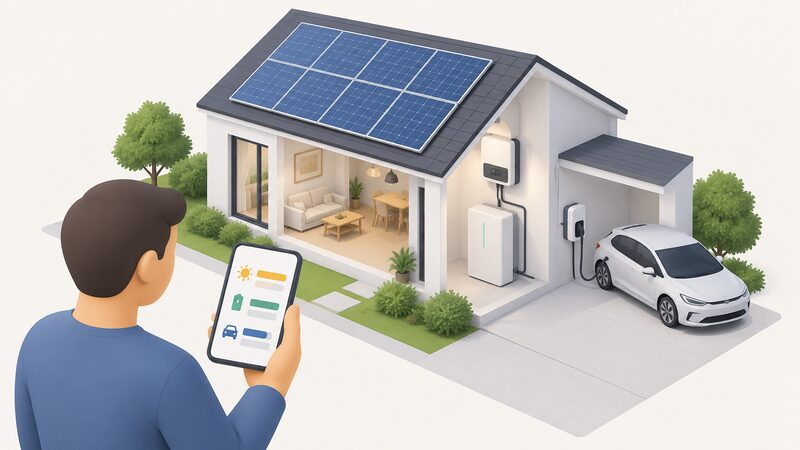
Buying a Growatt EV charger in the UK
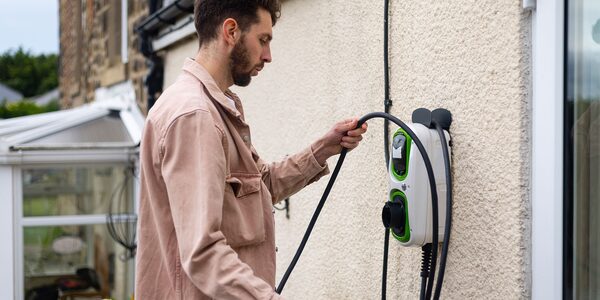
Growatt products are listed as available at Growatt.tech, the maker's own channel, and the company's UK-facing pages direct buyers there22. Beyond that, purchase runs through installers, and prices are installer-quoted rather than published as a fixed retail figure. Official guidance puts an EV charger at up to £1,0007.
Grant support exists for some installations. The Workplace Charging Scheme covers up to 75% of the total costs of the purchase and installation of EV chargepoints including VAT, capped at £500 per socket31. For rental accommodation or flat owners in the UK, the government's EV charge point grant provides funding of up to 75% towards the cost of installing EV charge points, up to a maximum of £3506. Both are official schemes with their own eligibility conditions, and neither is a domestic homeowner grant for a standard driveway installation.
Northern Ireland has its own arrangements. The chargepoint and infrastructure grants are administered separately from the GB schemes, and the guidance sits with the Northern Ireland departments rather than with the UK-wide scheme pages7. Households there should check the NI guidance directly rather than assuming the GB grant figures apply.
The independence picture for a buyer is mixed and worth stating. A Growatt charger ties the household into Growatt's ecosystem for monitoring and support, and into the installer for the physical work. What it offers in return is a capacity band that covers the domestic case, a solar-linked charge mode, and a maker with a broad warranty list and a large installed base. The grid connection remains, the supplier remains for any units not self-generated, and the app remains a manufacturer dependency. The charger changes the fuel, not the underlying structure.
For households comparing the wider market, the home EV charger manufacturers page sets Growatt alongside other brands, and Growatt solar inverters and home batteries covers the rest of the ecosystem the charger plugs into.
Sources32 cited
- THOR 07AS-S/P/SE/PE EV charger, Growatt, 2026-09-17
- EV charger installation guidance, Fuse Energy, 2026-09-01
- Electric car charging at home, Which?, 2026-02-25
- THOR 60-200DD-P DC charger, Growatt, 2026-09-17
- Understanding electric car charging, Spirit Energy, 2026
- Electric vehicle charging, Electricity North West, 2026-09-19
- Electric vehicles, nidirect, 2026-09-17
- THOR 11-22AS-S/P/SE/PE EV charger, Growatt, 2026-09-17
- How long does it take to charge an EV, Electroverse, 2025-10
- Electric vehicle charging, SMMT, 2025-06-25
- EV charging, Uswitch, 2026-09-19
- Electric car battery, Fuse Energy, 2026-05-19
- New to EVs, Ohme, 2026-04-23
- EVs: the facts, SMMT, 2025-09-22
- Connector types, Zapmap, 2026-05-20
- Electric car charging guide, Which?, 2026-05-20
- Charging electric vehicles, Energy Saving Trust, 2026-04-23
- How long does it take to charge an electric car, Zapmap, 2026-04-15
- EV charger solutions, Growatt, 2026-09-17
- Manage EV charging in the Enphase app, Enphase, 2025-10-08
- Green driver, Good Energy, 2026-07-09
- Growatt MIN 5000 TL-X inverter, Growatt.tech, 2026-09-17
- Growatt, Growatt.tech, 2025-09-15
- Residential storage system, Growatt, 2026-09-17
- Growatt ARK battery set 20.48 kWh, Growatt.tech, 2026-09-17
- Growatt ARK 25.6 kWh battery kit, Growatt.tech, 2026-09-17
- Growatt WIT 6kW-HU hybrid inverter, Growatt.tech, 2026-09-17
- Growatt WIT 10kW-HU 3-phase hybrid inverter, Growatt.tech, 2026-09-17
- Warranty, Growatt, 2026-09-17
- Growatt support FAQ, Growatt, 2026-09-19
- Electric vehicle chargepoint and infrastructure grants, Department for Infrastructure, 2026-09-18
- THOR 40DS-P/DD-P DC charger, Growatt, 2026-09-17
 EV Charging Speeds and TimesHow long an electric car takes to charge depends on the charger and the car together, so a faster charge point will not always speed things up.
 Cost to Charge an EV at HomeHow home charging cost is worked out from battery size, efficiency, the unit rate paid and the tariff behind it, with full-charge costs of about £8 to £17, cost per mile, annual running costs and what changes for EV owners from April 2028.
 Portable Power Station SizeHow big a portable power station does a home actually need, and how long will it keep things running in a power cut?
 Capacity and Usable CapacityA battery sold as ten kilowatt hours rarely gives you all ten to use.
 The Full EV Charging GuideCharging an electric car at home usually means a wallbox, but do you need one, and what will it cost to fit and run?
 Home EV Charger ManufacturersWhich home EV charger brands are worth considering, and how do you choose between them?