In this guide
A Sunsynk hybrid inverter is a single wall-mounted unit that manages solar generation, battery charging and discharge, grid import and export, and household loads at the same time. The company builds single-phase, three-phase and high-voltage models spanning 1kW to 80kW, and its UK residential range runs from 3.6kW to 8kW on single phase, 8kW to 12kW on three phase, and 20kW to 50kW for high-voltage commercial work1.
For a household, the appeal is consolidation. One box replaces a separate string inverter and battery inverter, and the same unit provides backup switching, time-of-use scheduling and remote monitoring through the Sunsynk Connect app3. Sunsynk says its inverters are optimised for its own LiFePO4 batteries and guaranteed compatible across that range, while many models also accept third-party batteries over CAN bus or RS4852.
The dependence that remains is real. A Sunsynk system stays tied to the grid for import and export, to a supplier for whatever the array and battery cannot cover, and to a broadband connection and the manufacturer's cloud platform for remote monitoring and control. The company is UK-based in Widnes with a direct support line, which shortens the service chain but does not remove it4.
What a Sunsynk hybrid inverter does
A hybrid inverter sits between four things at once: the solar array, the battery bank, the grid and the household loads. Sunsynk describes its single-phase units as managing energy flow between all four simultaneously, with built-in support for both low-voltage and high-voltage battery packs, time-of-use optimisation and seamless backup switching3. That combination is what separates a hybrid from a plain string inverter, which only converts DC from the panels to AC for the house and grid.
The architecture is the same across the range. Sunsynk states that its all-in-one products use the same LiFePO4 chemistry and hybrid inverter architecture as the standalone ranges, so a household choosing between a separate inverter and battery or a combined unit is choosing a form factor rather than a different control system5. The company draws on over 20 years of engineering experience in developing these systems, and says they are trusted by installers in over 40 countries1.
For an existing solar household, the retrofit route matters. Sunsynk states that a hybrid inverter can be added alongside an existing string inverter using AC coupling, or the existing inverter can be replaced2. Sunsynk's own position is that DC coupling is generally more efficient and preferred for new installs, while AC coupling suits a retrofit where the original inverter is still serviceable2. That choice affects how much of the existing array can be routed through the battery, and it is worth understanding before specifying a system. More on the general case is at hybrid solar inverters and adding battery storage to a solar system.
The range: 1kW to 80kW, single-phase, three-phase and high-voltage
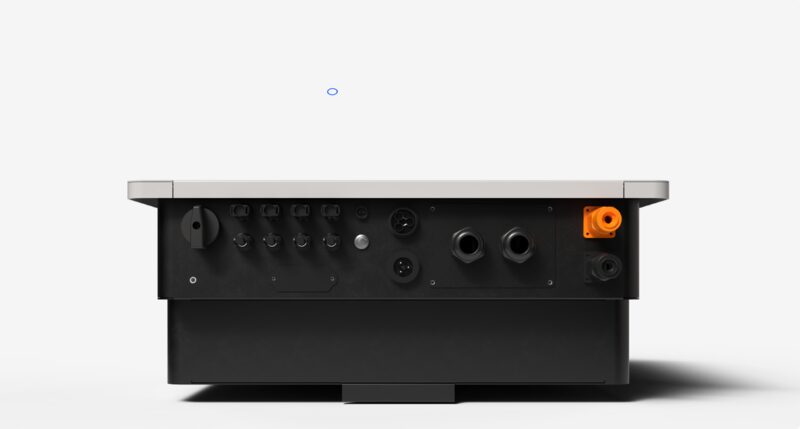
Sunsynk's headline range figure is 1kW to 80kW, split across single-phase, three-phase and high-voltage options and designed for residential and commercial energy management1. The UK-facing breakdown is narrower and more useful: single-phase systems from 3.6kW to 8kW for residential use, three-phase systems from 8kW to 12kW for larger homes and light commercial premises, and high-voltage commercial inverters from 20kW to 50kW2.
The three-phase range is described as available from 8kW to 30kW, balancing load across all three phases and supporting multi-unit parallel operation for higher capacity6. The high-voltage collection lists models including 20kW, 25kW, 29.9kW, 30kW, 50kW and 80kW three-phase units7. Sunsynk also sells string inverters with an interactive LCD display and intelligent air cooling for households that do not need battery integration8.
| Category | Stated range | Typical application |
|---|---|---|
| Single-phase hybrid | 3.6kW to 8kW2 | Homes and small businesses on a standard single-phase supply3 |
| Three-phase hybrid | 8kW to 30kW6 | Larger homes and light commercial premises2 |
| High-voltage commercial | 20kW to 50kW2 | Commercial and industrial-grade three-phase9 |
| Full range, all types | 1kW to 80kW1 | Residential, commercial and utility-scale2 |
The breadth is the point of the brand for installers: one manufacturer covers a domestic retrofit and a small commercial array. For a household, only the single-phase band is likely to apply, and the practical ceiling is set by the supply fuse and the distribution network operator's connection rules rather than by what Sunsynk sells. The general sizing question is covered at what size solar system does a home need.
Single-phase models: what homes on a standard supply get
The single-phase hybrid range runs from 3.6kW to 8kW and is sold in white and black finishes3. Sunsynk describes these units as intended for homes and small businesses on a standard single-phase supply, which covers the great majority of UK houses3. Every unit ships with full remote monitoring through the Sunsynk Connect app and over-the-air firmware updates, and all models include Wi-Fi monitoring and compatibility with Sunsynk LV batteries3.
The 8kW model is the top of the domestic single-phase band. Sunsynk's own product page for that unit sits alongside the wider range, and the company positions the single-phase band as the residential workhorse while three-phase takes over above it2.
Backup behaviour is worth understanding precisely. Sunsynk's system mode settings describe a "limited to home" mode as zero export but covering UPS and non-essential loads, while allowing excess solar to charge the batteries11. That is a configuration choice made at commissioning, not a fixed property of the hardware, and it determines which circuits stay live when the grid drops. The wider question of what stays powered is covered at do solar panels work in a power cut.
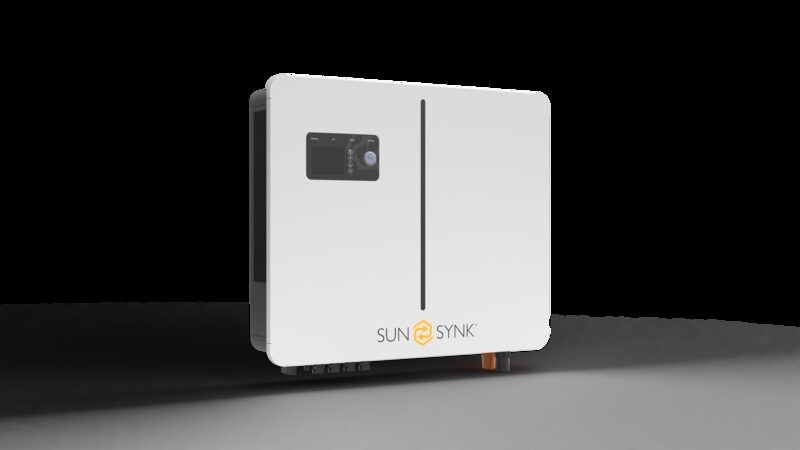
The Fusion all-in-one: 2.1 to 5.2 kWh with the inverter built in
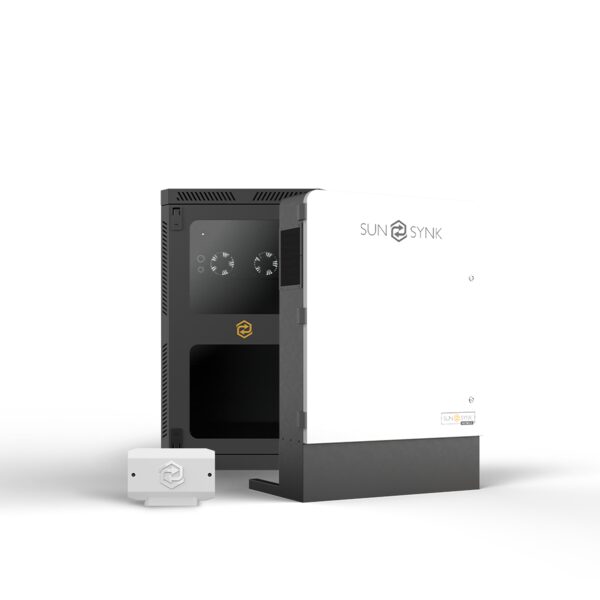
The Fusion range combines the inverter and battery in one enclosure, which removes a separate battery cabinet and its DC cabling. Sunsynk lists three pairings: a 2.5kW inverter with a 2.1kWh battery, a 3.6kW inverter with a 3.8kWh battery, and a 5.5kW inverter with a 5.2kWh battery9. The same pairings appear in the Fusion style listing10. The smallest inverter array in the range is described as 2.5 single phase9.
The Fusion unit ships prewired with the CT coil, battery isolator and fuse included, has a built-in solar isolator, supports on-grid operation, and can be set remotely9. Sunsynk states that extra batteries can be added and that the unit can be retrofitted9. The Verlinkt home battery storage system is a related all-in-one product, combining a 2.048kWh lithium iron phosphate battery with a hybrid inverter and 2kW power output12.
The Elite all-in-one takes the same idea further, with scalable storage per inverter of 5.12 to 30.72kWh13. Sunsynk describes the all-in-one system range as covering 3.6kW with 5.1kWh up to 8kW with 15.3kWh, spanning typical UK residential loads5. The trade-off is straightforward: an all-in-one is quicker to install and tidier, but capacity expansion is bounded by what the enclosure and its battery stack will accept, whereas a separate inverter and battery bank can be sized and grown independently.
| Model pairing | Inverter | Battery |
|---|---|---|
| Fusion, smallest | 2.5kW | 2.1kWh9 |
| Fusion, mid | 3.6kW | 3.8kWh9 |
| Fusion, largest | 5.5kW | 5.2kWh9 |
| Verlinkt | 2kW output | 2.048kWh12 |
| Elite all-in-one | Per inverter | 5.12 to 30.72kWh scalable13 |
Battery compatibility: Sunsynk LiFePO4, LV and HV packs, and the Pylontech protocol
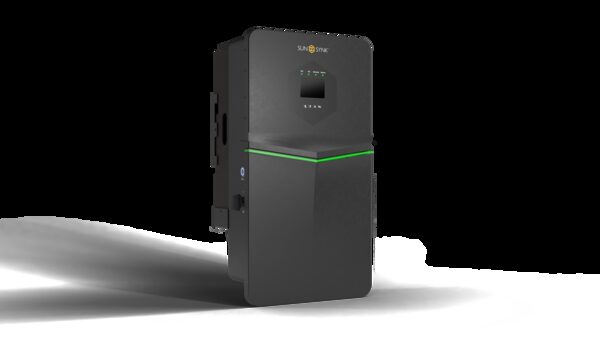
Sunsynk states that its inverters are optimised for use with Sunsynk LiFePO4 batteries and are guaranteed compatible across the entire Sunsynk battery range2. The chemistry is lithium iron phosphate throughout, offered in low and high voltage configurations1. The single-phase hybrid range is compatible with Sunsynk LV batteries, and the LP range of 3.6kW, 6kW and 12kW IP65 units is described as offering flexible battery compatibility3.
The all-in-one Elite models are more specific. The 2&4 Light Kit is compatible with a Sunsynk low-voltage battery14.
Third-party support is where the picture widens. Sunsynk states that many models also support third-party batteries via CAN bus or RS485, and directs buyers to the specific inverter datasheet for confirmation2. That is the route by which a household might pair a Sunsynk inverter with a Pylontech or other compatible pack, provided the protocol matches and the datasheet confirms it. The guarantee of compatibility, however, applies to Sunsynk's own battery range, not to third-party packs.
For a household, this matters for independence in a specific way: battery choice determines whether the system can be expanded later, and a proprietary pairing narrows the second-hand and replacement market. The general trade-offs are set out at adding battery storage to a solar system and home battery storage.
Monitoring and control with the Sunsynk Connect app
Sunsynk hybrid inverters are compatible with the Sunsynk Connect app, which provides real-time monitoring of all energy flows and remote system control15. Every single-phase unit ships with full remote monitoring through the app and over-the-air firmware updates, so the system can be updated without a site visit3. The three-phase range offers real-time monitoring through the Sunsynk app alongside flexible time-of-use scheduling and grid-protection settings6.
There is a second monitoring path. The Sunsynk data logger connects the inverter to the SolarmanV5 cloud platform, accessible through a mobile app for iOS and Android and a web portal12. Sunsynk also offers the Sunsynk Saver app for monitoring and managing an energy system remotely1. Across the range, the stated monitoring features are live data, fault alerts and remote installer access2. The Innagator series adds integration with the Sunsynk app so homeowners can see how surplus energy is being used each day17.
This is the clearest dependence the brand creates. Local operation continues without an internet connection, but remote monitoring, fault alerts, over-the-air updates and installer diagnostics all run through a cloud platform and a manufacturer's app. A household that wants to see and control its system from outside the house is relying on home broadband, Sunsynk's servers and continued app support. The general subject is covered at monitoring a solar PV system.
Sunsynk the company: UK base in Widnes, offices in seven territories

Sunsynk designs and develops solar storage systems and says it is trusted by installers in over 40 countries1. The company draws on over 20 years of engineering experience and reports a customer rating of 4.8 out of 5 based on verified reviews16. It states that more than 500,000 systems have been installed globally2.
The UK operation is a real presence rather than a distributor arrangement. The UK office address is Unit 8, Total Park, Bennetts Lane, Shell Green, Widnes WA8 0GW, and the UK telephone number is +44 151 832 43004. The same number is given for the UK technical support team, and it appears on the support site as the UK contact12. Beyond the UK, Sunsynk lists offices in Hong Kong, Australia, South Africa, the USA, Poland and the Canary Islands16.
| Territory | Address |
|---|---|
| United Kingdom | Unit 8, Total Park, Bennetts Lane, Shell Green, Widnes WA8 0GW4 |
| Hong Kong | Units 702-704, 7/F Texwood Plaza, 6 How Ming Street, Kwun Tong16 |
| Australia | Level 1, 982-988 Wellington Street, West Perth WA 600516 |
| South Africa | Stand 375, Northland Business Park, Angus Crecent Road, Hoogland, Randburg, Johannesburg16 |
| USA | 100 S. Ashley Drive, Suite 600, Tampa, Florida, 3360216 |
| Poland | Business House, Żeligowskiego 8/10, Łódź 90-753, Budynek C16 |
| Canary Islands | Tafetana, 32 P.I. Las Andoriñas 38639 Las Chafiras, Santa Cruz de Tenerife16 |
A UK base with a direct support line shortens the service chain compared with a brand supported only through importers. It does not change the underlying position: the hardware is manufactured overseas, spares and firmware come from the manufacturer, and the household's relationship with the brand runs through whoever installed the system.
Owning a Sunsynk inverter: CT placement, grid settings and G98/G99 compliance
Sunsynk's inverter range is G98 or G99 compliant depending on the model, and the all-in-one units are described as MCS-eligible and G98/G99 certified for UK grid connection2. The 3.6kW Elite all-in-one lists G98 and G99 under grid connection standards, and the 5kW Elite lists G9919. Sunsynk's general guidance is that all UK grid-connected solar inverters must comply with G98 or G99 engineering recommendations, which govern how distributed generation connects to the network15.
The grid setting itself is a commissioning decision with a compliance consequence. Sunsynk states that G98/G99 should be enabled instead of G98/G99_NI, and warns in capitals that grid settings must not be taken outside G98/G99 because doing so affects the inverter's compliance with UK grid regulations21. The Northern Ireland variant is a separate setting for that jurisdiction. The wider framework is explained at connecting solar to the grid: G98 and G99.
The current transformer is the other common commissioning issue. Sunsynk states that the arrow on the CT coil should point away from the grid and towards the inverter22. A CT fitted backwards, or clamped around the wrong conductor, produces the W04 meter comms fault or absent grid-side load readings22. The inverter uses that measurement for zero-export control, so a misread CT undermines the export limitation the household is relying on. Export limitation generally is covered at export limitation and G100 for home solar.
Faults and behaviour that are not faults
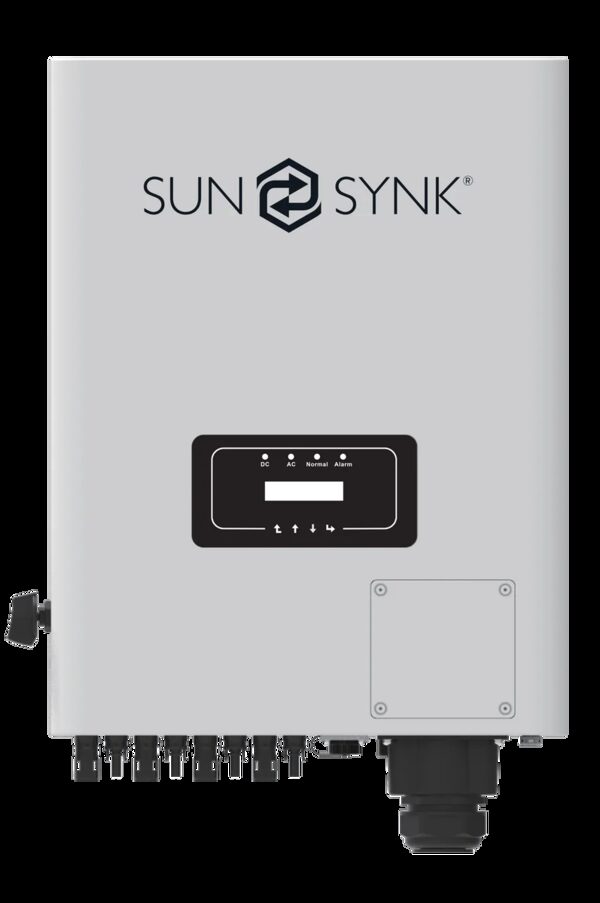
Two behaviours generate most support queries. The first is repeated grid disconnection. Sunsynk states that the inverter disconnects from the grid as a safety precaution if grid voltage falls outside specification, sending a Sunsynk Connect notification, then retries after 60 seconds, which triggers a second notification21. If the grid voltage is still too high the relay disconnects again, causing persistent notifications to both the installer and the end user21. Independent guidance from a distribution network operator lists grid voltage mismatch among the causes of solar inverter faults, which points the diagnosis at the supply rather than the equipment23.
The second is PV output stopping when the battery is full. Sunsynk explains that if the batteries are fully charged there is nowhere for the power to go, and this cuts out the PV power21. It is normal. The Energy Saving Trust describes the same logic for battery storage generally: charging stops when the battery is full, and the battery discharges when the next cheap tariff period ends, automatically24. A household seeing midday PV collapse on a sunny day with a full battery is seeing the system working as designed, not failing.
Firmware is occasionally part of the answer. Sunsynk notes that firmware updates are occasionally required, and the single-phase range supports over-the-air updates3. For a household, the practical implication is that some faults resolve remotely and some require the installer, and the split is not always obvious from the app.
Where a Sunsynk system has limits
The limits are worth stating as plainly as the capabilities. A Sunsynk hybrid inverter keeps a home connected to the grid for import and export, and to an electricity supplier for whatever the array and battery cannot cover. Backup during a power cut depends on how the system was configured at commissioning, not on the hardware alone, and Sunsynk's own mode descriptions show that backup coverage is a setting rather than a default11. Independent guidance notes that solar panels stop working during a power cut for safety reasons and most restart automatically once power is restored, which is the baseline any backup arrangement is built on25.
Remote monitoring and control depend on home broadband, Sunsynk's cloud platform and the continued availability of the app. Battery compatibility is guaranteed across Sunsynk's own LiFePO4 range, with third-party support subject to datasheet confirmation2. Grid compliance depends on the correct setting being enabled and left alone21. And the whole system depends on the installer who commissioned it, since CT placement, grid settings and system mode are all set on site.
None of that is unusual for a hybrid inverter, and the UK support presence in Widnes is a genuine advantage over brands with no domestic operation. The honest summary is that a Sunsynk system reduces dependence on imported electricity and increases control over when power is drawn, while leaving the household on the grid, on a supplier, on broadband and on a manufacturer's platform. The wider picture is at solar panels and household energy independence and hybrid solar inverters.
Sources25 cited
- Sunsynk home page, Sunsynk, 2026-09-17
- Sunsynk inverters range, Sunsynk, 2026-09-17
- Single-phase hybrid inverters, Sunsynk, 2026-09-17
- Sunsynk 8kW hybrid inverter, Sunsynk, 2026-09-17
- All-in-one solar storage, Sunsynk, 2026-09-17
- Three-phase hybrid inverters, Sunsynk, 2026-09-17
- High-voltage collection, Sunsynk, 2026-09-17
- String inverters, Sunsynk, 2026-09-17
- Sunsynk Fusion inverter, Sunsynk, 2023-09-23
- Sunsynk Fusion style inverter, Sunsynk, 2023-08-27
- Classic, Acure and Elite system mode settings, Sunsynk, 2026-09-17
- Sunsynk accessories, Sunsynk, 2026-09-17
- Sunsynk Innagator series, Sunsynk, 2026-09-17
- Sunsynk 2&4 Light Kit, Sunsynk, 2026-09-17
- How does a solar inverter work, Sunsynk, 2026-06-18
- Sunsynk contact and offices, Sunsynk, 2026-09-17
- Sunsynk LP range, Sunsynk, 2026-09-17
- Sunsynk support, Sunsynk, 2026-09-17
- Sunsynk 5kW all-in-one Elite hybrid inverter, Alternergy, 2026-09-17
- Sunsynk 3.6kW all-in-one Elite hybrid inverter, Alternergy, 2026-09-17
- UK grid voltage, Sunsynk, 2026-09-17
- No grid-side load readings, Sunsynk, 2026-09-17
- Managing voltage changes in your property, Electricity North West, 2026-09-19
- Battery storage, Energy Saving Trust, 2026-08-19
- Electricity North West FAQs, Electricity North West, 2026-09-20
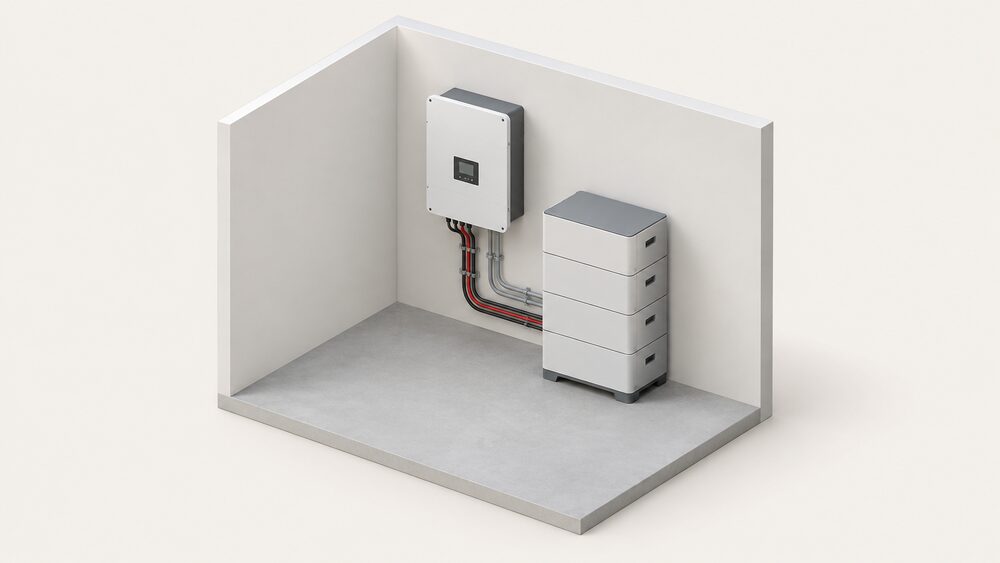 Sunsynk ECCOA Sunsynk ECCO package pairs a hybrid inverter with a battery to store solar power at home.
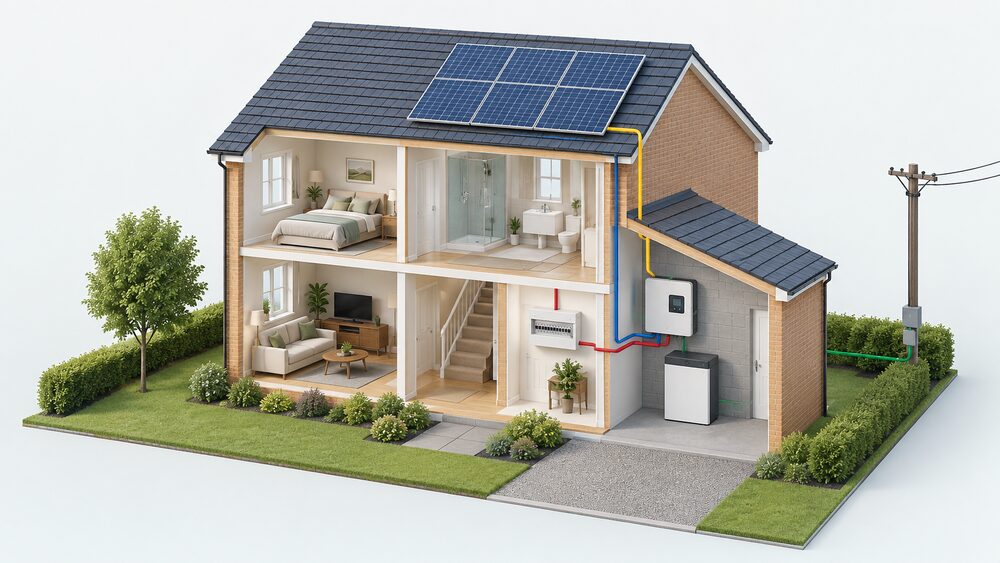 Sunsynk Hybrid Inverters and Home Battery StorageSunsynk hybrid inverters let your home store the solar power it makes and use cheap overnight electricity instead of buying at peak times.
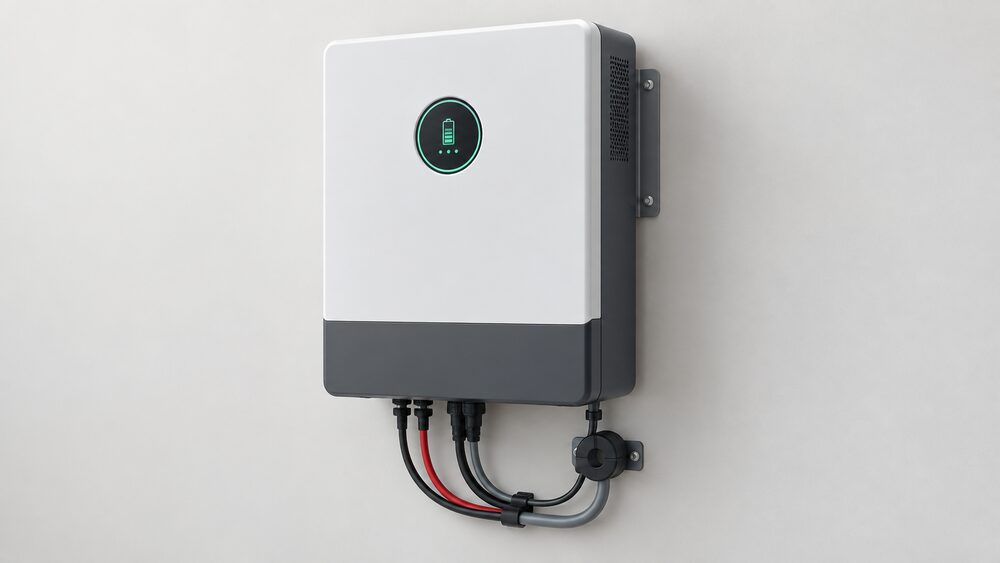 Sunsynk hybrid inverters and batteriesWhich Sunsynk inverter suits a typical UK home, and what size do you need?