
In this comparison
A hybrid heating system usually costs less to install than a full heat pump, and the gap is not small. Independent analysis puts hybrid installations at 30 to 40% cheaper than standalone air source heat pumps, with average hybrid costs of £8,000 to £9,000 against a typical standalone install at £13,0001. A separate guide gives £5,000 to £10,000 for a boiler combined with an air source heat pump, installation included3.
Running costs are a different question, and the evidence does not point one way. One analysis found a hybrid could cost about 10% more to run than a standalone heat pump at the current gap between electricity and gas prices, while the same document elsewhere reports marginal savings of around 2% excluding standing charges2. The upfront saving is the reliable part of the case; the running cost case depends on fuel prices, how much of the year the heat pump covers, and how the controls are set.
What a hybrid buys a household is a smaller electrical load, a retained gas connection and less disruption. What it does not buy is independence from gas, from the grid or from a supplier. The boiler remains, and so does the standing charge that comes with it.
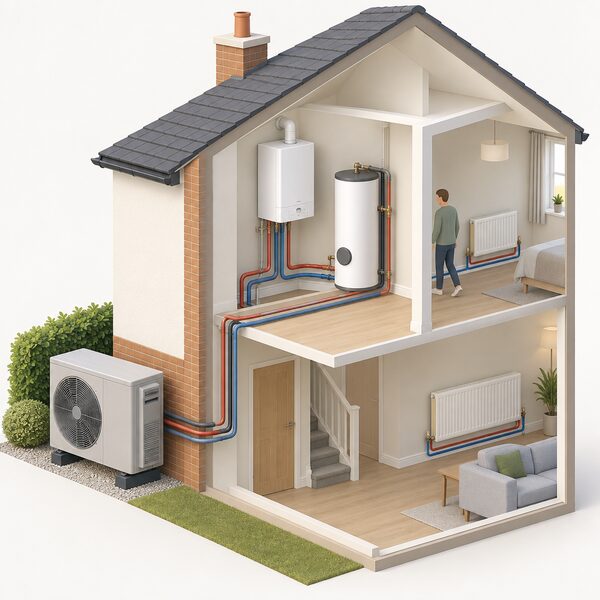
What a hybrid heating system is and how it works
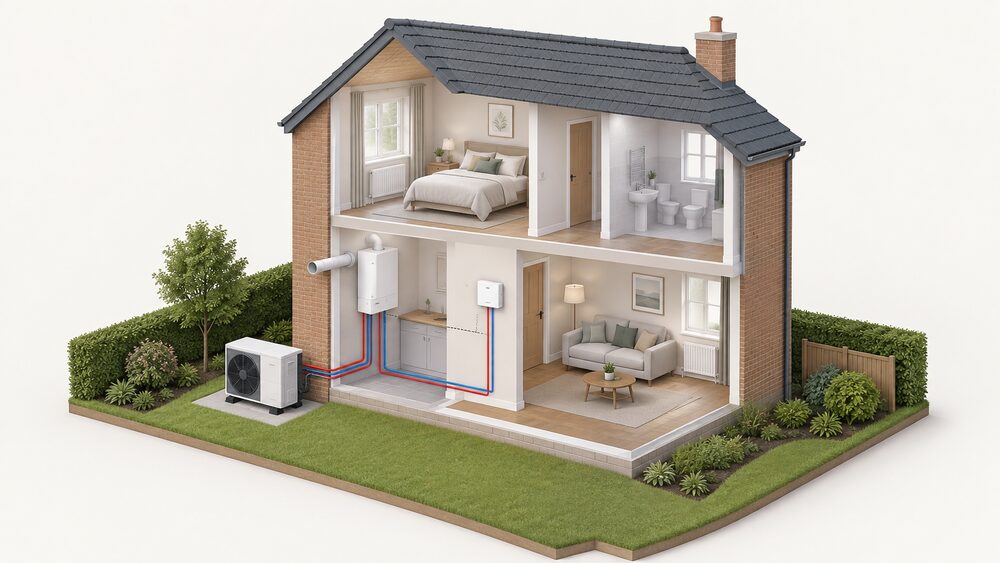
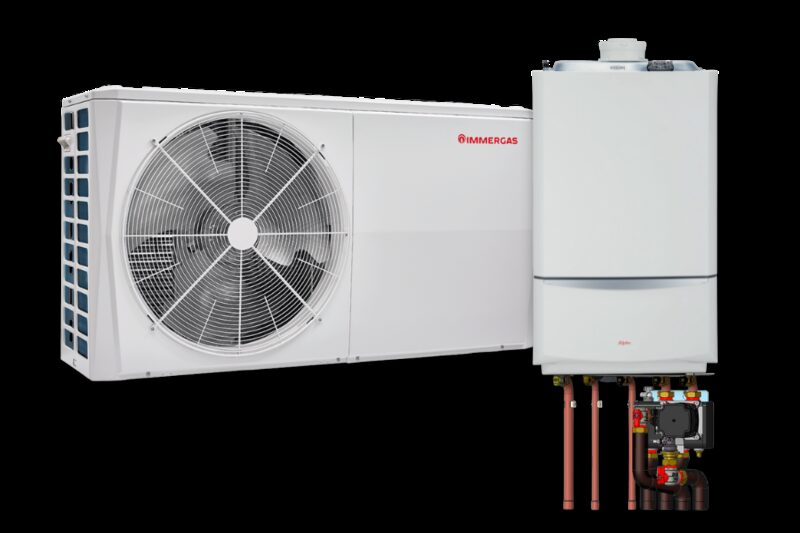
A hybrid heat pump is the combination of an electric-driven air source heat pump with a new or existing gas condensing boiler, run by a single control that operates the whole system5. Older official work defines it the same way: an electric air to water or ground to water heat pump combined with a gas boiler, a means of feeding heat into the existing distribution system, and a dedicated control to switch between the two6. Northern Ireland's government information describes hybrid heat pumps as able to work with another heating system in a building, such as a gas boiler7.
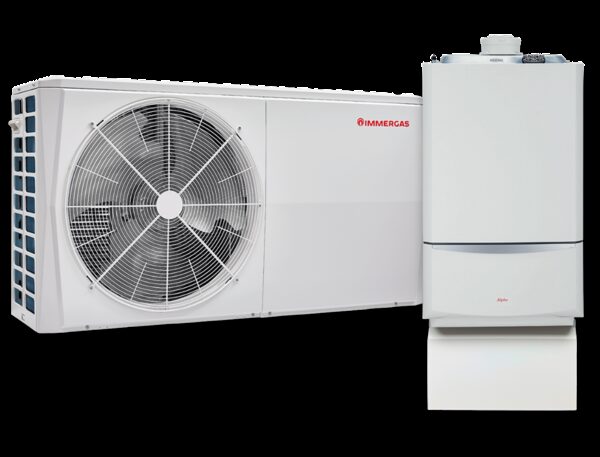
There are two kinds. Bivalent systems pair a heat pump with another heat source, while packaged systems are sold as a complete unit, sometimes with the components integrated into a single product8. A hybrid system has a dedicated controller managing all heat sources, not two controls competing with each other9.
The heat pump does most of the day-to-day work using low carbon electricity, and the boiler covers peak demand and hot water10. Manufacturers recommend a split of between 70:30 and 85:15 heat pump to boiler across annual heat demand2. In practice the heat pump often does less than that: performance data from monitored hybrid systems found the heat pumps typically met about 39% of space heating demand4.
Upfront cost: £5,000 to £9,000 for a hybrid versus more for a standalone heat pump
The headline comparison is straightforward. Average hybrid installation costs are £8,000 to £9,000, described as two thirds the cost of a typical stand-alone heat pump install at £13,0002. An independent guide gives £5,000 to £10,000 for combining a boiler with an air source heat pump, including installation3.
Standalone heat pump costs sit higher and spread wider. A parliamentary committee reported a range of £8,000 to £15,000 depending on the work needed to the home11. Official statistics from 2021 put the median upfront cost of air-to-water heat pumps at around £10,500, and ground or water source units at around £20,00012. Off-gas-grid households face a premium of about £8,000 over equivalent fossil fuel systems13.
Older official work framed the hybrid premium differently, as the additional installed cost over a gas fired condensing boiler: £4,000 to £10,000 for the total additional installed cost, with add-on hybrids in around the same range6. That study also quoted appliance prices from under £2,000 for a 5kW stand-alone heat pump and controller to over £7,000 for a 16kW heat pump packaged with a boiler, though those figures date from 2016 and are appliance only6.
| System | Cost | What it covers |
|---|---|---|
| Hybrid, average | £8,000 to £9,000 | Installed hybrid system2 |
| Boiler plus air source heat pump | £5,000 to £10,000 | Includes installation3 |
| Standalone heat pump, typical | £13,000 | Standalone install2 |
| Standalone heat pump, range | £8,000 to £15,000 | Depends on work to the home11 |
| Air-to-water heat pump, median | Around £10,500 | Upfront cost, UK 202112 |
| Ground source hybrid | £13,000 to £20,000 | Installation and integration3 |
Where a household already has a working boiler, the marginal cost of adding a heat pump is lower still, because the boiler is not being replaced. That is the case the hybrid argument rests on.
Installation: why a hybrid can be 30 to 40% cheaper to fit
The saving comes from what a hybrid does not need. A standalone heat pump often requires supplementary work: upgrading radiators, new pipework and a hot water cylinder5. A hybrid avoids much of that because the boiler continues to serve peak demand and hot water, so the existing emitters and pipework can often stay14. Official work found the technology suitable for the UK housing stock and potentially fittable with existing high temperature radiators, though replacing some radiators may be preferable in some cases6.
Independent analysis puts hybrid installations at 30 to 40% cheaper than standalone air source heat pumps, citing Eunomia research from 20231. The same analysis notes hybrids can be fitted more quickly, potentially within a day, against several days for a standalone air source heat pump2. Hybrids are also described as more flexible to install and quieter than an all-electric installation5.
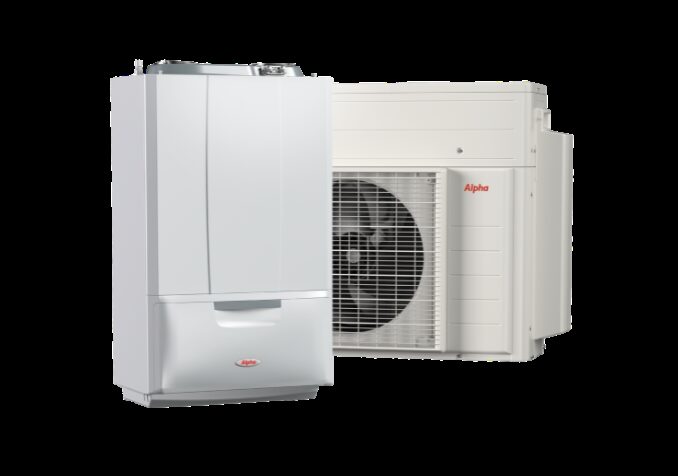
The scale argument is made by manufacturers. Alpha states that a fixed budget of £30,000 would install around six hybrid systems compared to two heat pumps15. That is a maker's claim about its own market, not an independent costing, but it illustrates the arithmetic that drives the comparison.
Running costs: where the hybrid wins and where it does not
This is where the case weakens. One analysis found the cost to run a hybrid heating system could be about 10% more than a standalone heat pump at the current spark gap, on typical energy consumption2. The same document reports hybrid heating offering marginal running cost savings of around 2% over a full heat pump, excluding standing charges2. The two figures point in opposite directions, so neither should be treated as settled.
Against a gas boiler, the picture depends on fuel price ratios. Research indicates heat pumps become more expensive to run than gas boilers where the electricity to gas price ratio exceeds 3.4 to 1, under existing market arrangements with no other changes16. Independent guidance is blunt that heat pumps may be no cheaper to run than a conventional liquid fuel-fired or gas appliance17. Official guidance notes running costs for heat pumps are typically lower than traditional gas boilers, but adds a condition: if a system is not designed or operated well, that advantage can disappear18.
The hybrid's defence is its controls. Having the system react to fuel prices should mean the boiler only turns on when it is cheaper to run than the heat pump, lowering overall operating costs compared to running either alone8. Some hybrid systems automate this on electricity costs, fossil fuel supply costs, time of day, and whether solar panels are generating or exporting8. Where that control works well, the system arbitrages between the two fuels. Where it does not, the boiler runs more than the design intended and the saving evaporates.
For a household's independence, the position is mixed. A hybrid cuts gas consumption, and hybrids using a smaller heat pump can reduce it by around 80%5. It does not remove the gas connection, the standing charge or the exposure to gas prices. It reduces dependence rather than ending it.
Efficiency: 126 to 142% overall system efficiency
A hybrid's overall efficiency sits between a boiler and a full heat pump, which is exactly what the design implies. Independent analysis estimates overall heating system efficiency of between 1.26 and 1.42, or 126 to 142%, depending on boiler efficiency and the proportion of hot water demand4.
The heat pump side performs below a standalone unit. Monitored hybrid systems had a median heat pump efficiency of 2.37 under the SPF H4 system boundary, lower than standalone air source heat pumps4. That is expected: a hybrid's heat pump is often smaller and sized to cover milder conditions rather than the full load.
Where a hybrid is well designed, the numbers improve. In a high-quality hybrid installation up to 80% of annual heating can be provided by the heat pump, and 80% of space heating demand is then delivered by a technology around three times more efficient5. Independent guidance suggests assuming an average coefficient of performance around 2.6 where the heat pump meets 80% of space heating demand and a gas boiler covers the rest5.
Carbon savings follow the same pattern. Independent guidance reports up to 55% carbon savings as an average across different building types5. Another analysis puts hybrid heat pump systems at up to 60% carbon reduction today, rising to around 80% by 2030 against gas heating2. The two figures differ on the ceiling.
Flow temperature matters as much as the technology. A heat pump system designed for a higher flow temperature will reduce whole-system efficiency compared with a lower temperature design9. A hybrid that leans on the boiler is effectively running at higher flow temperatures, which is part of why its heat pump efficiency reads lower than a standalone unit's.
Which homes suit a hybrid: EPC ratings D to F
Hybrids are more common in homes that need more heat to reach a comfortable temperature19. Official guidance describes them as suitable for buildings with existing heating systems, or buildings needing significant fabric, energy efficiency and pipework upgrades before a standalone heat pump would work7. Older official work found a hybrid can meet the full heating and hot water needs of a domestic property6.
The cost-effectiveness modelling is the most useful guide. Bio-hybrids are more cost-effective than heat pumps in 30% of GB homes in a base scenario where both a new boiler and a new heat pump are required20. Where an existing boiler is retained without replacement, that rises to 45% of GB homes20. Where the existing boiler is kept and not replaced at all, it reaches 65% of GB homes20. The pattern is clear: the older and more serviceable the existing boiler, the stronger the hybrid case.
The two main reasons an installer might suggest a hybrid are high heat demand, or a standalone heat pump that would not lower energy bills8. Homes with poor fabric, limited radiator capacity or no space for a cylinder fall into this group. So do homes where the electrical supply would need upgrading, since a hybrid draws less peak current than a full heat pump.
Policy treatment differs across the UK. Hybrid heat pumps must be whole house systems providing both heating and hot water to qualify under the Home Energy Scotland scheme, with the fossil fuelled and low and zero emission elements costed separately and assessed case by case21. The Scottish Government has consulted on the role of hybrids before 2030, noting they may be cost-effective alongside hydrogen and that the position would be kept under review22. Scotland's draft strategy set a vision of all buildings reaching zero emissions by 204522.
Ground source hybrids: the £13,000 to £20,000 exception
Ground source changes the arithmetic. For the installation and integration of a ground source heat pump with a hybrid system, the cost is likely to rise to between £13,000 and £20,0003. That is well above the £5,000 to £10,000 range for an air source hybrid, and it reflects the ground works rather than the heat pump itself.
Ground source units are generally more efficient than air source, dependent on ground conditions, but have higher set-up costs23. A ground source heat pump can cost around £15,000 as a standalone installation24. Official guidance puts ground source costs at more than £10,00025. The efficiency gain is real: ground source gives lower running costs and lower CO2 emissions than an equivalent air source system, but costs more to install24.
Support exists but is capped. The Boiler Upgrade Scheme offers a £9,000 grant for a ground source heat pump in an off-gas-grid property replacing an oil or liquefied petroleum gas heating system, from 21 July 202626. The Home Energy Scotland scheme sets a maximum combined funding of £15,000 for a ground source heat pump21. Neither closes the gap on its own.
For a household weighing independence, a ground source hybrid is the least coherent option of the three. It carries the highest upfront cost, keeps the gas boiler and its standing charge, and adds ground works that a full ground source installation would need anyway. Where the ground works are being done, the marginal case for keeping the boiler is weaker than it is for an air source hybrid.

Sources26 cited
- Hybrid heat pumps, HIES Scheme, 2022-05-10
- The Future of the Gas Network: Recommendations for Hybrid Heating, Cadent Gas, 2025-04
- Domestic Heat Pump Guide, HHIC, 2026-09-17
- Heat pumps shown to be three times more efficient than gas boilers, Energy Systems Catapult, 2023-03-16
- Hybrid heat pumps, Nesta, 2025-02-03
- Domestic Hybrid Heat Pumps, UK Government, 2016-11
- Heat pumps, nidirect, 2025-02-24
- Hybrid heat pumps, Energy Saving Trust, 2026-07-16
- Domestic Heat Pump Guide, MCS Certified, 2024-04-02
- MCS certificates: why data matters, MCS Certified, 2025-03-11
- Public Accounts Committee report on heat pumps, UK Parliament, 2024-05-26
- EINAS 2025 heat and buildings, UK Government, 2021
- Electrification of Heat: heat pump user guides, UK Parliament, 2022-05-17
- Why pragmatic thinking on clean heat matters now more than ever, IGEM, 2026-02
- Hybrid systems: common questions answered, Alpha Innovation, 2024-07-12
- The benefits of heat pumps and the role of electricity and gas prices, UKERC, 2023-03-29
- Off gas grid heating options, OFTEC, 2026-09-17
- What impact can heat pumps have in domestic heating today, UK Government, 2023-11-21
- Electrification of Heat heat pump user guides, Energy Systems Catapult, 2024-02-22
- Cadent Green Gas Taskforce report on bio-hybrids, Cadent Gas, 2026-02-03
- Home Energy Scotland Grant and Loan terms and conditions, Home Energy Scotland, 2024-06-05
- Draft Heat in Buildings Strategy, Scottish Government, 2021-02
- Advice on improving energy efficiency, Eryri National Park Authority, 2022
- Air source heat pumps vs ground source heat pumps, Energy Saving Trust, 2026-07-16
- Air and ground source heat pumps, Croydon Council, 2026-09-17
- Boiler Upgrade Scheme guidance for installers, Ofgem, 2026-07-21
 Heat Pump Running CostsWhat does a heat pump cost to run each year, and is it cheaper than a gas boiler?
 Hybrid Heat PumpsHow hybrid systems pair a heat pump with a gas, oil or LPG boiler, what decides which appliance runs, what they cost, how much gas they displace, and why the Boiler Upgrade Scheme will not fund them.
 How Much Does a Heat Pump CostA heat pump usually costs around eleven thousand pounds installed, though quotes vary a lot depending on your home.
 Heat Pump Electricity TariffsA heat pump tariff gives you cheaper electricity for part of the day, so running your heating costs less than on a standard rate.
 Heating Schedules and SetbackIs it cheaper to leave the heating on low all day, or set it to come on only when you need it?
 Energy IndependenceA heat pump runs your heating on electricity instead of gas or oil, so how much does that really cut what you pay and how exposed you are when fuel prices jump?