

In this comparison
Neither tariff type is better in the abstract. A fixed tariff sets the unit cost of energy and the daily fee for a contract term, usually a year, so the rate stays the same for the length of the contract1. A tracker tariff follows wholesale energy prices, and its rates can change each day3. The choice is between a known rate for a set period and a rate that moves with the market.
The price cap sits between them. It applies to standard variable tariffs, not to fixed-term deals and not usually to trackers4. That means a tracker can be charged above the cap if wholesale prices rise beyond its level, while a fixed tariff is protected from cap changes until the contract ends6. Ofgem's own research found that 80% of consumers correctly identify budgeting as easier on a fixed tariff, and that considerably more claim to be on fixed tariffs (38%) than the official data suggests (11%)1.
For a household weighing independence, the distinction is about who carries the price risk. A fixed tariff transfers that risk to the supplier for the term. A tracker keeps it with the household, in exchange for the chance of paying less when wholesale prices fall.
Tracker or fixed: the short answer
A fixed tariff suits a household that wants the unit rate and daily fee held for a known period and is willing to accept that a fall in wholesale prices will not reach the bill before the term ends. A tracker suits a household that wants wholesale movements passed through, accepts that the rate can rise as well as fall, and has the metering to support it.
The evidence on what households actually understand is mixed. Around one in five reported having no understanding of what fixed or variable tariffs are, at 15% for fixed and 19% for variable1. That matters because the difference between the two is not a matter of degree: one is a contract with an end date, the other is a pricing formula.
A fixed tariff is identified simply. If a bill says the contract has an end date, the household is on a fixed tariff12. The unit cost of energy and the daily fee are fixed, and the amount charged depends on energy used, unit cost and daily fee12. The term "fixed" refers to the price per kilowatt of gas and electricity used, not to the total bill8. Home Energy Scotland puts it plainly: the unit price is fixed, not the energy bill13.
Tracker tariffs work differently. Costs usually follow wholesale energy prices and can change on a daily basis14. Some trackers track wholesale prices directly and set the prices customers pay on a daily basis14. Others are cap trackers, which track the level of the energy price cap and often provide a guaranteed discount against it, so they change when the cap changes14.
The practical consequence is that a fixed tariff gives a household a stable rate to plan around, while a tracker gives a household exposure to the market with the possibility of a lower rate. Neither is a saving in itself.
What a fixed tariff actually is: a fixed term with a set end date
A fixed rate tariff lets a household pay a set amount for each unit of energy until a set end date15. Fixed tariffs usually last for a year, and the range across suppliers runs from a minimum of 12 months to somewhere between 12 and 24 months8. Ofgem's consumer research tested 12 month fixed terms, 24 month fixed terms and standard variable tariffs as the options households face1.
The fixed elements are specific. The unit cost of energy and the daily fee are fixed; the amount charged is set by the amount of energy used, the unit cost and the daily fee12. The rate stays the same for the length of the contract5. What is not fixed is consumption, which is why a fixed tariff does not produce a fixed bill.
At the end of the term, the supplier moves the account automatically onto the standard variable tariff, which is typically higher than the fixed rate17. Suppliers must contact the household 42 to 49 days before the end date of a fixed-term tariff9. Once the fixed tariff has ended, the household can still switch supplier or tariff12.
The regulatory history is worth knowing because it explains the shape of the market. The Retail Market Review proposed "no surprises, no lock-ins", with roll-on to the cheapest evergreen tariff at the end of a fixed term unless the consumer makes an active choice19. The statutory consultation that followed set out that fixed-term tracker tariffs would no longer be able to track the price of tariffs offered by suppliers, but only a published stock exchange quotation or index or a financial market rate over which the supplier has no control20. That is why a tracker today follows an index rather than a rival's price list.

How the price cap shapes what each tariff can save you

The price cap applies to standard variable tariffs, which can increase or decrease over time6. It does not apply to fixed-term energy tariffs, meaning a tariff with a fixed end date and an agreed fixed per unit price4. Tracker tariffs are also generally outside it: the cap does not apply to them, so a household on a tracker should be able to save if prices drop below the cap, but can be charged more than the cap if prices rise beyond its limit5.
That single distinction drives most of the comparison. A fixed tariff will not be impacted by cap changes during its term21. Customers on fixed tariffs are protected from price cap changes until their contract ends, because they pay a fixed unit rate for the duration of their agreement6. A tracker has no such protection unless it is a cap tracker.
Cap trackers are the middle case. A cap tracker tariff tracks the level of the energy price cap and often provides a guaranteed discount against it, so it changes when the cap changes14. Some trackers that follow the price cap offer a fixed discount on unit rates versus the cap; others offer discounts against the price cap using standing charges14. Tracker tariffs with an in-built discount against the price cap exist, and those discounts are often taken out of standing charges, so while unit rates would change like a normal tracker, standing charges would not8.
The savings pattern differs by design. On a unit-rate discount, higher usage means higher savings, and vice versa14. On a standing-charge discount, the tariff is better for lower-consumption households than a tracker where the discount is on the unit rate14.
Where a fixed deal is priced below the cap, the gap can be material. One analysis put customers switching to a cheap fixed tariff at up to 19% cheaper than the standard rates once a reduction kicked in22, and another found a saving of £100 more than the price cap with a fixed deal23. Those figures are dated and move with the cap, so they describe a moment rather than a rule.
Costs and exit terms compared
Exit fees are where the two tariff types diverge most in practice. On a fixed tariff, a household usually has to pay an exit fee to leave before the contract term ends, although it is still able to leave at any time15. The fee varies by supplier15. Typical amounts run at £30 to £60 on a fixed-rate tariff24, and one analysis put the figure at often £100 on a 12 month fixed tariff9. The most expensive example reported was a £300 exit fee on a 2 year fixed tariff25.
The rules limit when a fee can be charged. Exit fees only apply to fixed-term deals, including some tracker tariffs, and cannot be charged in the last 49 days of the contract3. In that window there is no exit fee and the household has the right to switch freely without being charged9. Suppliers must contact the household 42 to 49 days before the end date, which overlaps with that window9.
Tracker tariffs are not uniform on exit. Tracker tariff contract lengths are usually fixed, but while some tracker tariffs have exit fees, others do not14. On a tracker or standard variable tariff the price can change but the household is also free to leave at any point9. Where a tracker has a fixed term and an exit fee, the 49-day rule applies to it as it does to a fixed tariff3.
Before changing tariff, the check is the same in both directions: make sure you understand any exit fees, fixed-term conditions or other charges that might apply26. Ofgem's research found that 57% net of consumers could identify that exit fees may still apply to a fixed contract even when moving to another deal with the same supplier1. That is the trap: switching to a tracker with the same supplier is not automatically free.
| Fixed tariff | Tracker tariff | |
|---|---|---|
| Rate basis | Set unit cost and daily fee for the term12 | Wholesale-linked, can change daily3 |
| Price cap | Does not apply to fixed-term deals4 | Usually does not apply5 |
| Typical term | 12 to 24 months8 | Contract length usually fixed14 |
| Exit fee | Usually applies before term end15 | Some have fees, others do not14 |
| Fee-free window | Last 49 days3 | Last 49 days where a fee applies3 |
| Smart meter | Not required for the tariff itself | Required10 |
Do you need a smart meter for a tracker tariff?
Yes. A supplier will need a working smart meter so it can charge the tracker correctly10. Some tariffs are only available to customers with smart meters, or to those who agree to have one fitted3. The same requirement runs through flexible pricing generally: a smart meter set to send readings every half hour is required to access new flexible time-of-use tariffs27, and customers need a smart meter to get all the benefits from new flexible energy tariffs27.
The metering requirement is not unique to trackers. Many EV-specific tariffs, particularly smart or time-of-use tariffs, need a working smart meter28. A smart time of use tariff needs a smart meter installed15. Economy 7 and Economy 10 use fixed cheaper periods, while newer EV and tracker tariffs can be more dynamic and usually work best with a smart meter27. For export, a Smart Export Guarantee tariff needs a smart meter, and the household can choose between a standard variable or fixed tariff29.
This is the point where a tracker stops being purely a pricing choice and becomes a metering one. A household without a smart meter, or with one that has lost its wide area network connection, cannot be billed accurately on a daily-changing rate. The dependence is on the meter, the supplier's systems and the communications network behind them, not only on the wholesale market.

Is a tracker tariff cheaper in winter?

Not by design. Tracker tariff costs usually follow wholesale energy prices and can change on a daily basis14, and rates change each day based on wholesale market energy prices29. Winter is when demand and wholesale prices tend to move, and a tracker passes that movement through rather than smoothing it.
The design of the discount decides who benefits. A cap tracker with a unit-rate discount gives higher savings to higher usage, and vice versa14. A cap tracker with a standing-charge discount is better for lower-consumption households than a tracker where the discount is on the unit rate14. A household that heats with gas or electricity through winter has higher usage, so the two designs pull in opposite directions for the same home.
A fixed tariff behaves differently in the same season. The unit rate and daily fee are held for the term, so winter consumption changes the bill through volume alone, not through the rate12. That is the budgeting benefit Ofgem's research found most consumers identify, at 80% correctly identifying that budgeting is easier on a fixed tariff1.
For a household with an electric vehicle, the calculation shifts again. A fixed rate tariff is described as better for drivers with an irregular schedule, or who rely on public chargers, or who need the simplicity of a set rate30. A driver with predictable overnight charging has more to gain from a time-of-use structure than from either a flat fixed rate or a plain tracker.
Which tariff is better if wholesale prices fall?
A wholesale-linked tracker passes the fall through. Some tracker tariffs work by tracking wholesale energy prices and setting the prices customers pay for their energy on a daily basis14. On tracker tariffs, energy rates are based on wholesale energy prices, with the cost on a given day depending on wholesale prices that day27. A household on such a tariff sees a falling market in the rate quickly.
A fixed tariff does not. The rate stays the same for the length of the contract5, and fixed tariffs will not be impacted by cap changes during the term21. A fall in wholesale prices is not passed through before the term ends, which is the price of certainty.
A cap tracker sits between the two. It changes every three months when the price cap is reset, with most providers guaranteeing a discount on the price cap3. That gives a slower response than a daily tracker and a faster one than a fixed term, with the discount fixed in advance.
The reverse case is the one to hold in mind. Because tracker tariffs are not usually subject to the price cap, customers can be charged more than the cap if prices rise beyond its limit14. A household choosing a tracker is accepting that symmetry.
What this means for household energy independence
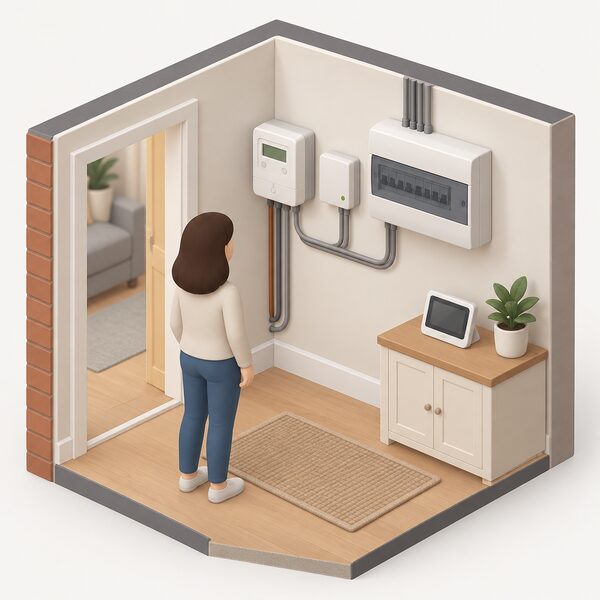
A tariff choice changes who carries price risk; it does not change where the energy comes from. A fixed tariff locks in the price per unit of energy, protecting from potential increases in energy prices for the term17. A tracker keeps the household exposed to the wholesale market, with the possibility of paying less when prices fall and more when they rise14.
Neither tariff reduces dependence on the grid or on a supplier. Both are supply contracts, and both leave the household buying every unit from a licensed supplier. What a fixed tariff buys is predictability: the unit cost of energy and the daily fee are fixed for the term12. What a tracker buys is transparency: the rate follows a published index rather than a supplier's price list, which is the model the Retail Market Review set out when it restricted fixed-term trackers to a published stock exchange quotation or index or a financial market rate over which the supplier has no control20.
The dependence that remains is specific. A tracker depends on a working smart meter and the supplier's billing systems10. A fixed tariff depends on the supplier remaining solvent for the term, and on the household staying within the contract to avoid an exit fee15. Both depend on the grid, and neither generates a unit of energy.
For a household with its own generation, the picture is different again. Export arrangements sit alongside the import tariff, and a Smart Export Guarantee tariff typically runs for 12 months, after which a new one is needed31. The Feed-in Tariff, now closed to new applicants, pays a rate that changes annually with the Retail Prices Index, and the money is tax-free31. Those are separate from the import choice, and a household comparing tracker and fixed import tariffs is deciding how to buy, not how much to buy or where from.
The honest summary is that a tracker offers a closer link to wholesale prices and a fixed tariff offers a known rate for a known period. Neither makes a home self-sustaining, and the choice between them is a judgement about how much price movement a household is willing to absorb.
"If you have a tracker tariff or you're on a standard variable tariff (SVT), the price can change but you're also free to"
Sources31 cited
- Understanding consumers' energy tariff choices: research report 2024, Ofgem, July 2025
- Fixed-rate tariff: a set price for an agreed period, Home Energy Scotland, 20 September 2026
- How to switch energy supplier, Which?, 15 May 2026
- What is the energy price cap, Energy Saving Trust, 7 September 2026
- Choosing an energy tariff, Citizens Advice, 24 August 2023
- Rising energy bills deepen affordability pressures ahead of winter, Consumer Scotland, 26 August 2026
- Energy price cap, Ofgem, 17 September 2026
- Types of energy tariff, Confused.com, 3 November 2025
- How to complain about your electricity, gas or energy bill, Which?, 30 July 2026
- Energy tariffs explained, Uswitch, 17 February 2026
- Price cap: US-Iran war set to add £155 to annual household bills from July, Energy and Climate Intelligence Unit, 30 June 2026
- Your gas or electricity supplier has put up its prices, Citizens Advice, 17 September 2026
- Fixed-rate tariffs: switching, Home Energy Scotland, 20 September 2026
- What is a tracker tariff, Uswitch, 26 June 2026
- Switching your energy supplier, Energy Saving Trust, 26 June 2026
- Fixed rate tariffs, Confused.com, 2026
- Understanding energy bills, StepChange, 20 September 2026
- Standard rate tariffs, Uswitch, 26 August 2026
- The Retail Market Review: final domestic proposals, Ofgem, 27 March 2013
- The Retail Market Review: statutory consultation on RMR domestic proposals, Ofgem, 20 June 2013
- Energy UK explains typical domestic consumption values, Energy UK, 1 July 2026
- Uswitch responds to April energy price cap announcement, Uswitch, February 2026
- The best way to pay for energy, Which?, 28 March 2024
- Gas only tariffs, Confused.com, 2026
- Tariff watch, End Fuel Poverty Coalition, 20 September 2026
- Energy bills support, British Gas Energy Trust, 11 August 2026
- Energy flexibility, Smart Energy GB, 17 August 2026
- EV tariffs and home charging: what consumers need to know, Energy Ombudsman, 11 September 2026
- How to understand your electricity and gas bills, Energy Ombudsman, 24 April 2025
- Should EV owners get a fixed or time-of-use tariff, Uswitch, 2 July 2025
- Are solar panels worth it, Which?, 15 May 2026
 The Full Tariffs GuideWhich energy tariff suits how you live, and will switching really save you money?
 Tracker vs Price CapTracker tariffs can cost more than the price cap, so how do they compare?
 How Tracker Tariffs WorkTracker tariffs move your unit rate with wholesale prices or the Ofgem price cap, so what you pay can change daily.
 Fixed-Rate Energy TariffsWhat a fixed energy tariff fixes and what it does not, the contract lengths sold in the UK, exit fees and the 49-day window, how fixed rates compare with the price cap, and what happens when the term ends.
 Fixed and Variable TariffsCompares capped standard variable tariffs with fixed deals, including exit fees, contract end and rollover.
 Which Tariffs Your Meter AllowsHow meter type decides which energy tariffs a household can access, from single-rate and two-rate meters to smart, prepay and restricted configurations, and the constraints faced by flats, rented homes and homes without a working smart connection.