
In this guide
The price cap and a tracker tariff are not two versions of the same thing. The cap is a regulatory ceiling on the unit rate and standing charge of a default, or standard variable, tariff. Ofgem states that the cap protects people on tariffs where the unit rate can go up or down depending on the energy market, and that these are called standard variable tariffs1. The Welsh Government's energy advice is blunter about the boundary: the cap applies to default tariffs regardless of how bills are paid, and it does not cover fixed, green or time-of-use tariffs2.
A tracker tariff sits outside that protection. Tracker tariffs are not usually subject to the price cap, so customers can be charged more than the cap if prices rise beyond its limit3. What a tracker offers instead is a rate tied to wholesale prices, with the cost on a given day depending on wholesale prices that day4. A cap tracker is a narrower product: it tracks the level of the energy price cap and often provides a guaranteed discount against it, so it changes when the cap changes3.
The cap itself stands at £1,723 a year for a typical household from 1 October 2026, a rise of 4% from £1,6635. That figure is a benchmark for average use, not a ceiling on any individual bill, and it is the number against which every tracker and time-of-use offer is judged.
Tracker tariff vs price cap: how the comparison works
The comparison is not like for like, and the difference matters more than the headline saving. The cap sets maximum unit rates and standing charges for default tariffs. Ofgem's own description is precise: the caps are a cap on a unit of gas and electricity, with standing charges taken into account, and they are not a cap on customers' overall energy bills8. A household on a capped default tariff is protected on the rate, not on the total, because the total depends on how much is used.
A tracker replaces that regulated rate with a market one. On tracker tariffs, energy rates are based on wholesale energy prices4. Some tracker tariffs work by tracking wholesale energy prices and setting the prices customers pay for their energy on a daily basis3. Others follow the cap itself. A cap tracker tariff tracks the level of the energy price cap and often provides a guaranteed discount against it, so it changes when the cap changes3. Some trackers that follow the price cap offer a fixed discount on unit rates versus the cap; other trackers offer discounts against the price cap using standing charges3.
That distinction decides who gains. Where the discount sits on the unit rate, higher usage will mean higher savings, and vice versa3. Where the discount sits on the standing charge, the gain is flatter and better for lower-consumption households than a tracker where the discount is on the unit rate3.
Ofgem's own framing of fair value uses the cap as the yardstick: it proposes comparing real tariff and energy prices against price cap unit rates and standing charges as the current definition of fair value in the domestic market9. That is a regulatory benchmark, not a guarantee that any tracker will beat it. The older Tariff Comparison Rate, a simple p/kWh metric of the cost of a tariff based on average consumption, was an earlier attempt at the same problem10.
For a household's energy independence, the position is mixed. A tracker ties the household's rate to the wholesale market rather than to a regulator's quarterly decision, which removes one layer of insulation and adds another kind of exposure. The supply itself, the network and the standing charge remain exactly as they were.
The price cap: £1,723 a quarter and how it moves
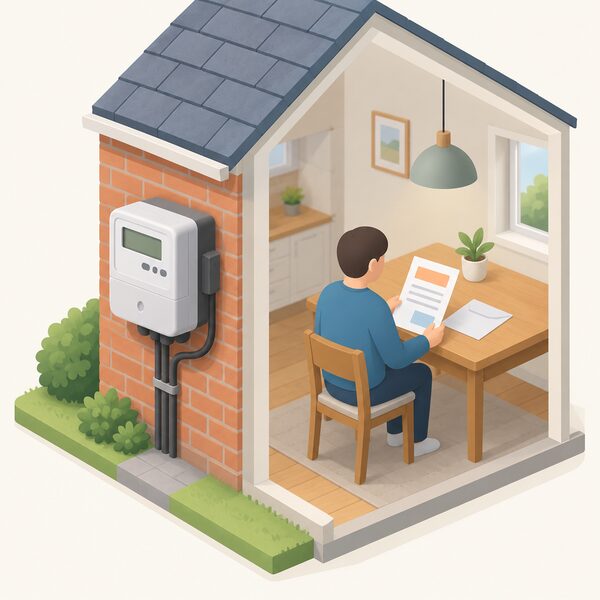
The cap for 1 October to 31 December 2026 is £1,723 a year for a typical household, a rise of 4% from £1,6635. Ofgem reviews and sets the level every 3 months, for how much an energy supplier can charge for each unit of energy and daily standing charge6. The same three-month cycle is confirmed in the January to March 2026 announcement11, and independent guidance describes the cap as reviewed every three months by the market regulator to reflect changes in wholesale prices12.
The direction of travel has been upward. The cap for 1 October to 31 December 2025 was 2.2% per year higher than the cap set for the same period in 2024, which was £1,7177. Part of the movement comes from costs outside wholesale energy: there have been increases to parts of the costs of transporting energy in Great Britain, covering England, Scotland and Wales6. Ofgem also reduced the cap by £1.79 per month from July 2025 following a review of operating costs13.
The cap is not one number. It varies by region and by payment method. For 1 July to 30 September 2026, the Northern region benchmark shows a £223.48 standing charge and an £824.03 annual bill at 2,500 kWh single-rate, or a £220.70 standing charge and £986.44 at 3,400 kWh multi-rate; the Midlands shows £207.57 and £810.72, or £206.15 and £977.095. Ofgem's older guidance sets out the principle: a capped tariff depends on how you pay, where you live, and what type of meter you have14.
Cap tracker tariffs: always priced below the cap, reviewed every three months
A cap tracker is the closest thing to a like-for-like alternative to the capped default. It tracks the level of the energy price cap and often provides a guaranteed discount against it, so it changes when the cap changes3. The discount is the product. It is not a regulatory entitlement, and it depends on the supplier continuing to offer the tariff on those terms.
The reset rhythm follows the cap. Tracker tariff rates change every three months when the price cap is reset, with most providers guaranteeing a discount on the price cap7. Variable tariffs behave the same way in practice: they usually change every three months when Ofgem changes the energy price cap, though suppliers are free to change them at any time7.
Where the discount is applied changes the arithmetic. A fixed discount on unit rates versus the cap rewards consumption, because higher usage will mean higher savings, and vice versa3. A discount applied through standing charges does the opposite: it is better for lower-consumption households than a tracker where the discount is on the unit rate3. A household that uses very little energy gains more from a standing charge discount, and a household with high consumption gains more from a unit rate discount.
The protection question is the one that decides whether a cap tracker is genuinely safer than a wholesale tracker. It is not covered by the cap. Tracker tariffs are not usually subject to the price cap, so customers can be charged more than the cap if prices rise beyond its limit3. Some trackers carry an inbuilt cap, but it could be as much as £1 per kWh of energy used3. That is a ceiling in name only: it sits far above any capped unit rate and would not bind in normal market conditions.
For energy independence, a cap tracker changes very little. The household still buys from a supplier, still depends on the grid, and still carries the standing charge. What it gains is a contractual discount against a published benchmark, for as long as the supplier honours it.
Time-of-use tariffs: peak, shoulder and off-peak pricing explained

A time-of-use tariff charges different rates depending on the time of day. When demand is low, usually overnight, the rate is cheaper; when demand is high, in the early evening, it is more expensive16. The Energy Ombudsman describes the structure plainly: electricity prices vary throughout the day, usually with a cheaper overnight charging window17. Smart time-of-use tariffs charge at least two different rates for electricity used during peak hours and off-peak hours18, and prices can vary depending on whether it is peak hours, off-peak hours or shoulder hours18.
This is a different proposition from a tracker. A tracker moves with the wholesale market over days and months. A time-of-use tariff moves with the clock, every day, and the household's bill depends on when demand falls rather than on what the market did. On a fixed or standard variable tariff, energy costs the same each day, at any time of day4. That is the baseline the time-of-use structure departs from.
The saving is not automatic. The potential saving depends on the price set by the tariff and how much demand can be shifted outside peak hours18. A time-of-use tariff will charge a higher price for any electricity used in the peak period19, and to benefit, the household must be able to move electricity use to off-peak periods19. A household that cannot shift load pays the peak rate for the same consumption it always had.
Ofgem is consulting on whether the cap itself should accommodate this structure. It proposes to design at least one time-of-use energy price cap variant, for those who pay different prices depending on when they use electricity20. It is also consulting on setting an electricity wholesale allowance that allows the energy price cap to track and reflect the efficient costs of serving price cap customers over time20. Neither is a decision, and neither changes the current position that the cap does not cover time-of-use tariffs2.
"Time-of-use tariffs: electricity prices vary throughout the day, usually with a cheaper overnight charging window."
Daily wholesale tracking: EDF's FreePhase Dynamic and its three rate bands
Daily wholesale tracking is the most exposed version of a tracker. Dynamic time-of-use tariffs set rates close to the time the electricity is actually used, and those rates are based on wholesale electricity prices18. The household is not buying a discount against a benchmark; it is buying the market itself, with the supplier's margin and the network costs layered on.
EDF Energy's FreePhase product adds a different mechanism. Depending on the tariff, the household either gets credit for electricity used during the free period or is not charged for it21. The free periods are communicated by text the day before21. That makes the benefit conditional on wholesale conditions and on the household noticing and responding to the message, rather than a standing discount applied to every unit.
The practical consequence is that a daily tracking tariff rewards attention. A household that can move a large load, such as charging a car or running a heat pump cycle, into a cheap or free window captures the value. A household that cannot shift load pays whatever the day's rates happen to be, including on days when wholesale prices are high.
For energy independence, daily tracking is the sharpest trade on the page. It gives the household direct exposure to wholesale prices, which is a form of price sovereignty, and it removes the insulation of a quarterly cap decision. It does not reduce dependence on the grid, the supplier or the network charges, and it adds a dependence on the supplier's app or messaging to know when the cheap periods fall.
What you need: a smart meter, half-hourly readings and shiftable demand
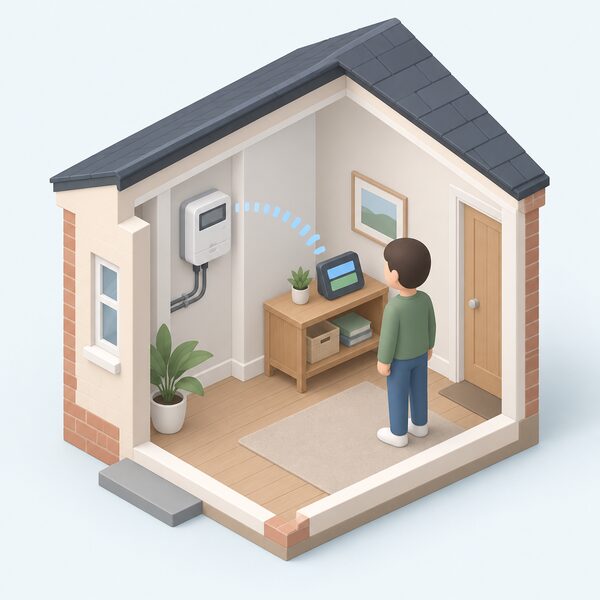
The meter requirement is not optional and not a formality. To access any new flexible time-of-use tariffs, a household needs a smart meter that is set to send readings every half an hour4. Smart time-of-use tariffs need a smart meter that communicates with the supplier every half hour16. Which? states the meter must be set up to provide automatic meter readings every 30 minutes, so that the provider can bill the correct rate18. A smart meter is needed to sign up to a time-of-use tariff19, and for many EV-specific tariffs, particularly smart or time-of-use tariffs, a working smart meter is required17.
The data does more than bill. Some suppliers and comparison tools let a household upload its half-hourly data to estimate what it would pay on a smart tariff16. That is the only reliable way to test a time-of-use tariff before committing, because the saving depends on the household's own load shape rather than on an average.
Shiftable demand is the second requirement. Energy Saving Trust states that an EV, heat pump or home battery makes smart tariffs much more valuable16. The Welsh Government's advice points to the same group, especially households with green tech such as a heat pump, battery storage or an electric or hybrid car22. Some tariffs are only available if certain equipment is installed, such as an EV charger or solar panels19.
The Feed-in Tariffs scheme shows how equipment conditions can bite. Some solar PV installations, such as community energy and standalone installations, are exempt from the Energy Efficiency Requirement or have reduced criteria they must meet for the higher tariff rate to apply25. The principle carries across: eligibility for the better rate can depend on the installation, not just the meter.
Savings: up to £50 a year on a cap tracker, £112 average on daily tracking
The saving figures are modest and conditional. On a cap tracker, the discount is a fixed margin against the cap, so the gain scales with consumption: higher usage will mean higher savings, and vice versa3. A household with low consumption gains little from a unit rate discount and more from a standing charge discount, which is better for lower-consumption households than a tracker where the discount is on the unit rate3.
The cap levels themselves show how much is at stake in the benchmark. For 1 October to 31 December 2025, the Southern region shows a £155.12 standing charge and £936.78 annual bill at 3,100 kWh single-rate, or £155.67 and £1,169.11 at 4,200 kWh multi-register, on the Other Payment Method table26. The Northern region on the same table shows £208.10 and £935.81, or £205.69 and £1,151.9526. The Eastern region shows £167.73 and £926.96, or £169.16 and £1,152.9826. A discount of a few per cent against those figures is a small absolute sum.
The regional spread is wide enough that a tracker's value depends on where the household lives as much as on how it uses energy. Ofgem's April 2024 cap data shows the same pattern: Northern at £1,134.83 for electricity at 4,200 kWh per annum on multi-register metering, Eastern at £1,128.47, Southern at £1,154.60, South East at £1,152.77, North West at £1,107.95 and South Wales at £1,146.6727. 12 and £936.78 in one official table and as £183.50 and £1,008.32 in another, and the disagreement is not resolved26. The Eastern annual cap for April 2024 appears as £1,128.47 in one table and £919.15 in another, also unresolved27.
For 1 July to 30 September 2025, the electricity cap annual cost at 4,200 kWh multi-register metering was £1,123.43 in the Northern third payment method table, £1,112.28 in the London first payment method table, £1,153.34 in the Northern first payment method table, £1,190.65 in the London second payment method table, £1,163.56 in the South East first payment method table and £1,245.93 in the South East second payment method table28. Payment method moves the number as much as region does.
The historical range puts the current figures in context. The cap fell to £1,834 in Q4 2023, with a planned increase to £1,92829. A tracker discount against a cap at that level would have been worth more in absolute terms than the same percentage discount today.
Where these tariffs fall short: peak rates, exit fees and rejoin restrictions

The limitations are structural, not fixable by choosing a better product.
- No cap protection. Tracker tariffs are not usually subject to the price cap, so customers can be charged more than the cap if prices rise beyond its limit3. The inbuilt cap on some trackers could be as much as £1 per kWh of energy used3.
- Peak exposure. A time-of-use tariff charges a higher price for electricity used in the peak period19, and the saving depends on how much demand can be shifted outside peak hours18.
- Exit fees. Some tracker tariffs have exit fees and others do not3. Exit fees only apply to fixed-term deals, including some tracker tariffs, and cannot be charged in the last 49 days of the tariff7. They are typically £100 or more, and often £100 per fuel7. Ofgem confirms that a household may have to pay a previous supplier an exit fee if it was on a fixed rate tariff and chose to leave before it ended30.
- Contract terms. Time-of-use contracts should be checked for early termination fees, contract duration and penalties for switching tariffs or suppliers, and for flexibility such as the ability to switch between tariffs or opt out of time-of-use pricing19.
- No protection on fixed terms. Prices are not protected by the caps if the household has chosen to be on a fixed-term energy tariff31.
The rejoin question is the one households ask last and should ask first. Moving back to a capped default tariff is possible, but the terms on offer at that point are whatever the supplier is offering then, and any exit fee on the outgoing contract applies. Ofgem's switching guidance sets out the process and the exit fee position30.
Tracker, time-of-use or price cap: which fits which household
The fit depends on three things: how much energy the household uses, how much of it can be moved, and how much rate uncertainty it can carry.
A capped default tariff suits a household that wants the unit rate fixed by regulation for the quarter and does not want to track the market. The cap applies to default tariffs regardless of payment method, and it does not cover fixed, green or time-of-use tariffs2. It is the baseline, and it is the only option on this page with a regulatory ceiling on the rate.
A cap tracker suits a household that wants a discount against that benchmark and can accept that the discount is a supplier promise rather than a protection. Where the discount is on the unit rate, higher usage means higher savings; where it is on the standing charge, it is better for lower-consumption households3.
A time-of-use tariff suits a household that can move a large share of its demand out of the peak window. The saving depends on the price set by the tariff and how much demand can be shifted outside peak hours18, and the household must be able to move electricity use to off-peak periods to benefit19. An EV, heat pump or home battery makes smart tariffs much more valuable16, and some tariffs are only available with certain equipment such as an EV charger or solar panels19.
A daily wholesale tracker suits a household that will watch prices and respond to them, and that can absorb the days when the rate is high. The free periods on a product like EDF's FreePhase are communicated by text the day before, and the household either gets credit for electricity used during the free period or is not charged, depending on the tariff21.
For energy independence, none of these tariffs changes the underlying position. The household still draws from the grid, still pays a standing charge, and still depends on a supplier's billing system and, for dynamic products, on its app or messaging. What a tracker or time-of-use tariff changes is who carries the price risk: the supplier under the cap, the household under a tracker. That is the trade, and it is the same trade in every region of Great Britain. Northern Ireland operates a separate market with its own arrangements.
Sources31 cited
- Energy price cap, Ofgem, 2026-09-17
- Energy price cap explained, Welsh Government, 2026-03-04
- What is a tracker tariff?, Uswitch, 2026-06-26
- Energy flexibility, Smart Energy GB, 2026-08-17
- Energy price cap levels 1 October to 31 December 2026, Ofgem, 2026
- Changes to the energy price cap between 1 October and 31 December 2025, Ofgem, 2025-08-27
- How to switch energy supplier, Which?, 2026-05-15
- Higher wholesale costs push default and pre-payment price caps, Ofgem, 2019-02-07
- Energy Consumer Outcomes: proposed implementation, Ofgem, 2026-06-23
- The Retail Market Review: statutory consultation on RMR domestic proposals, Ofgem, 2013-06-20
- Changes to the energy price cap between 1 January and 31 March 2026, Ofgem, 2025-11-21
- The history of Ofgem's energy price cap, Energy Helpline, 2026-09-20
- Energy price cap will rise 2 percent in October, Ofgem, 2025-08-27
- Energy price caps explained (large print), Ofgem, 2020-12
- Energy price cap benchmark review decision, Ofgem, 2025-11-21
- Should I switch to a time of use tariff?, Energy Saving Trust, 2026-01-23
- EV tariffs and home charging: what consumers need to know, Energy Ombudsman, 2026-09-11
- Time of use tariffs explained, Which?, 2026-04-23
- Time of use tariffs: all you need to know, Energy Saving Trust, 2026-05-20
- Energy price cap: technical approach to market wide half hourly settlement, Ofgem, 2026-03-25
- Free electricity: here's how to opt in, Which?, 2026-04-23
- Five top tips from Which? to cut your energy bills, Welsh Government, 2026-03-18
- Smart meters, Welsh Government, 2026
- How do you know if you have a smart meter?, Smart DCC, 2026
- Key terms explained: Feed-in Tariffs, Ofgem, 2026-09-17
- Energy price cap levels 1 October to 31 December 2025, Ofgem, 2025
- Default tariff cap level 1 April 2024 to 30 June 2024, Ofgem, 2024
- Energy price cap levels 1 July to 30 September 2025, Ofgem, 2025-07-01
- Energy price cap research briefing, House of Commons Library, 2026-08-28
- Switch your home energy supplier, Ofgem, 2026
- Energy price caps explained (easy read), Ofgem, 2018-12
 How Tracker Tariffs WorkTracker tariffs move your unit rate with wholesale prices or the Ofgem price cap, so what you pay can change daily.
 The Full Tariffs GuideWhich energy tariff suits how you live, and will switching really save you money?
 Time-of-Use Tariffs ExplainedCan you pay less for electricity by using it at different times of day?
 Fixed and Variable TariffsCompares capped standard variable tariffs with fixed deals, including exit fees, contract end and rollover.
 The Full Energy Bills and the Price Cap GuideWondering why your bill went up even when you used less power?
 Energy Price CapThe price cap sets the most you pay for each unit of gas and electricity, plus the daily standing charge, but not your total bill.