

In this guide
There is no energy social tariff in the UK. No supplier offers one, no regulator administers one, and no household can apply for one. What exists is a set of proposals: a Scottish Government model called the Emergency Energy Tariff, a Citizens Advice framework for an income-based social tariff, and a separate idea, the rising block tariff, that would restructure unit rates rather than target households. The Chancellor committed in the Autumn Statement 2022 to develop a new approach to consumer protection, including the option of a social tariff to apply from April 2024, and that commitment has not produced a scheme1.
The pressure behind the proposals is measurable. National Energy Action estimates there are now over six million households in fuel poverty, with energy debt at record levels2. An early day motion in the 2022-23 session put the figure at 6.7 million households in fuel poverty, with a further 3 million at risk of slipping into it in April 20233. The National Audit Office estimated that even after government support, the increase in energy prices meant around 238,000 more households in England fell into fuel poverty4.
The two live proposals work in opposite directions. The Emergency Energy Tariff would cut the bill for a defined group, funded from outside the bill. The rising block tariff would cut the price of an initial block of units for everyone and raise it above that, funded by heavier users. Modelling of the second finds that a fiscally neutral version creates losers at both ends of the income distribution5.
What a social tariff is and who it is meant to help
A social tariff is often understood to be a levy or subsidy-funded reduction in the cost of basic utilities for targeted groups of customers, typically those least able to pay. No legal definition exists for energy suppliers1. That absence matters: it means a social tariff could be built in several incompatible ways, and the argument between them is the substance of the policy debate.
The two defining questions are who qualifies and how the money is raised. On the first, Citizens Advice proposes that eligibility should be based on household income and household energy consumption together, not income alone8. On the second, it argues that funding should come from general taxation rather than levies applied to energy bills8. That distinction is not cosmetic. A levy on bills raises the unit cost for every household, including the households the tariff is meant to help, so part of the transfer is clawed back through the standing charge and unit rate.
The Scottish Government's Social Tariff Working Group recommended a similar set of eligibility metrics: household income, the number of people in the household, and unavoidable energy consumption, whether from medical need or rural challenges9. The Welsh Government has separately called for the social policy costs on bills to be moved to general taxation10.
"a social tariff is often understood to be a levy or subsidy-funded reduction in the cost of basic utilities for targeted groups of customers, typically those least able to pay"
For a household's energy independence, the shape of the scheme decides what it delivers. A tariff funded from general taxation reduces the bill without changing the household's exposure to wholesale prices. A tariff funded by a levy on bills redistributes between households but leaves the total cost of the system, and the household's dependence on the grid and a supplier, exactly where it was. Neither proposal addresses self-generation, storage or leaving the gas network. They are bill-shaping measures, not independence measures.
Why the pressure for one keeps building: fuel poverty in numbers

Fuel poverty is affected by three key factors: a household's income, their fuel costs, and their energy consumption11. All three moved against households through the price crisis, which is why the case for a targeted tariff strengthened rather than faded as wholesale prices fell back.
The headline estimates vary by source and by date, and the variation is worth understanding rather than averaging. National Energy Action estimates over six million households in fuel poverty2. The 2022-23 early day motion cited 6.7 million households in fuel poverty and a further 3 million at risk from April 20233. The National Audit Office, working from DESNZ estimates, put the increase attributable to higher prices at around 238,000 more households in England even after government support4. These are not competing measurements of the same thing: they use different definitions, different dates and different geographies.
That last point is the one households most often miss. Fuel poverty is a devolved policy area, defined and measured differently in different parts of the UK, and rates are not directly comparable between nations11. England uses a Fuel Poverty Energy Efficiency Rating of band D or below combined with residual income below the official poverty line after modelled energy costs12. Scotland uses a threshold of more than 10% of the household's adjusted net income after housing costs13. The older English indicator, still cited in some documents, defined a household as fuel poor if it would have to spend more than the median amount on fuel to keep the home at a reasonable temperature and doing so would put its income below the poverty line11.
There is also a known measurement problem in Scotland. The 2021 Scottish House Condition Survey estimates note that fuel poverty rates are likely being underestimated because of over-representation of higher income households in the social survey and mode effects driving increases in energy efficiency ratings14. Any eligibility threshold built on that survey data inherits the bias.
The Emergency Energy Tariff: the proposal on the table
The Emergency Energy Tariff is the most developed social tariff model in the UK, and it comes from the Scottish Government rather than Westminster. Scenario modelling was undertaken using the achieved sample from the 2023 Scottish House Condition Survey to model the tariff's effects6. It is a worked proposal with published eligibility criteria, not a consultation on principles.
The tariff reduction is dependent on the relationship between the eligibility criteria, set out in the modelling6. That structure is deliberate: it means the discount scales with circumstances rather than switching on and off at a threshold, which avoids the cliff edges that make means-tested schemes unpopular and hard to administer.
The delivery question is the harder one, and the Scottish modelling addresses it directly. Eligibility is based on a combination of net household income before housing costs, the number of people in the household, rural or urban location, and whether a household member has a medical need which requires additional energy use6. The medical need criterion is the awkward one. The modelling states plainly that it is not possible to measure whether a household member has a medical need requiring additional energy use using Scottish House Condition Survey data, so receipt of certain social security benefits is used as a proxy6.
That proxy is the point at which the Emergency Energy Tariff stops being purely income-based and starts to resemble the benefits system it was designed to avoid. A household with a medical need that does not attract a qualifying benefit would not be captured by the proxy. The modelling does not resolve this; it records the limitation.
Citizens Advice proposed a different data mechanism for the same problem: matching HMRC's Real Time Information on taxpayer incomes with data from the energy industry on households' energy consumption, with delivery by energy suppliers8. That approach reaches households that do not claim benefits, but it depends on data sharing between tax authorities and suppliers, which is a substantial legal and administrative undertaking.
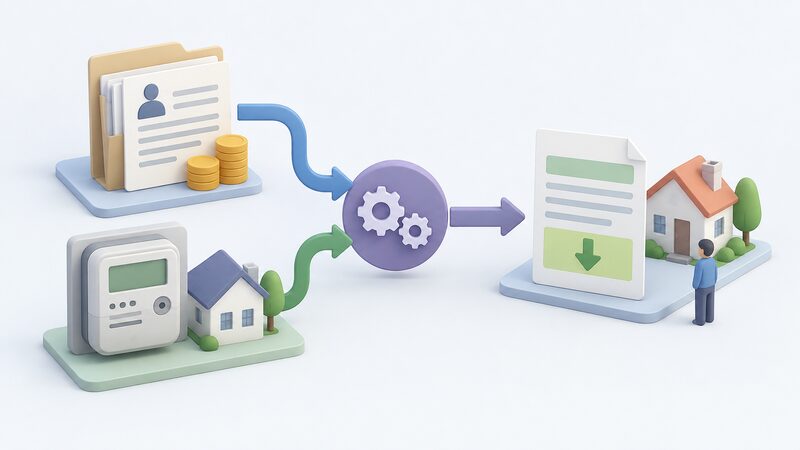
Emergency Energy Tariff eligibility: around 8 million households
The Scottish modelling puts eligibility at around 8 million households across the UK, based on the combination of net household income before housing costs, household size, rural or urban location, and medical need requiring additional energy use6. That is a large group, and its size is the central political difficulty: a tariff reaching 8 million households is not a niche safety net, it is a structural change to how domestic energy is priced.
The Social Tariff Working Group's recommended metrics point the same way. It recommended household income, the number of people in the household, and unavoidable energy consumption, giving medical need and rural challenges as examples of the last9. Rural location matters because off-gas-grid homes and dispersed settlements carry higher unavoidable costs for the same level of warmth, and a purely income-based test would miss that.
The practical consequence of an 8 million household threshold is that the scheme cannot be administered as an exception. It has to run as a standing feature of billing, which is why the delivery mechanism question is not a detail. Whether the assessment runs through benefit records, through HMRC data matched to consumption, or through supplier-held data determines how many of the 8 million are actually reached and how many fall through.
For energy independence, the eligibility design matters less than the funding design. A tariff that reaches 8 million households and is funded from bills moves money between households while leaving the total system cost and each household's dependence on the grid unchanged. A tariff funded from general taxation reduces what households pay without that offsetting effect, but it does not reduce consumption, does not add generation, and does not shorten the supply chain between a household and the wholesale market.
What it would cost and how it would be funded
The published cost figures come from modelling of an income-based social tariff rather than the Emergency Energy Tariff itself. The Joseph Rowntree Foundation modelled the effect of distributing £3 billion of funding via an income-based social tariff, equivalent to £216 per household, to all households with incomes of £33,000 and below after deductions5. That is a universal-within-threshold design: everyone under the income line receives the same amount, and the amount is a lump sum rather than a unit rate reduction.
Citizens Advice argues that the most progressive and fiscally efficient form would be a lump sum payment that varies according to a formula taking into account household income and energy use, and that funding should come from general taxation rather than levies applied to energy bills8. The lump sum form has an administrative advantage: it does not require the supplier to hold a different unit rate for different customers, which is difficult with the current billing and settlement systems.
The scale of what government has already spent on bill support gives a sense of the fiscal room. The Energy Bill Relief Scheme and related schemes between October 2022 and March 2023 had an estimated total cost of £29 billion, nominal undiscounted and excluding the VAT revenue impact, based on 10-day average forward prices for gas and electricity on 12 September 202216. That was a temporary, universal discount on unit prices, similar in mechanism to the Energy Price Guarantee4.
| Proposal | Modelled cost | Funding source | Basis |
|---|---|---|---|
| Income-based social tariff | £3 billion, £216 per household | Not specified in the model | Incomes of £33,000 and below after deductions5 |
| Emergency Energy Tariff | Not published | Not published | Income, household size, location, medical need6 |
| Energy Bill Relief Scheme (2022 to 2023) | £29 billion estimated | General taxation | Universal unit price discount16 |
The Welsh Government has proposed moving the social policy costs to general taxation as a cost of living measure10. The Commons Business, Energy and Industrial Strategy Committee recorded a government commitment to publish proposals on shifting or rebalancing energy levies away from electricity in 202217. Those are levy rebalancing measures rather than social tariffs, but they bear on the same question of who pays for the system and through which route.
The Rising Block Tariff: an alternative way to cut bills
A rising block tariff takes a different approach: instead of identifying households, it restructures the price of units so that an initial block is cheap and units above it cost more. Everyone gets the cheap block, and heavy users pay more for the excess. The Joseph Rowntree Foundation modelled a design with a universal electricity allowance, a gas allowance, and an allowance per child on electricity5.
The modelled rates are specific. The gas block carries a unit rate discount on the lower block under a fiscally neutral design5. The electricity block carries a discount on the lower block, with a £150 annual saving for the median household5. The foundation states that introducing a rising block tariff in the gas market to help progressively distribute some of the costs of rebalancing could be one place to start5.
The funding logic is what distinguishes it from a social tariff. In the foundation's model, if the gas rising block tariff is configured to raise money, that money can be used to fund making electricity cheaper5. That is a rebalancing mechanism: it shifts cost from electricity, which is the vector for heat pumps and electric vehicles, onto gas, which is the fuel being phased down. The Climate Change Committee has separately found that faster electrification would cut UK household bills18.
| Fuel | Universal allowance | Per child | Lower block discount | Annual saving |
|---|---|---|---|---|
| Electricity | Modelled, figure not published | Modelled, figure not published | Modelled, figure not published | £150 for the median household5 |
| Gas | Modelled, figure not published | Not applicable | Modelled under a fiscally neutral design | Not stated5 |
The distributional effect is modest and uneven. Low-income households receive slightly more and high-income households slightly less, on average5. The bottom decile saves £128, compared with £104 under a VAT cut; the top decile saves £89, compared with £128 under the VAT cut5. The comparison with a VAT cut is instructive: a rising block tariff is more progressive than a flat tax reduction, but only by a margin.
Who wins and who loses under each proposal
The losers are the reason neither proposal has been adopted. Under a fiscally neutral rising block tariff, 14% of households in income decile 1 are losing by £205 on average, and 31% of households in decile 10 would pay an additional £65 on their energy bills under a hybrid model5. The foundation's conclusion is blunt: designing a fiscally neutral rising block tariff produces intolerable numbers of losing households with significant redistributive inefficiencies at the top and bottom of the income distribution5.
The pattern is not random. Within the poorest decile, the households that lose are those whose consumption is high relative to their income, often because of electric heating, poor insulation, medical need or a larger household. A rising block tariff penalises exactly the consumption that fuel poverty policy is meant to accommodate. Within the richest decile, the losers are high-consumption households, which is the intended effect, but the gain to the winners is small enough that the scheme's overall redistributive power is limited.
A social tariff avoids that trap by targeting households rather than units. The lump sum form proposed by Citizens Advice varies according to a formula taking into account household income and energy use, which means a high-consuming low-income household is not penalised for consumption it cannot avoid8. The trade-off is administrative: a household-level assessment requires data that the energy industry does not currently hold in a form it can use, which is why the HMRC Real Time Information matching proposal exists8.
| Design | Who gains | Who loses | Main risk |
|---|---|---|---|
| Income-based social tariff | Households below the income threshold | Households above it, if funded by levy | Data matching and take-up8 |
| Emergency Energy Tariff | Around 8 million households meeting the criteria | Not modelled | Medical need proxy misses non-claimants6 |
| Rising block tariff | Low-usage households, slightly | 14% of decile 1 by £205; 31% of decile 10 by £65 | High unavoidable consumption penalised5 |
For a household's independence, the choice between them is a choice about what kind of dependence remains. A social tariff leaves the household dependent on a supplier, a billing system and an eligibility assessment, but reduces the cash cost. A rising block tariff leaves the household dependent on its own consumption profile, which rewards those who can invest in efficiency and insulation and penalises those who cannot.
Where the proposals stand and what happens next
The parliamentary record shows a series of starts without a scheme. A Westminster Hall debate on energy social tariffs was scheduled for 23 November 2023, opened by Marion Fellows MP, with the subject chosen by the Backbench Business Committee1. The Energy Costs (Pre-payment Meters and Social Tariffs) Bill was read a first time on 19 October 2022 and was due for Second Reading on Friday 24 March 202320. Neither produced an operating tariff.
The government position recorded in the briefing is that it would work with consumer groups and industry to consider the best approach, including options such as social tariffs, as part of wider retail market reforms from April 2024 announced in the 2022 autumn statement1. Citizens Advice set its own deadline: a new policy framework should be in place by spring 2024 and form the basis of energy bill policy for the rest of the decade8. That deadline has passed without a framework.
The Scottish track has run further. The Social Tariff Working Group published its final report in spring 2025 with recommended eligibility metrics9, and the scenario modelling followed6. Scotland's statutory fuel poverty targets are to be achieved by the end of 204021. The Heat in Buildings Strategy set out a series of next steps, including a refreshed Energy Strategy and Energy Just Transition Plan in Spring 2022, a Fuel Poverty Strategy by the end of 2021, an Islands Energy Strategy in 2022, a Heat in Buildings Supply Chain Delivery Plan by Summer 2022, a Green Heat Finance Taskforce by the end of 2021, and a second Tackling Child Poverty Delivery Plan in March 202221.
Ofgem's consultations show the regulator working the adjacent ground rather than the tariff itself. It has consulted on proposed changes to the Contracts for Difference cost allowance within the price cap, with responses from energy suppliers, energy industry bodies, consumer groups and charities22, and on the requirement to offer lower standing charge tariffs19. Both touch the distribution of fixed costs, which is the same problem a social tariff addresses by a different route.
Where to get free help with energy bills now

No social tariff exists, but free advice and grant support do, and they are the practical answer for a household struggling now. National Energy Action provides free advice about energy bills and keeping warm and safe at home, and can also help with benefits advice and income maximisation23. It offers advice and support to help people across England, Wales and Northern Ireland stay warm and manage energy costs7. The number is 0800 304 715923, and a British Sign Language interpreter can be requested23.
In Northern Ireland, the Northern Ireland Energy Advice Service can be contacted on 0800 111 4455, open 9am to 5pm Monday to Friday24. NI Energy Advice offers free advice on saving energy in the home, energy efficiency grants, and oil buying clubs25. Northern Ireland also has its own guidance for households struggling to pay energy bills26.
Local authority support covers energy and water bills through the Household Support Fund route27. The Local Energy Advice Programme offers a free telephone advice service to help with benefits, money and bill problems, and can help check whether a household is on the cheapest tariff28. Councils publish their own local offers: Birmingham, Tameside, Belfast City and Carmarthenshire all list energy bill support schemes23. The Energy Bills Support Alternative Funding scheme provided £400 to help with energy bills for households that do not have a domestic energy meter or do not pay bills directly to an energy supplier29.
Suppliers are also required to help. They offer advice on more efficient use of energy that could help cut bills26. Ofgem publishes guidance on getting help with energy bills30, and the Energy Ombudsman advises consumers worried about their bills7. For small businesses and microbusinesses, there is a separate government helpline for energy bill support30.
Sources30 cited
- Energy social tariffs research briefing, House of Commons Library, 2023
- Helping to tackle fuel poverty through smart data, Smart DCC, 2025
- Energy Costs (Pre-payment Meters and Social Tariffs) Bill research briefing, House of Commons Library, 2022
- Energy bills support: an update, National Audit Office, 2024
- Energy affordability: how to reduce bills for the majority of households, Joseph Rowntree Foundation, 2025
- Scenario modelling on social energy tariff proposal, Scottish Government, 2025
- Worried about your energy bills, Energy Ombudsman, 2026
- Fairer, warmer, cheaper: new energy bill support policies, Citizens Advice, 2023
- Social Tariff Working Group final report, Scottish Government, 2025
- Call for cost of living support in spring statement, Welsh Government, 2022
- Fuel poverty statistics research briefing, House of Commons Library, 2026
- Fuel poverty modelled estimates for Wales, Welsh Government, 2025
- Scottish House Condition Survey local authority tables: fuel poverty, Scottish Government, 2026
- Scottish House Condition Survey 2021: fuel poverty, Scottish Government, 2021
- Fuel poverty inquiry, Energy and Climate Change Committee, 2010
- Energy Bill Relief Scheme legislation, UK Parliament, 2022
- Energy pricing and levies inquiry, Business, Energy and Industrial Strategy Committee, 2022
- Faster electrification would cut UK household bills, Climate Change Committee, 2026
- Requirement to offer lower standing charge tariffs, Ofgem, 2025
- Energy Bill social benefit assessment, UK Parliament, 2022
- Fuel poverty policy, Scottish Government, 2021
- Energy price cap: proposed changes to the Contracts for Difference cost allowance, Ofgem, 2026
- Getting help with your energy bills, Birmingham City Council, 2026
- NISEP list of schemes 2026-27, Utility Regulator Northern Ireland, 2026
- Cost of living and winter support, Belfast City Council, 2026
- Advice if you're struggling to pay your energy bills, nidirect, 2026
- Cost of living help from your local council, GOV.UK, 2026
- Energy saving grants and funding, Tameside Council, 2026
- Energy Bills Support Scheme alternative funding, Carmarthenshire County Council, 2023
- Get help with your energy bills, Ofgem, 2026
 Standing Charge ReformPeople on low usage ask why they pay a daily charge at all, and whether a zero standing charge tariff is really coming.
 Dual Fuel TariffsExplains what a dual fuel tariff is, how discounts and single billing work, and where separate gas and electricity contracts remain available.
 Tariff Rules and ProtectionsOfgem decides which energy tariffs suppliers can offer you, so it's worth knowing what they must provide.
 Comparing Energy TariffsHow to compare energy tariffs on a like-for-like basis using estimated annual costs, personal projections and Tariff Information Labels, and the consumption assumptions behind the headline figures.
 Electric Vehicle TariffsCharging an electric car at home can cost far less overnight, but only on special electricity plans.
 Standing ChargesWhy is there a daily charge on a gas or electricity bill even when nothing is used, and what does it actually pay for?