
In this guide
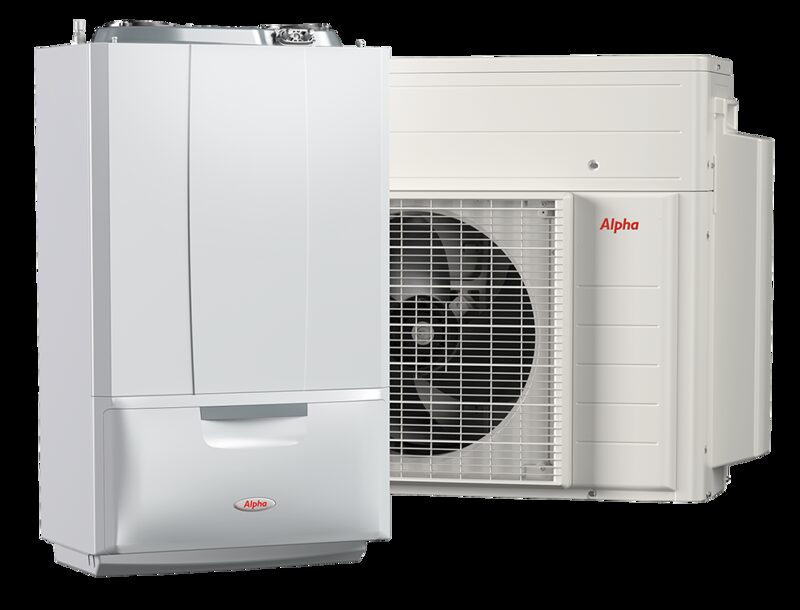
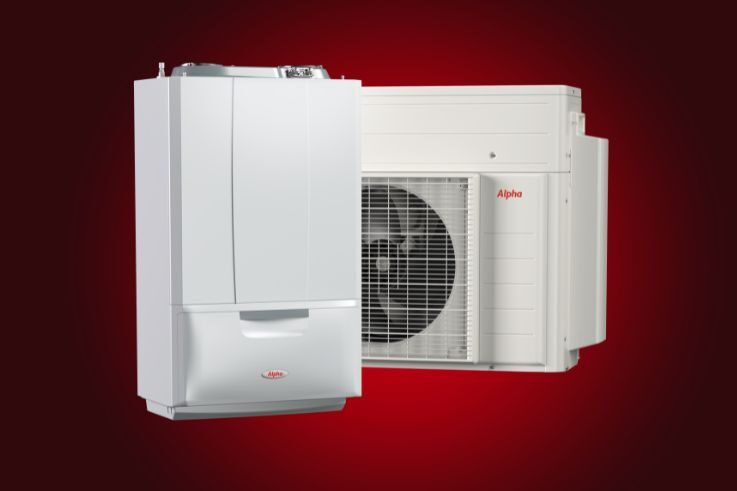
Alpha sells a packaged hybrid heating system, the E-Tec Hybrid, which pairs an air source heat pump with a gas boiler in one installation. The maker describes it as a "Packaged heat pump solution", built around the Alpha E-Tec 33 HB boiler connected to the Alpha E-Tec EHP external heat pump unit to give a full hybrid solution1. Alpha's wider range covers combi, system and regular boilers, smart controls and low-carbon options including a hybrid boiler and heat pump system range2.
The appeal is that the heat pump does most of the space heating while the boiler handles the peaks and the hot water. Independent guidance describes the air source electric heat pump alongside a gas condensing boiler as the most common hybrid heating system, and notes that in a high-quality hybrid installation up to 80% of the annual heating can be provided by the heat pump3. The household keeps a gas connection and a gas supplier, so this is a partial step towards independence rather than a break from the grid.
The critical limit is funding. Hybrid heat pumps are not eligible for the Boiler Upgrade Scheme, which funds air-to-water heat pumps and requires that supplementary heating appliances are not fossil fuel based4. A household choosing a hybrid is choosing to forgo that grant.
What the E-Tec Hybrid is: a heat pump and boiler in one package
The E-Tec Hybrid is not a single appliance. It is two: an Alpha E-Tec 33 HB boiler indoors and an Alpha E-Tec EHP external heat pump unit outside, connected and controlled as one system1. Alpha calls the result a full hybrid solution, and supplies Smartech controls with it, which the maker states gives high efficiency heating and hot water1.
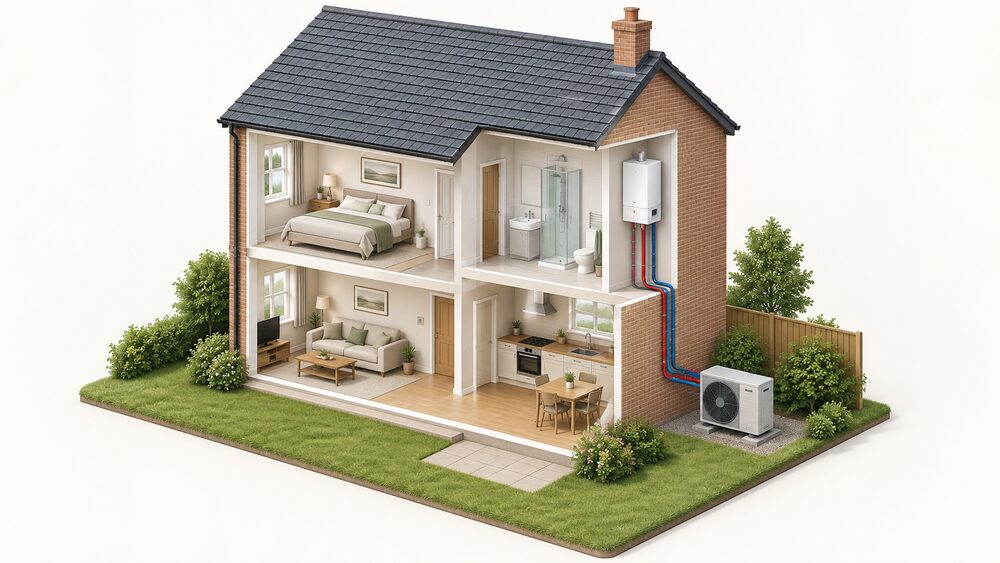
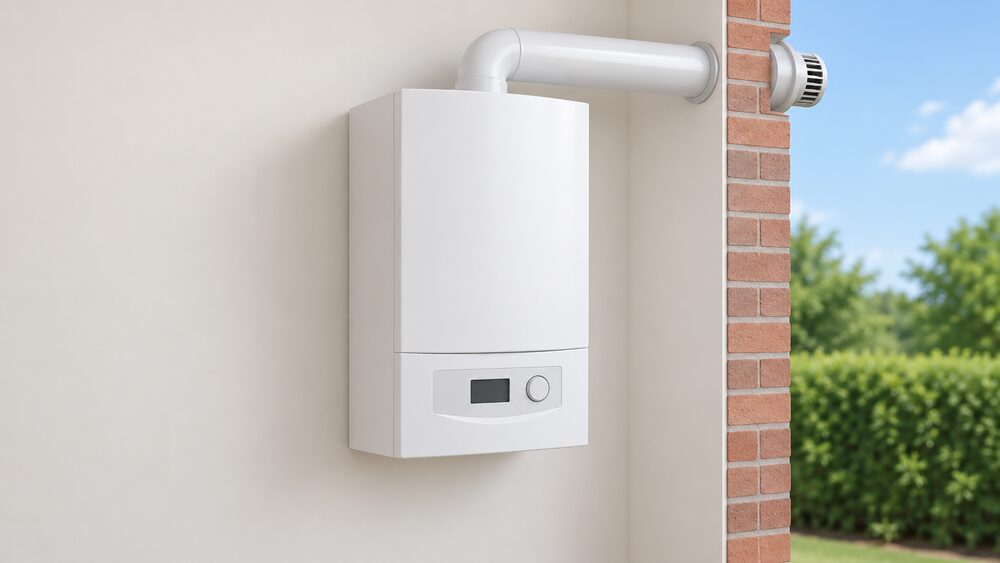
That architecture matters for how the household experiences the system. The boiler and control unit can often go indoors where the old boiler was, while the air source heat pump is installed outside the home7. For a retrofit, that means the internal disruption is broadly comparable to a boiler swap, with the additional external unit and its pipework.
| Component | Position | Role in the system |
|---|---|---|
| Alpha E-Tec 33 HB boiler | Indoors, often where the old boiler was7 | Peak heating and hot water1 |
| Alpha E-Tec EHP heat pump | Outside the home7 | Base space heating load1 |
| Smartech controls | Supplied with the package1 | Switching between sources1 |
Alpha also sells a separate product, the Alpha Hydro, described as a single-phase heat pump in a choice of outputs paired with a pre-plumbed 200 litre cylinder and Smartech control1. That is a different proposition: a heat pump with a cylinder rather than a hybrid with a boiler, and it sits closer to a full electrification route. The two should not be confused when comparing quotes.
Hybrid systems in general are recognised as a practical and affordable solution for both existing on-grid and off-grid homes6. The configuration is flexible: heat pump and hybrid controls can be fitted to different heat sources and boiler types such as regular or combination boilers6. That flexibility is what allows a household to keep an existing boiler in some arrangements rather than replacing everything at once.
How the hybrid splits the work: heat pump for heating, combi for hot water
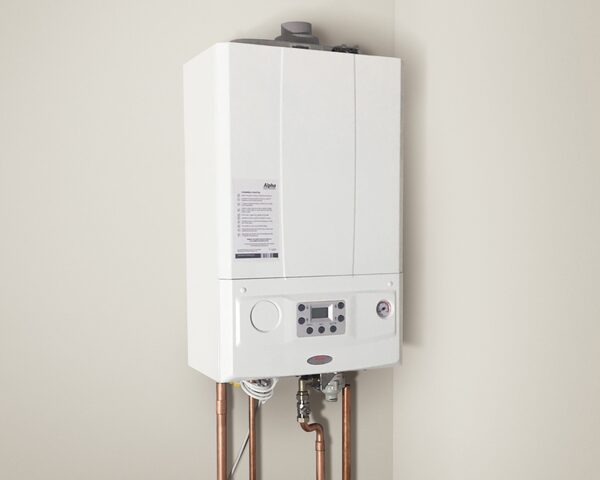
The division of labour is the defining feature of a hybrid. Some hybrid heat pumps are designed so that the heat pump provides heating, and the boiler then provides all of the instantaneous hot water on demand8. That is the combi hybrid arrangement, and it is the one that keeps hot water at mains pressure without a cylinder.
There is a second configuration. Independent guidance describes separating hot water and heating so the boiler only supplies hot water while the heat pump heats the home3. In that layout the boiler is effectively a hot water appliance and the heat pump carries the space heating load, which is a cleaner split than running both against the same demand.
The general category is described as bivalent: a heat pump works alongside another heat source3. Bivalent systems can be wired to run in different ways, and the control strategy decides which source leads at any given outdoor temperature. That is the setting that determines running costs more than the hardware does.
For a household, the practical consequence is that the gas boiler remains the hot water appliance in the combi configuration. The home stays on gas, keeps a gas connection and a standing charge, and depends on a supplier for the boiler side of the system. The heat pump reduces the volume of gas burned, but it does not remove the connection. Households weighing that trade-off against a full heat pump can compare the two routes at hybrid heat pumps and air-to-water heat pumps.
Compatibility with existing radiators and heating systems
Heat pumps can work with radiators or underfloor heating, though some types can work without either9. Air-to-water heat pumps in particular work well in combination with large radiators and underfloor pipes10. That is the emitters question in one line: the heat pump does not demand underfloor heating, but it performs best where the emitters can deliver heat at a lower flow temperature.
For a hybrid, the calculation is softer than for a full heat pump. Because the boiler can take over when the heat pump alone cannot meet the load, a system with smaller radiators can still function, with the boiler covering the coldest periods and the hottest flow temperatures. The trade-off is that the more the boiler runs, the less of the benefit the household captures.
Alpha's own range includes combi, system and regular boilers alongside the hybrid and heat pump options2, which means an existing Alpha boiler can in some cases be the boiler half of a hybrid installation. Alpha has published a case study of an E-Tec Hybrid installation in a recently renovated two-bedroom home whose owners moved in during 2021 with an existing Alpha boiler1. That is a maker's account of one installation rather than a general compatibility rule, but it illustrates the retrofit pattern.
Where a household is considering a full heat pump instead, the emitter question becomes central and is covered at radiators and emitters for a heat pump and do I need new radiators.
Smartech controls and automatic efficiency switching
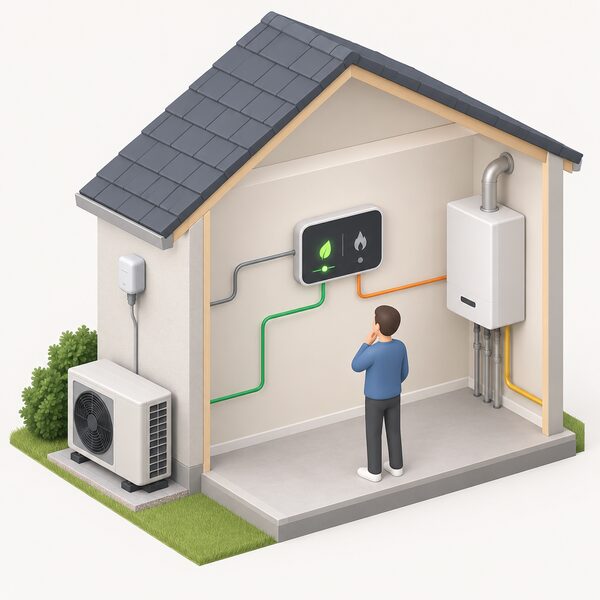
Alpha supplies Smartech controls with the E-Tec Hybrid, and states that together with them the system gives high efficiency heating and hot water1. The controls are the mechanism by which the system decides which heat source runs, so they carry more weight in a hybrid than a thermostat would in a boiler-only installation.
The switching logic follows outdoor temperature. Hybrid heat pumps are most efficient when temperatures are above two degrees centigrade, while the gas boiler is better below that threshold6. The heat pump alone can be used in milder weather, and the boiler can take over, or even run in parallel to the heat pump, in the winter when the building's heat load is at its maximum11. A control system that reads the outdoor temperature and the heat load is what makes that handover automatic rather than manual.
Alpha has argued publicly that static demand side response is reaching its limits for heat pumps, and that dynamic signals supporting heat pump operation are the next step, with hybrid systems as a practical middle ground1. That is the maker's position on where the technology is heading, not a description of the E-Tec Hybrid as sold.
The dependence here is worth stating plainly. Automatic switching depends on the controls working, and any remote or app-based monitoring depends on a home broadband connection and the manufacturer's platform. Local operation continues without either, but the optimisation layer does not. Controls and weather compensation are explained further at heat pump controls.
Heat pump sizes and outputs: from 5 kW to 16 kW
Sizing a heat pump starts with a heat loss calculation, not a floor area or a bedroom count. Independent guidance suggests about 5kW of heat output should be enough for smaller or well insulated homes11, and that 5kW, 8kW and 12kW systems should cover the demands of any household12. Those are the general bands a household should expect to see discussed.
The wider market shows how far the range extends. One monobloc air source heat pump is offered with a capacity range of four sizes from 9 to 16 kW for renovation and large new build properties13. Another is available in three output sizes: 1.5 to 8 kW, 3 to 13 kW and 4 to 18 kW14. A multi-port outdoor unit is listed with a heating capacity of 6.8 to 10.0 kW15. These are other makers' products, given here to show the span of what is sold in the UK rather than to describe Alpha's outputs.
| Product | Published output range |
|---|---|
| NIBE S1256-13 | Four sizes, 9 to 16 kW13 |
| LG Therma V R290 Monobloc | 1.5 to 8 kW, 3 to 13 kW, 4 to 18 kW14 |
| Daikin multi-port outdoor unit | 6.8 to 10.0 kW heating15 |
For larger properties, official guidance in Wales sets a threshold above 12 kW and up to 1000 kW for air heating, cooling products, high temperature process chillers and fan coil units16. That is a regulatory boundary rather than a sizing recommendation, but it marks where domestic-scale equipment ends.
Alpha's own published output figures for the E-Tec Hybrid and the Alpha Hydro are not stated in the material available here, so a household should expect the specific output to be confirmed by the installer's heat loss calculation. The general sizing method is set out at heat pump sizing and heat loss calculations before a heat pump.
Installing the outdoor unit and what a hybrid installation involves
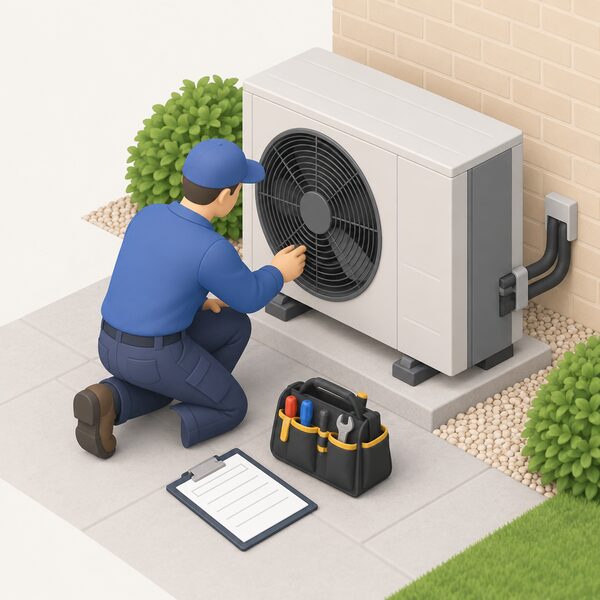
A hybrid installation has two siting questions rather than one. The air source heat pump is installed outside the home, while the boiler and control unit can often go indoors where the old boiler was7. That keeps the internal work close to a conventional boiler replacement, with the new external unit and its connections added.
The outdoor unit needs space and it needs to be placed lawfully. Most air-to-air systems require outdoor space for the external unit, and external units cannot be mounted on walls at height or hung from windows17. Air-to-air heat pumps usually have one unit outside and at least one unit inside, connected by pipes carrying a refrigerant between the units18. Air-to-water systems such as the E-Tec Hybrid connect the outdoor unit to the wet heating system instead.
Planning rules set limits on the unit itself. Official guidance states the volume of the unit must be no larger than 1.5m³ for a house or 0.6m³ for a block of flats19. That is a permitted development condition rather than a universal requirement, and it applies where a household is relying on permitted development rights. Siting, clearances and the noise assessment are covered at where a heat pump outdoor unit can go and MCS 020.
Alpha has published installer-facing maintenance guidance covering annual service fundamentals and additional steps including flow temperature optimisation and coastal corrosion checks1. For a household near the coast, that last point is worth raising at handover. The wider installation process is described at heat pump installation.
Hybrid heat pumps and the Boiler Upgrade Scheme

The Boiler Upgrade Scheme funds air-to-water heat pumps20. It provides upfront capital grants to support the installation of heat pumps and biomass boilers in homes and non-domestic buildings21, and eligible technologies include air-to-water heat pumps20. Air-to-air heat pumps are also listed among the eligible technologies in the installer guidance4.
Hybrid heat pumps are a different matter. Independent guidance states plainly that if you choose this type of heat pump, you will not be able to apply for funding from the Boiler Upgrade Scheme4. The scheme's own rules explain why: supplementary heating appliances must not be fossil fuel based5. A hybrid retains a gas, LPG or oil boiler, so it fails that condition.
There is one route back in. An approved grant category covers an air-to-water heat pump in an off-gas grid property that is replacing a fossil fuel hybrid system22. In other words, the scheme will fund the removal of a hybrid and its replacement with a full heat pump, but not the installation of a hybrid in the first place. The scheme's guidance was updated to clarify the position on hybrid heat pumps, with footnotes referencing the regulations23.
For a multi heat pump system the capacity limit is 70 kWth20. The scheme has also been consulted on for reform, with proposals to support installation of heat pumps, biomass boilers and heat batteries in homes and non-domestic buildings24. Grant levels and the position across the four nations are set out at heat pump grants and how much does a heat pump cost with a Boiler Upgrade Scheme grant.
How a hybrid performs in winter, and what it means for independence
Winter is where the hybrid earns its place and where its limits show. An air source heat pump will be less efficient in the winter when the air temperature is colder25. During winter the air temperature can drop by 5°C or more overnight, which reduces the heat pump's efficiency because it is heating water to a higher temperature19. The boiler covers that gap.
The control threshold is around freezing. Hybrid heat pumps are most efficient when temperatures are above two degrees centigrade, while the gas boiler is better below it6. In a high-quality hybrid installation up to 80% of the annual heating can be provided by the heat pump6, which means the boiler's share is concentrated in the coldest part of the year rather than spread evenly.
For comparison, some full heat pumps are marketed on cold weather performance. One is described as capable of reliably providing 100% heating performance even in extremely cold weather, at temperatures as low as minus 25°C, tested internally under lab conditions based on EN 1451126. That is a maker's claim for a different product, and it shows that the hybrid's compromise is a design choice rather than a physical necessity.
On independence, the position is clear. A hybrid keeps the home on the gas grid or on a delivered fuel, keeps a boiler that burns that fuel, and keeps a dependence on a fuel supplier for the boiler's share of the year's heat. It reduces the volume of fossil fuel burned and the exposure to price movements on that volume, but it does not end the connection. Hybrid systems can also be upgraded later to a range of future low or carbon free heating options, including an all-electric heat pump, an electric-hydrogen hybrid, an electric-biofuel hybrid, or an electric heat pump with instantaneous electric hot water6. That upgrade path is the strongest argument for the configuration as an interim step. The wider picture is at heat pumps and household energy independence.
Warranty, servicing and where the system has limits
The E-Tec Hybrid carries a 5 year warranty on an approved and correctly installed and maintained installation1. Both conditions are load-bearing: the installation has to be approved, and the system has to be maintained. Servicing records are therefore part of the warranty position rather than an optional extra. For comparison, another manufacturer's heat pump is listed with a 5 year warranty as standard27.
Alpha has published installer-facing maintenance guidance setting out annual service fundamentals and additional steps including flow temperature optimisation and coastal corrosion checks1. Alpha has also published winter guidance for new heat pump owners advising steady operation, gradual flow temperature reduction, insulation upgrades, tariff checks and annual servicing1. Those are the maker's recommendations for getting the most from a system.
The limits to state plainly are these:
- The system keeps a fossil fuel boiler, so it does not remove the household from gas, LPG or oil6.
- It does not attract the Boiler Upgrade Scheme grant4.
- Its efficiency advantage narrows in cold weather, when the boiler takes a larger share6.
- The warranty depends on approved installation and continued maintenance1.
Servicing and warranty terms are covered further at heat pump servicing and warranty and heat pump servicing and maintenance.
Sources27 cited
- Alpha E-Tec Hybrid heat pump product page, Alpha Innovation, 2025
- Alpha boilers review, Which?, 2025
- Hybrid heat pumps, Energy Saving Trust, 2026
- Boiler Upgrade Scheme: installers, Ofgem, 2026
- Boiler Upgrade Scheme guidance for installers V5, Ofgem, 2026
- Domestic hybrid heat pumps guidance, HHIC, 2026
- Hybrid heating frequently asked questions, Cadent Gas, 2026
- Is now a good time to get a heat pump, Energy Saving Trust, 2025
- Heating your home, Energy Saving Trust, 2026
- How heat pumps work: a guide for homeowners, NICEIC, 2025
- Your home guide to heat pumps, OFTEC, 2025
- Ground and water source heat pumps, MCS Certified, 2026
- NIBE S1256-13 heat pump, Quiet Mark, 2026
- Approved Document L Volume 1 consultation, Welsh Government, 2025
- LG Therma V R290 Monobloc 14kW heat pump, Quiet Mark, 2026
- Air-to-air heat pumps, Energy Saving Trust, 2026
- Planning guidance for heat pumps, Richmond Council, 2026
- Air-to-air heat pumps: a low carbon solution for UK homes, Nesta, 2026
- How to ensure a heat pump runs efficiently, Energy Saving Trust, 2026
- Boiler Upgrade Scheme guidance for installers v5.1, Ofgem, 2026
- Reforming consumer protection for home upgrade schemes, GOV.UK, 2026
- Notice of approved grant categories and values for the Boiler Upgrade Scheme, GOV.UK, 2026
- Summary of updates to Boiler Upgrade Scheme guidance for property owners, Ofgem, 2023
- Domestic hybrid heat pumps final report, BEIS, 2016
- Air source heat pumps fact sheet, Pendle Borough Council, 2026
- InstaGen IG8-MP1-A1 heat pump, Quiet Mark, 2026
- Daikin 4 port multi air conditioner, Quiet Mark, 2026
 Alpha boilersAlpha is an Italian-owned boiler brand with a Kent base, sold in the UK as combi, system and hybrid options, with warranties up to 13 years when specified accessories are fitted.