
In this guide
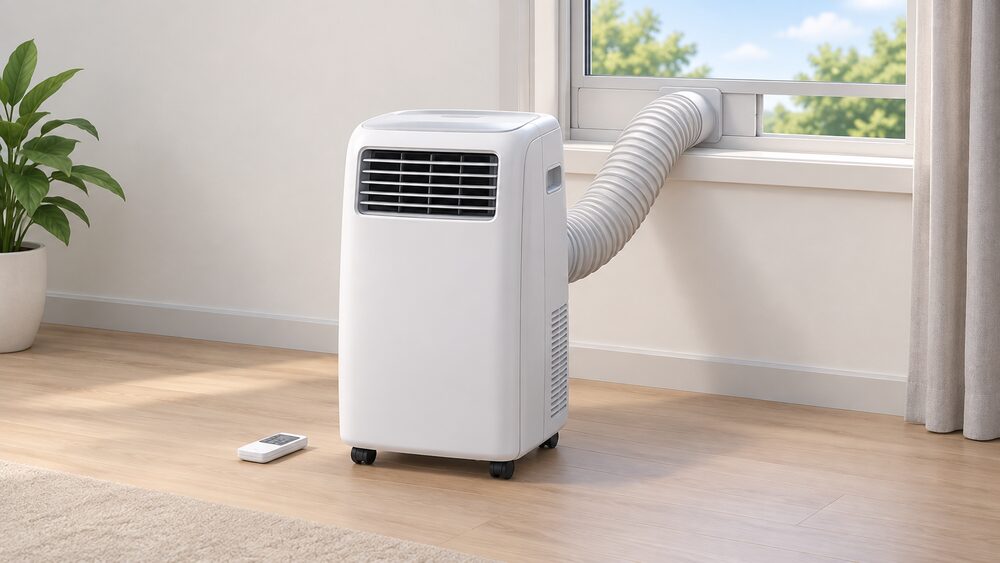
Honeywell sells portable air conditioners into the UK through its own Honeywell Air Comfort store, alongside fans and air treatment products. The range is the plug-in kind: a floor-standing box on casters, an exhaust hose, and a window kit in the box. Honeywell describes the units as coming with smooth-gliding caster wheels and as equipped with exhaust hoses and window kits so they are easy to install1.
The control story is where the current models differ from a basic portable. Honeywell lists programmable timer and sleep mode across the range, and the HJ16CESVWK adds Wi-Fi, Alexa and Google Assistant voice control and the Honeywell Air Comfort App with 24-hour daily and weekly scheduling1. The HT12CESVWK and HT13CESVWK carry the same 24-hour timer with daily and weekly scheduling set through the app, and a maximum timer duration of 24 hours3.
What that buys a household is cooling without any installation work, and what it costs is efficiency. The Centre for Sustainable Energy reports that portable units use 30 to 50% more electricity than fixed systems5, and Daikin states that a portable A+ class model could still consume 2.4 times more electricity than a wall-mounted unit of the same class6. A portable air conditioner is a room-by-room appliance that keeps a home on the electricity grid for its entire cooling load.
What a Honeywell portable air conditioner is and who it suits
A portable air conditioner is a single self-contained unit that sits on the floor of the room being cooled. It removes warm air from the room and vents it outside through an exhaust hose, while circulating cooled air indoors8. Honeywell's own range is built on that principle: the units ship with exhaust hoses and window kits, and the maker describes them as easy to install1.
The functions vary by model. The HJ16CESVWK is a 3-in-1 unit covering cooling, dehumidification and fan2. Honeywell also sells a heat mode category, describing portable air conditioners with a built-in heat pump to keep a home warm in winter1. That matters for how the appliance is used across a year: a cooling-only unit sits idle for much of it, while a unit with a heat pump has a second season.
Who it suits is set by the limits rather than the features. Daikin states that portable air conditioning units still have a place, particularly for temporary set-ups or rooms under 10 m², but that for longer-term use a fixed system performs better6. A maker price list aimed at UK buyers puts the same point positively: portables are ideal for bedrooms, lounges, home offices and rental properties where fixed systems may not be possible9. The rental point is the practical one, since a portable needs no fixing work and can be stored away when not in use10.
For a household, the appeal is that nothing has to be installed, no outdoor unit is needed and no consent from a landlord or freeholder is required for the appliance itself. The trade is that the cooling is confined to one room at a time and the unit has to be vented at a window whenever it runs.
Control features: programmable timer and sleep mode
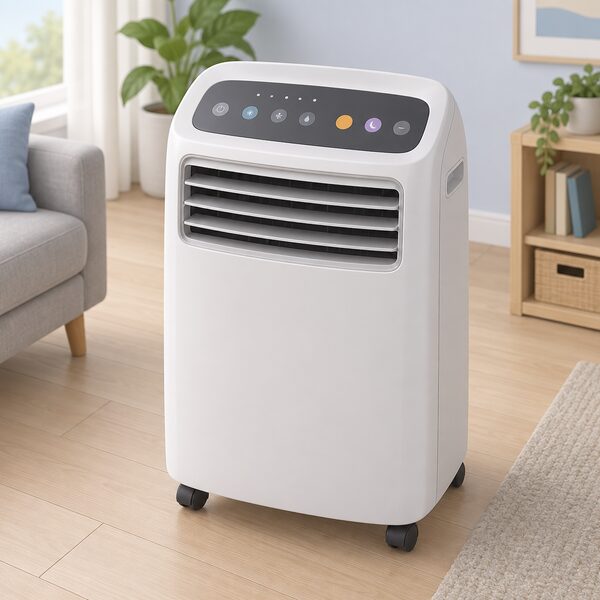
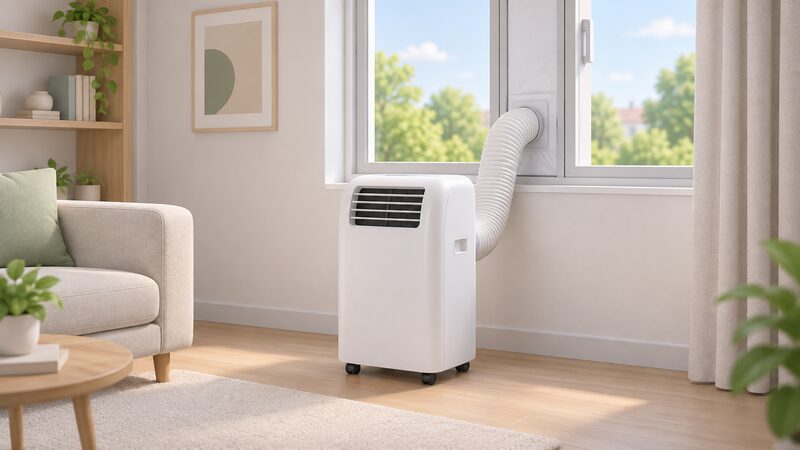
Honeywell's portable range is sold on convenience features, and the maker names two specifically: a programmable timer and sleep mode, described as maximising comfort and saving energy1. Those two settings do different jobs.
The timer is the scheduling function. On the HT12CESVWK and HT13CESVWK it is a 24-hour timer with daily and weekly scheduling that can be pre-set using the Honeywell Air Comfort App, with a maximum timer duration of 24 hours3. The HJ16CESVWK carries the same app-based scheduling alongside Wi-Fi and voice control through Alexa and Google Assistant2. In practice that means a unit can be set to start before a room is occupied and stop after it is empty, rather than being switched on and left.
Sleep mode is the night setting. Honeywell lists it as a feature but does not spell out the behaviour on its UK pages1. Other makers describe the same mode in more detail, and the pattern is consistent: on the electriQ P18CW, sleep mode reduces fan noise, dims the display and turns off the LED lights overnight11; on the EcoPlus10HPW it reduces fan noise and disables the LED lights, with the fan running at a constant low speed12. Meaco lists sleep as one of four modes, alongside cool, fan and dry, on the Cirro 12000 BTU, with an on and off timer of 1 to 24 hours13.
The wider market treats these as standard rather than premium. Rointe lists remote control, touch LED display, timer and window kit as included features across its portable range14, and the electriQ EcoPlus12HPW offers Wi-Fi app control, a 24-hour manual start and stop timer, or a touch control panel15. A timer and a night mode are the baseline for a portable sold in the UK, not a differentiator.
| Feature | HJ16CESVWK | HT12CESVWK | HT13CESVWK |
|---|---|---|---|
| Cooling, dehumidify, fan | 3-in-12 | Listed3 | Listed4 |
| App scheduling | 24-hour, daily and weekly2 | 24-hour, daily and weekly3 | 24-hour, daily and weekly4 |
| Maximum timer duration | Not stated | 24 hours3 | 24 hours4 |
| Voice control | Alexa and Google Assistant2 | Not stated | Not stated |
| Handle and casters | Built-in handle and casters2 | Casters1 | Casters1 |
| Filter | Not stated | Washable filter3 | Filter clean alert4 |
Mobility: smooth-gliding caster wheels
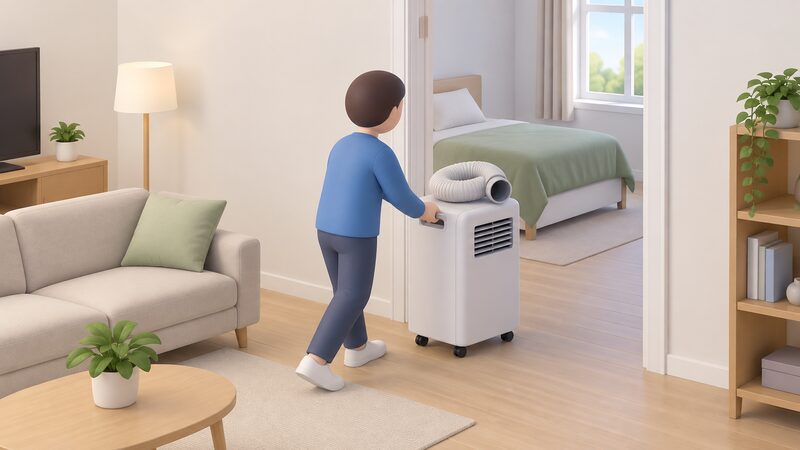
Honeywell describes its portable units as sleek and powerful, coming with smooth-gliding caster wheels1. The HJ16CESVWK goes further and lists a built-in handle as well as built-in casters2. That combination is what makes a portable genuinely movable rather than merely wheeled.
The limit is set by physics, not by the wheels. Pro Breeze states that while a single unit cannot cool multiple rooms at once, its portable models with wheels make it easy to move the unit from room to room16. Netatmo makes the same point: a portable system is on castors so it can be wheeled from one room to another, but it can only cool small spaces10. Moving the appliance also means moving the exhaust arrangement, since the hose has to be routed to a window or other opening in whichever room it is used.
Room coverage figures published by other makers give a sense of the scale involved. The Meaco Cirro 12000 BTU is given a room size of 20 to 30 m² as an estimate for a typical UK living space13. That is a single-room figure. A household moving a unit between a bedroom and a living room is choosing which room gets cooled, not extending the cooling to both.
Buying from the maker: free shipping and what is in the box
Honeywell sells its portable air conditioners directly through its UK site, and the portable air conditioning pages state free shipping1. That is the maker's own published term for orders placed with it, and it applies to the range rather than to a single model.
The box contents are listed per model and are consistent. The HT12CESVWK ships with the portable air conditioner, a remote control, a window installation kit with insulation foam tape, a drain pan, a drain tube, a user manual and a warranty guide3. The HT13CESVWK ships with the same set4, and the HJ16CESVWK likewise includes a window installation kit with insulation foam tape, a drain pan, a drain tube, a user manual and a warranty guide2. Honeywell also lists a washable filter on the HT12CESVWK3, and the HT13CESVWK includes a filter clean alert4.
The window kit is the part that matters most, because it is what stops the exhaust from simply heating the room it is trying to cool. Honeywell describes the HT12CESVWK as coming with a fully packed window kit with an adjustable window bracket and a dehumidifier drain tube3.
Other sellers in the same market bundle comparable items. Pro Breeze offers free UK delivery and states that its portable air conditioners come with a window kit for quick setup, with no permanent installation needed, and that they are low maintenance with washable filters and easy-access drainage points16. The electriQ EcoPlus12HPW ships with a 2 m exhaust hose, a hose-end adaptor, a TRUE HEPA filter, a carbon filter and a remote control15, and the EcoPlus10HPW with a 2 m exhaust hose, a hose-end adaptor, a TRUE HEPA filter, a carbon filter and a remote control12. A window kit, a remote and a filter are the normal contents of a portable sold in the UK.
Venting: the hose has to go outside
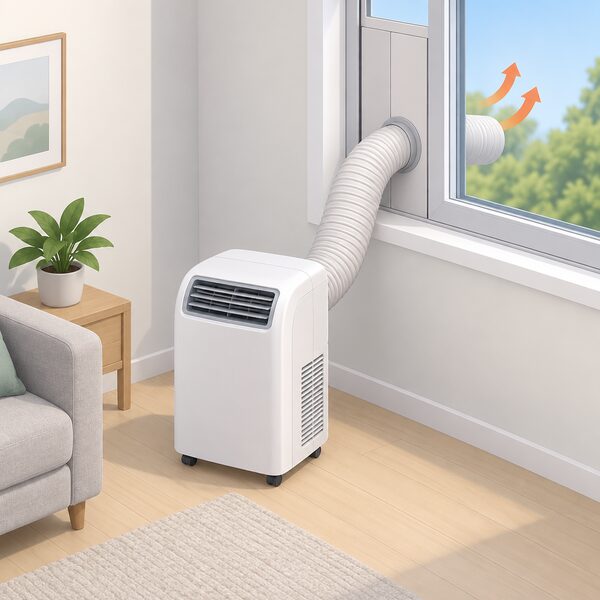
Every portable air conditioner has to be vented. The Centre for Sustainable Energy states that portable units need to be properly vented to the outside using a special fitting for the window, and warns that if the vent is just put through an open window, heat will come back in5. The maker guidance agrees across brands: electriQ states on several product pages that all portable air conditioners must be vented out so the heat is removed from the room being cooled11, and that without venting the unit will not cool effectively11.
The venting route is flexible. The electriQ P18CW states that the unit must be vented outside through a window, a door with a sealing kit, a wall vent or another suitable opening11. Pro Breeze states that its units come with a window kit for quick setup and need no permanent installation16.
Ventilation more broadly is a separate matter from cooling, and the two can pull against each other. The Centre for Sustainable Energy notes that the simplest way of ventilating a home is to open the windows, but that this offers no guarantee the fresh air reaches the places that need it, and that opening windows in winter leads to significant heat loss18. Official guidance for private rented housing in Northern Ireland states that all habitable rooms should be ventilated directly to the open air by opening a window19, and Scottish building guidance states that permanently open air vents should be non-adjustable20. Replacement windows and doors need adequate ventilation included to remove airborne vapour, otherwise it may condense on the coldest surface21. A window kit that seals around an exhaust hose is a compromise between venting the appliance and keeping the window open.
What owning a portable unit means for household energy independence
A portable air conditioner is the least independent cooling option available to a UK household, and it is worth being exact about why.
The appliance runs entirely on mains electricity. Electrical Safety First gives a typical portable air conditioner a power rating of up to 2,000W22, and the National Energy Action summer guidance gives a typical portable unit as 1,000 to 1,500W7. A press release on UK cooling demand describes the 2.2 million homes with portable air conditioning units as using 1kW of power23. There is no gas connection, no flue and no combustion, so the unit adds nothing to a home's fuel diversity: every hour of cooling is an hour of grid electricity, bought from a supplier at whatever tariff applies.
The efficiency position is worse than for fixed cooling. The Centre for Sustainable Energy reports that portable units use 30 to 50% more electricity than fixed systems5, and Daikin states that although a portable A+ class model might appear efficient, it could still consume 2.4 times more electricity than a wall-mounted unit of the same class6. EDF describes portable models as standalone units that can be plugged into a wall socket for instant cooling, but notes they are not as efficient as split units and tend to use more energy, especially when left running all day24. Netatmo lists the disadvantages plainly: an auxiliary device with limited cooling capacity, and noisier than a fixed unit10.
The dependence that remains is therefore threefold. The household depends on the grid for the entire cooling load, on an electricity supplier for the price of it, and on the appliance itself, which is a sealed refrigerant product with no user-serviceable cooling circuit. What a portable does offer is independence from installation: no outdoor unit, no pipework, no F-gas work, no planning question and no landlord consent for the hardware. For a renter or a household in a flat where a fixed system is not an option, that is the whole of the case. The wider trade-offs are set out in portable air conditioners and in split vs portable air conditioning.
Where a portable air conditioner fits in a UK home
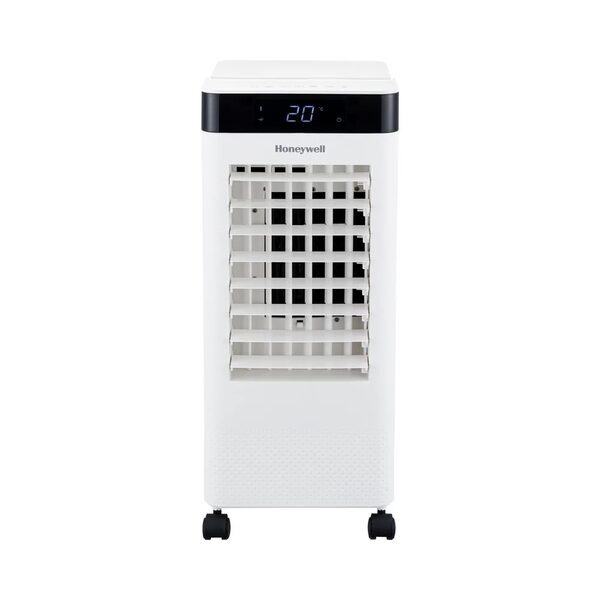
The honest answer is: in one room, for part of the year, as a supplement rather than a system.
Daikin's guidance is that portables suit temporary set-ups or rooms under 10 m², and that for longer-term use a fixed system is the better performer6. A maker price list aimed at UK buyers puts the same appliance in bedrooms, lounges, home offices and rental properties where fixed systems may not be possible9. The Meaco Cirro 12000 BTU is given a room size of 20 to 30 m² as an estimate for a typical UK living space13, which is a normal bedroom or a modest living room rather than a whole house.
The practical pattern for a UK household is a unit that comes out for the hottest weeks, is wheeled to whichever room is occupied, and is vented at a window each time. It can be stored away when not in use and needs no fitting work10. It plugs into a wall socket for instant cooling24. Against that, it is noisier than a fixed unit and has limited cooling capacity10, and it uses more energy than fixed cooling for the same result5.
For a household weighing up cooling options, the portable sits at the low-cost, low-commitment end of the market. It is less expensive upfront than a split system24, and it requires no installation, which is why it appears so often in rented homes and flats. What it does not do is change the household's relationship with energy: it adds a summer electrical load to a home that is already dependent on the grid for everything else. Households looking at the alternatives can compare types of air conditioning, the running cost picture in air conditioning running costs, and the wider question of home cooling and energy independence.
Sources24 cited
- Portable Air Conditioners, Honeywell Air Comfort, 2026
- HJ16CESVWK Smart Local Air Conditioner, Honeywell Air Comfort, 2026
- HT12CESVWK Smart Local Air Conditioner, Honeywell Air Comfort, 2026
- HT13CESVWK Smart Local Air Conditioner, Honeywell Air Comfort, 2026
- How to keep your home cool in hot weather, Centre for Sustainable Energy, 2026
- Air-to-air heat pumps for small rooms, Daikin UK, 2026
- Summer energy tips, National Energy Action, 2026
- Packaged air conditioning, Netatmo, 2026
- Domestic Portable Air Conditioners, Cool Easy, 2026
- Home air conditioning, Netatmo, 2026
- electriQ P18CW, electriQ, 2026
- electriQ EcoPlus10HPW, electriQ, 2026
- Meaco Cirro 12000 BTU, Meaco, 2026
- Portable Air Conditioners, Rointe, 2025
- electriQ EcoPlus12HPW, electriQ, 2026
- Air Conditioners, Pro Breeze, 2026
- electriQ A2/EcoSilent12HPW, electriQ, 2026
- Ventilation, Centre for Sustainable Energy, 2025
- Checking your home is fit to live in, nidirect, 2026
- Permitted development rights: air source heat pumps, Scottish Government, 2015
- Windows knowledge hub, Glass and Glazing Federation, 2026
- Ratings of electrical appliances, Electrical Safety First, 2026
- The cost of keeping cool, Uswitch, 2026
- Guide to air conditioning units, EDF Energy, 2024