
In this comparison
Meaco and Honeywell both sell portable air conditioners in the UK, and buyers cross-shop them because they sit at different points on price, noise and warranty. Meaco's range runs from £389.99 for the MeacoCool MC Pro 9000 BTU to £659.99 at the top of the collection, with the Cirro 12000 BTU at £519.99 and the Cirro+ 16000 BTU at £629.991. Honeywell's UK air comfort site lists its portable units with free shipping and a 12 month warranty4.
The practical differences are room size, noise and heat mode. Meaco quotes the Cirro 12000 BTU at 20 to 30 square metres and 45 to 51 dB, the Cirro+ 16000 BTU at 35 to 40 square metres and 42 to 51 dB, and the MeacoCool MC Pro 9000 BTU at 16 to 26 square metres and 52 to 54 dB2. Honeywell sells portable air conditioners with a built-in heat pump for winter use, alongside cooling-only models4.
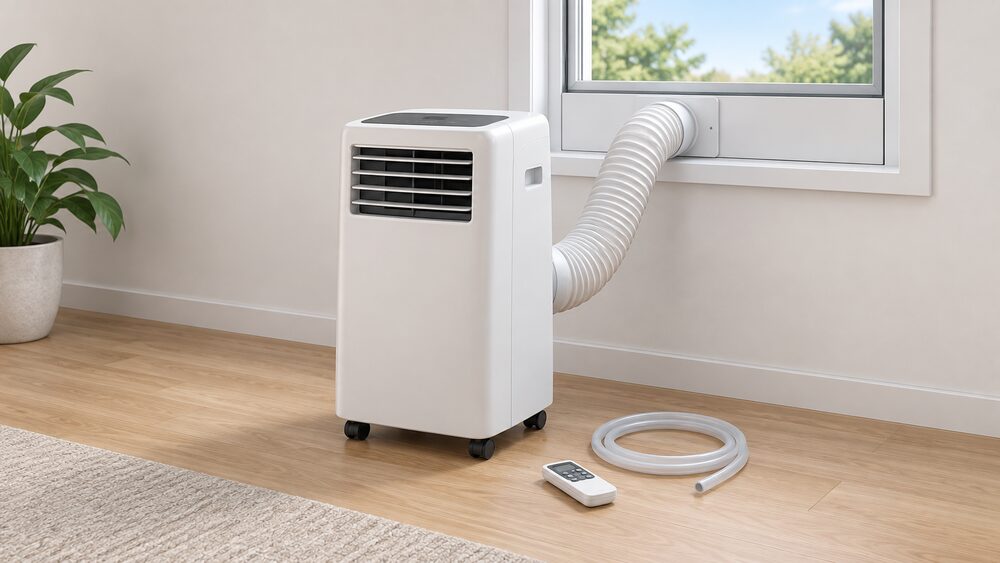
Both brands are portable in the same limited sense: a unit on castors that can be wheeled between rooms, but which must be vented to the outside through a window fitting to remove the heat it extracts6. Neither gives a household independence from the grid, and both draw more electricity than a fixed system for the same cooling.
Meaco or Honeywell: which portable air conditioner suits a UK home
The two brands answer different questions. Meaco publishes a full specification table for each model, with room size, noise, airflow, refrigerant and running cost, and designs its units in the UK through an in-house team2. Honeywell's UK pages are shorter on specification and lead on features: caster wheels, a programmable timer and sleep mode, thermal overload protection, and exhaust hoses with window kits included4.
Meaco's range splits into two families. The Cirro and Cirro+ models are the quiet, inverter-led line, with Super Quiet mode quoted at 45 dB on the Cirro 12000 BTU and 42 dB on the Cirro+ 14000 and 16000 BTU units2. The MeacoCool MC Pro models are the cheaper line, at 52 to 54 dB on the 9000 BTU and 53 to 55 dB on the 10000 BTU, and both list heating capacity as not applicable9. Meaco also sells heater versions of the Cirro 12000 BTU and the Cirro+ 14000 and 16000 BTU, which add a heat mode and a second running cost figure3.
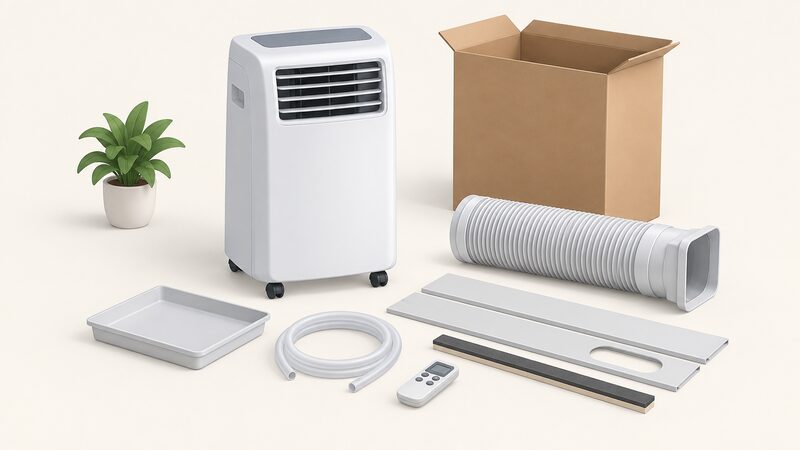
Honeywell's UK range is organised by function rather than by model family, with a category for portable air conditioners that include a built-in heat pump and a category for cooling-only units4. Its box contents are consistent across models: the unit, a remote control, a window installation kit with insulation foam tape, a drain pan, a drain tube, a user manual and a warranty guide12.
For a household, the choice turns on three things the makers state plainly: the room size the unit is rated for, the noise figure in the quietest mode, and whether a heat mode is wanted. Meaco gives all three per model. Honeywell gives the heat pump option and the warranty term, and leaves the rest to the individual product page.
Why portable air conditioning matters in Britain now

Meaco states that four out of five of the hottest days in Britain's history have occurred since 20191. That is the maker's own framing of the market, and it matches the pattern the independent advice bodies describe: the Centre for Sustainable Energy publishes guidance on keeping a home cool in hot weather, and the National Energy Action summer tips set out what a household can do without cooling equipment at all6.
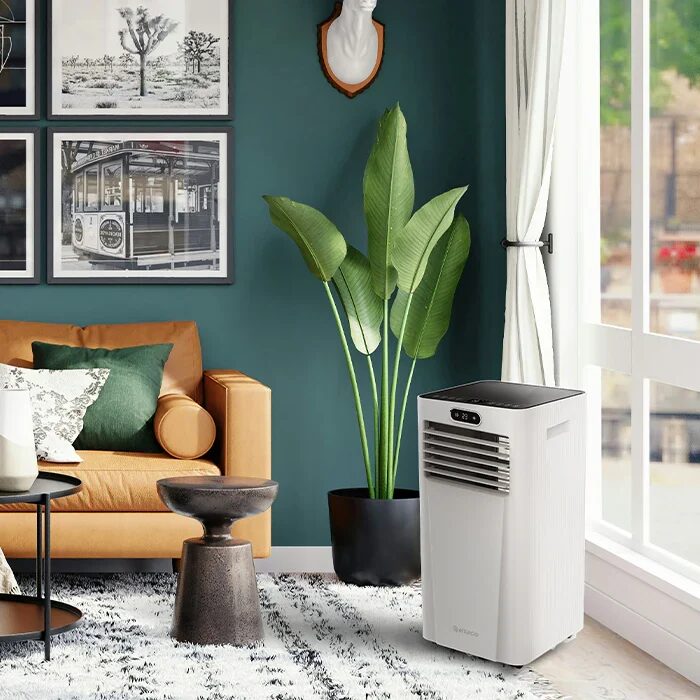
Portable units occupy a specific niche. Daikin's guidance puts portable air conditioning in its place for temporary set-ups or rooms under 10 square metres, and notes that portable units often operate at higher noise levels of up to 65 dB15. Netatmo describes the format as a system on castors that can be wheeled from one room to another but can only cool small spaces, and as a device placed on the ground with no lengthy installation process7.
That combination, no installation and one room at a time, is why portables sell into rented homes and into rooms where a fixed system is not possible. Distributor listings describe them as ideal for bedrooms, lounges, home offices and rental properties where fixed systems may not be possible, and as suitable for bedrooms, living rooms, home offices and commercial spaces where flexible, on-demand control is wanted17.
The limit is built into the format. A portable unit sits inside the room it is cooling, so the heat it removes has to leave through a hose, and the compressor and fan are in the same space as the occupant. A fixed split system puts the noisy part outside. That is the trade a household makes: no installation, no outdoor unit, no planning question, in exchange for noise in the room and a vent hose through a window.
The Meaco range of portable air conditioners
Meaco's collection page lists models from £399.99 to £659.99, and the individual product pages carry the specification1. The Cirro 12000 BTU is the mid-range unit at £519.99, rated for 20 to 30 square metres, with a 12000 BTU cooling capacity, 1350 watts cooling power consumption, 400 cubic metres per hour maximum airflow, 1.6 litres per hour moisture removal, an A energy rating, R290 refrigerant at 200g, a 65 cm drainage hose, a glow in the dark remote, Wi-Fi on 2.4 and 5 GHz, optional app control, voice control through Amazon Alexa and Google Assistant, a child lock, and dimensions of 722 by 430 by 358 mm2. It ships with one standard window kit and one flexible window kit, the standard kit designed for sash windows and the flexible kit for all window types, with the flexible kit taking up to 39 cm width and up to 4 m in length2.
The Cirro+ 16000 BTU is the largest of the quiet line at £629.99, rated for 35 to 40 square metres, with an A energy rating, 0.8 litres per hour moisture removal, 42 to 51 dB noise, a glow in the dark remote and the same two window kits3. The Cirro+ 14000 BTU sits below it at £599.99, with 42 to 51 dB noise and 40p per hour running cost8.
The MeacoCool MC Pro line is the value end. The 9000 BTU is £389.99, rated for 16 to 26 square metres, with 1005 watts cooling power consumption, 52 to 54 dB noise, an A energy rating, a remote control, Wi-Fi on 2.4 and 5 GHz, voice control, and a temperature range of 16°C to 32°C5. The 10000 BTU is £399.99, rated for 18 to 28 square metres, with 1120 watts cooling power consumption, 310 cubic metres per hour maximum airflow, 53 to 55 dB noise, R290 refrigerant at 260g, a 65 cm drainage hose, a dimmable front facing display, a remote control, Wi-Fi, voice control and a temperature range of 16°C to 32°C9.
One naming point matters at the point of delivery: Meaco states that the product title on packaging for the Cirro 12000 BTU, the Cirro+ 14000 BTU and the Cirro+ 16000 BTU will show as MeacoCool Pro2.
| Model | Price | Room size | Noise | Running cost | Heat mode |
|---|---|---|---|---|---|
| MeacoCool MC Pro 9000 BTU | £389.995 | 16 to 26 m²5 | 52 to 54 dB5 | 25p/hour5 | No5 |
| MeacoCool MC Pro 10000 BTU | £399.999 | 18 to 28 m²9 | 53 to 55 dB9 | 28p/hour9 | No9 |
| Cirro 12000 BTU | £519.992 | 20 to 30 m²2 | 45 to 51 dB2 | 35p/hour2 | Heater version sold11 |
| Cirro+ 14000 BTU | £599.998 | Not stated | 42 to 51 dB8 | 40p/hour8 | Heater version sold8 |
| Cirro+ 16000 BTU | £629.993 | 35 to 40 m²3 | 42 to 51 dB3 | 46p/hour3 | Heater version sold3 |
The Honeywell range and free shipping
Honeywell's UK air comfort site presents portable air conditioners as sleek and powerful units that come with smooth-gliding caster wheels, equipped with exhaust hoses and window kits for easy installation, and offering a programmable timer and sleep mode4. The same page lists a category of portable air conditioners with a built-in heat pump to keep you warm all winter, and states that thermal overload protection prevents the machines from overheating4. Free shipping is listed on the UK portable air conditioner pages4.
The individual product pages carry the box contents rather than a full specification table. The HJ16CESVWK smart local air conditioner is a three in one cooling, dehumidification and fan unit, supplied with a remote control, a window installation kit with insulation foam tape, a drain pan, a drain tube, a user manual and a warranty guide12. The HT12CESVWK and HT13CESVWK smart local air conditioners ship with the same list of contents13.
Honeywell's warranty term is 12 months, stated on the UK portable air conditioner page4. That is shorter than Meaco's two years extendable to five, and it is the maker's own term for its own products.
The free shipping statement is the maker's own shop term. It says nothing about delivery charges from third-party retailers, which set their own terms, and it does not indicate stock levels. A household comparing the two brands on delivery should treat the maker's shipping line as one seller's term rather than a market-wide position.
Cooling performance and room size: what to compare
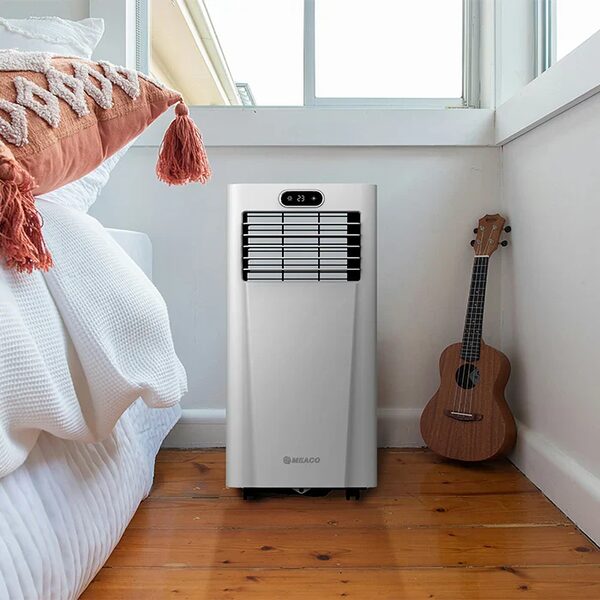
Room size is the first figure to compare, and both makers publish it in square metres rather than leaving it to a BTU calculation. Meaco's stated sizes run from 16 to 26 square metres on the MeacoCool MC Pro 9000 BTU, 18 to 28 square metres on the MC Pro 10000 BTU, 20 to 30 square metres on the Cirro 12000 BTU, and 35 to 40 square metres on the Cirro+ 16000 BTU2. Meaco adds the caveat that room sizes are approximate and that ceiling height, insulation, glazing and sun exposure can affect cooling performance1.
That caveat matters more than the headline figure. A south-facing room with large glazing and a low ceiling will not cool to the same standard as a shaded room of the same floor area, and the maker's range is a guide rather than a guarantee. The independent advice points the same way: the Centre for Sustainable Energy's guidance on keeping a home cool deals with shading, ventilation and the timing of heat gains, not with equipment sizing alone6.
Noise is the second figure. Meaco's Super Quiet mode is quoted at 45 dB on the Cirro 12000 BTU and 42 dB on the Cirro+ 14000 and 16000 BTU units, with the full range running to 51 dB on those models2. The MeacoCool MC Pro line runs at 52 to 54 dB on the 9000 BTU and 53 to 55 dB on the 10000 BTU9. Daikin's guidance notes that portable air conditioners often operate at higher noise levels of up to 65 dB, which puts Meaco's quietest figures at the lower end of the format15.
Airflow and moisture removal are the third comparison. The Cirro 12000 BTU moves up to 400 cubic metres per hour and removes 1.6 litres per hour, the MeacoCool MC Pro 10000 BTU moves up to 310 cubic metres per hour, and the Cirro+ 16000 BTU removes 0.8 litres per hour2. Higher airflow and moisture removal suit larger or damper rooms; the figures are the maker's own for its own models.
For a household, the practical test is whether the unit is rated for the room it will sit in, and whether the noise figure in the quietest mode is acceptable for the room's use. A bedroom unit at 42 dB is a different proposition from one at 55 dB, and the difference is visible in the specification before purchase.
Cost, running costs and what you get for the price
Meaco's prices run from £389.99 for the MeacoCool MC Pro 9000 BTU to £629.99 for the Cirro+ 16000 BTU, with the MC Pro 10000 BTU at £399.99, the Cirro 12000 BTU at £519.99 and the Cirro+ 14000 BTU at £599.992. The collection page gives the overall range as £399.99 to £659.991. Distributor listings for the Meaco Pro 7000 BTU models show £409.99 including VAT for both the cooling-only and the heating version, with the heating version showing as pre-order and the cooling-only unit out of stock19.
Running costs are quoted per hour by Meaco, based on 24.67p per kWh on the MeacoCool models. The MC Pro 9000 BTU is 25p per hour, the MC Pro 10000 BTU is 28p per hour, the Cirro 12000 BTU is 35p per hour, the Cirro+ 14000 BTU is 40p per hour and the Cirro+ 16000 BTU is 46p per hour2. The Cirro 12000 BTU heater version quotes cooling at 35p per hour and heating at 29p per hour11.
The independent figure for the format is close to the lower end of that range. National Energy Action states that a typical portable air conditioner of 1,000 to 1,500W can cost around 26 to 39p per hour, roughly 14 to 20 times more than a fan10. Ecotricity's guidance puts a standard fan at 20 times less than portable air conditioners21.
The comparison that matters for a household is against other ways of cooling and heating. The Centre for Sustainable Energy states that portable units use 30 to 50 per cent more electricity than fixed systems6. A case study from Mixergy reports that using a portable AC unit for the same purpose consumes around five times as much energy as an air to air unit22. EDF guidance notes that portable units tend to use more energy, especially when left running all day23.
UK availability, delivery and buying online
Stock is the immediate practical issue. Meaco's own pages show the Cirro 12000 BTU as sold out with a return in March 2027, the Cirro+ 14000 BTU and Cirro+ 16000 BTU as sold out with a return in April 2027, and both MeacoCool MC Pro models as sold out2. Distributor listings show the Meaco Pro 7000 BTU as out of stock and the heating version as unavailable with a notify-me option19.
Honeywell's UK site lists free shipping on its portable air conditioner pages, and its product pages carry the box contents and warranty guide4. Pro Breeze lists free UK delivery on its portable air conditioner collection, and electriQ's portable air conditioner pages list models at £259.98 and £899.9724. Those are other sellers' terms and prices, not Meaco's or Honeywell's.
Buying online means buying from whichever seller has stock. The maker's own shop gives the maker's warranty and the maker's shipping term; a third-party retailer gives its own price, its own delivery charge and its own returns process, and the warranty still runs from the maker. For a Meaco unit, the two-year parts and labour warranty extendable to five years applies to the product, and the packaging title may show MeacoCool Pro rather than the name on the order2.

What owning a portable air conditioner means for energy independence

A portable air conditioner does very little for a household's energy independence. It runs on mains electricity from a supplier, it draws more power than a fixed system for the same cooling, and it cannot be run from a domestic battery or solar array without those systems being sized for it. The Centre for Sustainable Energy figure of 30 to 50 per cent more electricity than fixed systems, and the Mixergy case study figure of around five times the energy of an air to air unit for the same purpose, both point the same way6.
What it does offer is independence of a different kind: no installer, no outdoor unit, no planning question, and no fixed commitment to a property. Distributor listings describe the format as ideal for rental properties where fixed systems may not be possible, and as suitable for bedrooms, living rooms, home offices and commercial spaces where flexible, on-demand control is wanted17. For a tenant or a household in a flat where a split system is not an option, that flexibility is the whole point.
The dependence that remains is on the grid, on a supplier, and on the unit's own controls. Meaco's Cirro and MeacoCool models offer Wi-Fi on 2.4 and 5 GHz, optional app control and voice control through Amazon Alexa and Google Assistant, which means the smart functions depend on a home network and on the maker's app2. Honeywell's units offer a programmable timer and sleep mode, which keeps the scheduling local to the unit4.
The honest summary is that a portable air conditioner is a plug-in appliance, not a step towards self-sufficiency. It cools one room, it needs a window vent, it adds to the electricity bill at a rate the maker publishes per hour, and it leaves the household as dependent on the grid as any other appliance. Where a household wants cooling that reduces rather than adds to its energy dependence, the passive measures in the Centre for Sustainable Energy guidance and the National Energy Action summer tips are the place to start6.
Sources25 cited
- Meaco air conditioners collection, Meaco, 2026-09-23
- Meaco Cirro 12000 BTU Super Quiet Smart Portable Air Conditioner, Meaco, 2026-09-23
- Meaco Cirro+ 16000 BTU Super Quiet Inverter Smart Portable Air Conditioner, Meaco, 2026-09-23
- Honeywell portable air conditioners, Honeywell Air Comfort, 2026-09-23
- MeacoCool MC 9000 BTU Portable Air Conditioner and Dehumidifier, Meaco, 2026-09-23
- How to keep your home cool in hot weather, Centre for Sustainable Energy, 2026-07
- Packaged air conditioning, Netatmo, 2026-09-20
- Meaco Cirro+ 14000 BTU Super Quiet Inverter Smart Portable Air Conditioner, Meaco, 2026-09-23
- MeacoCool MC 10000 BTU Portable Air Conditioner and Dehumidifier, Meaco, 2026-09-23
- Summer energy tips, National Energy Action, 2026-08-13
- Meaco Cirro 12000 BTU Super Quiet Smart Portable Air Conditioner and Heater, Meaco, 2026-09-23
- Honeywell HJ16CESVWK smart local air conditioner, Honeywell Air Comfort, 2026-09-23
- Honeywell HT12CESVWK smart local air conditioner, Honeywell Air Comfort, 2026-09-23
- Honeywell HT13CESVWK smart local air conditioner, Honeywell Air Comfort, 2026-09-23
- Air to air heat pumps for small rooms, Daikin UK, 2026-09-17
- How does air conditioning work, Netatmo, 2026-09-20
- Domestic portable air conditioners, Cool Easy, 2026-09-23
- Cooling and heating portable air conditioners, Cool Easy, 2026-09-23
- Meaco Pro 7000 BTU portable air conditioning unit, Air Con Centre, 2026-09-17
- Meaco Pro 7000 BTU portable air conditioning unit with heating, Air Con Centre, 2026-09-17
- Do fans work in hot weather, Ecotricity, 2025-07-15
- The R&D bungalow, Mixergy, 2026-06-15
- Guide to air conditioning units, EDF Energy, 2024-05-22
- Pro Breeze air conditioners, Pro Breeze, 2026-09-23
- electriQ portable air conditioners, electriQ, 2026-09-23
 Running CostsA portable air conditioner costs roughly twenty to forty pence for every hour it runs, while a fixed unit uses far less electricity for the same cooling.
 Passive Cooling at HomeKeeping a home cool without air conditioning comes down to blocking heat before it gets in, then letting trapped heat out.
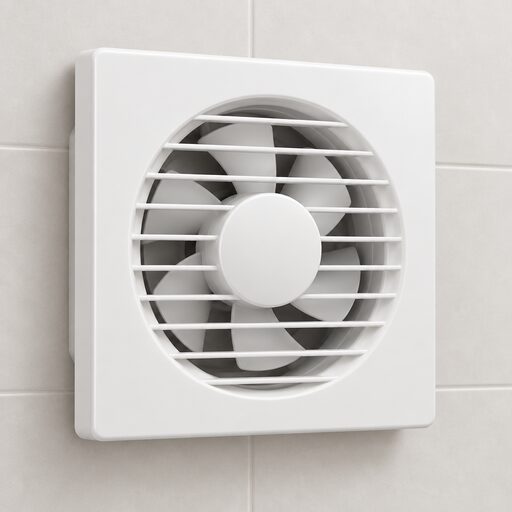 Ventilation ManufacturersWhich brands make home ventilation equipment, what does each type cost, and is a quiet one genuinely quiet?
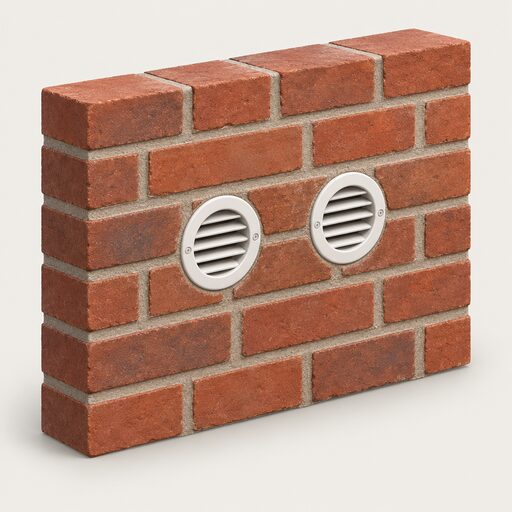 Without an Outdoor UnitFlats and listed homes often cannot have a box on the outside wall, so how does air conditioning work with everything indoors?
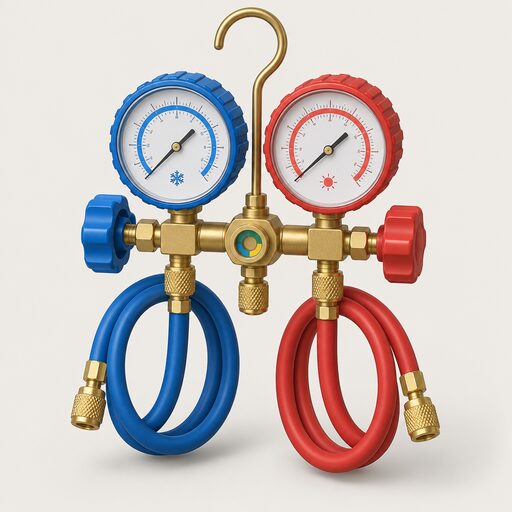 Monobloc and Split Heat PumpsWhich heat pump suits your home, a monobloc or a split?
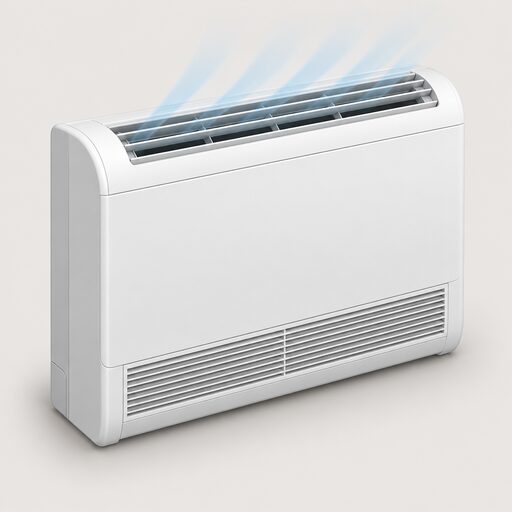 Split Air ConditioningA split air conditioning system cools or heats one room using an indoor unit and an outdoor unit linked by pipes.