
In this comparison
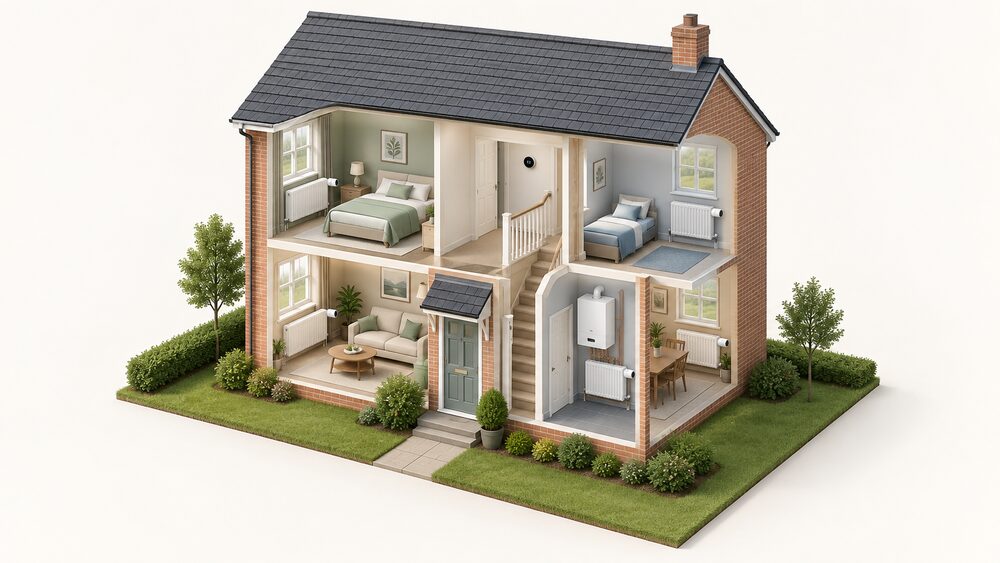
Honeywell evohome and tado° are the two names that come up most often when a larger home needs room-by-room heating control rather than one thermostat for the whole property. Both replace a single wall thermostat with a system that can hold different temperatures in different rooms, and both rely on smart radiator valves to do it. The difference is in how the control is built and where the intelligence sits.
tado° is a Munich company that has been making smart heating products since 2011, and the maker describes it as the market leader in Europe, with over 1 million homes served1. Its current range, tado° X, stores heating schedules directly on each device, so the heating still runs if the internet goes down2. Honeywell evohome is a zoning system from Honeywell Home, sold in the UK through professional installers, and independent guidance describes it as incorporating the usual array of smart thermostat features, including hot water control and remote control via smartphones or tablets3.
The practical split is this: tado° is a retrofit-first product designed for DIY fitting, with a subscription for the most automated features, while evohome is a zoning system usually installed professionally and aimed at homes where several rooms need independent control. Both work with the majority of UK heating systems. Neither removes the household's dependence on gas, a boiler and the grid, and tado°'s more advanced functions depend on a cloud account and, for some features, a paid subscription.
At a glance: how the two systems differ
The two systems approach multi-zone control from opposite directions. tado° builds outward from a smart thermostat and smart radiator valves, adding zones as the household buys more valves. evohome is a zoning controller from the outset, designed around a central hub that manages several zones and, in the versions that support it, hot water as well.
tado° Multi-Zone Control lets a household manage each heating zone independently through a single app, and each zone gets its own smart schedule, remote control and energy-saving automations, so only the areas that are actually occupied get heated6. The upgrade path is incremental: with Smart Radiator Thermostats in every room, a multi-zone setup becomes a multi-room setup with completely individualised room control, coordinated through a feature the maker calls Room Link6. Room Link is described as a smart integration between the tado° room thermostats and the boiler, activating the boiler only when there is actual demand for heat from a room2.
evohome's independent evidence base is thinner and older. A National Energy Action project, CP751, examined intelligent heating controls and weather compensators, and in that work three properties had Honeywell evohome installed7. That is a small sample and the report dates from 2017, so it should be read as an early trial rather than a current performance claim.
For a household's energy independence, the distinction matters in one specific way. tado° X keeps its schedules on the device, so a broadband outage does not stop the heating running to time2. A system that depends on the cloud for its schedule hands a degree of control to a server the household does not own. That is a resilience question rather than a running-cost question, and it is the clearest structural difference between the two approaches.
Zoning: room-by-room control with smart TRVs

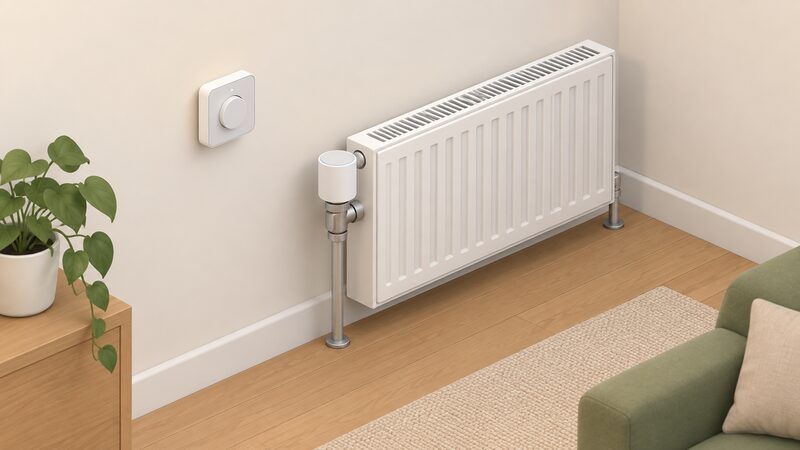
Room-by-room zoning is the feature that separates these systems from a single smart thermostat, and it is the reason a larger home considers either. The maker's own comparison table states plainly that tado° offers room-by-room zoning via smart TRVs while Google Nest does not2. That is a maker claim about a rival, but it illustrates the category: zoning needs a valve on each radiator, not just a clever thermostat in the hall.
Retrofitting is straightforward on the tado° side. For radiators, the maker states that the old TRV heads are simply swapped out for Smart Radiator Thermostats X8. No pipework changes and no draining down. Each valve then becomes its own zone with its own schedule, and the boiler is called only when a room actually asks for heat through Room Link2.
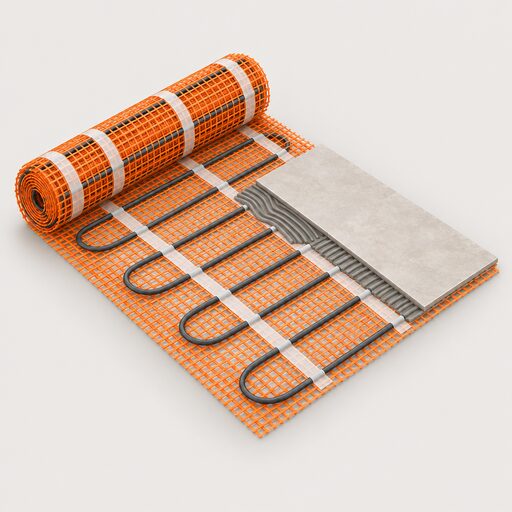
tado° also integrates underfloor heating into a multi-zone system: the existing wall thermostat is replaced with a tado° thermostat and the app is used to set whether the room runs as a separate zone or is linked to other rooms6. That matters in a larger home where one extension or kitchen may have underfloor heating while the rest of the house has radiators. For homes with air conditioning or air-to-air heat pumps, the Smart AC Control works with units that have an infrared remote showing current settings, covering split, multi-split and portable systems, and a household can mix product lines, heating with tado° X in one property and cooling with Smart AC Control in another9.
The limit is the same for both systems. Zoning controls when and where heat is delivered; it does not change how the heat is generated. A zoned gas system still burns gas, still depends on the grid for the boiler's pump and controls, and still depends on a supplier for the fuel. What zoning buys is less waste, not independence from the fuel itself. Households weighing that distinction can read more in heating zoning and smart TRVs.
Savings evidence: what the studies and maker data claim
The savings figures for tado° come from several places and do not agree, which is worth understanding before treating any single number as a forecast.
The maker's headline claim is that tado° is proven to reduce energy usage by 22%, based on internal data for all tado° customers collected up to 30 November 20231. The same page cites up to 23% energy savings from geofencing1. Independent guidance reports that a study by Tado found users saved an average of 22% on their energy bills thanks to scheduling features10. A separate independent guide reports that tado° systems, according to the manufacturer, can help users save up to 31% on energy bills3. The 22% and 23% figures are the maker's own; the 31% is a manufacturer claim relayed by a consumer guide, and it is the highest of the three.
The cash figure is more concrete. A maker product page states that the saving can add up to £244 less spent on heating costs per year, reflecting 22% of an average UK household gas heating bill of £1,109 for 20241. That is a maker calculation built on an average bill, so a household whose bill is above or below that average should expect a proportionally different figure.
For context on what government modelling shows for bill reductions, official statistics for Scotland give a mean fuel bill reduction of £170 per year for households with mains gas heating after the Renewables Obligation levy and the ECO scheme were removed, covering January to March 202611. That is a different exercise entirely, modelling the removal of levies rather than the effect of a thermostat, and it is included only to show the scale of the numbers involved. Energy UK has estimated that clean heat support for low-income households would lead to aggregate annual savings of £157 million and £2.9 billion in lifetime bill savings12.
The honest position is that a 22% reduction is the maker's own average across its customer base, that independent guides relay claims between 22% and 31%, and that no figure here is a guarantee for a specific home. Savings depend on how the house was heated before, how many rooms were being warmed unnecessarily, and how the schedule is set. The wider evidence on whether controls pay is set out in do heating controls save money.
Schedules, apps and smart home integration
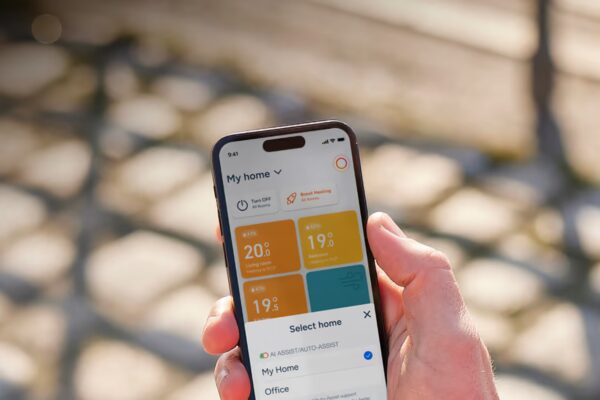
Both systems are app-controlled, and the app is where most of the daily interaction happens. The free version of the tado° app comes with every tado° product, and the maker describes it as packed with features to control and schedule heating13. Manual scheduling is granular: the maker states that schedules are set by room and day, down to 15-minute blocks2. The app also shows room-by-room temperature and humidity, tracks energy consumption and integrates with dynamic energy tariffs2.
Smart home integration is broad on the tado° side. The maker states that tado° is compatible with all the major smart home platforms, including Amazon Alexa, Google Home and Apple HomeKit8, and that the tado° X range works with Google Home, Apple Home, Amazon Alexa and Samsung SmartThings2. The Smart AC Control works natively with Apple HomeKit, Alexa and Google Home9. Voice control is supported, with the maker giving the example of asking Siri to make the kitchen 20°1.
evohome's app provision is described in independent guidance as including hot water control and remote control via smartphones or tablets3. That is the extent of what the independent material covers; the maker's own app documentation is not part of this comparison.
The subscription line falls in a specific place. The maker states that auto-learning schedules require an AI Assist subscription2. Without Auto-Assist, Geofencing and Open Window Detection send a notification only rather than acting on the heating9. The subscription is priced at £3.99 per month or £29.99 per year, and a single AI Assist subscription for tado° X, or Auto-Assist for V3+ and older generations, covers every property under a user's admin account4. Subscribers can be signed into all their homes simultaneously with a one-click switch, while non-subscribers sign out and in again to switch between properties4. The wider question of what these charges buy is covered in smart thermostat subscriptions.
"While multi-home management will be available for all tado° users, AI Assist/Auto Assist subscribers can be simultaneously signed into all their homes and enjoy a 'one-click' instant switch experience, whereas non-subscribers simply sign out and sign in again to switch homes"
Compatibility: boilers, heat pumps and 95% of systems
The compatibility claim that matters most is the maker's statement that tado° works with 95% of systems across European energy management and heating brands1. That is a maker figure, not an independent test, and it is the kind of claim that should be checked against the specific boiler or heat pump in a property before purchase.
For heat pumps, the maker states that the Heat Pump Optimizer X is compatible with major European heat pump brands including Vaillant, Daikin and Panasonic, and with air-to-water, water-to-water and brine-to-water heat pumps, even those not connected to a thermostat2. That last point is significant for older installations where the heat pump has its own internal controls and no separate room thermostat. On the boiler side, the Vaillant ecoTEC sustain combi range is described as compatible with the aroTHERM air-to-water heat pump hybrid system15, which is a boiler-side fact rather than a controls fact, but it shows the kind of hybrid arrangement a controls upgrade may sit alongside.
The independent evidence on comfort is worth noting because it addresses the fear that controls and heat pumps leave a home colder. Among Octopus customers with heat pumps, electric vehicles and solar panels, 94% report that their home feels just as comfortable or more comfortable than it did with their previous boiler16. That is a satisfaction figure from a specific customer base, not a controls study, but it is the most recent independent comfort data available here.
The dependence that remains is worth stating plainly. A smart thermostat or zoning system sits on top of a boiler or heat pump that still runs on gas or electricity from the grid. tado°'s dynamic tariff integration can shift heating to cheaper periods, and the maker states that tado° Balance for heat pumps works automatically with any energy supplier using dynamic time-of-use electricity tariffs with real-time pricing, with prices retrieved from ENTSO-E by region13. That is a genuine independence gain in the sense of using the grid more cleverly, but it is not independence from the grid. Households interested in that distinction can read heating controls and energy independence.
Installation: DIY versus professional fitting
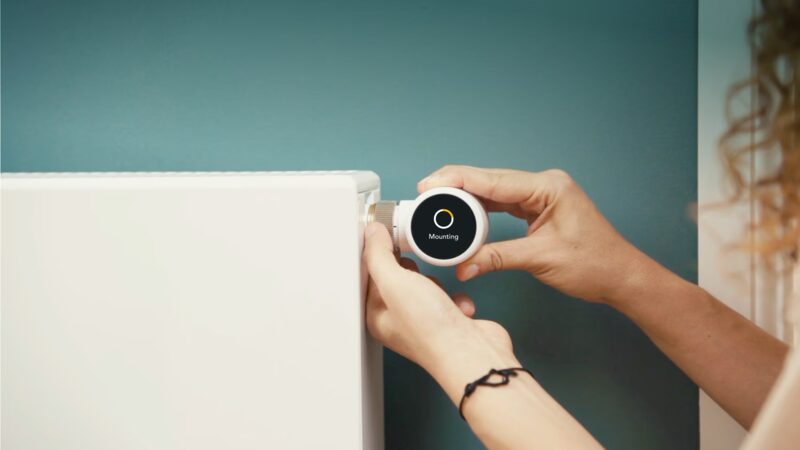
This is the sharpest practical difference between the two systems. tado° is explicitly a DIY product. The maker states that it is designed for easy DIY installation14, that multi-zone control needs no professional installer6, and that the Heat Pump Optimizer X can be installed without a professional by following the tado° in-app instructions and de-installed without damage to the heat pump13. The Smart AC Control is listed with a 5-minute install time9.
evohome, by contrast, appears in the independent record as an installer-led product. The CP751 project that examined intelligent heating controls and weather compensators installed Honeywell evohome in three properties as part of a managed trial7. There is no equivalent maker statement in this material describing evohome as a DIY fit.
For comparison, the wider market shows how much this varies. Hive recommends finding a local tradesperson to install its smart thermostat, as it can be a bit of a task17. Dry underfloor heating is described as an option for a skilled DIY-er, but a qualified electrician would need to connect it to the mains electricity18. Ezy-Warm underfloor heating is described as installable by a tradesperson or competent DIYer, rather than having to wait and pay for a professional plumber or electrician19. The pattern is consistent: low-voltage, plug-in and battery components are within reach of a competent householder, while anything that connects to mains wiring or opens up a boiler's control circuit is not.
Planning matters even where the work is simple. Independent case-study guidance on heat pump installation advises planning with the installer when they will come, how long it will take and what they need to do inside and outside the house, noting that it will be a bit disruptive20. The same applies to a zoning retrofit across a large house, where every radiator needs a valve changed.
Warranty and subscription costs
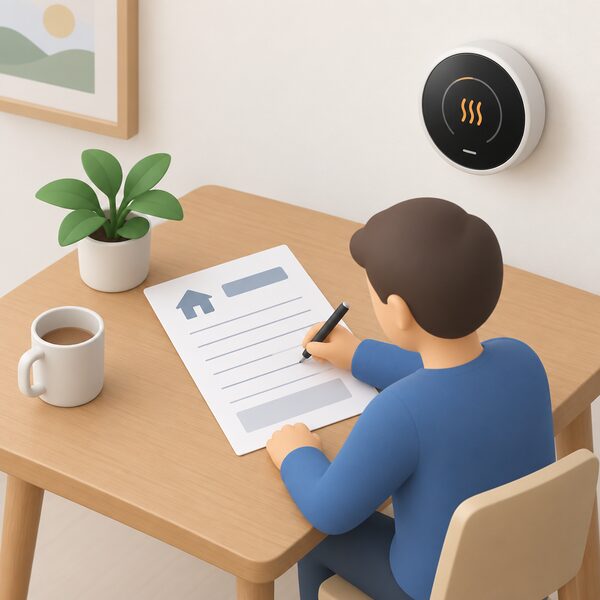
The warranty position on tado° X changed during 2026 and the change is the most important thing to know. The maker states that an exclusive 10-year extended warranty was included as a special introductory offer, and that registration was required to benefit from it5. That offer applied only to purchases before 30th June 20265. New purchases after that date are not eligible for the 10-year term.
The subscription position is separate from the warranty. AI Assist is priced at £3.99 per month or £29.99 per year, and the maker states that subscribers unlock automated Geofencing, Open Window Detection, Adaptive Heating and more across all their homes simultaneously4. A single subscription covers every property under one admin account4. The free app tier still provides smart schedules and remote control, and without Auto-Assist the geofencing and open-window features notify rather than act9.
For evohome, the independent material in this comparison does not give a warranty term or a subscription price. That is a gap rather than a zero, and a household considering evohome should ask the installer for the current terms in writing.
The independence question here is direct. A subscription ties part of the system's function to a recurring payment and to a company account. If the subscription lapses, the automated features stop and the household falls back to manual scheduling. That is a real and ongoing dependence, and it is the trade-off for the automation. The maker also offers a refund if a household is not happy with its savings, and describes tado° as a retrofit solution whether the property is owned or rented1. The broader picture on app charges across the market is in smart thermostat subscriptions.
| tado° X | Honeywell evohome | |
|---|---|---|
| Zoning method | Smart TRVs on each radiator, plus room thermostats2 | Zoning controller with multiple zones7 |
| Offline operation | Schedules stored on device2 | Not stated in this material |
| DIY installation | Designed for easy DIY installation14 | Installer-led in the independent record7 |
| Subscription | AI Assist at £3.99 per month or £29.99 per year4 | Not stated in this material |
| Extended warranty | 10 years, purchases before 30th June 2026 only5 | Not stated in this material |
| Smart home platforms | Alexa, Google Home, Apple HomeKit, Samsung SmartThings2 | Remote control via smartphone or tablet3 |
Which suits which home
The choice comes down to how much of the work a household wants to do itself, how many rooms need independent control, and whether a recurring subscription is acceptable.
tado° suits a household that wants to start with one thermostat and add zones over time. The upgrade path is incremental: a multi-zone setup becomes multi-room by adding Smart Radiator Thermostats, with Room Link coordinating the boiler call6. The DIY installation route removes the labour cost of a zoning retrofit, and the on-device schedule storage means the heating keeps running through a broadband outage2. The trade-off is the subscription for the most automated features and the fact that the 10-year extended warranty window has closed for new purchases5.
evohome suits a household that wants a zoning system installed and commissioned as a single job, particularly where hot water control is wanted alongside heating zones3. The independent evidence base is small and dated, resting on a 2017 trial covering three properties7, so a household should treat performance claims for evohome as less well evidenced than the maker data available for tado°.
Neither system changes what the house is heated by. A zoned gas system still depends on gas, a boiler and the grid, and a zoned heat pump system still depends on electricity and a supplier. What both do is reduce the heat delivered to rooms that are not in use, which is where the savings claims come from. For a household thinking about the wider picture, heating controls by home type sets out how property size and construction change the calculation, and the heating controls pillar covers the full range of thermostats, TRVs and zoning options.
Sources20 cited
- tado° Smart Thermostats, tado°
- tado° vs Google Nest, tado°
- What are smart thermostats?, Uswitch
- tado° multi-home management, tado°
- tado° Warranty, tado°
- tado° Multi-Zone Control, tado°
- Installation of intelligent heating controls, weather compensators, boiler flue gas heat recovery systems (CP751), National Energy Action, 2017
- tado° Multi-Room Control, tado°
- tado° Smart AC Control, tado°
- The best way to run your central heating to save money, ivie
- Scenario modelling: impact of removing the RO levy and ECO scheme on fuel poverty in Scotland, Scottish Government, 2026
- Clean heat: supporting low-income households, Energy UK
- tado° Heat Pumps, tado°
- tado° UK, tado°
- Vaillant ecoTEC sustain combi boilers, Quiet Mark
- Watt a Save 2026, Home Builders Federation, 2026
- tado° vs Hive: which smart thermostat is best?, Energy Helpline
- Underfloor heating advice, Centre for Sustainable Energy
- OVO EV energy tariffs, Uswitch
- Matthew Bell OBE heat pump case study, Energy Saving Trust, 2026
 Heat Pumps vs BoilersWill a heat pump actually cost less to run than my boiler, and does it heat the house as well?
 Underfloor Heating SystemsWhich rooms suit electric underfloor heating and which need a wet system?
 Electric Radiators and PanelsDo electric radiators cost more to run than gas heating, and are they worth it for one room or a whole house?
 Energy Independence and MakersWhich brands let you keep control of your heating, solar or car charging, and which tie you to their app and their cloud?
 Heating and Energy IndependenceCan you heat your home without relying on gas or oil, and what would that take?
 Monobloc and Split Heat PumpsWhich heat pump suits your home, a monobloc or a split?