
In this comparison
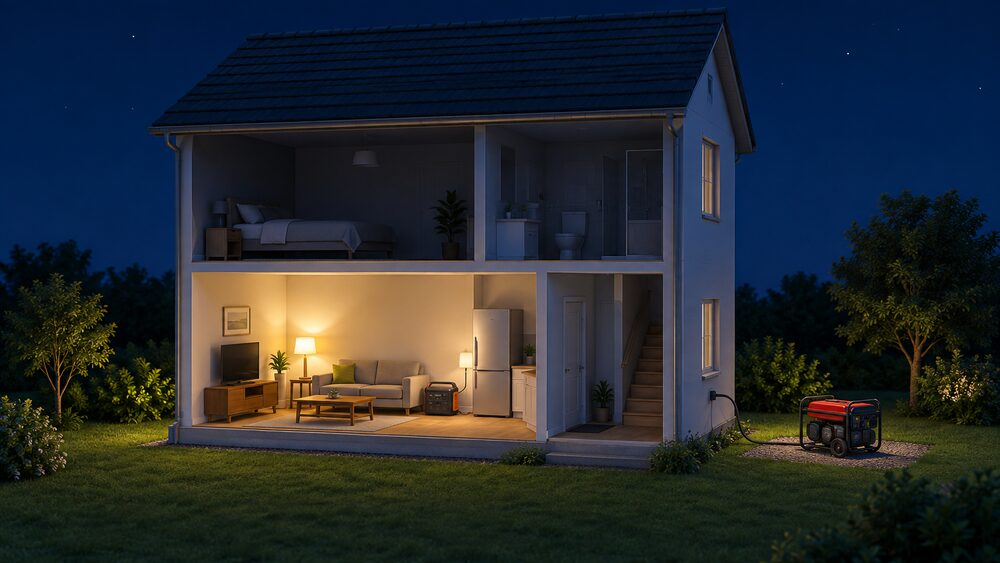
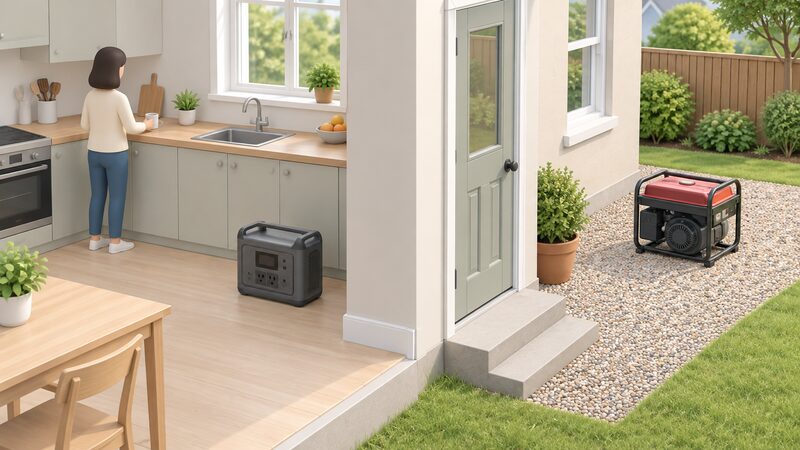
A portable power station is a battery that stores energy and releases it silently, indoors, with no fuel. A generator makes electricity by burning petrol, diesel, LPG or natural gas, and must be sited outside. That single difference decides most of the comparison for a UK household facing a power cut.
The trade is capacity against convenience. A portable power station is light, about the size of a small drink cooler, often with handles or wheels, and extremely quiet, quieter than inverter generators, but it is on the pricey side, often costing as much as an inverter generator1. A generator has a lower initial cost but depends on fuel and routine maintenance2. A typical portable petrol generator runs for 6 to 18 hours on a full tank under moderate load3.
For a household, the question is what stays on and for how long. A battery station's capacity determines how much power the unit can store and deliver4, so runtime falls as the load rises: a 400W essential load covering a refrigerator, lighting, router and boiler draws down a given capacity far faster than a single lamp. A generator sized for a freezer, six light bulbs and a router needs roughly 3,800 to 4,200 watts continuous plus surges3. Neither is a whole-house solution on its own, and both leave the household dependent on something: a fuel supply, a supplier, or daylight.
What each one actually is
A portable power station is an energy storage unit with multiple port options, AC, USB and wall outlets, that stores energy but does not generate it1. It charges from the grid, a car alternator or solar panels. A portable solar generator combines a portable power station with solar panels, so the pair can collect, store and distribute solar energy; it typically consists of solar panels, a battery, a battery charging device and an inverter11.
A generator is an engine coupled to an alternator. Portable petrol generators are generally smaller, lightweight and more portable than diesel generators12. Inverter generators are more expensive than traditional fossil fuel generators but offer a more fuel-efficient output1. Home standby generators are typically powered by natural gas, diesel fuel or liquid propane13. One maker's portable natural gas generator holds liquefied natural gas11.
The distinction matters because a battery station's stored energy is finite and set at purchase, while a generator's output is limited only by fuel on hand. Batteries, in the language of the grid, can deliver electricity that is much more limited than pumped storage14. That is the honest framing: a power station is a reservoir, a generator is a tap.
Running essential loads: what a power station can and cannot cover
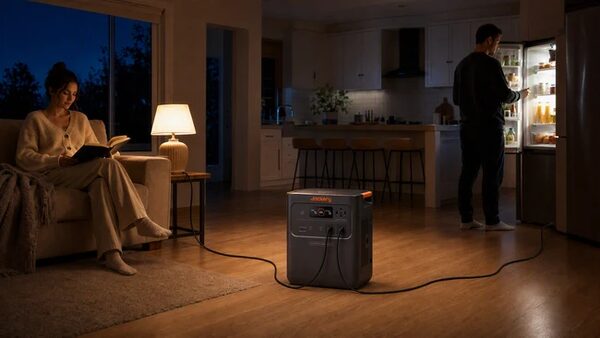
A power station covers electronics, lighting, a router, a fridge and, on a good unit, a boiler. One maker states a battery will keep a kettle, heater, hot plate, microwave, fridge or freezer running, with a fridge or freezer lasting several days5. A station with at least 1,800W continuous output is the practical minimum for a 1,500W kettle plus a 200W fridge and 100W of electronics7. For fridge backup alone, around 1000W output or above is usually more practical than a very small unit3.
What it cannot cover is the whole house. Electric showers, immersion heaters, ovens and heat pumps draw far more than a portable station delivers, and the larger the load the shorter the runtime, because the battery's capacity determines how much power the unit can store and deliver4. The runtime example above assumes only 400W of continuous load; double the load and the hours halve.
Generators cover more, but not everything either. Medium generators at 3,000 to 5,000 watts handle large appliances such as refrigerators, freezers, space heaters and sump pumps3. Large generators at 6,000 to 10,000 watts cover most household appliances, power tools and large construction lights3. Extra large units at 10,000 watts and up are aimed at multiple large appliances and whole home systems3.
For a household deciding what stays on, the useful exercise is to list the loads that matter and add their running watts, then check the surge requirement of anything with a motor. That is the same method whether the supply is a battery or an engine, and it is set out in more detail in essential loads and backup circuits.
Fuel, fumes and where each can be used
This is the sharpest dividing line. Battery power stations do not burn petrol or diesel, so they do not produce combustion exhaust such as carbon monoxide during normal operation, and can be used indoors when the manufacturer allows it7. One maker describes a battery-powered alternative to a gas generator that can be used inside or outside during a blackout5.
Generators burn petrol, diesel or LPG, releasing carbon emissions and contributing to air pollution2. Petrol generators cannot be used indoors; they produce toxic fumes that can be one-hundred times more poisonous than CO from vehicle exhaust12. The safety rule is absolute: never run a petrol, diesel or gas generator inside or near a tent, awning, caravan, motorhome or cabin, and keep it away from open doors and windows6. Fuel-burning appliances should be kept outside unless they are designed and installed for indoor use, as portable gas, charcoal, petrol, diesel or solid fuel appliances can be extremely dangerous in enclosed spaces6.
Fuel supply is the second constraint. LPG can be stored in bulk tanks or portable cylinders, providing energy wherever it is needed16. Petrol and diesel need rotation and safe storage, and a generator that has sat unused may not start when it is needed. A battery station kept charged has no such failure mode, but it also has no way to refill itself except from the grid or the sun.
Battery chemistry and lifespan: LiFePO4 and cycle life
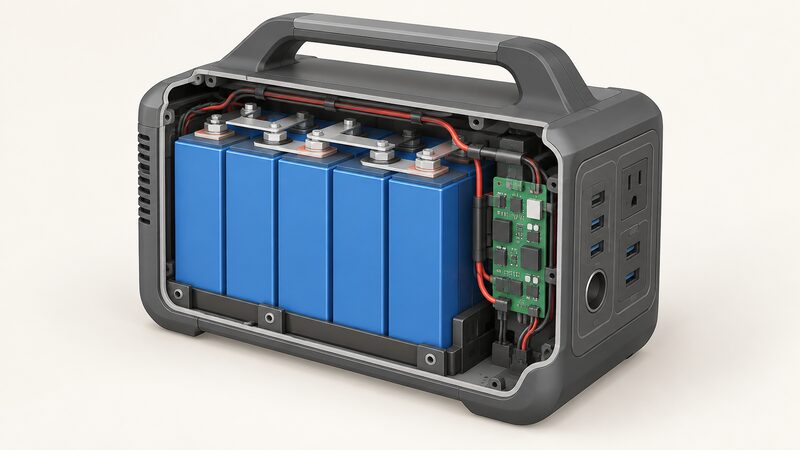
Most current portable power stations use lithium iron phosphate, LiFePO4 or LFP. One maker states many current LiFePO4 stations are rated for roughly 3,000 to 6,000 cycles before falling to about 80% of original capacity7. Another states LFP cells deliver over 6,000 full charge cycles17. Anker SOLIX states LiFePO4 batteries power up for 3,000 cycles10. One maker guidance figure gives a 10 to 12-year service life, 95% round-trip efficiency and over 6,000 charge cycles before significant degradation4.
Reported figures across maker pages range from 2,500 to 3,500 cycles at the low end to 4,000 to 10,000 cycles at the high end, with 3,000 to 4,000-plus cycles described as typical before a drop in capacity. A household should treat the lower end of any maker's range as the planning figure and the higher end as a best case.
For context, domestic battery storage has a shorter lifetime of around 10 to 15 years when compared with solar panels18. A portable station's cells sit in the same order of magnitude, which means the purchase is a decade-scale decision, not a one-off for a single winter.
Sizing for home backup: from 3,000 to 10,000 watts
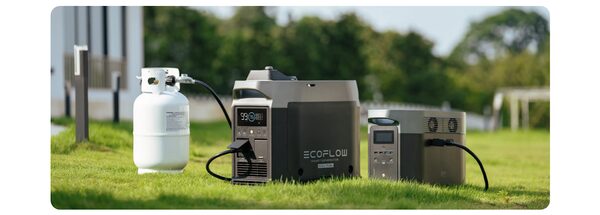
Sizing runs on two different scales, watts for generators and watt-hours for batteries, and confusing them is the commonest error.
For generators, the maker bands are clear. Small generators at 1,000 to 2,000 watts cover small appliances such as portable TVs, radios and light bulbs3. Medium generators at 3,000 to 5,000 watts cover large appliances such as refrigerators, freezers, space heaters and sump pumps3. Large generators at 6,000 to 10,000 watts cover most household appliances, power tools and large construction lights3. Extra large generators at 10,000 watts and up cover multiple large appliances and whole home systems3. For off-grid living, a 3,000 to 5,000 watt generator is sufficient to run basic off-grid appliances, and 5,000 to 10,000W is needed to live off the grid comfortably19.
For batteries, capacity in watt-hours sets the runtime. A 2,500Wh unit and above suits heavier home backup and longer off-grid stays7. A 1,500 to 2,500Wh unit is better for caravans, work equipment or short household outages where several essentials need to run together7. An 800 to 1,200Wh unit is a useful weekend-camping range for a compressor fridge, electronics, lighting and occasional higher-wattage items7. For longer caravan stays, 1 to 2kWh is a practical starting range and solar can extend autonomy7.
| Load | Generator band | Battery capacity guide |
|---|---|---|
| Phones, router, lights, radio | 1,000 to 2,000W3 | 800 to 1,200Wh7 |
| Fridge, freezer, small heater | 3,000 to 5,000W3 | 1,500 to 2,500Wh7 |
| Several essentials together | 5,000W+21 | 2,500Wh and above7 |
| Whole home systems | 10,000W and up3 | Not covered by portable units |
The two columns are not equivalents. A 5,000W generator can run a 5,000W load indefinitely while fuel lasts; a 2,500Wh battery running a 5,000W load lasts about half an hour. Watt-hours divided by watts gives hours, and that arithmetic is the whole sizing exercise for a battery.
Cost, warranty and returns compared
Prices for both categories are installer-quoted or retailer-listed, and no published UK price is given here. What the documents do record is the shape of the cost. Generators have a lower initial cost but depend on fuel and routine maintenance2. Portable power stations are on the pricey side, often costing as much as an inverter generator1. One maker states solar power stations are always more affordable than traditional home battery backup systems because there is no installation cost22, and that they carry a higher initial cost than fossil generators but pay back in a few years through solar energy savings22.
Warranty terms differ by brand and model.
| Brand | Warranty stated | Returns |
|---|---|---|
| Jackery | 5-year warranty on portable solar batteries8; 3+2 year warranty on solar generators11 | Not stated in the documents |
| BLUETTI | 2 to 6 year warranty on all products23 | 30-day money-back guarantee9 |
| Anker SOLIX | Up to 5-year warranties10 | Return or exchange up to 30 days10 |
BLUETTI's refund terms are specific: within 30 days of purchase, if unsatisfied, a refund can be requested after returning complete and unused products in the original package9. Estimated delivery is 5 to 7 working days, excluding pre-sale products9. BLUETTI also states a 30-day price guarantee, refunding the difference if a lower price is found within 30 days of purchase23.
Which suits which household
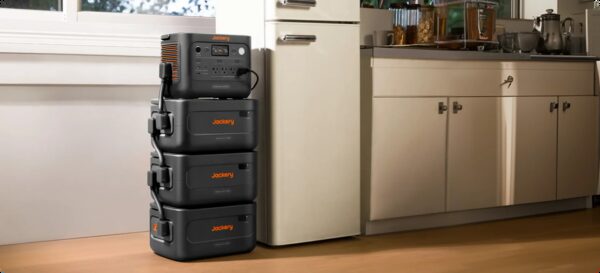
The choice follows the outage pattern and the siting.
A flat or a home with no outdoor space points to a battery station, because a generator cannot legally or safely be run there. A household that needs to keep a router, lights, a fridge and a boiler going for a day or two is within the range of a 2,500Wh-and-above station7. A household with a medical dependency should first check the network operator's support routes: generators are only provided in exceptional circumstances, such as for medical needs like oxygen equipment, mobility aids or end-of-life care, or events like weddings or funerals, and generator installation uses the same engineers repairing the fault24. The Priority Services Register is the route to that support, and the 105 number is how a cut is reported.
A rural property with outdoor space, a long outage history and a need to run larger loads points to a generator, with the fuel storage and siting rules that come with it. A household wanting both might run a battery station indoors for essentials and keep a generator outside for heavier loads, but the two need separate connection arrangements, and connecting a generator to a house supply is covered in generator connection and transfer switches.
What neither option delivers is independence from the grid. A battery station recharges from the grid or the sun; a generator depends on a fuel supply that must be bought, stored and rotated. Both are resilience measures, not sovereignty. The wider picture, including how network operators handle supply restoration, sits on the backup power pillar.
Sources24 cited
- Inverter generators vs portable power stations, EcoFlow, 2025-06-16
- Powerwall 3 or generator, Tesla, 2026-09-17
- Guide to emergency generator, Jackery, 2025-10-28
- Why solar PV battery storage is essential for UK homeowners, Jackery, 2026-08-27
- Prepare for a winter power outage, EcoFlow, 2025-06-16
- Holiday carbon monoxide safety tips, Northern Gas Networks, 2026-07-24
- Best portable power stations, BLUETTI, 2026-08-31
- Solar battery cost, Jackery, 2026-04-29
- New year sale, BLUETTI, 2026-09-19
- Anker SOLIX UK, Anker SOLIX, 2026-09-17
- Solar vs gas generator, Jackery, 2026-09-19
- Use a portable generator during a power outage, EcoFlow, 2025-06-16
- Home generator cost, Jackery, 2026-04-29
- How does storage help us balance the grid, NESO, 2026-09-17
- Fatal case studies, CO Gas Safety, 2020-02-12
- What is LPG, Liquid Gas UK, 2026-09-20
- Home battery storage and energy independence, Jackery, 2026-06-25
- Domestic battery storage, Parliamentary Office of Science and Technology, 2026-06-25
- Solar generator for off-grid living, Jackery, 2026-09-19
- Solar Generator 1000 v2, Jackery, 2026-09-19
- Winter storm backup power, BLUETTI, 2026-09-19
- Comparing Jackery's portable power stations to traditional home battery backup systems, Jackery, 2026-04-29
- 2026 BLUETTI Prime Summer Power Encore Sale, BLUETTI, 2026-09-19
- Advice and support FAQs, Electricity North West, 2026-09-20
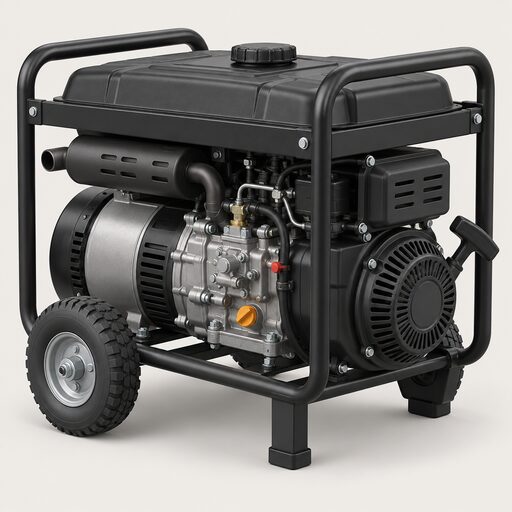 Portable Generators for HomesWhat can a portable generator actually run in a power cut, and for how long?
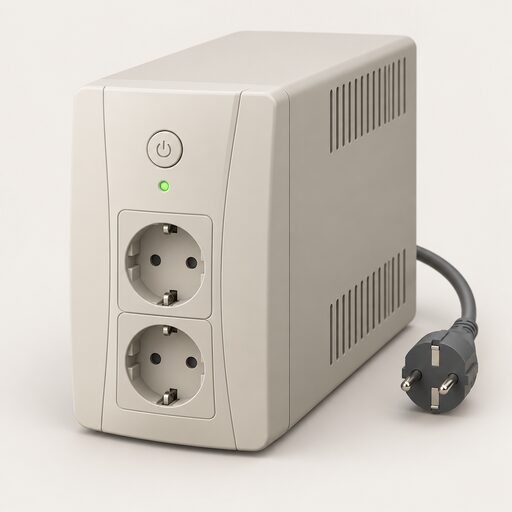 Backup Power Costs ComparedCompares purchase, installation and running costs across the main backup options, and what each delivers in runtime and coverage.
 Portable Power StationsWhat can a portable power station actually keep going in a power cut, and for how long?
 Power Station BatteriesWhat kind of battery is inside a portable power station, and does it matter?
 Backup Power for HeatingWhy gas boilers, heat pumps and storage heaters stop in a power cut, what a portable power station can and cannot carry, how to size one, and what home battery systems do when the mains fails.
 Generator Fuel and Running CostsPetrol, diesel, LPG or HVO: which is cheapest to run a whole-house generator, and how much does it really cost each day?