
In this comparison
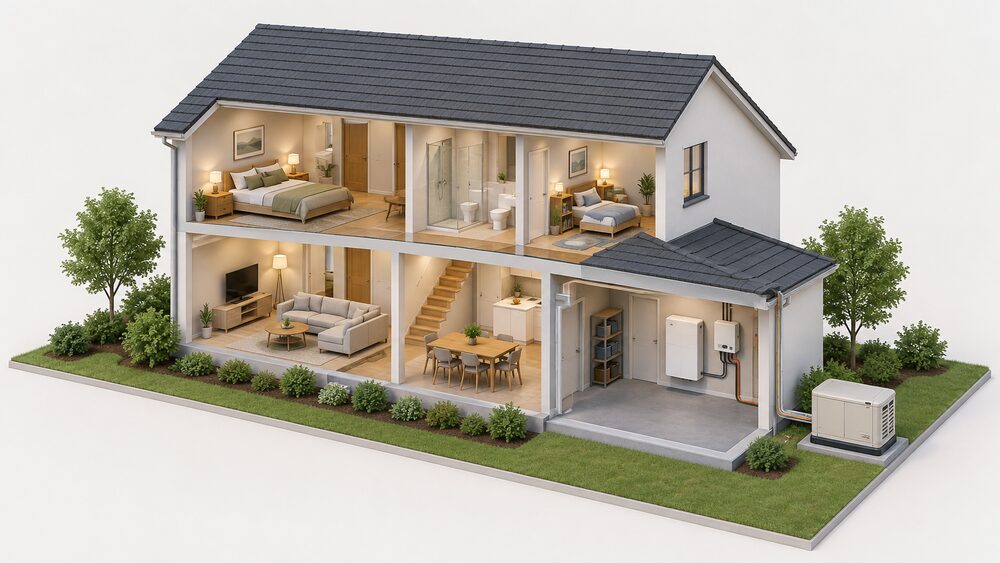
A standby generator and a home battery both keep a house supplied when the grid fails, but they are not the same purchase. A generator makes electricity on site from a stored fuel, so its runtime is set by how much fuel is kept and how often it is replaced. A home battery stores electricity that was already generated or imported, so its runtime is set by capacity and by what the house draws from it.
The distinction matters because most home batteries sold in the UK are not backup devices at all. The Energy Saving Trust advises that if the aim is protection against power cuts, not all systems are suitable, and that the installer should be asked whether the battery will work in an outage and for how long1. The more expensive battery systems can provide electricity during a power cut, while cheaper ones cannot2. A generator, by contrast, is a backup machine first and an energy store second.
The Committee on Climate Change describes the household options as generators, which are widely used already, or more innovative approaches such as batteries, solar and vehicle-to-everything3. That framing is useful: the generator is the established answer, the battery is the emerging one, and the two carry different dependencies. A generator depends on fuel supply and on a connection arrangement that is safe and notified. A battery depends on a manufacturer, a compatible inverter and, in most cases, the grid to recharge it.
Recall alert: SavePower Universal Standby Saver withdrawn over fire risk
Electrical Safety First issued a recall for all units of the SavePower Universal Standby Saver, Part No 06718, after reports of units catching fire during use9. The recall covers every unit, not a production batch, and it is the first thing to check before buying any standby-saving device of this kind. A product under recall should be taken out of service rather than monitored.
The wider pattern behind that recall is worth understanding, because it applies to battery backup as much as to plug-in gadgets. The government's product safety consultation states that non-compliant or incompatible battery components, and the use of batteries outside their safe design parameters, can lead to thermal runaway, causing fires10. Electrical Safety First's battery safety campaign calls for standards for conversion kits and charging systems and for consideration of a temporary ban on the sale of universal chargers11.
Home batteries have not been exempt. Electrical Safety First lists several LG ESS Home Battery models as affected models subject to replacement of all potentially affected units12. That is a manufacturer-led replacement programme rather than a household action, but it shows that a fixed home battery is a product with a recall history, not an appliance that can be forgotten once fitted.
For anyone weighing a generator against a battery, the practical lesson is that both categories contain compliant and non-compliant products, and that the safety record of the specific model matters more than the category. A generator brings carbon monoxide and fuel storage risks; a battery brings thermal runaway and high-voltage risks. GivEnergy's own support material warns that there is a risk of serious injury or death from the internal components of any high voltage system, and that a battery should not be removed from its mounting or tampered with13.
"There is a risk of serious injury or death from the internal components of any high voltage system."
Standby generator or home battery: what each one actually does
A home battery stores excess electricity produced from a solar system, so that it can be used later14. The Oxfordshire County Council guidance puts it in household terms: unused energy can be stored for use later, for example to power the home during the night15. The Energy Saving Trust adds that combining solar panels with a home battery lets a household store free, renewable electricity to power a heat pump, making the home less reliant on grid electricity16.
That is a self-consumption function, and it is the main reason most UK batteries are bought. Home battery storage is usually used in combination with solar panels or a smart time of use tariff, or both4. The benefit is measured in imported units avoided: generating renewable electricity at home lowers the amount of electricity imported and paid for from the grid17. A battery captures surplus solar that would otherwise be wasted or exported, often at a relatively low rate, and holds it for overnight use including electric vehicle charging18.
A standby generator does something different. It does not store energy in the sense a battery does; it converts fuel into electricity on demand, which is why the Committee on Climate Change groups generators with batteries, solar and V2X as backup power approaches rather than as storage3. Its output is limited by its rating and its runtime by fuel, and it needs a transfer arrangement so that it never runs into a live network.
The two therefore answer different questions.
- A battery answers: how do I use more of what I generate, and, in some models, how do I ride out a short outage?
- A generator answers: how do I keep the house supplied for as long as I can keep fuelling it?
A household that wants both self-consumption and long outages is looking at two purchases, not one.
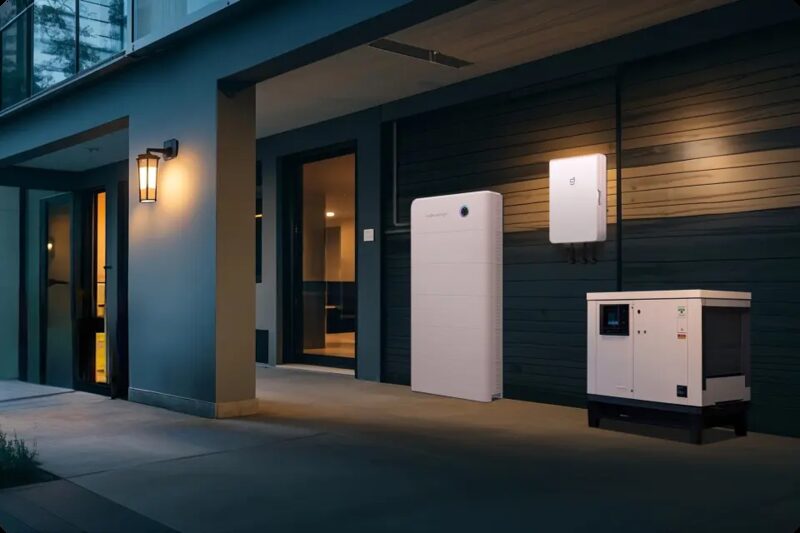
What a home battery system needs to integrate
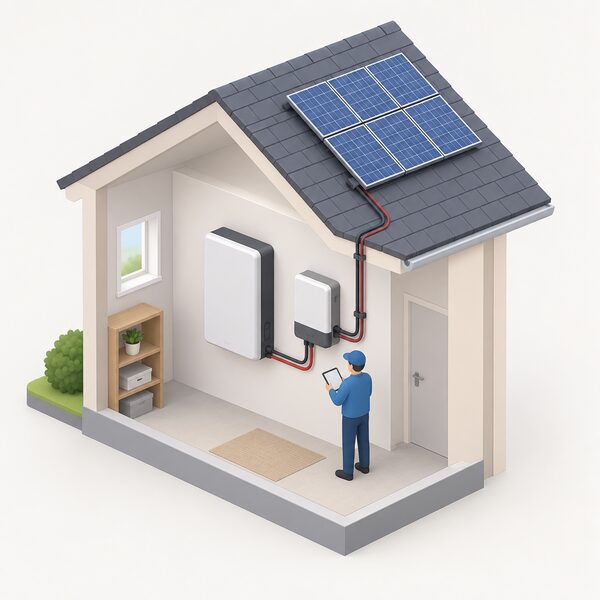
A battery is not a standalone box. It needs an inverter or inverter-charger, a means of communicating with the rest of the system, and a decision about how the solar connects.
Victron Energy sets out the design options as PV in parallel, AC-coupled PV, DC-coupled PV, or a combination of all of these8. The choice has consequences. DC-coupled systems, where PV and battery are installed at the same time, are typically more efficient and tend to be cheaper, though such a system might not be able to charge from the grid7. AC coupling suits a household adding a battery to an existing solar installation, because the PV inverter stays in place.
Managed batteries, meaning batteries with their own battery management system that the inverter can read, are integrated through Victron's GX devices, which the maker states takes minutes8. That is a configuration figure, not an installation figure. The GX device is the system's communications hub, and the compatibility list for high-voltage batteries was last updated on 18 September 20268.
The scale of what a well-matched system can do is set out by the Centre for Sustainable Energy: a domestic battery storing as much electricity as a household typically uses in a day can enable a PV system to provide up to 70% of a household's annual electricity demand2. That figure assumes the battery is sized to daily consumption and that the solar array is adequate. It is a modelled outcome, not a guarantee, and it describes self-consumption rather than outage cover.
Victron Energy: the Dutch maker behind many UK battery backup setups
Victron Energy describes itself as a family run business with over 50 years of experience, and states that this background informs how it builds energy storage and self-consumption systems8. The company is Dutch, and its equipment appears widely in UK off-grid, marine and backup installations rather than in mainstream domestic solar packages.
The relevance to a generator-versus-battery decision is that Victron sits in the inverter-charger category, the equipment that lets a battery system accept power from several sources and supply a house. That is the component that makes a battery behave a little more like a generator: it can take power from solar, from the grid, or from a generator, and put it into the battery or the loads.
The company's certification record is documented and recent.
| Certificate | Scope | Issued |
|---|---|---|
| 24-192-01 | Specified MultiPlus-II models | 15 January 20268 |
| 25-383-00 | Other MultiPlus-II models | 30 October 20258 |
| 26-001-00 | Listed MultiPlus-II models | 14 January 20268 |
| CB Test Certificate | Three Quattro models | 30 July 20258 |
Victron also issued a DIN 14679 declaration of conformity on 1 April 2025 and EU declarations of conformity through 20258.
One caution belongs here. GivEnergy Ltd, a UK domestic battery manufacturer, is described as the largest domestic battery manufacturer to stop trading to date13. That is a reminder that a battery system's useful life, around 10 to 12 years4, can exceed the life of the company that made it, and that the inverter and battery maker's continued existence is part of what a buyer is relying on.
Warranty: 5 years standard, with no published extension terms

Victron Energy states a 5 year warranty on its energy storage and self-consumption products8. A claim of an extension to 10 years for an extra 10% of the initial investment is not supported by any figure in the available material, and no extension mechanism or price is given, so it cannot be stated here as fact.
What can be said is how Victron's term compares with the wider market. It is standard for inverters to have warranties for 10 years6, and battery systems often come with a 10 year warranty1. On those figures, a 5 year Victron term is shorter than the market norm for inverters, and a buyer comparing systems should read the warranty document for the specific model rather than rely on a category average.
| Item | Typical warranty | Typical life |
|---|---|---|
| Inverters | 10 years standard6 | Not stated |
| Battery systems | 10 years often1 | About 10 to 12 years4 |
| Domestic battery storage | Not stated | Around 10 to 15 years5 |
| Victron energy storage products | 5 years, maker stated8 | Not stated |
The gap between a 10 to 12 year battery life and a 5 year warranty is the point a household should weigh. A warranty that ends before the asset does leaves the later years uncovered, and the cost of a replacement inverter or battery falls on the owner. Where a maker offers an extension, the terms, the price and the registration deadline all need to be in writing before purchase.
UK availability and support: where Victron equipment is sold
Victron equipment reaches UK households through distributors, marine and off-grid specialists, and installation firms. There is no single national retail channel, and availability moves. On 19 September 2026, several Victron Blue Smart chargers were listed as sold out20.
Published prices are scarce and tied to a specific model and stock position rather than to a system. Several Blue Smart IP22 and IP65 chargers were listed as sold out at the time of checking20. No published price is available for a complete Victron battery backup system, so for storage, inverters and GX monitoring the cost is installer-quoted and depends on the design. Victron also states that it provides full technical support in the UK20.
Support follows the same route. Because Victron sells through a dealer network, the first point of contact for technical help is normally the seller or installer who supplied the equipment. The material gives no UK support telephone number or address for Victron Energy B.V. itself, and none should be assumed.
Choosing the installer therefore matters as much as choosing the equipment. The Low Carbon Hub advises care in selecting a solar installer, which is the same trade that fits most battery systems6. For a household comparing a generator with a battery, the installer is also the person who can confirm whether the proposed battery will actually run during an outage, which the Energy Saving Trust identifies as a question not all systems can answer positively1.
What owning a battery backup means for household energy independence
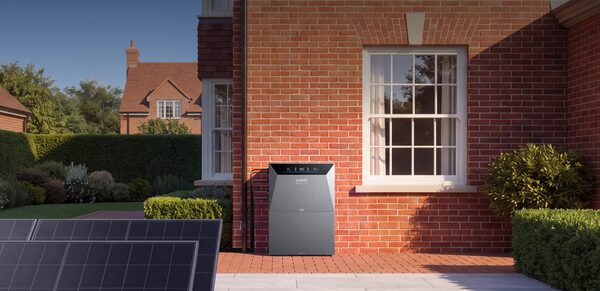
A home battery's contribution to independence is real but bounded. It stores electricity to use later, making the energy system more independent from the National Grid1. It captures surplus solar that would otherwise be exported at a relatively low rate and holds it for when it is needed, including overnight vehicle charging18. A household with solar and a battery imports less and pays for less17.
The dependence that remains is worth stating plainly.
- The grid: most home batteries recharge from the grid when solar is short, so a winter week of low generation still draws on a supplier.
- The maker: the system depends on an inverter and a battery management system that must remain compatible, and on a manufacturer that must remain in business.
- The app: monitoring and control often run through an app or cloud service.
- The design: a battery that cannot charge from the grid, such as some DC-coupled arrangements, is more independent in one sense and less flexible in another7.
Backup capability is the sharpest limit. Not all batteries can deliver electricity during a power cut7, and only the more expensive systems can2. A household that wants outage cover should treat that as a specification to be confirmed in writing, not an assumption that comes with storage.
A generator's independence profile is different rather than better. It does not depend on a supplier or an app, but it depends on fuel that must be bought, stored and rotated, and on a safe connection that does not feed the network. The Committee on Climate Change notes that generators are widely used already, alongside batteries, solar and V2X as household backup options3.
The honest summary is that a battery buys self-consumption and, in some models, short outage cover, while a generator buys duration at the cost of fuel and maintenance. Neither removes the grid from a normal week. For the wider picture of how these choices fit together, see backup power for UK homes and the comparison of backup power costs.
Sources20 cited
- Battery storage, Energy Saving Trust, 2026-08-19
- Solar panel battery storage, Which?, 2026-05-14
- Well-adapted energy system, Climate Change Committee, 2026-09-19
- POST note 771: domestic battery storage, Parliamentary Office of Science and Technology, 2026-06-25
- Is a home battery worth it, Independent Alliance of Analysts, 2026-09-20
- Making the most of your solar PV panels, Centre for Sustainable Energy, 2026-08
- Battery storage advice, Centre for Sustainable Energy, 2026-08-19
- Self-Consumption and Energy Storage brochure, Victron Energy, 2026-02
- SavePower Universal Standby Saver recall, Electrical Safety First, date not stated
- The UK's new product safety framework, GOV.UK, 2026-03-31
- Battery Breakdown: is your e-bike battery safe, Electrical Safety First, 2026-09-17
- LG ESS Home Batteries recall, Electrical Safety First, 2026-09-17
- GivEnergy FAQs, Energy Storage Association UK, 2026-04-17
- Solar energy, Solar Energy UK, 2026-09-17
- Solar panels and retrofitting your home, Oxfordshire County Council, 2026-09-17
- Generating renewable electricity, Energy Saving Trust, 2026-09-17
- Batteries in the home, Solar Energy UK, 2026-09-17
- Future Homes Standard for your home's future, Low Carbon Hub, 2026-09-01
- Warm Homes schemes guidance addendum, GOV.UK, 2026-05
- Fogstar Drift LiFePO4 chargers, Fogstar, 2026-09-19
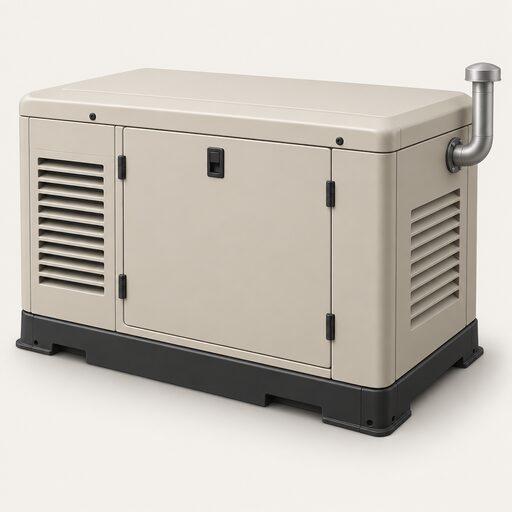 Standby Generators for HomesA standby generator starts itself when the power cuts out, so your home keeps running even when you are out.
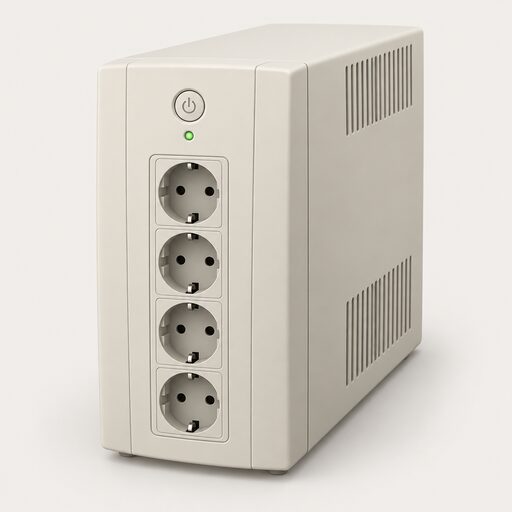 Maintaining Backup PowerWill your generator actually start when the power goes off?
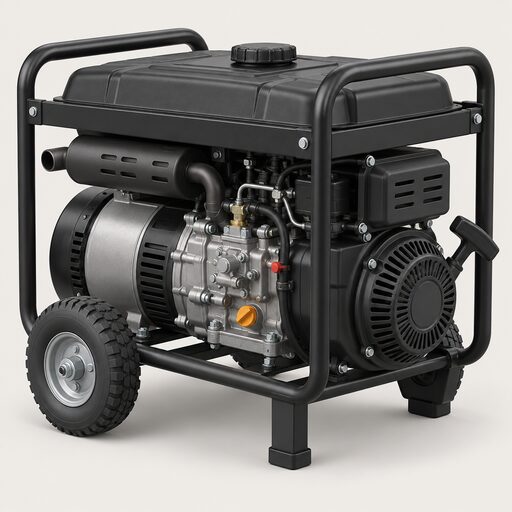 Portable Generators for HomesWhat can a portable generator actually run in a power cut, and for how long?
 Backup Power and EPSWill your lights stay on when the power goes out?
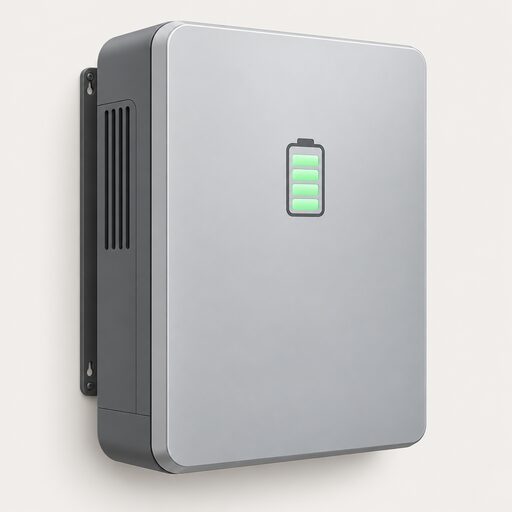 The Full Home Batteries GuideA home battery stores cheap or solar power for later, but will it really cut your bills enough to be worth it?
 Off-Grid Battery SystemsHow many days of power do you need when there is no sun?