
In this answer
Short answer
Thermal runaway is the failure mode that turns a battery fault into a fire. It starts when a cell overheats, whether from an internal fault, physical or electrical abuse, or extreme temperatures, and the heat then spreads to nearby cells, which enter the same uncontrollable and irreversible state1. The Electrical Safety Council describes it as the primary risk with lithium-ion batteries, occurring when internal temperatures exceed safe limits2.
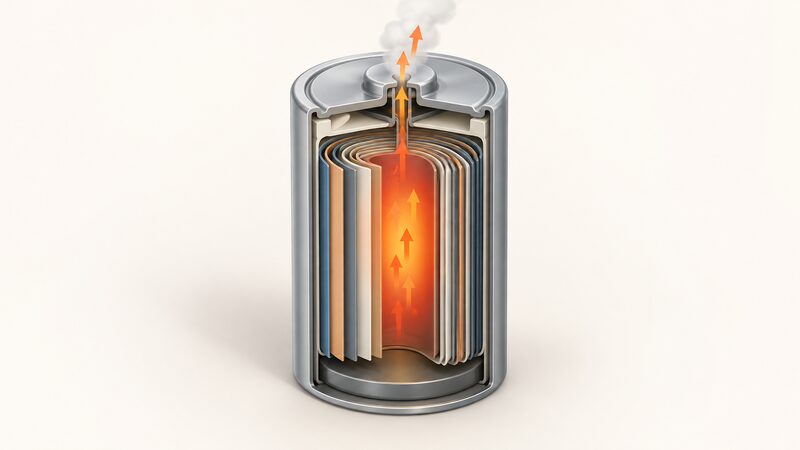
The process is self-sustaining. Elevated cell temperature drives exothermic reactions that produce more heat than can be dissipated to the surroundings, and eventually the internal structure of the cell becomes unstable and collapses, venting flammable and toxic gases, fire and explosion1. A recall notice for a faulty e-bike battery describes the same mechanism reaching up to 600 degrees centigrade, releasing toxic gases and creating a fire that is almost impossible to extinguish3.
For a household, the practical point is that thermal runaway is a design, component and handling problem rather than an inevitable property of battery storage. Official guidance states that non-compliant or incompatible battery components, and the use of batteries outside their safe design parameters, can lead to thermal runaway and fires4. The rest of this page sets out what causes it, what the warning signs are, how systems are built to resist it, and what to do if something goes wrong.
What thermal runaway is, and why lithium batteries are the ones at risk
The mechanism is specific to chemistries that store energy in a reactive cell. The Electrical Safety Council's battery breakdown work identifies thermal runaway as the primary risk with lithium-ion batteries2, and its dedicated explainer sets out the sequence: a cell overheats, exothermic reactions outpace heat dissipation, the cell structure collapses, and flammable and toxic gases, fire and explosion follow1. The heat then propagates to nearby cells, so a single cell fault can become a pack event1.
The causes are not mysterious. The same body lists poor quality and substandard components, flawed design, physical abuse and improper charging or discharging as the factors that create thermal instability5. Its guidance for e-scooters and e-bikes names overcharging, over-discharging and charging too quickly as some of the main causes of lithium-ion fires9. Government consultation material frames it in regulatory terms: non-compliant or incompatible battery components, and use outside safe design parameters, can lead to thermal runaway and fires4.
That framing matters for a household weighing storage. The risk is concentrated in products that fall outside the standards, in cells pushed beyond their ratings, and in damage that goes unnoticed. A compliant, correctly sized home battery with a functioning battery management system is a different proposition from a cheap replacement pack bought online. The home battery fire safety page covers containment and fire service guidance in more detail, and battery management systems explains what the electronics inside the unit are doing.
What causes it: charging faults, damage and overheating
Charging is the most common window for a fault to appear. A recall notice for a radiator fan with an internal lithium polymer battery states that the battery may fail during charging or while in standby mode, and that if the product is charged or left unattended in standby mode, a fault may occur leading to thermal runaway and the product catching fire11. The same notice records a risk of fire because the battery may fail during charging or while in normal use11.
The Electrical Safety Council's campaign material groups the causes under four headings: poor quality and substandard components, flawed design, physical abuse, and improper charging or discharging5. Its transport guidance repeats the charging-specific list: overcharging, over-discharging, or charging the battery too quickly9. Heat is a separate and compounding factor. Independent guidance notes that high temperatures can cause batteries, especially lithium-ion, to overheat and potentially catch fire12.
Manufacturing defects sit alongside user behaviour. A recall of RESU ESS home batteries was linked to specific electrode manufacturing issues that could potentially result in thermal instability leading to an overheating incident13. That is a home storage product, not a small device, and it shows that a defect introduced at the factory can surface years later in a fixed installation.
Warning signs a home battery is in trouble
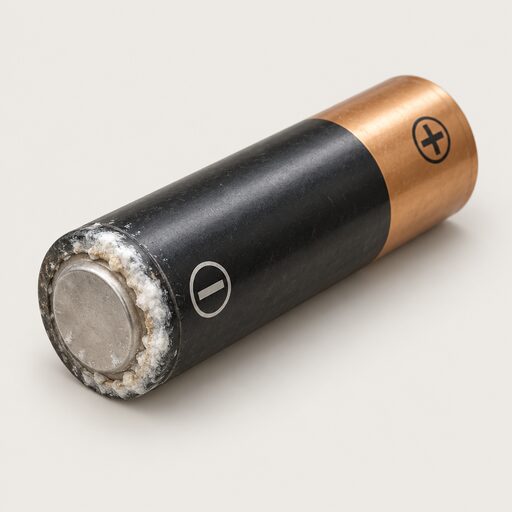
A failing cell does not always announce itself, but the published guidance points to conditions worth watching. Heat is the central one: high temperatures can cause batteries, especially lithium-ion, to overheat and potentially catch fire12. Charging behaviour is another, since a fault may occur while the product is charged or left unattended in standby mode11.
For a fixed home battery, the maker-side view of what to monitor is more specific. One manufacturer lists temperature sensing coverage and redundancy, current limits during fast charge and discharge, contactor behaviour during faults, and compatible inverter firmware and battery communications as the key factors in battery safety15. Those are the things a monitoring app or an installer's commissioning check can confirm. The battery maintenance and faults page covers alarms and common faults, and monitoring a home battery explains what the data shows.
Two system behaviours are worth knowing because they are easy to check. Independent guidance states the system should never let the battery discharge to zero, as this significantly reduces battery life7. And not all systems are suitable for power cuts, so it is worth asking the installer whether the battery will work in an outage, and for how long16. Neither is a thermal runaway warning sign in itself, but both indicate whether the system is being run inside its design envelope.
How modern battery systems are designed to stop it
The first line of defence is the battery management system, and the evidence is that it is not automatically sufficient. A government body's notice on a dangerous e-bike battery found that the battery management system had been deemed not sufficient to prevent the battery from entering thermal runaway17. That is a finding about one non-compliant product, but it sets the bar: a BMS is only as good as its design and its integration with the rest of the system.
A battery management system can fail at its core task: in one e-bike case the management system was deemed not sufficient to prevent the battery from entering thermal runaway15. That sets the bar for what protection in a home system has to achieve. Related principles appear elsewhere in household energy equipment: modern immersion heaters and thermostats have a safety cut-out to stop continuous reheating of the water if the thermostat fails, and modern central heating systems have frost-protection built in, so the boiler detects when it has dropped below a certain temperature and switches itself on to prevent a breakdown. The pattern is the same in each case, a sensor plus an automatic action that does not rely on the occupant noticing anything.
Chemistry is a second lever, and here the claims need care. One maker states that its lithium iron phosphate batteries carry zero risk of thermal runaway18. That is a manufacturer's statement about its own product line, not an independent finding, and it should be read alongside the official position that non-compliant or incompatible components and use outside safe design parameters can lead to thermal runaway4. The home battery chemistries page sets out what is sold in the UK.
"The battery management system has also been deemed not sufficient to prevent the battery from entering thermal runaway"
Where a home battery can safely be installed
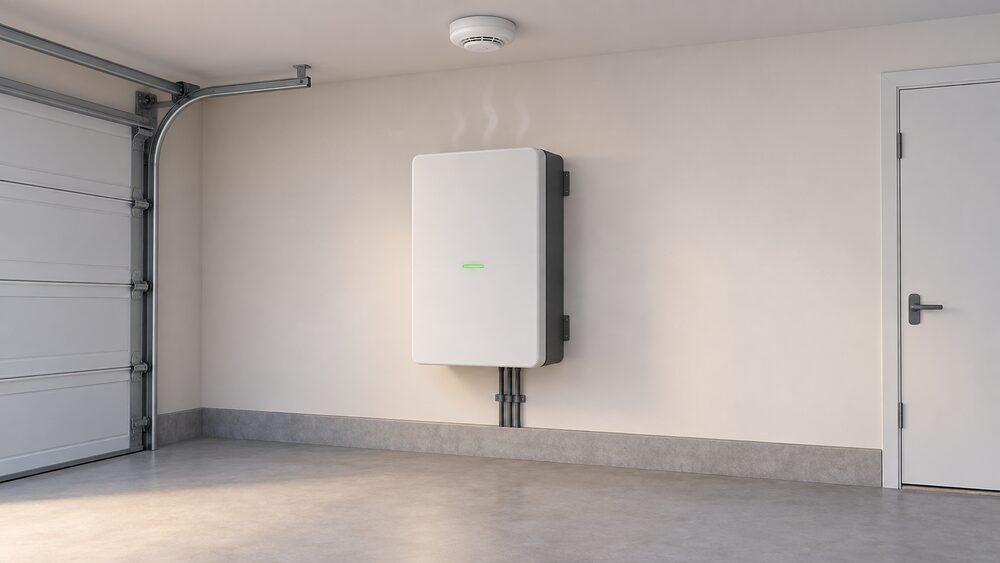
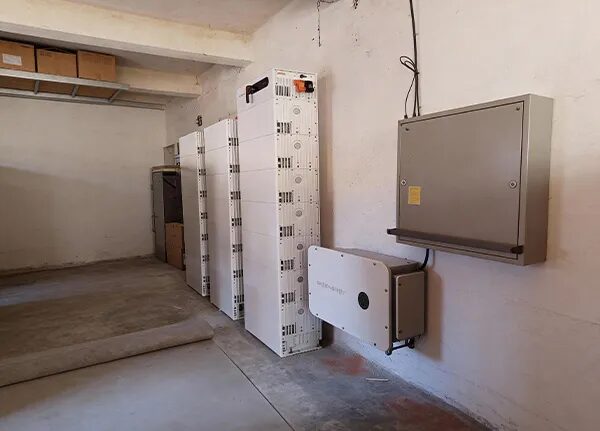
Independent guidance states that a battery can be installed in garages, on external walls or utility rooms, depending on which one you choose7. Those three positions share the same logic: they keep the unit out of the main living space and give it some separation from the rooms people sleep and live in. The where a home battery can be installed page covers siting in full, and ventilation, temperature and operating conditions covers the environmental limits.
The clearance rules that apply to smaller lithium devices give a sense of the principle. Guidance for e-bike batteries says it is dangerous to charge a battery close to combustible materials or hazardous substances, or where high temperatures or sunlight are likely10. Independent guidance for portable electric heaters, a different product with a similar fire risk, gives a clearance of at least one metre from combustible materials such as paper, furniture or curtains14. For a fixed home battery, the specific distances come from the installation standards and the manufacturer's instructions rather than from these general figures.
Two further points bear on safety in place. Official guidance for lithium-ion devices says to charge in a room that has a working smoke alarm, that does not compromise an escape route, keeping the door closed while charging and away from any heat source8. Independent guidance for portable heaters says to use smoke alarms or heat detectors nearby19. A smoke alarm does not prevent a cell fault, but it shortens the time between a fault starting and someone knowing about it.
What to do if you suspect thermal runaway
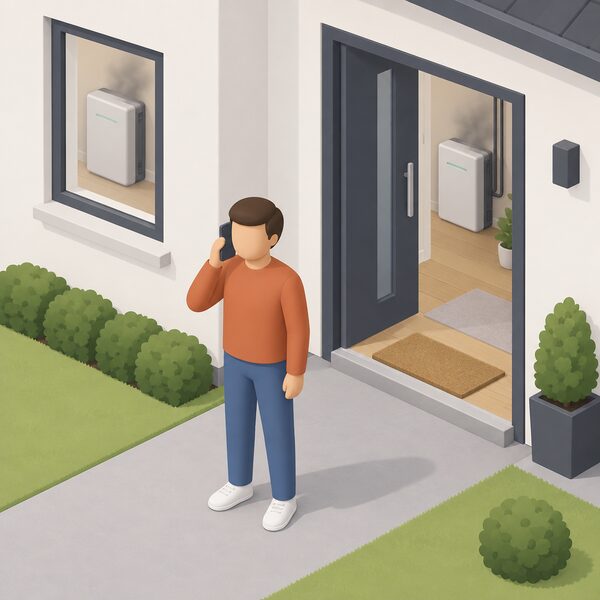
The published advice is short and consistent. The Electrical Safety Council's thermal runaway guidance is: warn others, get out, call the fire service14. Official guidance for lithium-ion devices in the home is equally direct: in the event of a fire, do not try and tackle it yourself, leave and call 9998. A battery fire that has entered thermal runaway is not a fire to fight with a household extinguisher.
If the problem is suspected rather than visible, the guidance for e-bike chargers and batteries is to stop using it immediately and report the fault to the manufacturer or retailer, or call the Citizens Advice helpline on 03454 04 05 0610. For a recalled product, official guidance advises owners to stop using it immediately and contact the manufacturer to arrange a modification20. The battery recalls and safety notices page tracks UK notices, including the LG ESS home battery recall.
Disposal has its own route. A recall notice for a product with a lithium polymer battery instructs owners to dispose of it safely via their local household waste disposal site, checking first whether the centre accepts that type of battery11. Official guidance adds that if a device or piece of equipment is stored without being used for any length of time, the battery should be removed8. The home battery recycling, disposal and end of life page covers this for fixed storage.
The limits of what a home battery removes
A home battery reduces dependence on the grid for the hours it can cover, and it does nothing about the dependence that remains. The unit is a manufactured product with a warranty, a firmware stack and, in most cases, a cloud app, so the household's independence runs through a company. The home batteries and household energy independence page sets out where that leaves a household.
On safety specifically, the honest position is that thermal runaway is a low-probability, high-consequence event that is managed rather than eliminated. The controls are component quality, compliant design, a functioning battery management system, correct siting, and detection in the space where the unit sits. The evidence for those controls comes from official and independent bodies, and the failure cases in the public record are products that fell outside them.
Two administrative points sit alongside the safety ones. HMRC guidance on VAT relief states that batteries storing energy in the form of heat, meaning thermal or heat batteries, are not included in that relief19. And an insurance-backed guarantee scheme lists battery storage among the technologies it covers, alongside biomass, air source heat pumps, ground source heat pumps, solar heating, solar PV, water source heat pumps and solar assisted heat pumps21. Neither is a statement about fire insurance, and the policy wording is the only reliable answer on cover.
Sources21 cited
- Thermal runaway, Electrical Safety First, 2026-09-17
- Battery Breakdown, Electrical Safety First, 2026-09-17
- Dangerous product risking fire found for sale across the UK, Electrical Safety First, 2026-09-17
- The UK's new product safety framework, GOV.UK, 2026-03-31
- Battery safety campaign, Electrical Safety First, 2026-09-17
- POST note 771: Domestic battery storage, Parliamentary Office of Science and Technology, 2026-06-25
- Battery storage, Energy Saving Trust, 2026-08-19
- Lithium-ion batteries, North Wales Fire and Rescue Service, 2026
- E-scooters, Electrical Safety First, 2026-09-17
- E-bikes, Electrical Safety First, 2026-09-17
- Valiant Radiator Fan recall, Electrical Safety First, 2025-11-07
- Be summer ready, Electricity North West, 2026-09-19
- LG ESS Battery Division RESU ESS home batteries, Electrical Safety First, 2026-09-17
- Thermal runaway, Electrical Safety First, 2026-09-17
- LFP vs NMC home batteries, SolaX Power, 2026-03-30
- Solar panel battery storage, Which?, 2026-05-14
- Dangerous e-bike battery notice issued by government body, Electrical Safety First, 2026-09-17
- Types of solar batteries, SolaX Power, 2026-01-29
- VAT energy saving materials and grant funded heating supplies, HMRC, 2026-09-17
- Product recalls and alerts, GOV.UK, 2022-04-07
- MCS approved financial protection products, MCS Certified, 2026-09-17
 Heating Control FaultsWhy is my heating on when the thermostat says it is off, or why does one radiator stay cold?
 Home Battery Fire SafetyHow likely is a home battery to catch fire, and what keeps it safe if it does?
 Energy Theft and TamperingExplains what counts as energy theft, how to report a suspected tampered or bypassed meter, and what a supplier may do on investigation.
 Maintenance and FaultsWhat does it mean when your home battery starts beeping or showing a warning, and can you fix it yourself?
 Bleed a RadiatorThe step-by-step method for bleeding a radiator, the tools needed and the order to work through a house.
 Battery Management SystemsWhat does a home battery's management system actually do, and why does a fault often show up as an inverter error?