
In this answer
Short answer
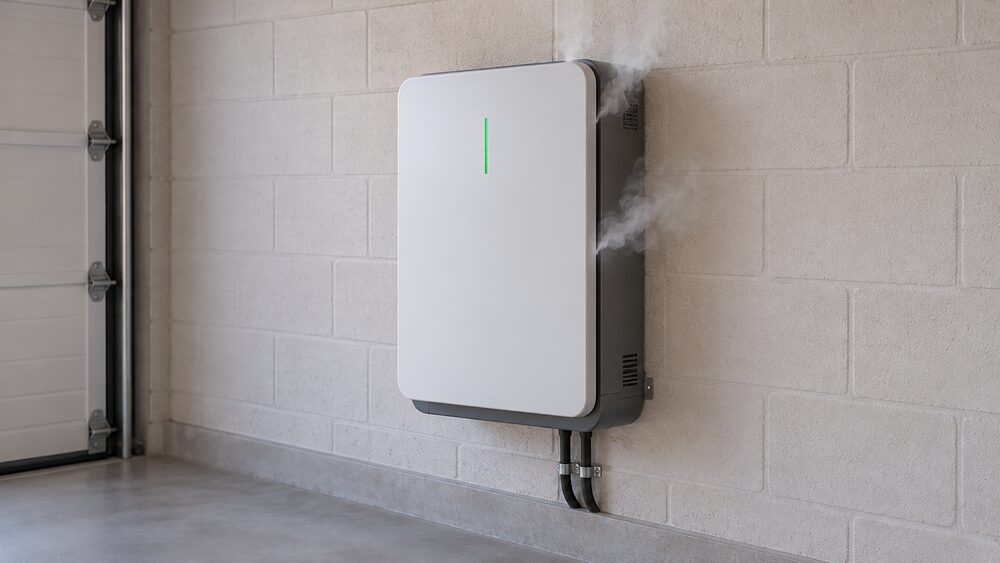
A domestic battery fire releases a mixture of flammable and toxic gases, and it does so before the flames are visible. The process is thermal runaway: a cell overheats, exothermic reactions generate more heat than the cell can shed, and the internal structure becomes unstable and collapses. The result, in the words of the independent safety body that documents it, is "the venting of flammable and toxic gases, fire and explosion"1.
The gases matter because they are the first hazard, not the second. Fire service guidance for lithium-ion devices in the home states that these fires "can develop very quickly, producing huge amounts of extremely toxic gases", and that those gases "will render a person unconscious"2. That is a different risk profile from a chip pan or a chimney fire, and it is why the advice for any lithium-ion fire is evacuation and a 999 call rather than an attempt to fight it.
For a household weighing up battery storage, the practical question is not whether a fire is possible but what the installation rules do about it. Domestic batteries are required to be installed in compliance with the MCS installation standard, PAS 63100 and PAS 20353, and PAS 63100:2024 exists specifically as the specification for protecting electrical battery energy storage systems against fire when installed in dwellings4. The chemistry, the enclosure and the location all bear on the outcome.
Which gases a domestic battery fire releases
The published UK guidance describes the release in terms of its properties rather than a compound-by-compound list. The independent safety body's account of thermal runaway is explicit that what vents is "flammable and toxic gases"1, and the fire service guidance is equally explicit that the quantity is large and the toxicity severe2. Both properties matter, and they call for different responses: the flammable fraction creates the explosion risk, and the toxic fraction creates the unconsciousness risk.
What the material does not do is name hydrogen fluoride or any other specific compound. No figure, concentration or compound list is available in the official and independent guidance here, and none should be inferred. A household searching for a precise chemical breakdown will not find one in the UK safety literature summarised on this page.
The materials inside the cells are the reason the question is asked at all. Domestic battery storage is built principally from lithium, the most common material used for domestic batteries, but also cobalt and nickel6. Those are the metals, not the gases, but they indicate the complexity of the chemistry involved when a cell is driven past its design limits.
It is worth separating this from the combustion gases a household may already know. Carbon monoxide from a faulty gas appliance is a well-documented hazard with its own detection regime, and the signs of incomplete combustion are listed as yellow or orange rather than blue flames, soot or yellow-brown staining, pilot lights that frequently blow out, and increased condensation inside windows7. Battery vent gas is a different problem with a different detection answer, and the two should not be treated as interchangeable.
Why lithium-ion cells produce flammable and toxic gas
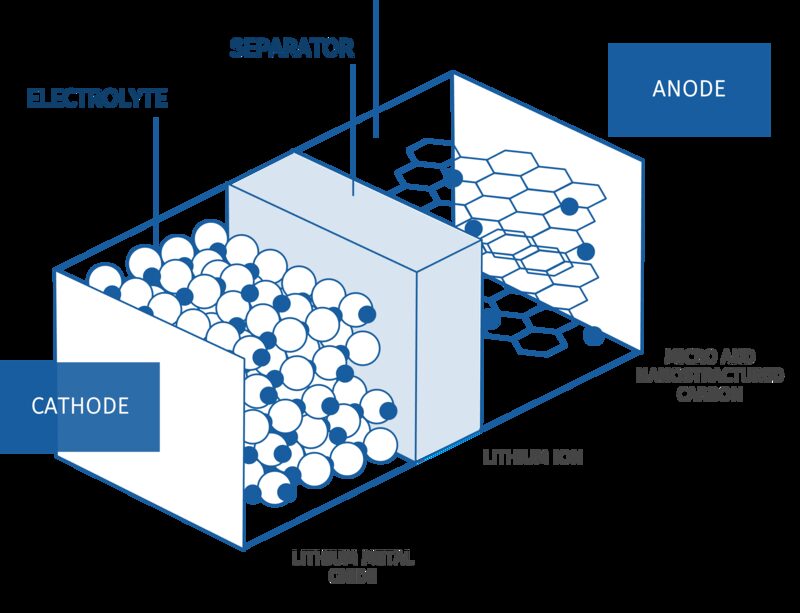
Thermal runaway is a chain reaction inside the cell, and the gas is a product of that chain rather than of combustion from outside. The independent safety body's definition sets out the sequence: the process "starts when a battery cell overheats, perhaps due to an internal fault, physical or electrical abuse, or extreme temperatures"1. Once started, the elevated cell temperature "results in exothermic reactions, which produce more heat than can be dissipated to surroundings", and eventually "the internal structure of the cell begins to become unstable and collapse"1.
That collapse is the point at which gas is released. The cell is a sealed container, so the pressure has to go somewhere, and it vents. Because the reactions are exothermic, the process is self-sustaining once it passes a threshold, which is why the fire service describes the development as very quick2.
The triggers are well documented and mostly avoidable. Non-compliant or incompatible battery components, and the use of batteries outside their safe design parameters, "can lead to thermal runaway, causing fires"8. High temperatures "can cause batteries (especially lithium-ion) to overheat and potentially catch fire"9. For the smaller lithium-ion packs in e-bikes and e-scooters, overcharging, over-discharging and charging too quickly are named as some of the main causes of fire10. The same principles of abuse apply to a fixed home battery, though a domestic system has a battery management system and an enclosure that a bike pack does not.
"This elevated cell temperature results in exothermic reactions, which produce more heat than can be dissipated to surroundings. Eventually the internal structure of the cell begins to become unstable and collapse, resulting in the venting of flammable and toxic gases, fire and explosion."
How gas composition changes as the fire develops
The guidance describes a progression rather than a fixed mixture. Thermal runaway begins with heat, moves to gas venting, and can end in fire and explosion1. The fire service account adds the timing: the fire develops very quickly and the gas production is large2. In practice that means the atmosphere in the room changes character over a short period, from a smell or a haze to an atmosphere that is both explosive and acutely toxic.
The sequence has a direct bearing on escape. Because the gases can render a person unconscious2, the window for getting out is measured from the first sign of trouble, not from the first visible flame. That is the reasoning behind the fire service advice to charge lithium-ion devices in a room with a working smoke alarm, in a position that does not compromise the escape route, with the door closed while charging and away from any heat source2.
For a fixed domestic battery, the equivalent controls are built into the installation rather than the charging routine. PAS 63100:2024 provides the specification for protecting electrical battery energy storage systems against fire when installed in dwellings4, and domestic batteries are required to be installed in compliance with the MCS installation standard, PAS 63100 and PAS 20353. Those documents govern siting, separation and containment, which is how the progression from a single cell to a room-scale event is meant to be interrupted.
Where the gases go in a home and how far they spread
Vent gas follows the same physics as any other gas: it rises while hot, spreads along ceilings and upper floors, and accumulates in enclosed spaces with no through ventilation. The published guidance does not give spread distances for a domestic battery fire, and no figure should be assumed. What the guidance does establish is the consequence of breathing it, which is loss of consciousness2.
The comparison that UK safety material does make is with carbon monoxide, where the pattern of accumulation in enclosed spaces is well documented. Carbon monoxide poisoning "can occur on boats when emissions from gas-powered engines and generators build up in boat cabins"12, and it can also occur "when people bring gas and charcoal barbecues into tents and other small enclosed spaces to try to keep warm"13. The lesson generalises: enclosed, poorly ventilated spaces concentrate combustion and vent gases, and the people most affected first are "older people, children, pets and anyone suffering from respiratory diseases such as asthma"14.
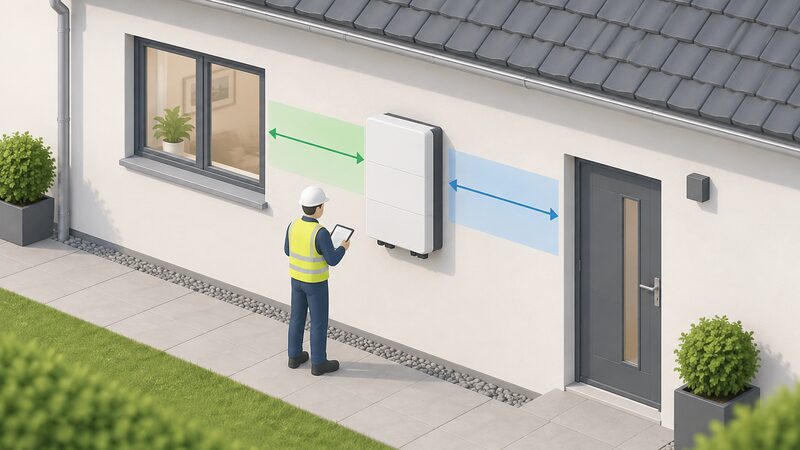
For a home battery, the location decision is therefore a gas decision as much as a fire decision. A unit in a garage, an outbuilding or on an external wall is separated from the sleeping accommodation by a door and a wall. A unit inside the thermal envelope shares air with the people in the house. The installation standards are the mechanism that resolves this, and the siting question is covered in more detail in where a home battery can be installed and in ventilation, temperature and operating conditions.
What the gases mean for detection and ventilation
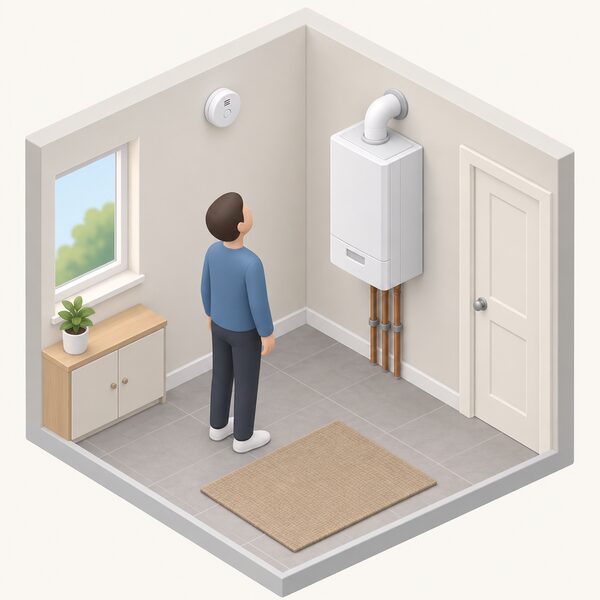
Detection is the weakest link in the chain, and it is worth being precise about what does and does not work.
A carbon monoxide alarm is specified to BS EN 50291:200115, and the fitting rule is that one "should be fitted in any room that contains a gas fuel burning appliance, like a boiler and gas fire, and a solid fuel burning appliance"16. That is a combustion appliance rule. A CO alarm responds to carbon monoxide, not to the mixture a venting lithium-ion cell produces, and it should not be relied on as a battery fire detector.
Flammable gas detection has its own limitation. No approved flammable gas alarms can run effectively from only internal batteries, because the sensor uses too much power17. A natural gas detector can detect dangerous and ignitable gas escaping and will sound an alarm18, but that is a mains gas device, not a battery vent gas device.
Smoke detection remains the practical early warning. The fire service advice for lithium-ion devices is to charge in a room that has a working smoke alarm, which does not compromise the escape route, with the door closed while charging and away from any heat source2. For ventilation after an event, no period is published in UK guidance, and the decision on re-entry belongs to the fire and rescue service. The wider picture on containment and fire service practice sits in home battery fire safety.
Safety standards and certification relevant to gas risk
The standards framework is where gas risk is actually managed, because it governs where a battery may sit and what must surround it. PAS 63100:2024 "provides the specification for protecting electrical battery energy storage systems against fire when the" systems are installed in dwellings4, and the same standard "helps ensure the fire safety of domestic battery energy storage systems (BESS)"4. It is the document a household should expect an installer to be working to.
The scheme rules reinforce it. Domestic batteries, described in this context as electrochemical batteries installed to be used in conjunction with solar PV panels in residential buildings3, must be installed in compliance with the latest version of the quality and installation standards, including the MCS installation standard, PAS 63100 and PAS 20353. The standards themselves are set out in more detail in the standards governing home battery installation.
Chemistry is not a substitute for any of this. Maker guidance is direct on the point: "No, an LFP solar battery is not automatically safe for indoor installation just because it uses LFP chemistry"19. Safety depends on the system listing, the enclosure rating, the clearances and the location19. A household comparing LFP and NMC should read that as a statement about installation discipline rather than about chemistry alone; the comparison is developed in home battery chemistries.
Reporting is improving. The All-Party Parliamentary Group for Electrical Safety has ensured that "lithium-ion battery fires will be recorded under the new UK fire reporting system"20, which should in time produce better UK data on how often these events occur and what they release. Until that data exists, the guidance position is the one to work from: flammable and toxic gas, rapid development, and a fire service response rather than a household one.
Sources20 cited
- Battery Breakdown: thermal runaway, Electrical Safety First, 2026-09-17
- Lithium-ion batteries safety advice, North Wales Fire and Rescue Service, 2026
- Warm Homes: Social Housing Fund wave 3 scheme guidance addendum, GOV.UK, 2026-06
- PAS 63100: protection against fire of battery energy storage systems, BSI, 2026-09-17
- POST note: domestic battery storage, Parliamentary Office of Science and Technology, 2026-06-25
- Battery storage advice, Centre for Sustainable Energy, 2025-10
- Carbon monoxide, Health and Safety Executive, 2026
- The UK's new product safety framework, GOV.UK, 2026-03-31
- Be summer ready, Electricity North West, 2026-09-19
- E-bike battery safety, Electrical Safety First, 2026-09-17
- E-scooter battery safety, Electrical Safety First, 2026-09-17
- Summer CO awareness, Cadent Gas, 2026-09-20
- Gas safety and carbon monoxide, nidirect, 2025-11-24
- Gas leaks safety, Uswitch, 2026-06-01
- Building Regulations Part J: heat producing appliances, Welsh Government, 2022-06
- Keeping your home warm in winter, Met Office, 2026-09-20
- Carbon monoxide alarms, CO-Gas Safety, 2018-09-08
- Sense of smell, Cadent Gas
- LFP vs NMC home batteries: which is safer, SolaX Power, 2026-03-30
- Westminster policy work, Electrical Safety First, 2026-09-17
 Home Battery Fire SafetyHow likely is a home battery to catch fire, and what keeps it safe if it does?
 Generator SafetyCovers the main hazards of running a generator at a home: exhaust fumes and carbon monoxide, hot surfaces and refuelling fires, electric shock and earthing.
 Lithium Battery SafetyLithium batteries power phones, e-bikes, scooters and home storage, and any of them can catch fire.
 Smell Gas or Suspect COThe emergency steps for a suspected gas escape or carbon monoxide alarm, including ventilation, ignition sources and turning the supply off at the emergency control valve.
 Carbon Monoxide SafetyHow carbon monoxide arises from gas, oil, LPG and solid fuel appliances, where alarms must be sited and what the requirements are in each UK nation.
 Maintenance and FaultsWhat does it mean when your home battery starts beeping or showing a warning, and can you fix it yourself?