
In this guide
Air conditioning in Wales is governed by a permitted development regime that is separate from England's, and the difference matters most for the outdoor unit. An air source heat pump, including an air-to-air system that provides cooling as well as heating, is permitted development in Wales under Class G of the Town and Country Planning (General Permitted Development) (Wales) Order 2012, provided every limit and condition is met1. The installation, alteration or replacement of an air source heat pump on a dwellinghouse, or within its curtilage, sits in that class1.
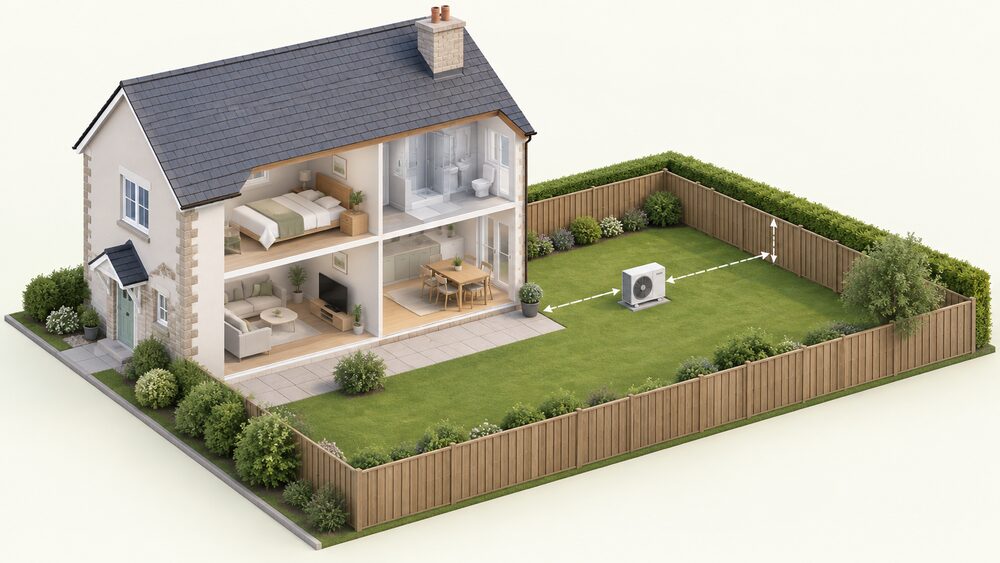
The conditions are where Welsh rules bite. The unit must comply with the MCS Planning Standards or equivalent standards, must not be installed on a site designated as a scheduled monument, and must not result in more than one air source heat pump on the dwellinghouse or within its curtilage2. Wales also requires a minimum distance of 3 metres from the property boundary, a rule the Welsh Government introduced to reduce noise pollution potential and which its own research calls the biggest constraint on air source heat pump deployment in Wales3.
Cooling-only equipment is the exception. Permitted development rights apply only if the system provides a heating function, including a system that can provide both heating and cooling; a cooling-only system requires a planning application5. That single condition decides the route for most households.
Permitted development in Wales: air-to-air heat pumps are allowed
The legal basis is Class G of the Welsh permitted development order, which covers the installation, alteration or replacement of an air source heat pump on a dwellinghouse or within the curtilage of a dwellinghouse1. The same order provides separate classes for other renewable equipment at a dwelling: Class C for ground source heat pumps, Class D for water source heat pumps, Class B for stand alone solar and Class H for a stand alone wind turbine, all within the curtilage1. Class F covers the installation, alteration or replacement of a flue forming part of a combined heat and power system on a dwellinghouse2.
The Welsh Government has been moving on the air-to-air question specifically. A consultation summary on changes to permitted development rights records that the majority of responses showed strong support for the proposal to remove condition G.3(a), which would enable air-to-air heat pumps8. That condition is the one that has kept cooling-led systems outside the automatic route. Until the change is made and commenced, the position for a household is the one set out in the current order.
The practical effect is that a household wanting a system that both heats and cools is on the permitted development track, subject to the limits, while a household wanting cooling alone is not. The distinction is not about the hardware in the room; it is about whether the system has a heating function. That is why the same outdoor unit can be permitted development in one installation and require an application in another.
What air-to-air means for a household wanting cooling and heating

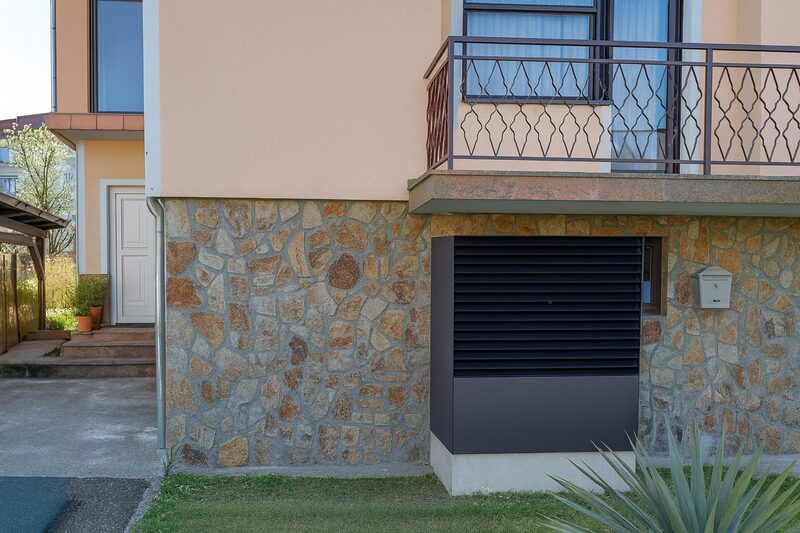
An air-to-air heat pump moves heat between the outdoor air and the indoor air rather than heating water. That is what makes it a cooling system as well as a heating system, and it is why the planning question and the building regulations question arrive together.
Welsh building standards treat these units as a defined category. Approved Document L for dwellings in Wales states that electrically driven air-to-air heat pumps with an output less than or equal to 12 kW should have a seasonal coefficient of performance as defined by Ecodesign Commission Regulation No 206/2012 Annex II, average rating conditions9. That is a performance requirement attached to the appliance type, not a planning condition, but it tells a household what the Welsh standards expect of the equipment.
Wales has also legislated on oversizing. Approved Document L states that the cooling appliance should not be sized for more than 120% of the design cooling load9. A unit specified well above the room's actual cooling demand is not simply wasteful; it sits outside the sizing guidance. For a household, that is an argument for a proper room-by-room assessment rather than a rule of thumb, and it connects to the wider question of what size air conditioner is needed.
The independence picture is mixed and worth stating plainly. An air-to-air system runs on electricity, so it does not remove dependence on the grid or on a supplier. What it does change is the fuel: it displaces gas for heating and it delivers more cooling per unit of electricity than a plug-in portable unit. The dependence that remains is electrical, and it is total during a power cut unless the household has its own generation and storage. The cooling and energy independence question is therefore about how the electricity is sourced, not about whether the system is connected.
How Wales differs from England and Scotland on heat pump rules
The single most important fact for a Welsh household reading UK-wide guidance is that most of it does not apply. Planning Portal's heat pump pages carry the same line repeatedly: the guidance relates to the planning regime for England and the policy in Wales may differ10. The same caveat appears on the boiler and heating pages, the roof pages, the solar pages, the wind turbine pages, the biomass pages, the insulation pages, the electrics pages and the solar thermal pages5.
That is not a formality. The English permitted development rights for air source heat pumps sit in Part 14 (Renewable Energy) of the Town and Country Planning (General Permitted Development) (England) Order 2015, a different instrument from the Welsh order21. England's regime dates from 1 December 2011, when the installation of an air source heat pump on domestic premises became permitted development subject to limits and conditions10. Wales made its own amendment order in 2012, and the Welsh Government's Planning Division at Cathays Park in Cardiff is the address given for obtaining copies of it22.
Scotland and Northern Ireland have their own regimes again. The practical consequence is that a figure quoted for England, whether a boundary distance, a volume limit or a noise threshold, cannot be carried across to a Welsh installation without checking the Welsh order. Where a household is comparing options across the UK, the England, Scotland and Northern Ireland pages set out those positions separately.
Cooling systems and permitted development: the wider picture across the UK
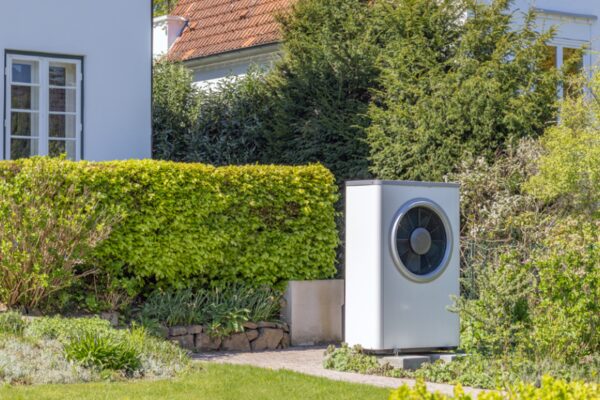
Permitted development in Wales is a patchwork of classes rather than a single right, and the boundaries between them decide what a household can install without an application.
- Air source heat pumps: Class G, on a dwellinghouse or within its curtilage, subject to the MCS standards requirement, the scheduled monument exclusion and the one-unit limit1.
- Ground source heat pumps: Class C, installation, alteration or replacement within the curtilage of a dwellinghouse1.
- Water source heat pumps: Class D, installation, alteration or replacement within the curtilage of a dwellinghouse1.
- Stand alone solar: Class B, within the curtilage of a dwellinghouse1.
- Stand alone wind turbines: Class H, within the curtilage of a dwellinghouse1.
- Flues for combined heat and power: Class F, on a dwellinghouse2.
The interaction between classes is a trap worth knowing about. Planning Portal's building-mounted wind turbine guidance states that only the first installation of any wind turbine would be permitted development, and only if there is no existing air source heat pump at the property; additional wind turbines or air source heat pumps at the same property require an application for planning permission16. The same principle appears in the heat pump guidance: additional wind turbines or air source heat pumps at the same property require an application for planning permission10. A household planning more than one renewable installation should treat the second one as an application, not an automatic right.
For the cooling side of the site, the types of air conditioning page sets out how the hardware categories map onto these planning classes, and air conditioning that heats explains why the heating function is the hinge on which permitted development turns.
Conditions a permitted development installation must still meet
Permitted development is a right with conditions attached, not a free pass. Planning Portal states that adding air conditioning to a home may be considered permitted development provided all the limits and conditions in legislation are met, and that those limits cover function, size, placement and quantity of units5.
The Welsh conditions that most often decide an installation are these:
- Heating function. The rights apply only if the system provides a heating function, including a system that can provide both heating and cooling; a cooling-only system requires a planning application5.
- Standards compliance. Development is not permitted by Class G unless the air source heat pump complies with the MCS Planning Standards or equivalent standards2.
- Boundary distance. Welsh permitted development requires a minimum 3 metre distance to the property boundary3.
- Volume. The existing volumetric constraint in Wales is 1 m³4.
- Quantity. Development is not permitted if it would result in more than one air source heat pump on the dwellinghouse or within its curtilage2.
- Scheduled monuments. Development is not permitted if the air source heat pump would be installed on a site designated as a scheduled monument2.
- Protected areas. If a home is in a protected area such as a Conservation Area then permission will be required, and listed buildings require listed building consent5.
The 3 metre rule deserves particular attention because the Welsh Government's own evidence is sceptical of it. The Phase 1 report states that there is no evidence supporting the need for the 3 metre rule to limit the adverse impact of noise, and that the biggest constraint for air source heat pump deployment in Wales is the 3 metre permitted development rule4. That is an official finding about the rule's effect, not a change to the rule. Until the Welsh Government acts on the review, the distance stands.
When you would need to apply for full planning permission instead
An application is needed whenever the limits and conditions are not met, or where permitted development rights have been removed in the area. Planning Portal's roof guidance states the principle directly: if these limits and conditions are not met, or permitted development rights have been removed in the area, then an application is required14.
For a Welsh household, the triggers are concrete. A cooling-only system needs an application because the rights apply only to systems with a heating function5. A second air source heat pump at the same property needs an application10. A unit that cannot meet the 3 metre boundary distance, or that exceeds the 1 m³ volume constraint, falls outside permitted development3. A unit that does not comply with the MCS Planning Standards or equivalent falls outside Class G2. A scheduled monument site is excluded outright2. A Conservation Area brings permission into play, and a listed building brings listed building consent as well5.
There is a related Welsh example that shows how local designations change the answer. External wall insulation which projects greater than 16cm requires planning permission in Wales, and permission is also required if the home is in a Conservation Area, a National Park, an Area of Outstanding Natural Beauty or a World Heritage Site19. The pattern is consistent: the physical limits decide the default, and the designation decides whether the default survives.
Where an application is needed, the local planning authority is the body that determines it. Planning Portal's heat pump guidance advises contacting the local planning authority if in doubt, because the policy in Wales may differ10.
Building regulations and other consents to check alongside planning

Planning permission and building regulations are separate approvals, and one does not imply the other. The Welsh Government states that installation of either a ground source or air source heat pump will have to comply with the Building Regulations23. Planning Portal's heat pump building regulations page covers the same ground for readers working from the England-facing guidance11.
The Welsh building regulations have their own requirements that bear on this work. The Building Regulations etc. (amendment) (Wales) Regulations 2022 require mechanical ventilation air flow rate testing on existing dwellings which undergo notifiable building work, and require that the ventilation in the building must comply with the standard set out in Part F of Schedule 1 or be no worse than before the Part L works24. A retrofit that tightens a dwelling and adds a system can therefore pull ventilation testing into scope.
Approved Document L Volume 1 for dwellings, the 2026 edition, gives guidance for compliance with the Building Regulations for building work carried out in Wales25. For new dwellings, the building control body must be notified once the work is complete of the as-built target primary energy rate, dwelling primary energy rate, target emission rate, dwelling emission rate, target energy use intensity, dwelling energy use intensity, fabric performance values and list of specifications25. That is a new-build obligation, but it shows the level of documentation Welsh building control expects.
Wales also has overheating guidance that sits alongside the cooling question. Approved Document O, in the 2022 edition, provides guidance for reducing overheating risk in new residential buildings26. The wider policy direction is set out in the Part L and F review, which describes introducing a world-leading performance standard incorporating low-carbon heat in new homes by 2025 as the basis for the changes27. For existing homes, the Part O overheating rules explain where that guidance applies and where it does not.
Costs and reliefs: what VAT applies to air conditioning units
VAT on air conditioning and heat pump equipment is time-limited, and the date of installation decides the rate. VAT relief on air source heat pumps and air conditioning units runs until 31 March 2027, with a 5% reduced rate from 1 April 20277. A household weighing an installation against a later date is weighing two different tax positions.
The reduced rate for installing energy-saving materials is illustrated in official guidance with a worked example: 5% of £1,000 equals £50 reduced-rate VAT on the total supply7. The same guidance gives a materials example in which the installer is charged £400 excluding VAT for the insulation material7. Those examples are about insulation rather than cooling equipment, but they show how the reduced rate is applied to a supply and installation.
On the funding side, Green Homes Wales is designed to support eligible homeowners in making energy-efficiency and low carbon heat improvements to their homes28. The scheme supports the installation, in domestic properties located in Wales, of certain types of energy efficiency improvement measures and low carbon heating systems, and the funding can be used to cover the costs of the supply and installation of the Eligible Measures29. Eligibility requires an owner-occupied home, owned by the householder with a freehold or long-leasehold interest, owned outright or with a mortgage, and situated in Wales29. The scheme also provides fully funded access to a Retrofit Coordinator to create a detailed home assessment providing energy-efficiency and decarbonisation recommendations29.
Whether a specific cooling installation qualifies is a question for the scheme rules rather than for this page, and the grants for air conditioning page covers the funding landscape. Prices for equipment and installation in Wales are installer-quoted, and no published range is given here.
What owning an air-to-air system means for household energy independence
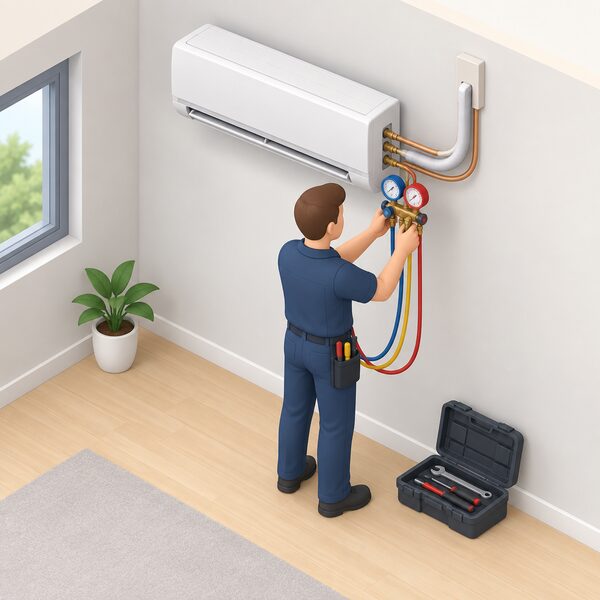
An air-to-air heat pump changes what a household buys and what it still depends on, and both halves of that deserve equal weight.
What it changes: the system provides cooling and heating from one set of hardware, running on electricity rather than gas. It displaces some gas use for heating and it cools more efficiently than a portable unit drawing the same power. Where the household also has solar generation, the cooling load can be met from self-generated electricity during the sunniest hours, which is when cooling demand peaks. The running air conditioning on solar panels page works through that overlap.
What it does not change: the household remains connected to the grid and dependent on a supplier for every hour the system runs. There is no stored heat and no cylinder, so a power cut removes both heating and cooling at once. The refrigerant circuit depends on a certified engineer for any work, which is a dependence on the trade rather than on the grid, and the F-gas rules set out what that means in practice. Controls and scheduling often run through a manufacturer's app, which is a cloud dependence that survives only as long as the maker supports it.
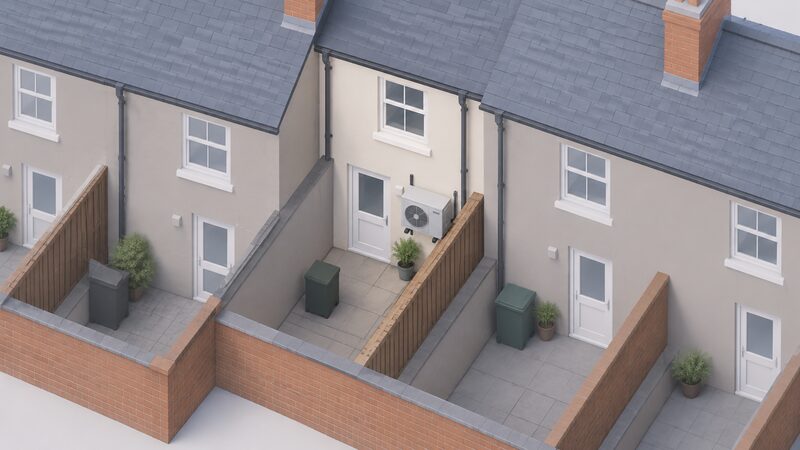
The planning regime itself is part of the independence picture in a modest way. Permitted development removes an application, a fee and a waiting period from the process, which lowers the barrier to installing a system that reduces gas dependence. The 3 metre boundary rule raises that barrier in dense Welsh housing, and the Welsh Government's own research identifies it as the biggest constraint on deployment4. A household in a terraced street may find that the planning route, not the technology or the cost, is what decides whether the installation happens.
"There is no evidence supporting the need for the 3 m rule to limit the adverse impact of noise."
Sources29 cited
- The Town and Country Planning (General Permitted Development) (Amendment) (Wales) Order 2012, legislation.gov.uk, 2012
- The Town and Country Planning (General Permitted Development) (Amendment) (Wales) Order 2012, article 2, legislation.gov.uk, 2012
- Written statement: publication of the Air Source Heat Pump Noise and Permitted Development Rights in Wales report, Welsh Government, 2024
- Air Source Heat Pump Noise and Permitted Development Rights in Wales, Phase 1 report, Welsh Government, 2024
- Boilers and heating: planning permission, Planning Portal, 2026
- Air and ground source heat pumps, London Borough of Croydon, 2026
- Draft VAT guidance on changes to energy-saving materials, HM Revenue and Customs, 2019
- Changes to permitted development rights: summary of responses, Welsh Government, 2025
- Building Regulations Part L and F review, stage 2A, Approved Document L, Welsh Government, 2020
- Planning permission: air source heat pump, Planning Portal, 2026
- Heat pumps: building regulations, Planning Portal, 2026
- Solar thermal water heating, Planning Portal, 2026
- Boilers and heating, Planning Portal, 2026
- Roof planning permission, Planning Portal, 2026
- Solar equipment mounted on a house or a block of flats, Planning Portal, 2026
- Building-mounted wind turbines: planning permission, Planning Portal, 2026
- Biomass fuelled appliances: planning permission, Planning Portal, 2026
- Insulation: planning permission, Planning Portal, 2026
- Planning permission: insulation, Welsh Government, 2026
- Electrics: planning permission, Planning Portal, 2026
- Heat pumps, Planning Portal, 2026
- The Town and Country Planning (General Permitted Development) (Amendment) (Wales) (No. 2) Order 2012, explanatory note, legislation.gov.uk, 2012
- Building regulations: heat pumps, Welsh Government, 2026
- The Building Regulations etc. (Amendment) (Wales) Regulations 2022, Welsh Government, 2022
- Building Regulations Approved Document L Volume 1, 2026, Welsh Government, 2026
- Part L Wales impact assessment, domestic existing and new build, Welsh Government, 2022
- £5 million to help Welsh households invest in greener homes, Welsh Government, 2026
- Green Homes Wales, Development Bank of Wales, 2026
- Green Homes Wales loan standard terms and conditions, Development Bank of Wales, 2026
 Planning Permission EnglandExplains when an external air conditioning or air-to-air heat pump unit in England needs planning permission, and how permitted development applies.
 Planning Permission in WalesDo you need planning permission for a heat pump in Wales?
 Planning Permission NIHow Northern Ireland's planning rules apply to external air conditioning and air-to-air heat pump units, when consent is needed, and how the position differs from England, Scotland and Wales.
 Planning Permission WalesDo you need planning permission for solar panels on your house in Wales?
 Wind Turbine Planning in WalesDo you need planning permission for a wind turbine at home in Wales?
 Home Energy Planning WalesSolar panels and heat pumps often need no planning permission in Wales, but the rules differ from England.