
In this guide
Solar control window film is a thin, applied layer that changes what a pane of glass does with sunlight. It reduces the solar heat that passes through the glazing, and it does so without replacing the window. That is the whole of its appeal: it is a retrofit to existing glass, not a new window, and it can be fitted to a sealed double glazed unit, a single pane in a sash window, or a large area of glazing in a conservatory or garden room.
The difficulty for a UK householder is that the published evidence base is thin. The figures that describe how much heat a film blocks, the g-value and the light transmission, are quoted by film manufacturers and by glazing specialists, and they are not independently verified in the way that, say, boiler efficiency or appliance energy labels are. What the official and independent sources do establish is the physics of the problem: shading works, and it works far better from the outside than the inside. The Centre for Sustainable Energy states the principle plainly: "It's much more effective to shade your windows from the outside."1 Film applied to the inside face of glass is, in that framing, an internal measure, and it sits below external shading in effectiveness.
That does not make film useless. It makes it a compromise, and the compromise has three parts: how much solar gain it rejects, how much daylight it costs, and what it does to the warranty on the glazing it is stuck to. This page sets out what is known about each, and is explicit where the numbers come from a maker rather than a regulator.
Solar control window film: what it does
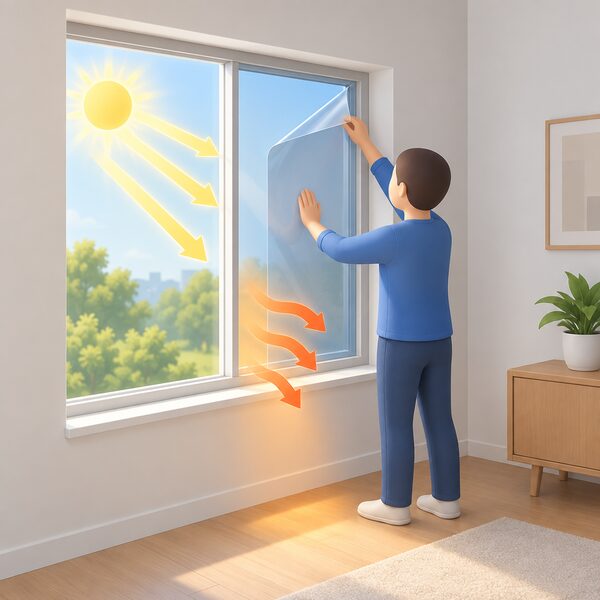
A window is a selective filter that the household did not choose. Standard clear double glazing transmits most of the visible light that falls on it and a large share of the solar heat, which is why a south or west facing room with a big glazed area overheats on a bright day even when the air outside is cool. Solar control film adds a second filter on top of the glass. Depending on type, it reflects part of the incident solar radiation, absorbs part of it and re-radiates it, or does both while transmitting a reduced share of visible light.
The mechanism matters because it determines where the heat ends up. A reflective film sends solar radiation back out through the glass. An absorptive film takes heat into the film and the pane, which then re-radiates it partly inward and partly outward, and raises the temperature of the glass itself. That temperature rise is the origin of the warranty problem discussed below, and it is why absorptive films on sealed units attract more concern than reflective ones.
The performance of any glazing product is described by two numbers. The g-value, also called the solar factor or total solar energy transmittance, is the fraction of incident solar energy that ends up as heat inside the room, counting both the radiation transmitted directly and the heat re-radiated inward after absorption. A lower g-value means less solar heat. Visible light transmission, usually given as a percentage, is the share of daylight that passes through. The two move together: a film cannot cut solar gain heavily while leaving daylight untouched, and any claim that it does should be treated with suspicion.
For a household thinking about energy independence, film is a passive measure with no running cost, no electricity and no controls. It reduces the cooling load that would otherwise be met by a fan or an air conditioner, and it does so without drawing on the grid. What it does not do is generate anything, store anything or reduce dependence on a supplier. It is a reduction in demand, not a source of supply.

How much solar heat film blocks: typical figures
The honest answer is that the figure depends entirely on the product, and that no independently verified rejection percentage exists for any specific film in the sources used here. What those sources do contain is the surrounding evidence on glazing, shading and solar gain, which sets the boundaries within which any film claim should be read.
The first boundary is that shading from outside beats shading from inside. The Centre for Sustainable Energy is direct on this: inside shading still lets most heat through the glass, so external measures are much more effective1. A film on the inner face is an internal measure. It intercepts radiation before it is absorbed by the room's surfaces, which is better than nothing, but it does not stop the glass itself heating up and re-radiating inward.
The second boundary is the scale of the glazing being treated. A typical domestic solar array of 3.5 kWp covers between 10 and 20 square metres of roof surface, using between six and 12 panels4. That is a useful reminder of how much area a large glazed elevation represents: a single storey of full-height glazing can easily exceed the area of a domestic solar installation, and every square metre of it is a solar collector in summer whether the household wants one or not.
The third is that most UK solar installations are small and domestic. Official statistics record that most solar PV installations are domestic rooftop installations in the 0 to 4 kW capacity range5. The UK's solar resource is real but modest, which is precisely why unwanted summer gain through glazing is worth managing and why winter gain is worth keeping.
Types of film: reflective, tinted and ceramic
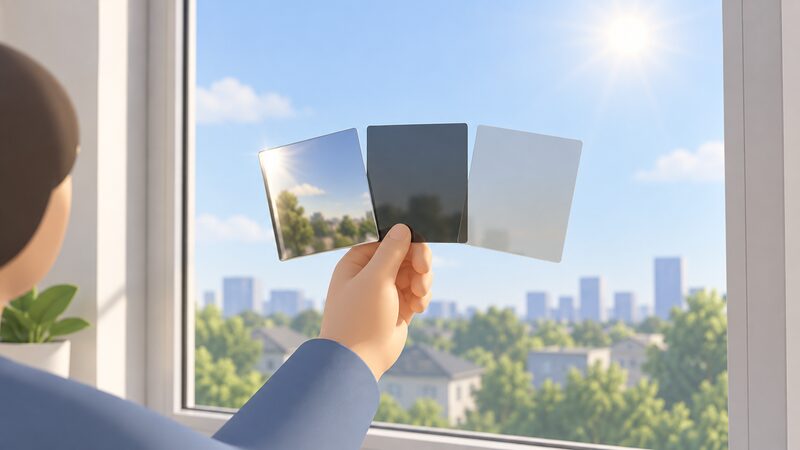
Film is sold in three broad families, and the differences between them are about how the solar energy is dealt with rather than how much of it is dealt with.
Reflective film has a metallic or metallised layer that sends a large share of incident solar radiation back through the glass. It is the most effective family for pure heat rejection, and it is the most visually obvious: from outside, the glazing takes on a mirror or bronze cast, and at night, when interior lighting is brighter than the exterior, the effect reverses and the room can look exposed. Reflective film also reduces light transmission substantially.
Tinted film absorbs solar radiation rather than reflecting it. It darkens the glass, cuts glare and visible light, and reduces solar gain, but because the energy is absorbed into the film and the pane, the glass runs hotter than with a reflective product. Tinted film is the cheapest family and the one most likely to raise questions about the glazing warranty.
Ceramic film uses non-metallic ceramic particles to absorb and re-radiate selected wavelengths. It is generally the least reflective in appearance, so it preserves a more natural look from outside, and it is often specified where a reflective sheen would be unacceptable, for example on a listed building or in a conservation area. It is also the most expensive family.
The wider solar technology field shows how varied the underlying materials can be. Photovoltaic systems come in crystalline, thin-film and hybrid types6, and thin-film panels use materials including amorphous silicon, cadmium telluride and copper indium gallium selenide7. Thin film is less efficient than monocrystalline or polycrystalline panels but is flexible, giving it a much wider range of uses7. Some thin-film materials can contain cadmium, tellurium, indium and lead, which can be toxic8. None of that describes window film directly, but it explains why "film" is not one product and why the material specification, not the marketing name, is what determines performance.
Where film helps most and where it falls short
Film helps most where the problem is solar gain through a large area of glass that cannot be shaded externally. A south or west facing room with full-height glazing, a conservatory, a garden room, or a flat where external shutters are not permitted all fit that description. In those cases the choice is between film, internal blinds, and mechanical cooling, and film has the advantage of sitting on the glass itself, where it intercepts radiation before it reaches the room's surfaces.
It falls short in three ways. First, it is an internal measure, and internal measures are less effective than external ones1. Second, it reduces daylight, which in a UK climate is a real cost: rooms that are already dim become dimmer, and lighting demand rises. Third, it does nothing about the other routes by which a home overheats. Heat comes through the fabric, through ventilation, and from internal gains as well as through glazing, and film addresses only the glazing.
There is also a seasonal asymmetry that is easy to overlook. Solar thermal systems rely on clear skies and daylight, which is why they are less suited to winter heating2. The same logic applies to glazing: in winter, solar gain through south facing glass is useful, offsetting some heating demand. A film fitted for summer comfort reduces that winter contribution as well. The household is trading a summer benefit against a winter cost, and in a UK climate the winter cost is not zero.
"It's much more effective to shade your windows from the outside."
For households weighing film against other measures, the wider cooling picture is worth reading alongside this page: passive cooling sets out the measures that need no energy at all, and external shading, shutters and awnings covers the external options that outperform film on heat rejection.
Glazing compatibility and warranty risk
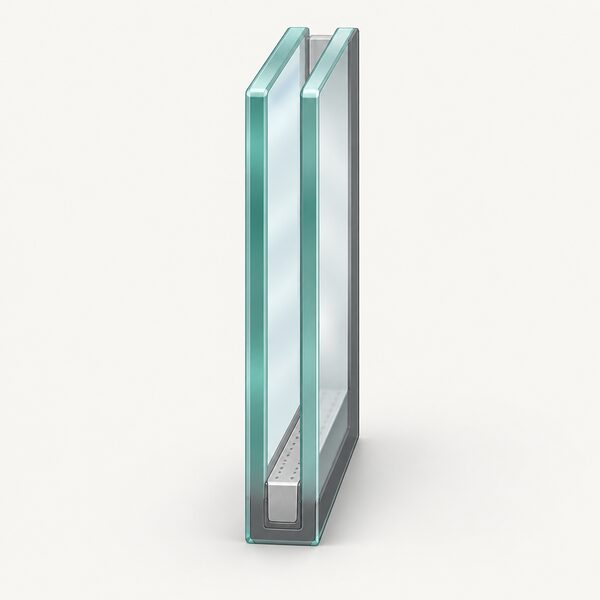
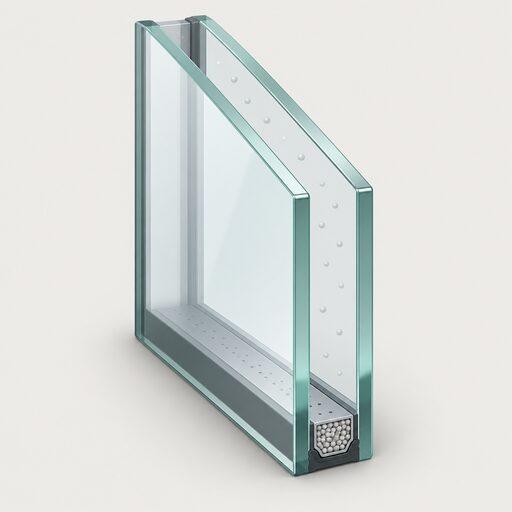
This is the section that decides whether film is a sensible purchase, and it turns on a single fact: a sealed double glazed unit is a factory-made assembly. The ECO4 guidance is explicit that the relevant provisions cover factory made sealed window units only3. A sealed unit is not a window that can be opened up and modified. It is a bonded assembly of glass, spacer and seal, filled with gas or evacuated, and its performance depends on that assembly remaining intact.
Applying film changes the thermal behaviour of the outer pane. An absorptive film raises the glass temperature, and the edge seal and spacer are the components most sensitive to sustained higher temperatures. The consequence is that sealed unit manufacturers commonly treat applied film as outside the warranty. The unit, not the film, is the expensive item: replacing a failed sealed unit in a large window can cost more than the film that caused the failure.
The position is not uniform. Some manufacturers permit specific films, usually reflective rather than absorptive, and some permit film only on certain orientations. The householder's protection is to ask the glazing supplier, in writing, before any film is fitted, and to keep the answer. Where the glazing is still under a new-build or replacement warranty, that step is essential rather than prudent.
Where the glazing is historic, a different route may be available. Slim profile double glazing or vacuum glazing can be used within some traditional window sashes as a direct replacement for single pane glazing9, and secondary glazing, which involves attaching a second sheet of glass or acrylic to the inside of the window frame10, avoids the film question altogether. Both are more disruptive than film and both are more likely to be acceptable where the window itself is protected.
Cost, installation and lifespan
There is no published UK price for solar control window film in the sources used here. Film is priced per square metre of glazing, and the installed cost depends on the film family, the access, the height and the condition of the glass. Prices are installer-quoted, and no range is given here because none is published.
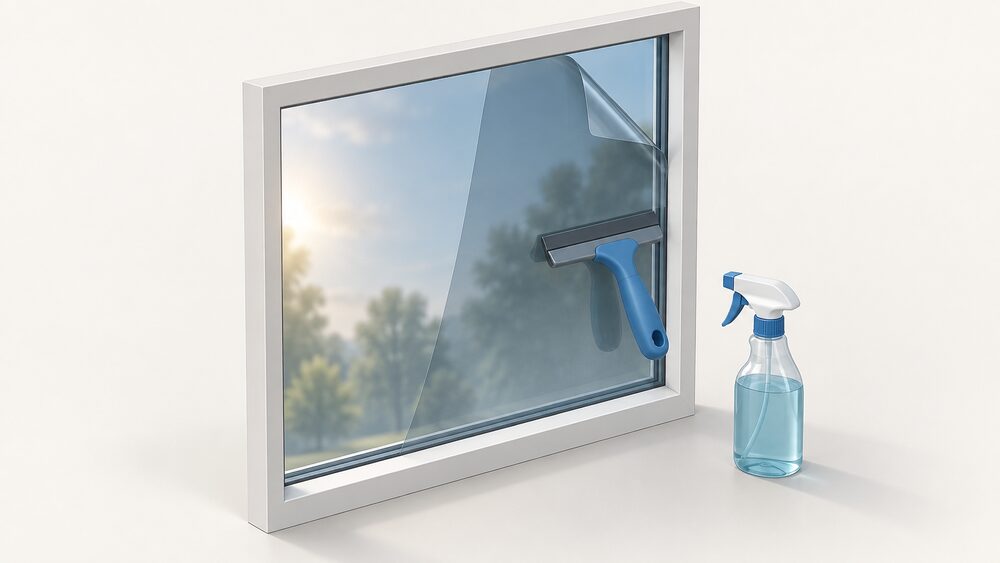
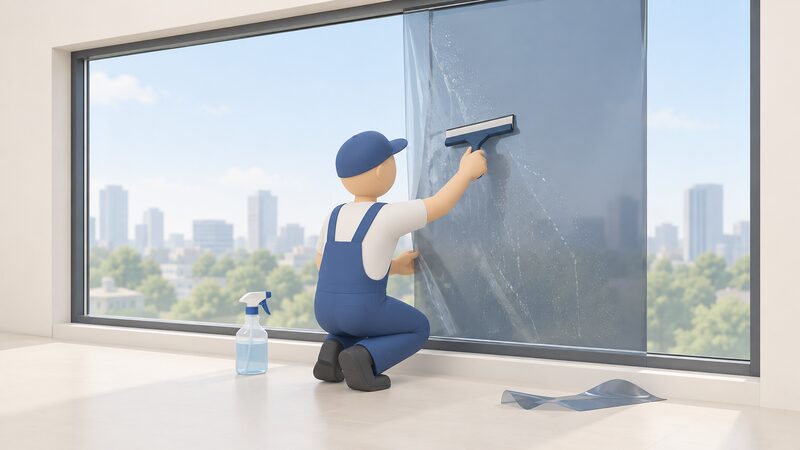
Installation is a wet process. The glass is cleaned, the film is applied with a slip solution, squeegeed to remove the liquid and air, and trimmed at the edges. The skills are in the preparation and the squeegeeing: bubbles, lift at the edges and contamination under the film are the common failures, and they are more likely on large panes and on glass that has been poorly cleaned. DIY kits are sold, but architectural film on high or large glazing is normally installed by a specialist.
Lifespan is a maker's estimate rather than an independently verified figure. Manufacturers commonly quote a service life in the region of ten to fifteen years for exterior-grade architectural film, with south and west facing glass degrading fastest because it receives the most ultraviolet and thermal cycling. Cleaning with abrasive products or ammonia-based cleaners shortens it. The figure assumes the film is correctly installed in the first place.
For comparison, the lifespan of new solar panels is estimated at 25 to 30 years, although this can vary depending on their environment8. That is a different product with a different duty, but it is a useful benchmark: film is a consumable with a service life measured in years, not decades, and it will need replacing at least once over the life of the glazing it sits on.
Film versus other shading options
Film is one option among several, and the comparison is not close on heat rejection alone. External shading is more effective than internal shading1, and film is internal. That ordering should govern the decision: where external shading is possible, it does more per pound spent on heat rejection.
The alternatives fall into four groups. External shutters, awnings and louvres intercept the sun before it reaches the glass and are the most effective. Secondary glazing adds a second pane and an insulating air gap, which helps in winter as well as summer10. Internal blinds and curtains are the cheapest and the least effective, because they sit inside the glass and the heat has already crossed it. Mechanical cooling, covered in the home cooling pillar, removes heat from the air but consumes electricity to do so.
Film's particular advantage is that it works on glazing that cannot be shaded externally: a flat where external fixings are not permitted, a listed building where external additions would not be acceptable, or a large fixed pane where shutters are impractical. In those cases the realistic comparison is film against internal blinds, and film wins on heat rejection because it sits on the glass rather than behind it.
The energy independence framing is straightforward. Film is a passive reduction in cooling demand: no electricity, no controls, no supplier, no app. It reduces the amount of grid electricity a household would otherwise use for fans or air conditioning, and it does so for the life of the film. What remains is dependence on the glazing it is applied to, on the installer who fitted it, and on the manufacturer whose estimate of lifespan and performance is the only figure available. It is a modest, low-risk measure with a real but bounded effect, and it is not a substitute for external shading where external shading is possible.
Sources10 cited
- How to keep your home cool in hot weather, Centre for Sustainable Energy, 2026-07
- How do heat pumps compare with other low carbon heating technologies?, Local Energy Scotland, 2026-09-20
- ECO4 New Measures and Products Guidance v3.0, Ofgem, 2026-03-26
- Solar panels, London Borough of Hammersmith and Fulham, 2026-09-17
- Feed-in Tariffs Annual Report Scheme Year 13, Ofgem, 2023-12
- Generating your own energy: solar electricity, Welsh Government, 2026-09-17
- Solar panel installation, maintenance and repair, NICEIC, 2026-09-17
- POSTnote 771: Solar technologies, Parliamentary Office of Science and Technology, 2026-06-25
- Guide to the conversion of traditional buildings, Scottish Government, 2026-08-10
- How to reduce heat loss from sash windows, Historic Environment Scotland, 2026-09-20
 Window Energy RatingsA window energy rating tells you how well a whole window keeps heat in, lets sunshine through and stops draughts, all in one letter from A++ down to E.
 Overheating and Hot WeatherIs your home getting uncomfortably hot in summer, and is there anything you can do about it?
 Solar PV Deployment StatisticsHow much solar power does the UK actually have, and how much of it sits on people's roofs?
 U-Values and R-ValuesWhat does a U-value on a window, wall or door actually tell you, and is a lower number really better?
 Overheating and Solar GainWhy do well-insulated homes get too hot in summer, and which windows cause the worst solar gain?
 Double GlazingMisted up panes, noisy streets, rooms that never feel warm: is new double glazing worth the money, and how much could it cut your bills?