
In this comparison
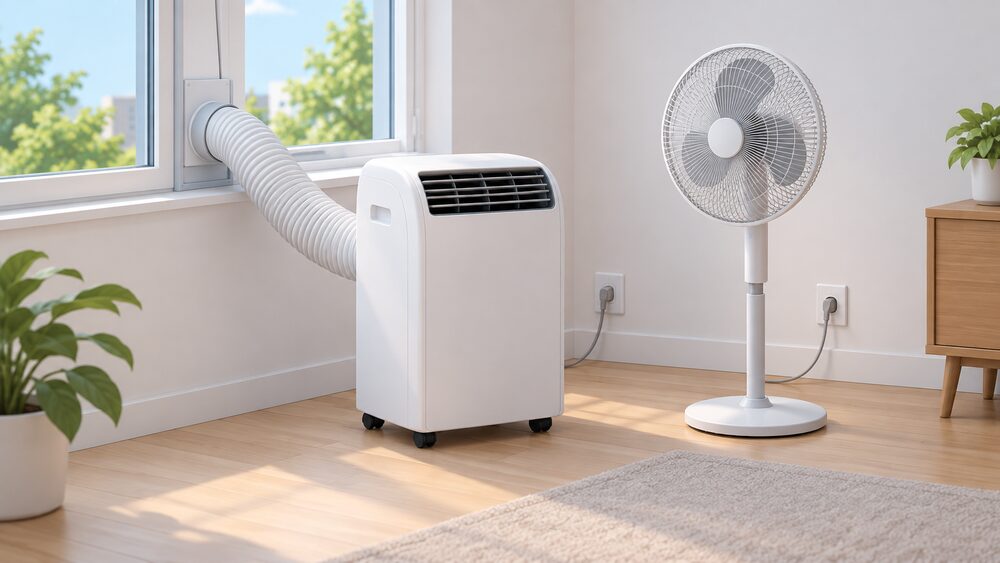
A fan and an air conditioner do different jobs, and the difference shows up in the electricity bill. A fan moves air around to create a cooling sensation on the skin but does not lower the temperature of a room, while an air conditioner actively removes heat and reduces room temperature1. A typical portable air conditioner drawing 1,000 to 1,500W costs around 26 to 39p per hour, roughly 14 to 20 times more than a fan, and a pedestal fan at 50W costs about 1.3p per hour at an electricity price of 25.7p per kWh1.
That gap is the whole decision in one line. Fans are cheap to buy and cheap to run, but they only work on the person, not the room, and above 35 degrees Celsius a fan will likely heat you up rather than cool you down2. Air conditioning does the thing a fan cannot, and pays for it in running cost and, for fixed systems, in installation, planning conditions and refrigerant rules.
For a household thinking about energy independence, the trade is straightforward. A fan draws a few tens of watts and can run from a modest solar or battery setup. A portable air conditioner draws up to 2,000W and up to 9.3A, which is a serious load on a circuit and on any off-grid supply3. A fixed system is more efficient than a portable one, but it ties the household to a manufacturer's equipment, a certified installer and, in most cases, the grid.
Fans do not cool a room, they cool the person
The mechanism matters because it sets the limit. A fan moves air across the skin, which speeds up heat loss from the body and creates a cooling sensation. It does not remove heat from the air, and the National Energy Action summer guidance is explicit that fans do not lower the temperature of a room1. Plymouth Energy Community makes the same point in practical terms: fans are only effective at cooling when blowing air directly onto you, and a bowl of ice or a damp cloth in front of a fan can boost the cooling effect5.
There is a hard ceiling on the trick. The Centre for Sustainable Energy states that if the room temperature is above 35 degrees Celsius, a fan will likely heat you up rather than cool you down, because it is moving air that is already hotter than the body2. That is the point at which a fan stops being a cooling device and becomes a convection device.
Fans also come in forms that are not cooling devices at all. A fan heater uses a coil of wire to heat the air and then forces that air into the room with a fan, which is the opposite function in a similar housing6. The distinction is worth holding on to when comparing products on a shelf.
What a fan does offer a household is independence. It draws tens of watts, needs no refrigerant, no outdoor unit, no installer and no consent, and it can run from a small battery or a solar panel through an inverter. It is the only cooling option on this page that a household can deploy with no external dependency at all beyond the appliance itself.

What air conditioning does that a fan cannot
Air conditioning moves heat out of the building rather than moving air around inside it. The Energy Saving Trust describes air-to-air heat pumps, which are the same hardware as a cooling air conditioner run in reverse, as warming the air inside the building instead of heating water in radiators or underfloor heating pipes7. In cooling mode the process runs the other way and heat is rejected outdoors.
Two consequences follow. The first is that an air conditioner genuinely reduces room temperature, which the National Energy Action guidance confirms when it contrasts air conditioners that actively remove heat and reduce room temperature with fans that do not1. The second is that it recirculates rather than ventilates: air-to-air heat pumps do not blow fresh air into the room, they recirculate the existing air7. A household expecting an air conditioner to freshen a stuffy room is expecting the wrong thing.
Ventilation is a separate system with its own rules. In places where lots of moisture is produced, such as kitchens, bathrooms and utility rooms, extractor fans are required to remove the excess moisture, and where there is no extractor fan, opening a window helps8. Ventilation is also distinct from air infiltration, the unplanned movement of air through gaps in the building fabric8. Air conditioning sits alongside these systems, not in place of them.
There is one safety rule that crosses the two. Extract fans should not be installed in the same room or space as a solid fuel burning appliance, according to Technical Booklet L, the Northern Ireland building regulations guidance9. Any household with a solid fuel appliance and a plan for mechanical ventilation or cooling needs to know that before work starts.
Running cost: fans are far cheaper, air conditioning adds significantly to electricity use
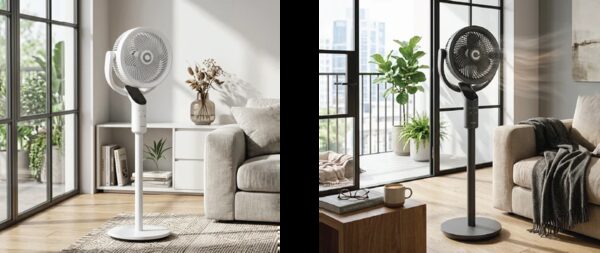
The running cost figures are the clearest part of the comparison, and they come from one independent source with a stated electricity price. At 25.7p per kWh, a pedestal fan drawing 50W costs about 1.3p per hour and a large fan drawing 75W about 1.9p per hour1. The Centre for Sustainable Energy puts the average fan at around 3p per hour2. A typical portable air conditioner drawing 1,000 to 1,500W costs around 26 to 39p per hour, which the same source describes as roughly 14 to 20 times more than a fan1.
| Appliance | Power draw | Running cost per hour |
|---|---|---|
| Pedestal fan | 50W | 1.3p1 |
| Large fan | 75W | 1.9p1 |
| Average fan | not stated | around 3p2 |
| Portable air conditioner | 1,000 to 1,500W | around 26 to 39p1 |
The comparison is not only about the headline rate. Plymouth Energy Community notes that fans are far cheaper to run than air conditioning, and that air conditioning increases electricity use and can add significantly to summer energy bills5. For a household on a fixed income or a prepayment meter, that summer addition lands in a season when heating demand is low and the bill is otherwise at its annual floor.
There is a middle option that sits between the two. Air coolers, also called evaporative coolers, use water to slightly cool air and are more effective than fans in dry conditions1. They draw far less than a compressor unit, though their performance depends on humidity, which in a British summer is often high.
For context on efficiency generally, the Energy Saving Trust notes that heat pumps should be cheaper to run than most other fuel types because they are so much more efficient7. That applies to a fixed reverse-cycle system used for heating as well as cooling. It does not rescue the portable air conditioner, which is the least efficient way to deliver the same cooling.
Portable air conditioners: what owning one involves
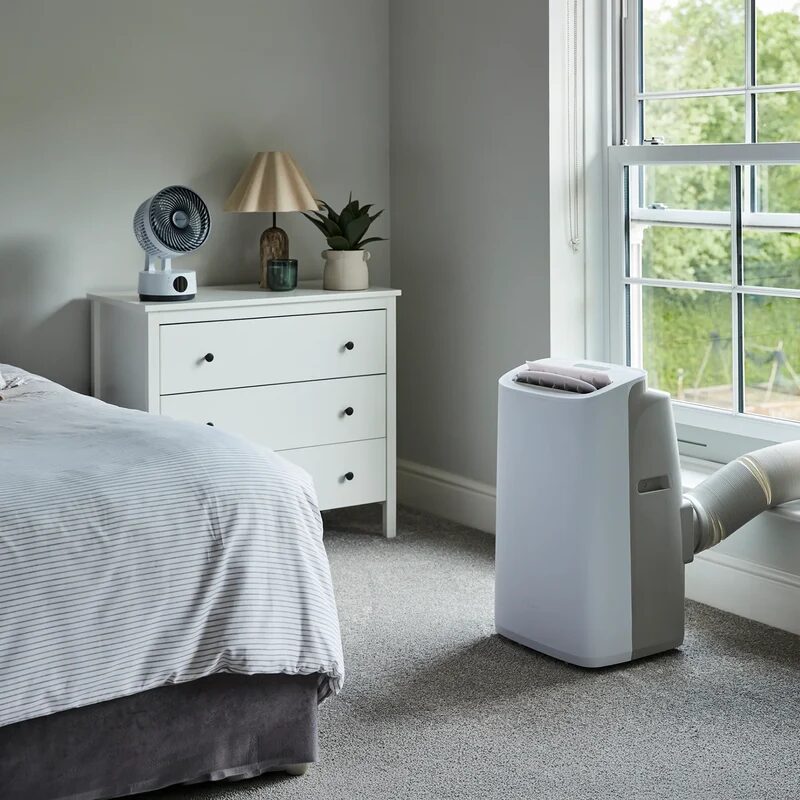
A portable air conditioner is a compressor unit on castors with a hose that must go out of a window or wall. The Centre for Sustainable Energy is direct about the installation: these units need to be properly vented to the outside using a special fitting for the window, and if the vent is just put through an open window, heat is let back in2. That single detail decides whether the appliance works as intended or fights itself.
The electrical load is substantial. Electrical Safety First rates portable air conditioners at up to 2,000W and up to 9.3A3. That is a load a household should plan for rather than assume, particularly where a circuit already carries other appliances, and it is a load that a small off-grid supply will struggle to meet.
Condensate is the other ownership detail. One retailer states that its 2.0kW (7000 Btu) model has cooling, fan and dehumidifier modes, and that it is self-evaporating in cooling mode and needs a drain hose only when the tank is full, indicated by error code E4, or in dehumidifier mode, and that where a hose is used it should have an internal diameter of about 13 mm, half an inch10. That is a maker's statement about one model, not a general rule, and other units behave differently.
The independence picture for a portable unit is mixed. It needs no installer, no planning consent in most cases and no fixed pipework, so a tenant or a household in a flat can use one without altering the building. But it depends on the grid for a 2,000W load, on a window or wall for venting, and on a manufacturer for parts and warranty. It is the least independent of the powered options.
Planning permission and permitted development for cooling systems
In England, adding air conditioning to a home may be considered permitted development provided all the limits and conditions set in legislation are met, and those limits cover the function, size, placement and quantity of units11. The critical condition is function: the rights only apply if the system provides a heating function, including a system that can provide both heating and cooling, so a cooling-only system requires a planning application11.
Protected areas change the answer. If a home is in a protected area such as a Conservation Area then permission will be required, and listed building consent is required for listed buildings11. For a listed building, both planning permission and listed building consent are needed for an air source heat pump12.
The quantity limits are specific. More than one air source heat pump requires planning permission on non-detached properties, meaning semi-detached or terraced homes and blocks of flats, whether on the building or within the garden13. On a detached property, more than two air source heat pumps requires planning permission13. Additional units at the same property require an application for planning permission14.
Other conditions apply to the installation itself. The unit must not be solely used for the purpose of cooling12. In a conservation area, planning permission is needed if the unit would be on a wall or roof which fronts a highway, or nearer to any adjoining highway than any part of the building12. Installations must comply with MCS 020a standards to benefit from permitted development rights, and where compliance is not achieved a planning application will be required15.
Scotland, Wales and Northern Ireland each have their own permitted development regimes, and the position on cooling-only equipment differs between them. Households in those nations should check the rules that apply where they live rather than assume the English position carries over. There is currently no legal requirement for existing homes to be retrofitted or for low-carbon heating technologies to be installed in existing homes, with exceptions for privately rented homes and homes owned by local authorities and housing associations in some parts of the UK18.
0% VAT on air conditioning units: the deadline to know
VAT relief is the one financial lever that applies to cooling equipment, and it has a date attached. Energy saving materials installed in residential accommodation and certain charitable buildings are subject to VAT relief at 0% until 31 March 2027, and the list includes air source heat pumps, central heating and hot water controls, insulation, solar panels, water source heat pumps, electrical storage batteries and smart diverters4. The temporary zero rate applies from 1 February 2024 to 31 March 202719.
The relief covers both the product and the labour. A household pays a rate of 0% VAT on both certain products supplied by the installer and the cost of all work to install those products in the home20. That is a meaningful difference from the old position, where heating controls were one of several designated energy-saving products whose installation incurred a reduced VAT rate of 5%21. The Spring Statement of 2022 set out the intention that households having energy saving materials installed pay 0% VAT22.
Eligibility is broad. All homes in England, Wales and Scotland are eligible for the 0% VAT rate without any qualifying conditions21. The Boiler Upgrade Scheme guidance confirms that between 1 April 2022 and 31 March 2027 there is a zero rate of VAT on the installation of energy-saving materials including heat pumps and biomass boilers23.
The VAT position is worth weighing against the running cost. A 0% rate on a fixed system reduces the upfront bill, but it does not change the fact that the same system will draw 30 to 50% less electricity than a portable unit doing comparable work2. The relief rewards fixed installations; the running cost rewards efficiency.
Which to choose: fan, portable unit or fixed system
The three options answer different questions, and the facts point to where each fits.
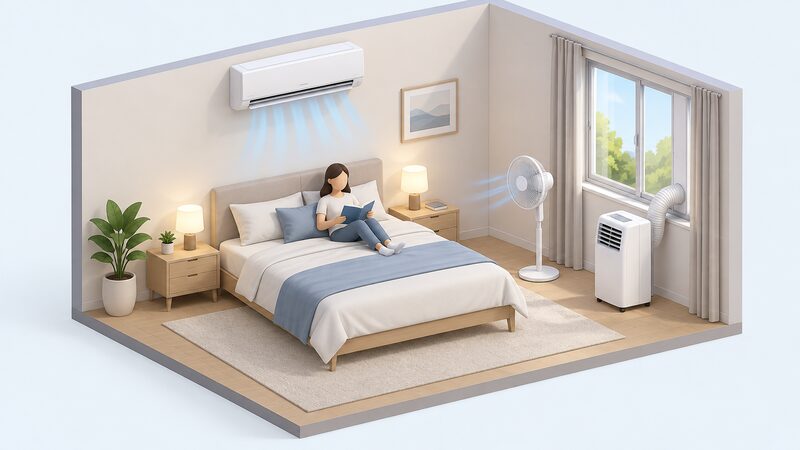
A fan suits a household that needs air movement on people in a room that is not excessively hot, wants the lowest possible running cost and wants no installation, no consent and no dependency beyond the appliance. It is the only option that can run comfortably from a small solar and battery setup. Its limit is the 35 degrees Celsius threshold, above which it works against the occupant2.
A portable air conditioner suits a household that needs genuine temperature reduction in one room, cannot alter the building, and accepts the running cost and the electrical load. It needs proper venting through a window fitting, draws up to 2,000W and up to 9.3A, and uses 30 to 50% more electricity than a fixed system2. It is the option for a rental or a flat where fixed work is not possible.
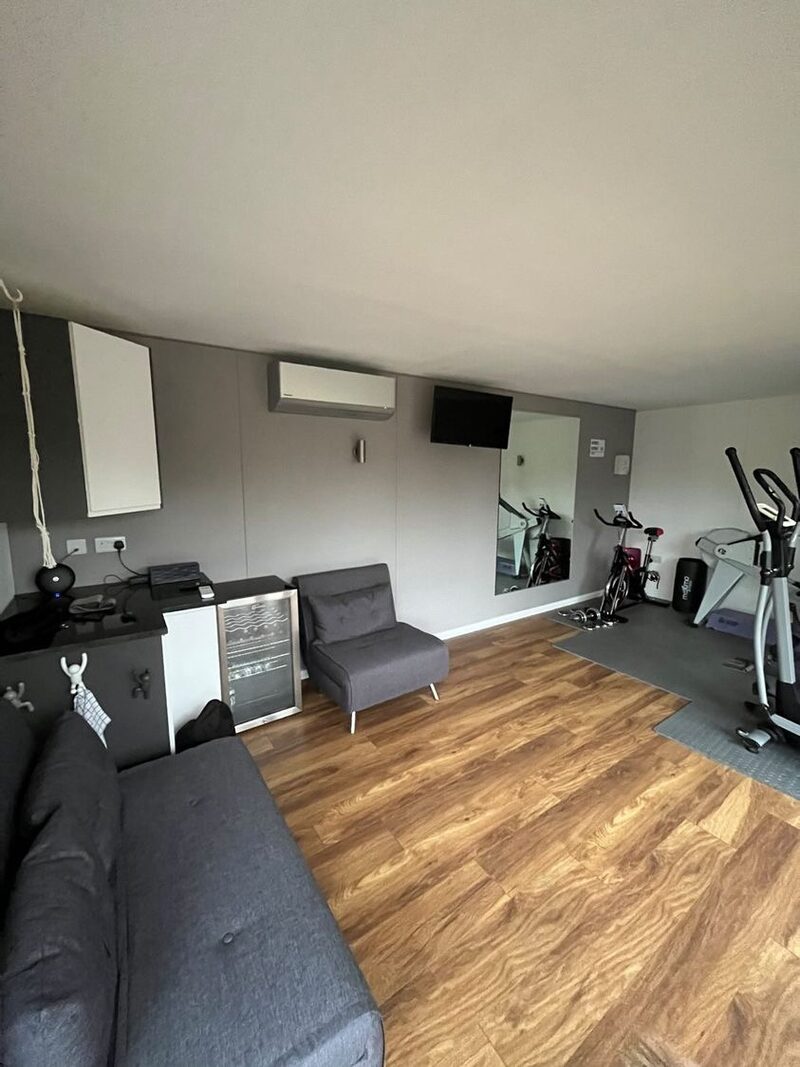
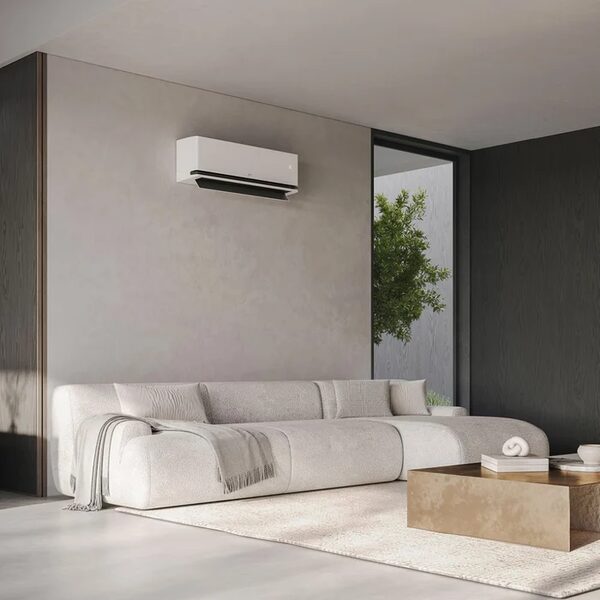
A fixed wall mounted system suits regular use. One maker states that fixed wall mounted air conditioning is usually better for regular use, especially in bedrooms, living rooms, offices and garden rooms, and that many models can provide heating as well as cooling10. That dual function is what brings a fixed system within permitted development in England, because the rights apply only where the system provides a heating function11. A cooling-only fixed system needs a planning application.
Sizing should come from a published table rather than a guess. One maker's sizing table puts 1.5 kW, or 5,000 BTU, at a room up to 12 square metres or 120 square feet, and 10.0 kW, or 34,000 BTU, at a room up to 80 square metres or 800 square feet10. A 12,000 BTU unit sits between those published points, so the maker's own table should be checked against the actual room.
For a household weighing independence, the ranking is clear. A fan depends on nothing but electricity. A portable unit depends on electricity, a vent path and a manufacturer. A fixed system depends on electricity, a certified installer, refrigerant rules, planning conditions in some cases and a manufacturer's parts and warranty. Each step up buys real cooling and costs real autonomy.
Sources23 cited
- Summer energy tips, National Energy Action, 2026-08-13
- How to keep your home cool in hot weather, Centre for Sustainable Energy, 2026-07
- Ratings of electrical appliances, Electrical Safety First, 2026-09-19
- VAT rates on different goods and services, GOV.UK, 2026-07-10
- Make your home more comfortable in warmer weather, Plymouth Energy Community, 2026-09-20
- Portable heaters, Electrical Safety First, 2026-09-17
- Air to air heat pumps, Energy Saving Trust, 2026-09-11
- Ventilation, Centre for Sustainable Energy, 2025-07
- Technical Booklet L: 2012, Building Control Northern Ireland, 2012
- Air conditioning size guide, Cool Easy, 2026-09-23
- Is permission needed for installing new roof tiles, Planning Portal, 2026
- Heat pumps, New Forest District Council, 2026-09-17
- Air source heat pumps: householder planning advice, Central Bedfordshire Council, 2026-09-17
- Planning permission: air source heat pump, Planning Portal, 2026-09-17
- Changes to permitted development rights: summary of responses, Welsh Government, 2025-12
- Fact sheet 5: air source heat pumps, Pendle Borough Council, 2026-09-17
- Air source heat pumps, Westmorland and Furness Council, 2026-09-17
- Retrofit and low-carbon heating requirements, House of Commons Library, 2026-09-17
- The Value Added Tax (Installation of Energy-Saving Materials) Relief Order 2024, legislation.gov.uk, 2024-01-10
- Tax on shopping: energy saving products, GOV.UK, 2026-09-17
- Zero rate VAT on heating controls, BEAMA, 2022-07
- Spring Statement 2022, HM Treasury, 2022-03
- Boiler Upgrade Scheme guidance, Ofgem, 2023-09-25
 The Full Cooling and Air Conditioning GuideDo you really need air conditioning in a British summer, or would a fan and better shading do the job?
 Using a Heat Pump for CoolingCan a heat pump cool your home in summer as well as heat it in winter?
 Passive Cooling at HomeKeeping a home cool without air conditioning comes down to blocking heat before it gets in, then letting trapped heat out.
 Cooling and Heat PumpsCan an air conditioner heat your home as well as cool it?
 Radiators and EmittersWill your radiators still heat the house properly with a heat pump?
 Ventilation ManufacturersWhich brands make home ventilation equipment, what does each type cost, and is a quiet one genuinely quiet?