
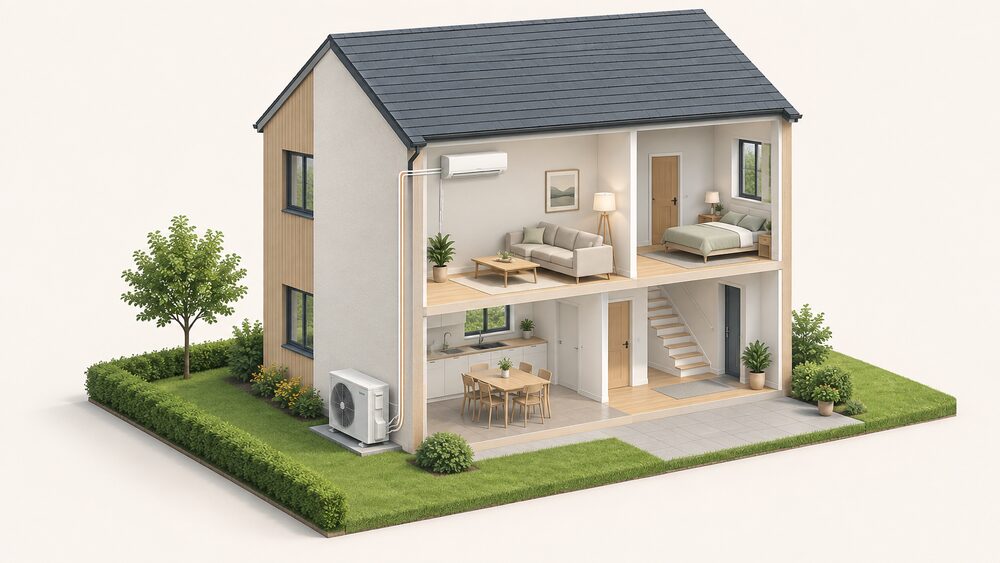
In this comparison
An air-to-air heat pump warms a home by blowing warm air through fan units, while an air-to-water heat pump heats water and distributes it through radiators, underfloor pipes or a cylinder. That single difference decides almost everything else: whether the system can supply hot water, what it costs, which grant it attracts and which homes it suits.
Air source heat pumps are classified as either air-to-air or air-to-water depending on whether the heat distribution system in the building uses air or water1. An air-to-air system produces warm air which is circulated by fans to heat the property; an air-to-water system distributes heat via a wet central heating system1. Air-to-air heat pumps transfer heat from the outside air into the home using electricity, and they deliver that heat via fans rather than through radiators or underfloor pipes2.
The money follows the same split. Air-to-air installation typically runs from £2,400 in a one bedroom flat to £8,800 in a four bedroom house, and the Boiler Upgrade Scheme pays £2,500 towards an air-to-air heat pump against £7,500 for air-to-water3. The catch is hot water: most models currently available in the UK do not provide it, so a second appliance is needed for showers and taps2.
Air-to-air and air-to-water: the core difference
The distinction is about the distribution system, not the heat source. Both types take warmth from the outside air. Air-to-water heat pumps transfer heat drawn from surrounding air to water in a wet central heating system8. Air-to-air heat pumps also transport and compress heat from the air outside, but transfer it to a home as blown air3.
That has consequences for the fabric of the building. An air-to-water system connects to pipework, radiators or underfloor loops and usually a cylinder, so it can serve every room that already has a wet circuit. An air-to-air system needs an indoor unit in each space it heats, connected to an outdoor unit by refrigerant pipes. Air-to-air heat pumps usually have one unit outside and at least one unit inside, using pipes carrying a refrigerant between them2.
The standards bodies have moved to make the distinction explicit. MCS published an update on incorporating air-to-air heat pumps into its installer and product schemes, and its design standard MIS 3005-D and installation standard MIS 3005-I both make clear that there is a distinction between air-to-water and air-to-air heat pump systems9. That matters because certification, installer competence and grant eligibility have all been built around the wet version.
For a household, the practical question is what the system can serve. Air-to-water reaches the whole house through existing emitters and can feed a cylinder. Air-to-air reaches the rooms where indoor units are fitted, and generally stops there. Air-to-water heat pumps carry higher upfront cost than most boilers, need some outdoor space and take longer to install than a boiler10.

How an air-to-air heat pump works: warm air from fans, not water in radiators
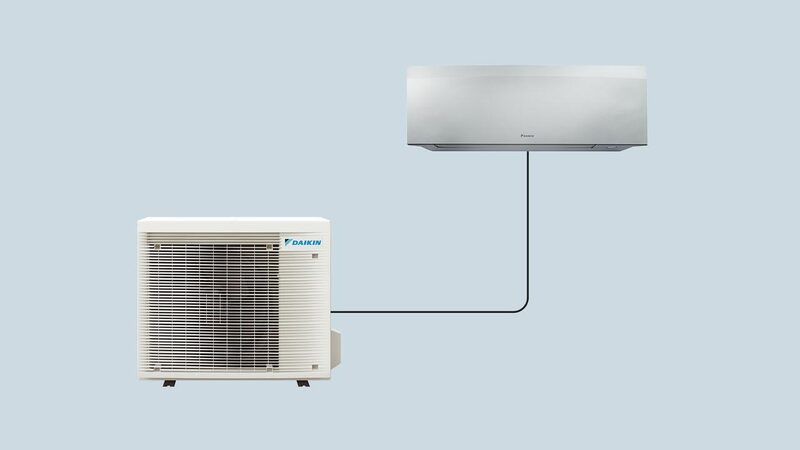
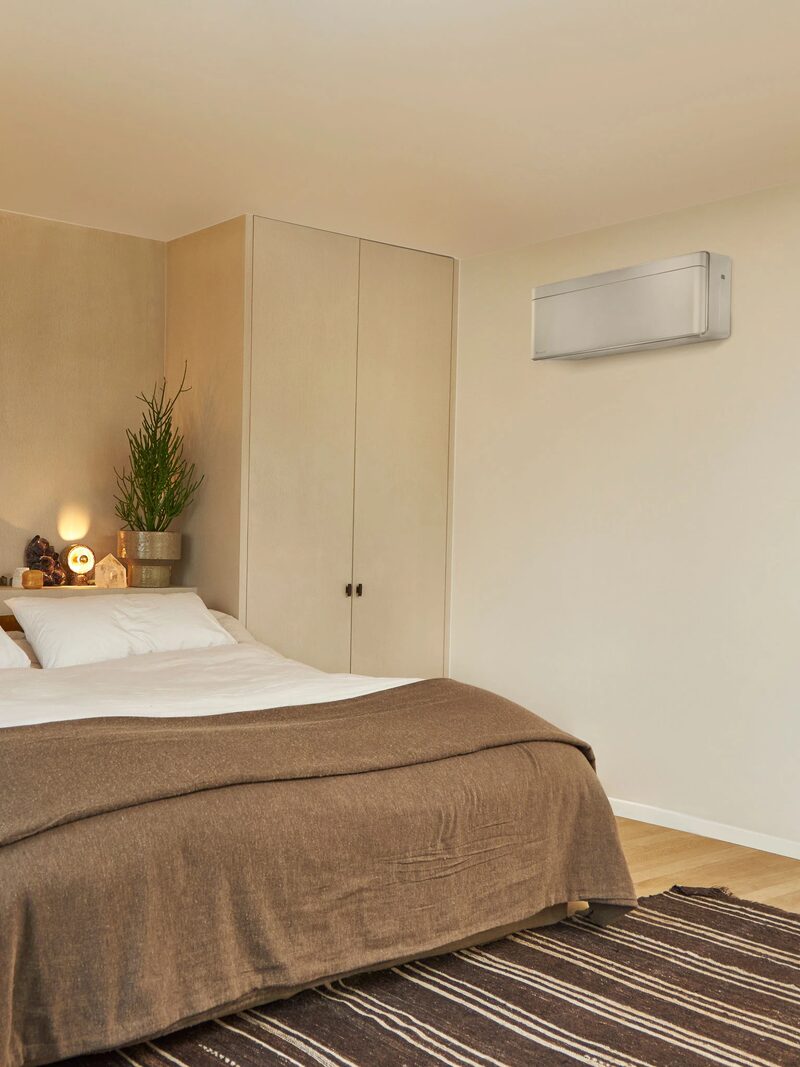
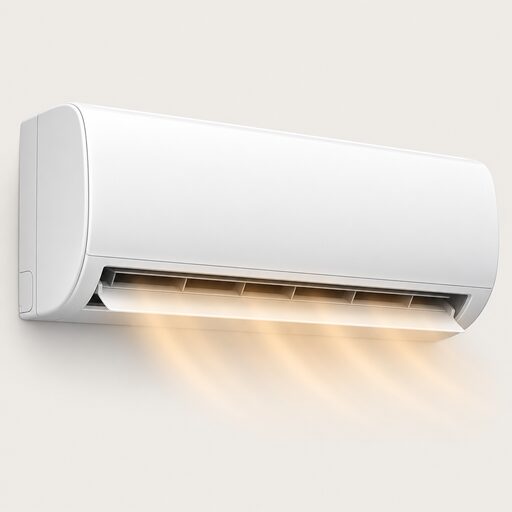
An air-to-air heat pump takes warmth from the air outdoors, puts it through a refrigerant, and uses that to warm up the air inside the home11. Instead of heating water in radiators or underfloor heating pipes, it warms the air inside the building2. The heat is delivered by fans that circulate warm air, rather than by radiators or underfloor pipes12.
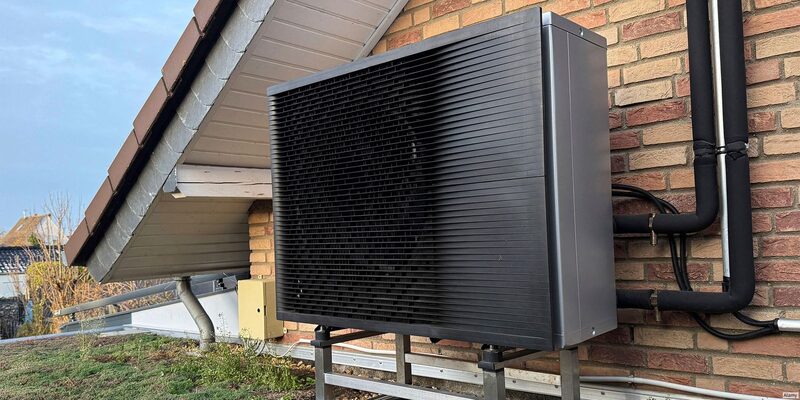
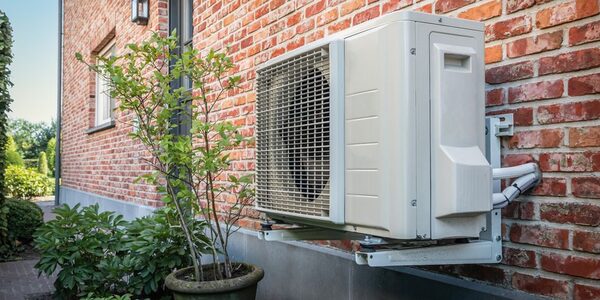
The hardware is a split system. There is an outdoor unit, usually roughly one metre high, between 50cm and 100cm wide and around 50cm deep, and at least one indoor unit4. One main outdoor unit can be connected to up to five indoor units, and the air is delivered into each room through units that can be wall-mounted, floor-standing or concealed within the wall7. Connecting more indoor units needs more pipework installed2.
Because the same circuit can run in reverse, air-to-air heat pumps can both heat and cool air depending on what is needed13. In summer the unit can be operated in reverse and used like an air-conditioning unit1. Air-to-air heat pumps can provide cooling as well, which is useful in a heatwave14. For a London flat, air-to-air heat pumps offer the added benefit of supplying air conditioning, keeping the home cool during the summer12.
The pipework is small. Air-to-air systems require refrigerant pipes typically 6 to 12mm in diameter for connection between outdoor and indoor units15. That is a narrower intervention than the flow and return pipework of a wet system, and it is one reason the type suits flats and homes without an existing central heating circuit.
Hot water: the biggest gap in an air-to-air system
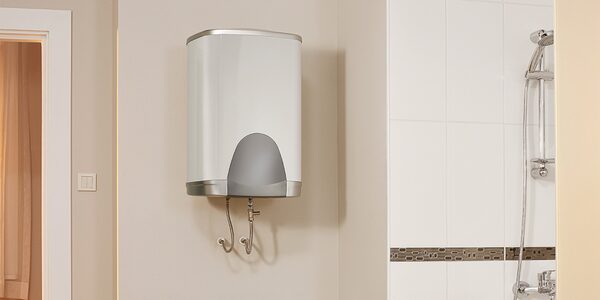
This is the limitation that decides most purchases. Air-to-air heat pumps do not usually provide hot water for taps and shower2. Most models currently available in the UK do not provide hot water, so a household may need an additional system in the home to deliver it11. Air-to-air heat pumps can't generally be used to heat larger homes and they don't heat water for showers and taps17.
There are workarounds, and they are well established. A separate hot water heat pump cylinder, heat battery, an electric immersion heater or a point-of-use water heater would be needed11. Air-to-air heat pumps require a separate technology, such as an immersion heater, alongside them3. Some air-to-air systems can be connected to a domestic hot water tank to provide hot water, although not all do this7.
The cost consequence is significant. After Boiler Upgrade Scheme grants are accounted for, air-to-air systems with hot water provision are comparable in cost, or more expensive, than most air-to-water systems with hot water15. In other words, the headline price advantage of air-to-air narrows sharply once the household has to buy and run a second appliance to get a shower.
Keeping the existing boiler for hot water only is a recognised route. Running an air-to-air heat pump for space heating while retaining a boiler for hot water could allow a household to quickly reduce its gas emissions by 80% whilst giving more time to find the right hot water solution4. At current energy pricing, air-to-air running costs are likely to be lower than using an oil boiler and similar to a gas boiler or an air-to-water heat pump with a standard electricity tariff4.
Cost: £2,400 in a small flat to £8,800 in a large home
Air-to-air heat pump installation costs range from £2,400 in a one bedroom flat to £8,800 in a four bedroom house19. The lower figure reflects a single indoor unit in a small, easily heated space; the upper figure reflects multiple rooms, more indoor units and more pipework. Installing a system that does not provide hot water usually costs from £1,700 to £2,700 per room, depending on whether a budget or premium model is chosen4. A single room can be heated for about £1,9002.
| Property size | Air-to-air upfront | Air-to-air running | Air-to-water upfront | Air-to-water upfront after £7,500 grant |
|---|---|---|---|---|
| Small | £2,4003 | £4203 | £10,27510 | £2,77510 |
| Medium | not stated | not stated | £11,74510 | £4,24510 |
| Large | £8,8003 | £1,4003 | £13,60010 | £6,10010 |
The pattern is clear: air-to-air is very affordable in small homes, especially studio flats, but costs rise sharply for larger homes3. High cost in larger homes is a recognised disadvantage of the type3. Air-to-air heat pumps may be a good option for smaller properties and flats3.
Air-to-water sits at a different level. Air-to-water heat pumps cost around £11,000 to install, against which the Boiler Upgrade Scheme provides a grant of £7,50020. Air source heat pumps carry higher upfront cost than most boilers, need some outdoor space and take longer to install than a boiler10.
Prices for both types are installer-quoted and vary with the property, the number of emitters or indoor units, and the state of the existing heating circuit. The figures above are the published estimates from independent guidance, not fixed prices.
Efficiency: COP of 3 to 5, but UK performance data is thin
Air-to-air heat pumps should have similar efficiencies to air-to-water heat pumps, but this is not well documented in the UK3. There is currently not much data on how air-to-air systems perform in the UK, so it is difficult to know how much money they save2. That is an unusually blunt admission from independent guidance, and it should temper any expectation of a precise running cost figure.
For air-to-water, the position is better documented. Air source heat pumps are often expressed as having a coefficient of performance of 3, meaning three units of heat are provided for every one unit of electricity used10. That is a measure taken under standard test conditions, not a guarantee of in-home performance, and real performance varies with flow temperature, weather and how the system is controlled.
The gap in evidence matters for a household weighing the two types. A wet system's performance can be checked against monitored installations and against the standard efficiency metrics used across the industry. An air-to-air system's seasonal performance in a UK climate is less well evidenced, so the running cost figures quoted for it rest on modelling rather than on a large body of measured data.
"They should have similar efficiencies to air-to-water heat pumps, but this is not well documented in the UK."
The practical implication is that air-to-air running costs should be treated as estimated. The published comparison, that air-to-air running costs are likely to be lower than an oil boiler and similar to a gas boiler or an air-to-water heat pump on a standard electricity tariff, is a modelled position at current energy pricing rather than a measured one4.
Which homes suit air-to-air, and which still need air-to-water
Air-to-air heat pumps can provide a good solution for smaller properties, flats, and homes currently without, or poorly suited for, traditional central heating11. They are particularly well suited to smaller homes and flats and can take up less wall space than traditional radiators12. More often, air-to-air systems are installed in smaller properties, such as flats and park homes2. If you live in a smaller property, like a flat or park home, you may be better suited to an air-to-air heat pump19.
An air-to-air heating and cooling system can be especially cost-effective if you have a smaller house or flat with relatively few rooms, especially homes that overheat in warm weather7. That last point is the type's strongest argument: the cooling function is not an add-on but the same hardware running in reverse.
Air-to-water remains the type for homes with an existing wet circuit and more than a few rooms. Air to water heat pumps are suitable in most detached and semi-detached houses, as well as many terraced houses21. The most common type of heat pump currently installed in UK properties is air-to-water22.
| Air-to-air | Air-to-water | |
|---|---|---|
| Heat delivery | Warm air circulated by fans1 | Wet central heating system1 |
| Hot water | Most UK models do not provide it2 | Cylinder or another method needed18 |
| Cooling | Yes, runs in reverse6 | Not the standard configuration |
| Best fit | Smaller properties, flats, park homes2 | Detached, semi-detached and many terraced houses21 |
| Outdoor unit | Usually smaller than air-to-water2 | Larger, needs clearances |
For a household's energy independence, the two types differ in what they leave in place. An air-to-air system removes gas from space heating but usually leaves a gas, oil or electric appliance serving hot water, so the household remains connected to a fuel supplier for that load. An air-to-water system with a cylinder can move both space heating and hot water onto electricity, at the cost of a larger upfront spend and a wet system that has to be sized correctly. Neither removes the grid connection, and both depend on electricity being available.
Grants and certification: the £2,500 Boiler Upgrade Scheme grant and MCS status
The Boiler Upgrade Scheme pays £2,500 towards an air-to-air heat pump and £7,500 towards an air-to-water heat pump4. The £7,500 covers air-to-water heat pumps, ground source heat pumps and water source heat pumps23. Air-to-water heat pumps in an off-gas grid property replacing an oil or liquefied petroleum gas heating system attract £9,0006. Only residential properties are eligible for air-to-air heat pumps7.
The £2,500 air-to-air grant is recent. The scheme was amended to add a new grant of £2,500 for air-to-air heat pumps along with technology rules covering air-to-air eligibility24. The government has described £2,500 grants for air-to-air heat pumps alongside £5,000 off the cost and installation of a biomass boiler25. Official statistics record £2,500 towards an air-to-air heat pump and £7,500 towards an air-to-water heat pump26.
| Measure | Grant | Notes |
|---|---|---|
| Air-to-air heat pump | £2,5004 | Residential properties only7 |
| Air-to-water heat pump | £7,5005 | Standard rate |
| Air-to-water, off-gas grid replacing oil or LPG | £9,0006 | From 21 July 2026 |
| Ground source and water source | £7,50023 | Same rate as air-to-water |
In Scotland, the funding landscape differs. Home Energy Scotland administers grants and loans, with air, ground and water to water source heat pumps attracting £7,500 per improvement under its scheme rules27. Air-to-air heat pumps are not eligible for the Warm Homes: Social Housing Fund until they are able to be certified by MCS, which was expected in 202628.
Certification is the gate. Air-to-air heat pumps were not eligible under the Boiler Upgrade Scheme while the rules required air source heat pump systems to be hydronic, that is air-to-water29. MCS has since published an update on incorporating air-to-air heat pumps into its installer and product schemes, and its standards make clear the distinction between air-to-water and air-to-air systems9. UKAS approved updates to the redeveloped MCS Installer scheme to incorporate air-to-air heat pumps, allowing MCS to proceed to the next stage of implementation30.
Installation: outdoor units, F-Gas installers and 2 to 3 days of work
Installation disruption for an air-to-air heat pump may be 2 to 3 days3. For comparison, disruption from installing an air-to-water system is typically 2 to 5 days10. Heat pump installation generally takes around three days, though it may take longer depending on the property18.
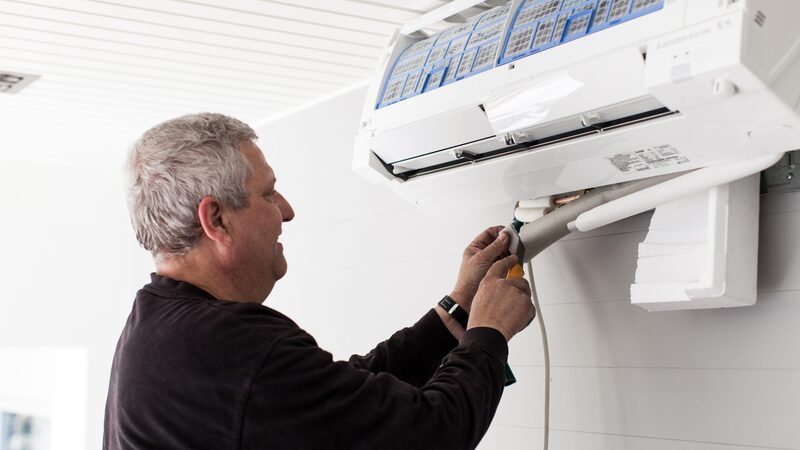
The work has three parts. An outdoor unit is fitted to a wall or to the ground near the house, with space around it for air flow2. Refrigerant pipes, typically 6 to 12mm in diameter, run between the outdoor and indoor units15. Indoor units are then mounted in each room to be heated, either wall-mounted, floor-standing or concealed within the wall7.
Because the circuit carries refrigerant, the installer needs the relevant competence to work on it. The pipework is small and the intervention is less invasive than a wet system's flow and return, but the refrigerant circuit is not a DIY job.
Planning is the other variable. Air-to-air systems might be more likely to require planning permission than air-to-water systems because of the greater chance of needing two outdoor units15. Permitted development rules for air source heat pumps are more restricted for flats and shared buildings, and planning permission is more likely to be required14. Where there is an existing air source heat pump on a non-detached dwelling or block of flats, or two existing air source heat pumps on a detached dwelling house, planning permission is required13.
For listed buildings the position is stricter. If the property is listed, listed building consent is usually needed before installing an air source heat pump, even where planning permission is not required14. If you live in a listed building, both planning permission and listed building consent are needed13. Adding renewable energy solutions such as air and ground source heat pumps might be acceptable but will require listed and or planning consent16.
Refrigerant rules tighten from 1 January 2029. Split air-to-air systems up to and including 12 kW face a placing-on-the-market restriction, with a GWP threshold of 150, while larger split systems face a threshold of 75031. These are EU restrictions, and the UK operates its own F-Gas regime, so the rules that apply to a UK installation are set by domestic regulation rather than by the EU timetable.
Sources31 cited
- Air-to-air heat pumps, MCS Certified, 2026
- Air-to-air heat pumps, Energy Saving Trust, 2026
- Domestic heating technology options: air-to-air heat pumps, Nesta, 2025
- Air-to-air heat pumps: common questions on air conditioning, Nesta, 2026
- Boiler Upgrade Scheme: what you can get, GOV.UK, 2026
- Boiler Upgrade Scheme guidance for installers v5.1, Ofgem, 2026
- Boiler Upgrade Scheme guidance for installers V5, Ofgem, 2026
- Boiler Upgrade Scheme guidance for property owners V5, Ofgem, 2026
- Update on the implementation of air-to-air heat pumps into MCS, MCS Certified, 2026
- Domestic heating technology options: air source heat pumps (air to water), Nesta, 2025
- Air-to-air heat pumps project, Nesta, 2026
- What it's really like to have a heat pump, Which?, 2025
- Heat pumps, New Forest District Council, 2026
- Air source heat pumps, Westmorland and Furness Council, 2026
- Air-to-air heat pumps: a low carbon solution for UK homes, Nesta, 2026
- Making alterations to a listed building, Bristol City Council, 2026
- Heating your home with renewable energy, Which?, 2025
- Heat pump installation: a step by step guide, Energy Saving Trust, 2026
- Should I choose an air source or an air-to-air heat pump?, Nesta, 2025
- Electric heating, Centre for Sustainable Energy, 2026
- Written evidence on heat pumps, UK Parliament, 2023
- How heat pumps work: a guide for homeowners, NICEIC, 2025
- Boiler Upgrade Scheme, Ofgem, 2026
- Summary of updates to BUS guidance for installers V5, Ofgem, 2026
- Carbon Budget and Growth Delivery Plan: heat and buildings factsheet, GOV.UK, 2026
- Boiler Upgrade Scheme statistics, July 2026, Department for Energy Security and Net Zero, 2026
- Grants and loans, Home Energy Scotland, 2026
- Warm Homes: Social Housing Fund wave 3 scheme guidance addendum, Department for Energy Security and Net Zero, 2026
- Boiler Upgrade Scheme property owner guidance V2.3, Ofgem, 2023
- Implementation of air-to-air heat pumps into MCS enters next phase, MCS Certified, 2026
- F-gas regulation, iDM Energie, 2029
 Air-to-Air Heating and CoolingAir-to-air heat pumps deliver warm air through indoor fan units rather than hot water to radiators.
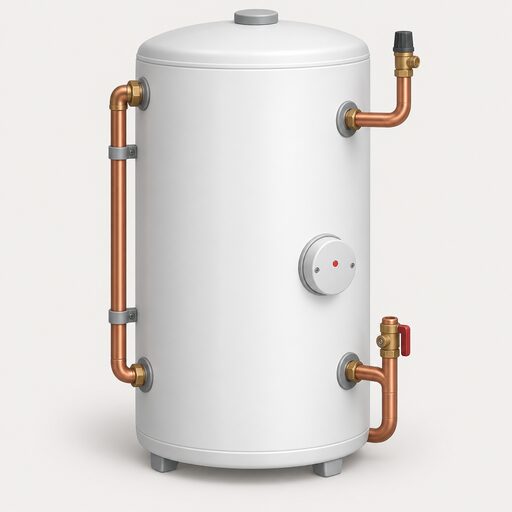 Air-to-Water Wet SystemsAir-to-water heat pumps feed radiators, underfloor heating and a hot water cylinder, and are the most common domestic heat pump in the UK.
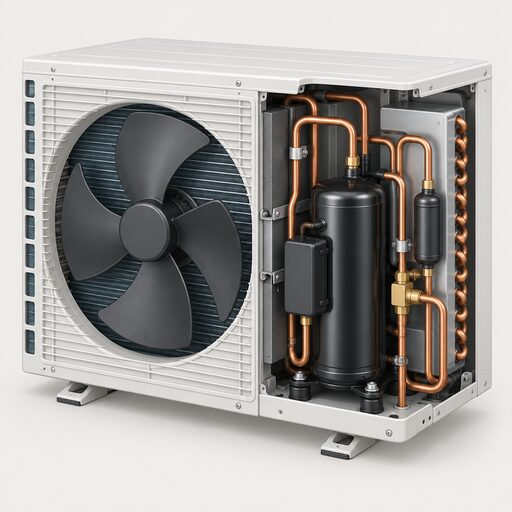 Air Source Heat PumpsHow an air source heat pump takes heat from outdoor air, the difference between air-to-air and air-to-water systems, typical efficiency, the £7,500 Boiler Upgrade Scheme grant, noise and planning limits, and what ownership means for a household's energy independence.
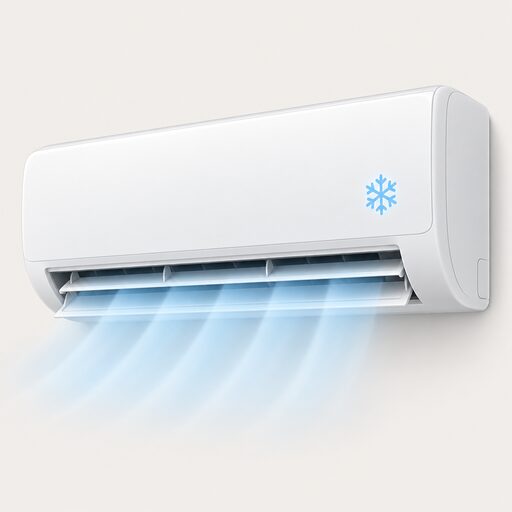 Using a Heat Pump for CoolingCan a heat pump cool your home in summer as well as heat it in winter?
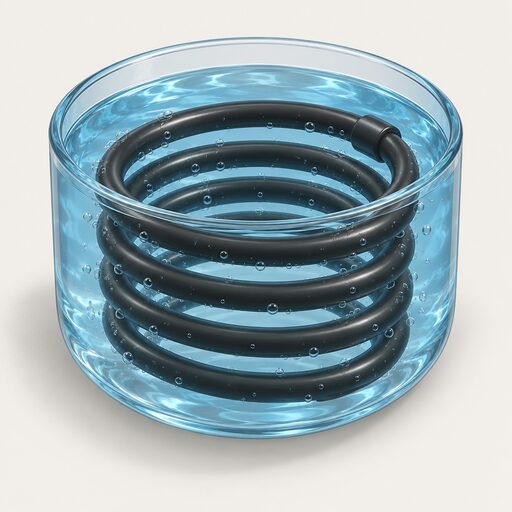 Water Source Heat PumpsYour home sits near a river, lake or the sea.
 Ground Source Heat PumpsA ground source heat pump takes warmth from the ground to heat your home and water.