
In this guide
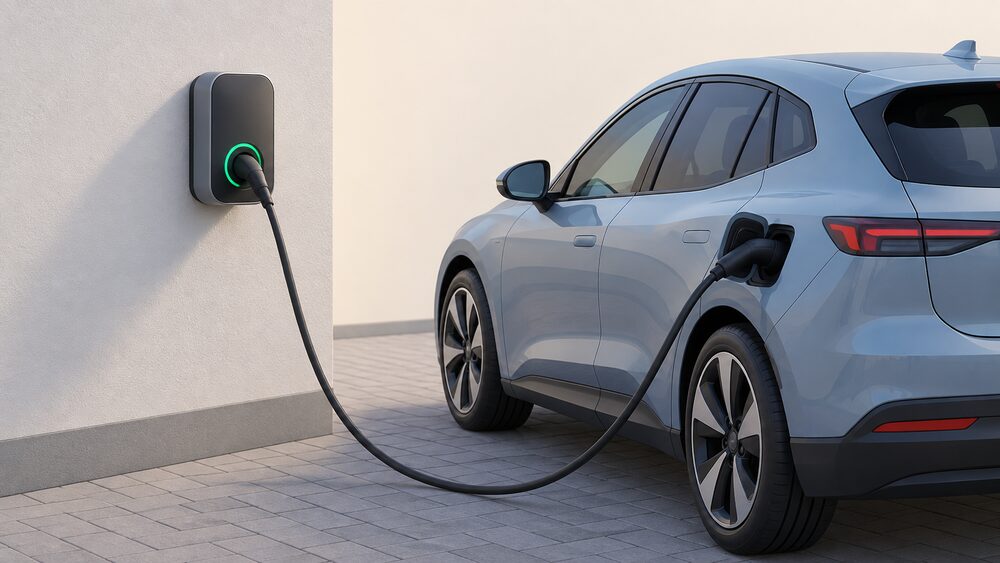
VCHRGD is a UK home charging brand sold through the energy supplier So Energy. Its wallboxes are aimed at households that want a compact smart unit tied to a cheaper overnight electricity rate rather than a premium hardware specification. The chargers sold through So Energy carry a 3 or 5 year warranty, are compatible with the supplier's So EV tariff, and can add up to 35 miles of range in an hour at 7.4kWh1.
The brand's own reported figures are strong on paper: a lifetime return rate of less than 1%, meaning how often a charger has to be sent back with a problem, and 97% of customer reviews rated five stars2. Both are maker-reported rather than independently audited, and they describe the installed base as a whole rather than the odds for any one unit.
What a VCHRGD wallbox does for a household is move car fuel from petrol or diesel onto electricity, and then shift as much of that electricity as possible into the cheapest hours. What it does not do is remove dependence on the grid, on a supplier, or on the manufacturer's software. The sections below set out the range, the tariff position, the warranty conditions and the limits.
VCHRGD at a glance: the maker and its record
VCHRGD sits in the supplier-linked part of the UK home charging market. The chargers are sold through So Energy rather than through a national retail network, which shapes both the buying route and the aftercare route: the supplier that sells the unit is also the first point of contact when something goes wrong1.
The two headline claims the brand makes about itself are a lifetime return rate of less than 1% and 97% of customer reviews rated five stars2. Read those carefully. A return rate measures how often a unit comes back, not how often it underperforms in place, and it is a figure the maker reports about its own installed base. A five-star review share is a satisfaction measure, not a reliability measure, and it reflects the experience of people who chose to leave a review.
For context on what home charging looks like nationally, the public network is dominated by slower equipment: as of 1 July 2026, 49% of UK public EV chargers were rated standard (3kW to less than 8kW), 27% standard plus (8kW to less than 50kW), 12% rapid (50kW to less than 150kW) and 12% ultra-rapid (150kW and above), with 52% classed as destination chargers3. A home wallbox in the 7kW class sits in the same band as the largest single group of public chargepoints, which is why home charging is mostly an overnight activity rather than a top-up on the way past.
The practical point for a household is that a VCHRGD unit is a grid-tied appliance. It draws from the same supply as the rest of the house, it needs private parking to be installed at home1, and its smart features depend on a connection to the supplier's systems. That is the trade: convenience and a cheaper rate in exchange for a continuing relationship with a supplier and a manufacturer.
Home wallbox range and specifications
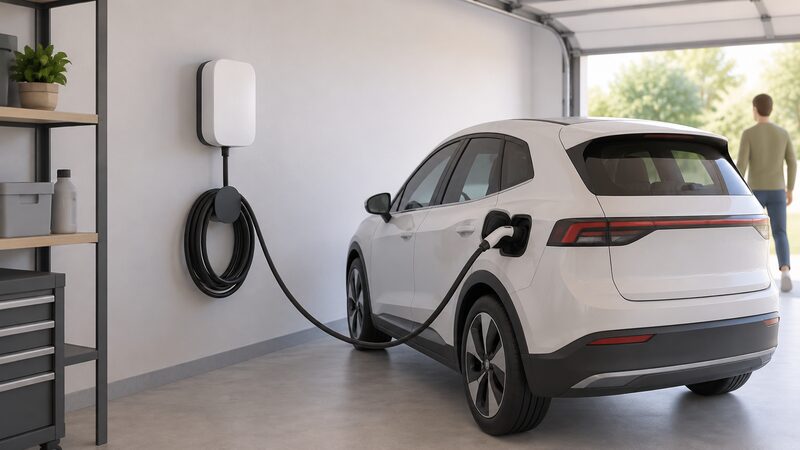
The VCHRGD Seven Pro is the model named in the supplier's own material, and it is the one to look at if you are comparing specifications. It includes a built-in scheduling feature, solar integration, load balancing and app-based charging control2. Those four functions cover most of what a household actually uses a smart wallbox for: setting the charge window, matching charging to solar output where panels exist, keeping the total household load within the supply's limit, and starting or stopping a charge from a phone.
The charging rate is the figure that matters most day to day. Chargers sold through So Energy can charge up to 35 miles in an hour at 7.4kWh1. That is a single-phase domestic rate, and it is the realistic ceiling for most UK homes without a three-phase supply.
Load balancing deserves a note of its own, because it is the feature that decides whether a charger can be added to a house at all. A domestic charge point draws a substantial continuous load, and the installation rules require the network operator to be contacted before connection where the maximum demand of the whole customer connection exceeds 13.8 kVA4. Load balancing is how many installations stay under that threshold, by reducing or pausing the charge when the rest of the house is drawing heavily.
| Feature | VCHRGD Seven Pro |
|---|---|
| Charging rate | up to 35 miles in an hour at 7.4kWh1 |
| Scheduling | built-in2 |
| Solar integration | included2 |
| Load balancing | included2 |
| App control | included2 |
| Warranty | 3 or 5 years1 |
| Tariff compatibility | So EV; Intelligent Octopus Go added 17 September 20262 |
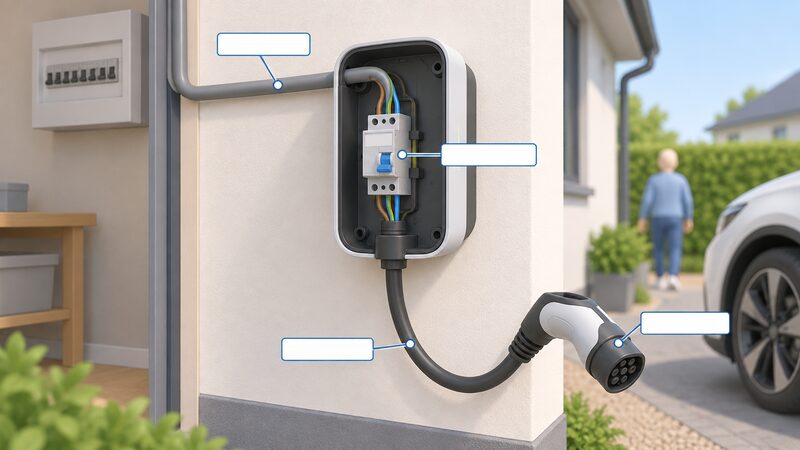
Installation itself is not a DIY job. An accredited EV charge point installer is required where the household does not already have one arranged5, and the work falls under Section 722 of the wiring regulations, which sets out the particular requirements for electric vehicle charging installations6. Where a charger has built-in DC fault current detection to 6mA, a Type A RCD at 30mA is sufficient protection6. That detail matters at the quote stage, because it determines what protective equipment the installer needs to add.
Smart charging: tariffs the chargers work with
The commercial case for a smart wallbox rests almost entirely on the tariff it can use. Some energy providers offer smart charging tariffs that make electricity cheaper at night, or at times of low demand7. That is the mechanism: the charger does not generate anything, it moves consumption into a window when electricity costs less.
VCHRGD chargers are described as fully compatible with So Energy's EV tariff and designed to help customers use the lower-cost window2. The chargers sold through the supplier are compatible with the So EV tariff1. Separately, the VCHRGD Seven Pro opened up compatibility with the Intelligent Octopus Go tariff on 17 September 20262. Compatibility of this kind is usually delivered by firmware, so it can change, and it is worth confirming the current position before relying on a specific pairing.
There is a condition that catches people out. An EV tariff usually applies the lower rate only to EV charging, not to the rest of the home's electricity use8. The cheap window is not a whole-house discount. A household that shifts its washing machine and dishwasher into the same hours may or may not benefit, depending on the tariff's terms, and the charger's own consumption is the part the tariff is designed around.
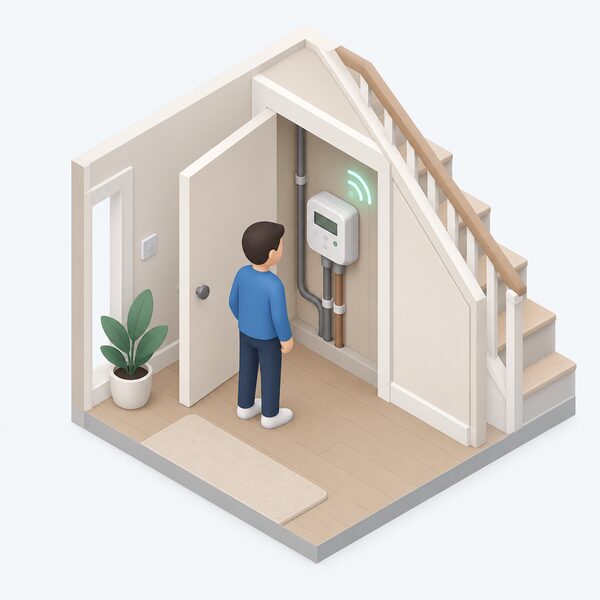
Eligibility for any of these tariffs depends on metering. A smart meter that works alongside a home EV charger is needed to be eligible for an EV tariff9. Without one, the cheaper window cannot be measured and billed.
The wider pattern across the market is that smart chargers work with most EV tariffs from the larger suppliers9. VCHRGD's position is narrower than that: the documented compatibility is with its own supplier's tariff plus Intelligent Octopus Go on one model. Households that expect to switch supplier regularly should check compatibility at each switch rather than assume it carries over.
Reliability: lifetime return rate below 1%
The reliability figure VCHRGD publishes is a lifetime return rate of less than 1%, described as how often a charger needs to be sent back with a problem2. On its face that is a low number, and it is the kind of measure that matters more than a satisfaction score, because it counts units that failed rather than customers who were pleased.
Two caveats apply. First, it is a maker-reported figure about the maker's own installed base, so it is not directly comparable with an independent survey. Second, a return rate captures units sent back, which is not the same as units that developed a fault and were fixed in place, or units that underperformed without being returned at all.
The failure modes that affect home chargers generally are worth knowing, because they shape what a household should expect. Voltage is the most common external cause. A charger will not function and will display a red ring or an error when the voltage goes beyond the acceptable range10. Voltages of 253V or more can disrupt the charging process by triggering the protective devices installed to prevent damage11. Voltage drop or surge is a recognised cause of EV charger errors11. In each case the charger is behaving correctly: it is protecting itself and the vehicle, and the fault lies upstream in the supply.
Physical risk is a separate category. Vandalism carries the risk of chargepoints being repeatedly out of order or unusable for long periods, and theft of charging cables for the copper is one driver12. That risk is concentrated on publicly accessible equipment rather than a wallbox on a private drive, but an untethered unit left with a cable attached is more exposed than a tethered one.
At the network level, the aggregate effect of home charging is a known planning issue. With typical 7kW domestic chargers, just 2% of them switching on at the same time would generate a load step of between 1.7 and 3.6 GW, in a scenario of 12 to 26 million EVs in 203513. That is why scheduling and load balancing are built into smart units rather than offered as extras: spreading the load is what keeps a street's supply stable as adoption rises.
Customer satisfaction: 97% five-star reviews

VCHRGD reports that it has worked hard to deliver high customer satisfaction ratings, with 97% of customer reviews rated five stars2. That is a strong headline and it should be read as what it is: a share of reviews, from customers who chose to write one, on the platform where they were collected.
Review-based measures and survey-based measures answer different questions. A review share tells you how satisfied the people who engaged were. It does not tell you the failure rate, the average time to resolve a fault, or how the brand performs for a household that never posts online. The return rate figure, at less than 1%, is the closer thing to a reliability measure, and it is also maker-reported2.
For a household weighing a purchase, the more useful comparison is with the wider charging experience rather than with other brands' marketing. In an independent chargepoint experience survey, 38% of respondents said they charge at a destination because it is convenient14. Convenience, not speed, is the dominant reason people charge where they do, and a home wallbox is the most convenient destination there is.
Speed expectations are worth calibrating too. On a DC rapid or ultra-rapid charger, the expectation is 80 percent charge in 20 to 60 minutes15. A home wallbox does not compete with that, and it is not meant to: it replaces the weekly forecourt stop with an overnight charge at a lower rate. Households that routinely need a fast top-up mid-journey are buying public charging, not a wallbox.
The honest summary of the satisfaction position is that the reported figures are favourable and self-reported. They are a reasonable starting point for a shortlist and a poor substitute for checking the warranty terms, the installer's accreditation and the tariff compatibility that apply to a specific address.
What a VCHRGD charger means for household energy independence
A home wallbox changes where a household's transport energy comes from, and it changes who it depends on. Both halves matter.
On the independence side, charging at home moves car fuel off petrol and diesel and onto electricity the household buys directly. Combined with a smart tariff, it also moves consumption into cheaper, lower-demand hours, which is a form of control over when energy is used rather than just how much is bought7. Where solar panels are present, the Seven Pro's solar integration allows charging to follow generation rather than the grid2.
On the dependence side, the list is longer than the marketing usually admits. The charger draws from the grid, so the household remains dependent on the network and on an electricity supplier. The smart functions depend on a connection to the supplier's systems and on the manufacturer's app. The warranty depends on the supplier relationship continuing. And the tariff that makes the economics work is a contract that can be repriced.
Fuller independence would require bidirectional hardware, which is a different class of equipment. Vehicle-to-grid technology allows an EV charger to not only charge a vehicle but also take energy from the vehicle16, and it allows electric vehicles to draw power from the grid to charge their batteries and to send electricity back to the grid when needed, generating cash for the owner17. Energy stored in the vehicle's battery can be exported to the grid during periods of high demand18, and a household may be able to use the EV's battery to release power back through the charger either for use in the building it is connected to or back into the grid in general19. There is also a recognised potential for a household to use an EV as a supplementary energy source to power a heat pump, aiding grid flexibility and resilience20.
None of that is what a standard VCHRGD wallbox does. It is a one-way, grid-tied, supplier-linked appliance with good reported reliability and a narrow but documented tariff position. For a household with private parking, a smart meter and an overnight charging habit, that is a workable arrangement. For a household expecting the charger to reduce its dependence on the grid or on a supplier, it does not.
Sources20 cited
- EV chargers, So Energy, 2026
- How much does it cost to charge an electric car at home, So Energy, 2026-07-03
- Public electric vehicle charging infrastructure statistics, 1 July 2026, Department for Transport, 2026-07-01
- Electric vehicle charging installations FAQs, IET, 2026-09-17
- Electric vehicles for home: charging, Electricity North West, 2026-09-19
- Section 722 EV charging: complete guide, Elec-Mate, 2026-07-02
- Electric vehicle charger installation and maintenance, NICEIC, 2025-08
- Does a hybrid car need an EV tariff, Uswitch, 2025-07-02
- EV energy tariffs, Uswitch, 2025-09-17
- Voltage changes in your home or business, UK Power Networks, 2026-09-17
- Managing voltage changes in your property, Electricity North West, 2026-09-19
- EV charger vandalism, Energy Saving Trust, 2026-02-26
- Resilient electric vehicle charging, Energy Systems Catapult, 2035
- The results are in: EV chargepoint experience survey, Cenex, 2026-09-17
- Electric vehicle charging, SMMT, 2025-06-25
- Vehicle-to-grid best practice guide, Energy Saving Trust, 2026-05-05
- Connecting to the networks: LCT strategy, Energy Networks Association, 2026-09-17
- Five electric vehicle innovations to watch, Energy Saving Trust, 2026-09-20
- EV glossary, Uswitch, 2024-11-26
- Driving the shift to sustainable living: heat pumps and electric vehicles, Cenex, 2024-01-30