
In this comparison
The Boiler Upgrade Scheme and the Clean Heat Grant are the same scheme under two names. Ofgem records the Boiler Upgrade Scheme as "formerly known as the Clean Heat Grant"1, and the Clean Heat Grant itself was consulted on in 2020 as a proposal to incentivise the cost effective installation of low carbon heat technologies and the generation of renewable heat2. Anyone searching for the older name is looking at the scheme that launched on 23 May 2022 and now pays upfront capital grants towards approved heat pumps and biomass boilers3.
The headline figure today is £7,500 for eligible properties that do not qualify for the uplifted rate, rising to £9,000 for eligible off-gas grid properties from 21 July 20264. The scheme is installer-led, administered by Ofgem, and open to homes and small non-domestic buildings in England and Wales only6. It is not a warranty product and it is not a loan: it is a capital grant deducted from the installer's quote before the household pays anything7.
What follows sets out what the scheme offers, the specifications an installation must meet, what warranty protection actually exists, what it costs, who runs it, and what a heat pump funded this way does and does not do for a household's energy independence.
What the scheme offers across the UK
The Boiler Upgrade Scheme provides upfront capital grants to encourage property owners to replace existing fossil fuel heating with low carbon systems6. The Energy Saving Trust describes it plainly as a UK Government grant of up to £7,500 to help pay for a heat pump or biomass boiler in England and Wales10. Parliament's own research briefing confirms the purpose: grants to assist with installation costs11.
The critical limit is geography. Only properties in England and Wales are eligible for BUS funding7. Scotland and Northern Ireland are not covered by this scheme, and the Welsh Government has separately promoted grants for heat pump installations across England and Wales through the same scheme12. The Energy Saving Trust notes that the UK Government's Boiler Upgrade Scheme grant and the Scottish Government's Home Energy Scotland Grant and Loan Scheme are the two routes that have made heat pumps more affordable for households, which is the clearest statement that they are different schemes for different nations13.
| Nation | BUS availability |
|---|---|
| England | Eligible7 |
| Wales | Eligible7 |
| Scotland | Not covered by BUS7 |
| Northern Ireland | Not covered by BUS7 |
The scheme covers homes and non-domestic buildings, so small commercial premises can apply alongside households14. It pays one grant per property, and only one voucher can be redeemed per property8. A property is not eligible if a previous BUS grant has already been received for installing a heat pump or biomass boiler at the same address7.
For households in Scotland, Wales and Northern Ireland, the practical position is that this particular grant is not the route. Wales is covered by BUS, but Scotland and Northern Ireland are not, and the devolved schemes operate on their own terms. A household in Glasgow or Belfast searching for the Clean Heat Grant will find the name change but not an entitlement.
Specifications: what an installation must meet
The scheme sets technical conditions that determine whether a grant is payable at all. All heating systems installed under the Boiler Upgrade Scheme must meet the relevant MCS standards approved and published by the Secretary of State, and all BUS installations must be Microgeneration Certification Scheme certified7.
Eligible technologies are air-to-water heat pumps, air-to-air heat pumps, ground source heat pumps including water source heat pumps and shared ground loops, and biomass boilers7. Air-to-air heat pumps are only eligible in residential properties7. Biomass boilers may only be installed in properties in rural areas7.
| Specification | Limit or requirement |
|---|---|
| Individual heat pump system capacity | 45 kWth maximum7 |
| Multi heat pump system capacity | 70 kWth maximum7 |
| Shared ground loop system capacity | 300 kWth total, each connected heat pump not exceeding 45 kWth7 |
| Individual biomass boiler capacity | 45 kWth maximum7 |
| Heat pump efficiency | In situ seasonal coefficient of performance of at least 2.87 |
| Biomass particulate matter | Not exceeding 30g/GJ net heat input7 |
| Biomass NOx | Not exceeding 150 g/GJ net heat input7 |
| Space heating | Heat pump must provide 100% of the space heating needs of the eligible property9 |
| Compressor | Heat pump compressors must be electric-driven9 |
The retrofit conditions matter as much as the equipment. The previous heating system being replaced must have been either a fossil fuel heating system such as gas, oil or LPG, or an electric heating system excluding existing heat pumps16. The BUS-funded system must fully replace the property's existing fossil fuel or electric heating system, except where supplementary heating appliances are permitted, and the main heat-generating unit must always be new9.
From 28 April 2026, BUS heat pumps can be installed alongside supplementary heating appliances, provided these appliances are not fossil fuel based7. That change widened what is possible without opening the door to hybrid systems. A hybrid heat pump system, for example a combination of gas boiler and air source heat pump, cannot receive a grant8. Exhaust air-to-water heat pumps are eligible for the £7,500 BUS grant, but exhaust air-to-air heat pumps are not eligible for support under the scheme at this time9.
Self-build properties are eligible for heat pumps only, not biomass, where the property has been built mainly using the labour or resources of the first owner7. New build properties which the developer is still building are not eligible, and new builds by developers are excluded, though a household moving into a finished new build with a fossil fuel boiler may be able to get a grant for a heat pump17.
Warranty: what the grant does and does not cover

The Boiler Upgrade Scheme is not a warranty. It pays a capital grant towards installation costs and sets product standards, and nothing in the scheme rules creates a guarantee of workmanship or of the equipment's performance over time7. Any warranty comes from the manufacturer or the installer, on their own terms, and the grant does not extend it.
What the scheme does provide is a compliance framework. Installations must meet MCS standards approved and published by the Secretary of State, and must be MCS certified7. Ofgem can conduct site or desk audits at any point after a BUS application, including after grant payment, and installers are required to keep all documentation relied upon in voucher applications and voucher redemption applications for six years from the date the application was properly made9. That retention period is the practical backstop: if a question arises about an installation years later, the paperwork should still exist.
The application itself has two stages, a Voucher Application and a Voucher Redemption Application7. A voucher application is only considered properly made once Ofgem has all the necessary information to assess eligibility, and the property owner has provided consent and identity verification9. The application must be properly made within 120 days of the commissioning date, and Ofgem may grant an extension to that rule where the length of time taken to reach certain administrative decisions results, or is likely to result, in the 120-day period being exceeded for a re-application7. Vouchers are valid within 6 months for ground-source heat pumps18.
For a household, the warranty question is therefore separate from the grant question. The grant determines who pays part of the capital cost. The warranty determines who is responsible if the system underperforms or fails, and that is a matter between the household, the installer and the manufacturer.
What it costs, and how the money reaches the household
The grant values are set out in the approved grant categories and values notice and in Ofgem's installer guidance. The standard grant is £7,500 for eligible properties that do not qualify for the uplifted grant7. From 21 July 2026, eligible off-gas grid properties can apply for an uplifted grant of £9,000 for an air-to-water heat pump or ground source heat pump, where the previous heating system was fuelled by oil or liquefied petroleum gas and the property is not fuelled by mains gas4. The uplifted grant value for off gas grid properties is in place until 31 March 20277.
| Technology | Grant value |
|---|---|
| Air-to-water heat pump, standard | £7,5007 |
| Ground source heat pump, standard | £7,5007 |
| Air-to-water or ground source heat pump, off-gas grid uplift | £9,0004 |
| Air-to-air heat pump | £2,5008 |
| Biomass boiler | £5,0008 |
The government increased its grant by 50% for new heat pumps in November 2023, which is the change that lifted the headline figure to £7,50019.
The money does not pass through the household's hands. Installers must deduct the full BUS grant value from the quote before any payment is made by the property owner7. The application is installer-led, with the installer applying for the grant on the property owner's behalf, applying to Ofgem for a grant voucher, and redeeming the voucher after installation and commissioning6. That is why the grant is described as a discount rather than a rebate.
Budget is finite and does not roll forward. The scheme had an initial budget of £150m per financial year for 2022-20257, and unspent budget is not carried over to the next scheme year21. The 2025/26 budget is given as £295 million, with 2024/25 funding increased by £30 million23. A separate official figure of £450 million appears in other guidance, so the two totals conflict; the £295 million figure for 2025/26 is the one tied to a stated year23. Because unspent budget is not carried over, a household weighing timing should know that a scheme year's allocation does not accumulate.
The scheme's status and who runs it

Ofgem administers the scheme on behalf of the Gas and Electricity Markets Authority9. It is a live government scheme, not a failed company or a closed programme: the Boiler Upgrade Scheme launched on 23 May 2022 to support the decarbonisation of heat in buildings3, and it is scheduled to close at 11:59pm on 30 December 20296. Ofgem guidance states the scheme has been extended to 20307.
Reporting is public and regular. Ofgem is required to publish quarterly and annual reports on its website, and aims to publish monthly operational updates7. The most recent quarterly report covers the period from 1 May 2026 to 31 July 202614. General enquiries go to BUS.Enquiry@ofgem.gov.uk or by phone on 0330 053 200616.
The scheme is installer-led, and installers who are MCS certified can apply for and redeem Boiler Upgrade Scheme vouchers on behalf of property owners18. That makes the installer the gatekeeper: a household cannot apply directly. The consultation on Boiler Upgrade Scheme and certification requirements for clean heat schemes concluded, and it applied to England, Scotland and Wales, which is wider than the scheme's own England and Wales eligibility18.
Two eligibility relaxations are worth noting because they changed the practical position. From 28 April 2026, properties are no longer required to have a valid EPC to apply for BUS7. Earlier guidance referred to an EPC no more than 10 years old, and the certificate number being provided9. The current position is that the EPC requirement has been removed for applications properly made on or after 28 April 20267.
What it means for household energy independence
A BUS-funded heat pump changes what a household depends on. It replaces a fossil fuel heating system, such as gas, oil or LPG, or an electric heating system that does not include a heat pump, with an electric-driven heat pump that must provide 100% of the property's space heating needs16. For a household off the gas grid, that is a move away from delivered oil or LPG and towards electricity, and the £9,000 uplift is aimed specifically at that group4.
The dependence that remains is real. The heat pump runs on electricity, so the household still depends on the grid and on a supplier. The grant does not fund a battery, a solar array or a tariff, and it does not make a home self-sufficient. It reduces the capital cost of one component of a low carbon heating system, and it removes the fuel delivery that comes with oil or LPG. For a household on mains gas, the change is from gas dependence to electricity dependence, not to independence.
The scheme has also funded installations where no heating system was replaced at all. Official statistics record 2,417 grants paid for heating systems in eligible self-build properties where no heating system was replaced, cumulative to 31 July 202324, and an earlier report recorded 1,090 such grants for eligible self-build properties25. Self-build properties are eligible for heat pumps only7.
The wider direction of travel is set by the phase-out of fossil fuel boilers. The Heat and Buildings Strategy set a target for phasing out gas boilers from 2035 in favour of low carbon alternatives, running in line with replacement cycle timelines so that almost all heating systems in 2050 are low-carbon26. A BUS grant is one of the ways a household moves ahead of that timeline rather than waiting for it.
For households comparing routes, the Boiler Upgrade Scheme sits alongside supplier-funded obligations such as the Energy Company Obligation, and the two cannot be blended on one measure20. The eligibility rules determine whether a property qualifies at all, and the application process runs through an MCS certified installer rather than the household. For the wider picture of how grants fit together, the pillar guide to home energy grants sets out the schemes by nation and by measure.
Sources26 cited
- Decision on administration of the Boiler Upgrade Scheme, Ofgem, 2022-04-07
- Help design digital services for future low carbon heat schemes, Ofgem, 2020-09-14
- Boiler Upgrade Scheme annual report April 2025 to March 2026, Ofgem, 2026-07-31
- Thousands of homes will be eligible for £9,000 off a heat pump, GOV.UK, 2026-07-21
- Notice of approved grant categories and values for the Boiler Upgrade Scheme, GOV.UK, 2026-07-21
- Boiler Upgrade Scheme grant listing, Find Government Grants, 2026-09-18
- Boiler Upgrade Scheme guidance for installers v5.1, Ofgem, 2026-07-02
- Carbon Budget and Growth Delivery Plan: heat and buildings factsheet, GOV.UK, 2026-06-23
- Boiler Upgrade Scheme guidance for installers V5, Ofgem, 2026-04-28
- Energy jargon buster, Energy Saving Trust, 2026-03-20
- Research briefing: Boiler Upgrade Scheme, UK Parliament POST, 2026-09-19
- £5 million to help Welsh households invest in greener homes, Welsh Government, 2026-03-05
- Supporting households with low carbon technology combinations, Energy Saving Trust, 2026-07-15
- Boiler Upgrade Scheme quarterly report issue 17, Ofgem, 2026-08-31
- Boiler Upgrade Scheme statistics July 2026, GOV.UK, 2026-08-27
- Boiler Upgrade Scheme guidance for property owners V5, Ofgem, 2026-04-28
- Check if you're eligible for the Boiler Upgrade Scheme, GOV.UK, 2026-09-17
- Boiler Upgrade Scheme and certification requirements for clean heat schemes consultation, GOV.UK, 2025-04-30
- Heat pump applications surge after increase in government grant, GOV.UK, 2023-11-30
- ECO4 delivery guidance v3.2, Ofgem, 2025-12-08
- Boiler Upgrade Scheme quarterly report issue 13, Ofgem, 2025-08-29
- Boiler Upgrade Scheme quarterly report issue 14, Ofgem, 2025-11-26
- Research briefing CBP-9889, House of Commons Library, 2026-09-17
- Boiler Upgrade Scheme quarterly report issue 5, Ofgem, 2023-08-31
- Boiler Upgrade Scheme quarterly report issue 3, Ofgem, 2023-02-28
- Heat and Buildings Strategy, GOV.UK, 2035-01
 Replacing a Gas or Oil BoilerSwapping a gas, oil or LPG boiler for a heat pump changes how your home is heated and how much it costs.
 Hybrid Heat PumpsHow hybrid systems pair a heat pump with a gas, oil or LPG boiler, what decides which appliance runs, what they cost, how much gas they displace, and why the Boiler Upgrade Scheme will not fund them.
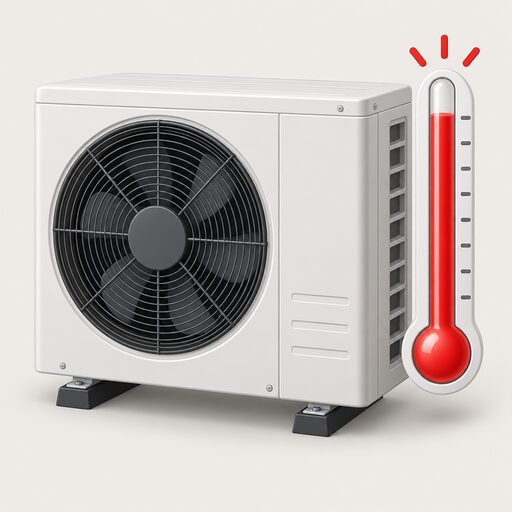 High Temperature Heat PumpsHigh-temperature heat pumps deliver flow temperatures of roughly 65 to 80°C, close to boiler levels, so existing radiators can often stay in place.
 Heat Pumps vs BoilersWill a heat pump actually cost less to run than my boiler, and does it heat the house as well?
 Air Source Heat PumpsHow an air source heat pump takes heat from outdoor air, the difference between air-to-air and air-to-water systems, typical efficiency, the £7,500 Boiler Upgrade Scheme grant, noise and planning limits, and what ownership means for a household's energy independence.
 Shared Ground Loop NetworksA shared ground loop lets several homes draw heat from one set of underground pipes, each with its own heat pump.