

In this answer
Short answer
The short answer is three. Independent guidance from the Energy Saving Trust recommends quotes from at least three installers, and its installation guide is more specific still: at least three MCS-certified heat pump installers, to find the best value1. Citizens Advice gives the same figure for anyone sourcing their own installer, and the recommendation repeats across heating controls, renewable energy systems generally and solar water heating3.
The number matters because a heat pump is a designed system, not a box swapped for a boiler. Government guidance puts it plainly: get at least three installers to quote "so that you can compare costs and design"7. Two quotes tell a household what the work costs. Three begin to show where installers disagree about what the work is.
Why three quotes, and what the comparison is actually for
Three is not a ritual. It is the smallest number that exposes a difference. With one quote, a household sees a price and a proposed system. With three, it sees three heat loss calculations, three proposed flow temperatures, three emitter specifications and three prices for broadly the same house. The variation between them is the information.
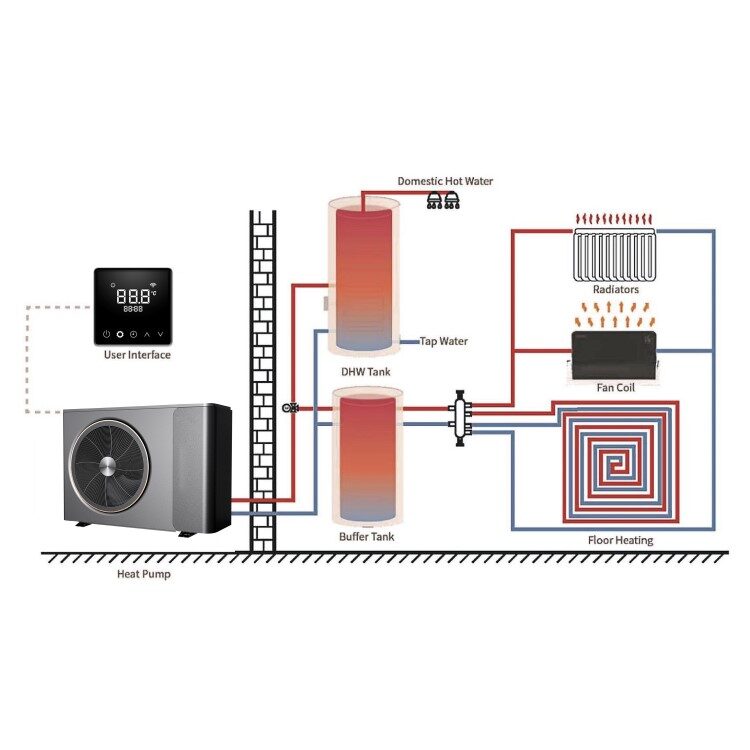
The reason design varies so much is that heat pumps perform differently from combustion boilers. Which? describes a heat pump with a COP of 3.0 as producing three times more heat energy than the electrical energy it consumes, and notes that heat pumps typically deliver three to four units of heat for each unit of electricity11. Government guidance states that heat pumps are now typically more than three times as efficient as a gas boiler12. Those figures are the reason a heat pump can heat a home at all, and they are also the reason sizing and emitter design matter: a system designed around a lower flow temperature needs larger emitters, and a system designed around a higher one may not reach the efficiency the household expected.
That is what the three quotes are testing. An installer who has calculated the heat loss properly will propose a system size and a flow temperature that follow from the calculation. An installer who has not will propose something that looks similar on paper and behaves differently in January.
"We'd recommend getting at least 3 installers to quote, so that you can compare costs and design."
The same three-quote recommendation appears in guidance on heating controls, which recommends quotes from at least three different installers "to make sure you're getting value for money"4. Northern Powergrid's installation guidance for renewable energy systems says to talk to more than one installer and obtain at least three quotes5. The figure is consistent across official, independent and network operator guidance, which is unusual and worth noting.
What to check: MCS certification and qualifications

The certification to look for is MCS. The Energy Saving Trust's moving-house checklist includes the instruction to check whether the heat pump has an MCS certificate, and the installation guide specifies MCS-certified installers rather than installers generally2. Independent guidance on choosing an installer states the same requirement: choose an MCS-certified heat pump installer14.
MCS certification is not a badge of quality in the abstract. It is the route by which a heat pump becomes eligible for the Boiler Upgrade Scheme. Official guidance for installers under that scheme states that installers must be MCS certified and certified to install heat pumps and/or biomass boilers15. A household that uses a non-certified installer may find the installation cannot be grant-funded, and may find the metering information that Ofgem requires cannot be added to an MCS certificate16.
There is a second layer of qualification that applies to the building work rather than the product. Official guidance for Wales sets out that, before work begins, an installer not registered as a competent person must either notify the local authority or arrange for a registered building control approver to oversee the work17. That is a Welsh position and the devolved building regulations differ, so a household in England, Scotland or Northern Ireland should expect the equivalent requirement to be framed differently. The practical point is the same: ask which competent person scheme the installer belongs to, and expect the answer to be specific.
How long it takes: booking delays of a few weeks
The quote process has its own lead time, separate from the installation. One documented case study of a household replacing storage heaters with an air source heat pump reports that booking installers to quote took a few weeks8. That is the period between deciding to get quotes and having three installers in the house, and it is worth building into any timetable.
The installation itself is shorter than most households expect. Independent guidance states that the installation typically takes around three days, though it may take longer depending on the property2. The gap between the two figures, a few weeks to quote and three days to install, is where most of the elapsed time in a heat pump project sits.
There is a third delay that applies to some installations only. Independent guidance notes that some installations may need approval from a distribution network operator, which can add a delay of up to 12 weeks9. Separate guidance puts the average approval time for a heat pump installation at between 2 and 4 weeks under different DNOs10. Those two figures describe different things: a typical approval and a worst case. Where an installation needs a supply upgrade, the DNO process runs alongside the installer's work rather than after it, but it can still set the earliest date the system can be commissioned.

What a quote should cover: design, heat load and controls
A quote that gives a price and a model name is not enough to compare. Official guidance on new dwellings sets out what operating and maintenance information provided to the dwelling owner should include: the heat loss calculation, the design flow temperature, confirmation of the competent person scheme, the size of the emitter circuit, and minimum set back temperatures17. Those five items are a reasonable checklist for what a quote should contain, even though the requirement is written for new build.
The heat loss calculation is the foundation. Independent guidance describes installers calculating the home's heat demand and other information to inform their recommendations2. Without that calculation, the proposed system size is an estimate, and the household has no way to tell whether two installers proposing different sizes are disagreeing about the house or about the method.
Controls belong in the quote rather than in a separate conversation. Independent guidance recommends quotes from at least three different installers for heating controls work4, which implies controls are quoted as part of the job. Design flow temperature and minimum set back temperatures are control settings as much as design decisions, and both appear in the official list of information the owner should receive17.
Metering is the fourth item, and it is easy to overlook. Ofgem's guidance for the Domestic Renewable Heat Incentive sets out heat meter counts by system type: one heat meter for a heat pump with a two-pipe output, two for a four-pipe or three-pipe output or a bivalent system with a two-pipe heat pump, and three for a bivalent system with a four-pipe or three-pipe heat pump, with fewer meters permitted where the manufacturer has integrated metering18. A household that wants to monitor performance, or that is claiming a grant, needs to know which arrangement is being quoted.
When three is not enough: hybrid and complex systems
Three quotes is a floor, not a target. Where the system is more complex, or where the market offers more combinations, more quotes give a household more to compare.
Hybrid systems are the clearest case. Official guidance on domestic hybrid heat pumps notes that there are three packaged solutions on the UK market alongside a large number of add-on hybrid heat pumps19. A packaged hybrid is a defined combination of heat pump and boiler; an add-on hybrid is assembled from parts. Those two categories are not quoted on the same basis, and a household comparing a packaged system against an add-on system is comparing different things unless the quotes make the distinction explicit.
The performance case for hybrids rests on how much of the heating load the heat pump carries. Independent guidance states that, by using a hybrid, 80% of the space heating demand is delivered by a technology that is around three times more efficient20. It also notes that smaller heat pumps require a lower electrical demand, often with only a 6 to 10 amp mains supply necessary20. That lower electrical demand is one of the practical reasons a hybrid is specified, and it is a design point that should appear in the quote.
Complexity also shows up in noise assessment. The MCS 020 calculator supports assessments for one, two and four heat pumps, with four assessment positions per assessment, and requires the make and model and installation location for each unit21. A property needing more than one outdoor unit, or a bivalent system, is a more involved design, and the quote should reflect that work rather than treat it as a single-unit job.
There is a knowledge gap that bears on how many quotes a household may need. Official statistics from the winter 2025 public attitudes tracker report that around a third of owner-occupiers said they did not know enough about each system to make a decision, with 30% saying so for air source heat pumps and 38% for hybrid heat pumps22. Which? reports a third of homeowners thinking the technology would not be good enough to heat their homes23. More quotes, and more detailed quotes, are one way a household closes that gap before committing.
What to compare between heat pump quotes
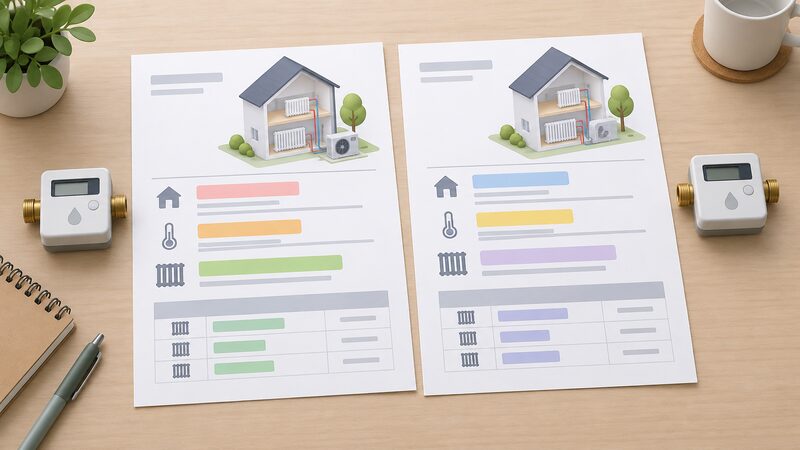
Comparing quotes means comparing the same items across all of them. The table below sets out what to look for and where the requirement comes from.
| Item to compare | What to look for | Basis |
|---|---|---|
| Heat loss calculation | A room-by-room figure, not an estimate from floor area | Official guidance lists it among the information the owner should receive17 |
| Design flow temperature | The temperature the system is designed to run at | Same official list17 |
| Emitter circuit | The size of the emitter circuit, and any radiator changes | Same official list17 |
| Controls | Weather compensation and set back temperatures | Independent guidance recommends three quotes for controls work4 |
| Metering | Heat meter count for the system type quoted | Ofgem guidance sets counts by pipe configuration18 |
| Certification | MCS certification of installer and product | Energy Saving Trust checklist and installation guide2 |
| Grant eligibility | Whether the installer is certified for the scheme | Official Boiler Upgrade Scheme installer guidance15 |
The comparison is not only about price. Two quotes can arrive at the same total through different routes: one specifying a larger heat pump and smaller emitters, another a smaller heat pump and larger emitters. Both may work. Only the heat loss calculation shows which is sized to the house.
What this means for a household's energy independence

A heat pump moves a home's heating off gas and onto electricity, which changes where the dependence sits rather than removing it. The household still relies on the grid, on an electricity supplier, and on the manufacturer for parts and, in many cases, for controls that connect to an app or a cloud service. What changes is the fuel: imported gas is replaced by domestically generated and increasingly renewable electricity, and the efficiency figures are the reason that substitution works at all. Government guidance puts heat pumps at more than three times the efficiency of a gas boiler12, and Which? puts the typical range at three to four units of heat per unit of electricity11.
The quote process is where that independence is either designed in or designed out. A system sized from a proper heat loss calculation, with emitters and controls specified to match, will run at a lower flow temperature and use less electricity for the same warmth. A system sized by rule of thumb may still heat the house, but it will lean harder on the grid and on the household's bills. The three-quote recommendation exists because that difference is invisible in a single quote.
The dependence that remains is real and worth stating. A heat pump needs electricity, and a household without on-site generation is buying that electricity from a supplier. Controls that rely on a manufacturer's app or cloud service add a second dependency, on a company rather than a network. Metering, whether required for a grant or chosen for monitoring, is what lets a household see whether the system is performing as designed, and it is worth having in the quote from the start18.
Sources23 cited
- Heat pump fact check, Energy Saving Trust, 2026-07-01
- Heat pump installation: a step by step guide, Energy Saving Trust, 2026-07-15
- Deciding if a heat pump is right for you, Citizens Advice, 2025-12-08
- Thermostats and heating controls, Energy Saving Trust, 2026-02-10
- Renewable energy installation, Electricity North West, 2026-09-19
- Could solar water heating work for you, Energy Saving Trust, 2026-05-20
- Heat pumps explained: experts answer your questions, GOV.UK, 2024-03-28
- Joanna O'Loan: upgrading storage heaters with an air source heat pump, Energy Saving Trust, 2026-02-19
- Three steps to unlocking heat pumps as an option to replace broken boilers, Nesta, 2026-07-27
- How to get homes more ready for heat pumps, Nesta, 2026-02-12
- An introduction to heat pumps, Which?, 2025-09-22
- Heat pumps investment roadmap, Department for Energy Security and Net Zero, 2023-04-03
- Moving house energy checklist, Energy Saving Trust, 2026-05-01
- Heat pump guide: UK air source vs ground source explained, IAA, 2026-09-20
- Boiler Upgrade Scheme guidance for installers v5.1, Ofgem, 2026-07-02
- Eligible heating systems, Ofgem, 2026-09-17
- Approved Document L Volume 1, consultation version, Welsh Government, 2026-09-17
- Domestic RHI: guide to metering, Ofgem, 2022-03
- Domestic hybrid heat pumps, Department for Business, Energy and Industrial Strategy, 2016-11
- Heat pump guide, HHIC, 2026-09-17
- MCS 020 noise assessment calculator, MCS Certified, 2026-09-19
- DESNZ public attitudes tracker: heat and energy use in the home, winter 2025, Department for Energy Security and Net Zero, 2025
- Warm Homes Plan, Which?, 2025
 Comparing Installation QuotesWhat should a solar or heat pump quote actually include before you pay a deposit?
 Getting Installation QuotesHow householders obtain quotes for boilers, heat pumps and solar PV, how many quotes are usually recommended, what a survey should involve, and the difference between an estimate, a quotation and a fixed price.
 Sizing and Heat LossHow do installers work out what size heat pump your home needs, and why can a unit that is too big cost more to run than one that is slightly small?
 Hybrid Heat PumpsHow hybrid systems pair a heat pump with a gas, oil or LPG boiler, what decides which appliance runs, what they cost, how much gas they displace, and why the Boiler Upgrade Scheme will not fund them.
 The Full Heat Pumps GuideWill a heat pump keep my house warm in winter, and what does one cost to buy and run?
 Heat Pump Install StatisticsHow many heat pumps are actually being fitted in the UK each year, and is that number going up?