

In this guide
A competent person scheme is a way for tradespeople to prove their ability to carry out certain work to required standards, instead of the householder applying for building regulations approval. An installer of windows, boilers, electrics, solar panels or a heat pump who is registered with a relevant scheme can self-certify that their work complies with the building standards, notify the local authority themselves, and issue a certificate of compliance. Where a registered installer is used, the householder does not need to get approval, and does not have to ask the local council or a private approved building inspector to check the work1.
Membership is voluntary. Schemes are trade-specific: an installer chooses a scheme that supports their trade or types of work, and schemes differ in their application processes and fees. Installers who do not join, or who prefer not to use the route on a given job, can still use local council or private inspectors2. That is the structural point for a household: self-certification is a substitute for a building control application, not a substitute for the Building Regulations themselves, which set standards for the design and construction of buildings to ensure the safety and health of people in or around them and include requirements to ensure that fuel and power is conserved3.
For a household pursuing its own generation, storage or low-carbon heating, the scheme route is the normal way that solar PV, heat pumps, ventilation, chargepoints and heating work become documented as compliant. The dependence that remains is real: the certificate comes from a private scheme operator, its insurance-backed warranty and complaints procedure are the operator's products, and the legal responsibility for compliance stays with the building owner, who may be served with an enforcement notice if the work does not comply1.
Why the schemes exist at all
Building regulations apply to a wide range of domestic work: putting up a new building, extending or altering an existing one, and providing services or fittings such as hot water cylinders, drainage, replacement windows and fuel burning appliances of any type. Building work also covers the insertion of insulation into a cavity wall, underpinning, and work affecting the thermal elements, energy status or energy performance of a building. Some kinds of project are exempt, and the regulations may also apply to certain changes of use9.
Requiring a building control application for every boiler swap, every window and every new circuit would be slow and costly, so the self-certification route was created. Official guidance describes it plainly: an installer can join a scheme to self-certify certain types of building work if they work in the building trade, and this is instead of getting building regulations approval10. The heating trade body OFTEC describes the schemes as having been introduced so that registered heating businesses can self-certify the installation work they carry out11.
The direction of travel is toward more reliance on scheme registration, not less. The government's Future Homes and Buildings Standards consultation response states that significant amendments have been made to the Approved Documents to say that a competent person scheme should be used when undertaking a heat pump or mechanical ventilation installation12.
Self-certification and building control: two routes to the same compliance
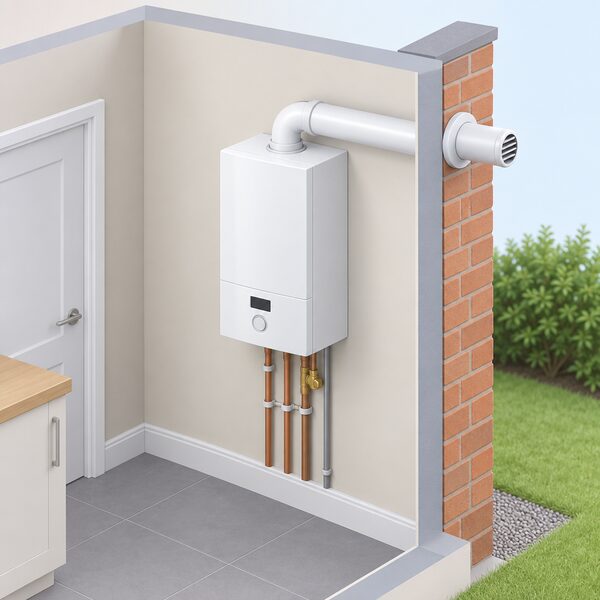
The two routes lead to the same legal outcome, a compliant installation with documentary evidence, but they differ in who checks and who notifies.
| Registered competent person | Building control route | |
|---|---|---|
| Approval before work | Not needed; a registered installer is approved to carry out the work to comply with building regulations without involving local authority building control13 | Notice must be given to the local authority in advance, or a registered building control approver arranged to oversee the work14 |
| Who certifies | The installer, self-certifying compliance1 | The building control body, after inspection |
| Notification | The installer notifies the local authority, directly or through the scheme operator16 | The householder or firm notifies, and pays a notification fee14 |
| Inspection by council or private inspector | Not required2 | Required |
A householder who is quoted for work by a firm outside any scheme should expect the cost and timing of the building control route to be part of the job. Official guidance on boilers is explicit that such an installer will not be able to self-certify that their work is compliant, and that the firm or the householder will need to give notice to the local authority in advance and pay a notification fee14. The same pattern applies to heat pumps, where the Approved Document requires an installer who is not a registered competent person to notify an appropriate building control body before work begins18, and to domestic electric vehicle chargers, where notifiable work must be reported to the local building control body unless completed by someone registered on the competent person scheme who can provide a compliance certificate19.
Building control bodies may also accept certification under independent schemes of certification and accreditation of installers as evidence of compliance with a relevant standard15.
Part P: the electrical work that must be notified or self-certified
Part P applies to all new electrical work in a dwelling, including houses, flats and maisonettes, and to installations operating at voltages not exceeding 1000 V a.c. in or attached to a dwelling20. The Building Regulations set standards for electrical installation work in dwellings; they do not set standards for the safety of electrical appliances, but they do require that fixed connections of appliances are safe21.
With the exception of some minor tasks, electrical work must either be reported to the local authority building control body before it starts, or be carried out by a registered electrician who is a member of a Government-approved scheme22. Notifiable work includes new installations, house re-wires, the installation of new circuits, and additions to existing circuits in special locations, a special location including a room containing a bathtub or shower7.
Part P applies to all electrical work in dwellings whether carried out by professionals or by people doing it themselves7. Doing the work yourself does not remove the duty; it removes the self-certification option, leaving the building control route. Electrical Safety First states that Part P was introduced to increase the safety of households by improving the standard of electrical wiring in homes, that public awareness of Part P is as low as 10%, and that the Electrical Safety Council is campaigning for better enforcement8. The IET notes the government estimate that around 30 per cent of electrical accidents could be prevented through regulation7.
"Failure to comply with the Building Regulations is a criminal offence and local authorities have the power to require the removal or alteration of work"
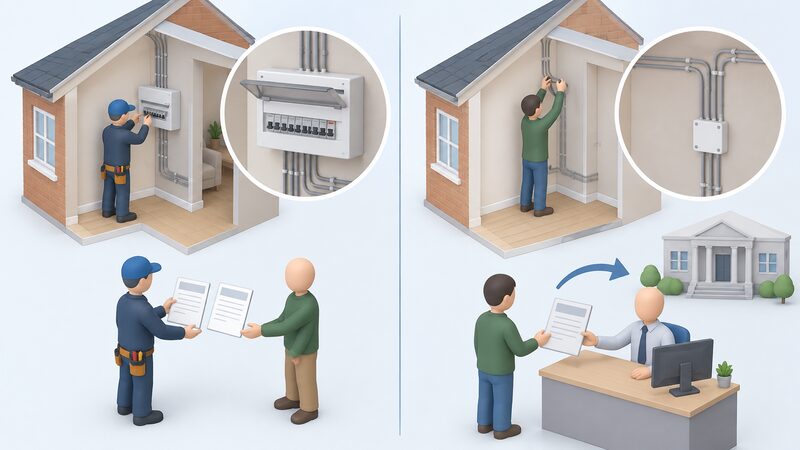
Where a scheme member does the work, the client must receive both a copy of the self-certification certificate and a BS 7671 electrical installation test certificate24. Local authority guidance asks for a copy of the installer's electrical installation test certificate compliant with BS 7671 to be supplied to the authority25, and treats an electrical installation certificate issued under a competent person scheme as one route to demonstrating completion25. Electricians register with an approved self-certification organisation, described in council guidance as a government approved scheme26. Further detail on who can self-certify electrical work and on verifying an electrician's registration is covered separately.
Which schemes cover which trades
No single scheme covers everything. Schemes are authorised for particular work types, and an installer must choose one that supports their trade2. Council and scheme guidance names schemes including NAPIT, ELECSA and NICEIC for electrical work27; NICEIC states that its registered electricians are deemed competent to self-certify their work as compliant with the Building Regulations20. For windows and doors, Certass describes its competent person scheme, under which installers are assessed and inspected on a regular basis and householders receive Building Regulation Compliance Certificates28. OFTEC operates as a scheme provider for heating businesses11. For mechanical ventilation and air conditioning systems in dwellings there are currently four registered competent person schemes: BESCA, Blue Flame Certification, Certsure and Napit12.
| Work type | Scheme names given in guidance |
|---|---|
| Domestic electrical | NAPIT, ELECSA, NICEIC27 |
| Windows and doors | Certass competent person scheme28 |
| Oil and renewable heating | OFTEC as scheme provider11 |
| Mechanical ventilation and air conditioning in dwellings | BESCA, Blue Flame Certification, Certsure, Napit12 |
| Energy efficiency measures under ECO4 Flex | MCS, NICEIC, CIGA, Stroma named as examples29 |
Council guidance for ECO4 Flex describes the effect directly: if the installer is part of a competent person scheme such as MCS, NICEIC, CIGA or Stroma, they can self-certify their work and will not need building regulations approval from the council29. TrustMark is described in council guidance as a competent person register for finding an installer that will assess your circumstances and property to identify suitable measures30. Individual scheme pages cover NICEIC registration, NAPIT, OFTEC, HETAS, FENSA and Certass, MCS and TrustMark in more detail.
Scope matters more than the logo. Guidance on solid fuel and oil fired boilers says an installer should be registered with the competent person schemes for that appliance type14; for micro combined heat and power the advice is to contact an installer who belongs to the relevant competent person scheme14. A scheme membership held for one trade does not carry across to another.
How installers are assessed and inspected

Before approval, an installer's work is assessed to check they meet the level of competence required2. After approval, gov.uk sets out the inspection pattern: yearly for the first 2 years, with ongoing inspections thereafter2. Certass describes its own registrants as assessed and inspected on a regular basis to ensure that workmanship standards are up to scratch, and regularly audited so that they can register their own work28.
That is the mechanism that gives the certificate its weight. A self-certification certificate is not a declaration made on trust alone: it is issued by a firm whose work has been sampled before entry and is sampled again on a cycle. The limits should be stated as firmly. Inspection is by sample, not job by job, so no scheme inspects every installation; and the certification condition is narrow. The Approved Document F guidance is explicit that work can only be certified by a member of a competent person scheme if the work complies with the Building Regulations31. Certification of non-compliant work is outside the scheme's authority, which is why the complaints and warranty machinery exists behind it.
Where energy performance work is concerned, the Approved Document expectations bear on the installer's conduct as well as their paperwork: a registered competent person installing a heat pump is expected to install and commission the system to the standards set out in the approved document and to give notice to the building control authority that commissioning has been carried out in accordance with it18. For ventilation, the government's position is that those installing and commissioning ventilation systems should typically be a member of a competent person scheme or an equivalent body, while for lower risk work such as a single intermittent extract fan adequate training is expected without scheme membership12.
What you receive: certificates, deadlines and evidence of compliance
When work is complete the householder receives a certificate showing the work was done by a registered installer13, which can be used as evidence of compliance1. Welsh Government guidance says the registered installer should both notify the local authority of the work and issue a certificate of compliance with Building Regulations, either directly or through the scheme operator16.
The deadline is where the documents diverge. Most guidance gives 30 days. Council guidance on electrical work says the competent person is to send a self-certification certificate to the local authority within 30 days of completion24; Welsh guidance says the electrician will arrange for a building regulations compliance certificate within 30 days of completion21; Approved Document L requires the notice to be given to the building control body within 30 days of the work being completed6; the Part J guidance for Wales requires the occupier to be given a certificate within 30 days of completion32; Approved Documents L2B and L1B for Wales use thirty days of completion33; and gov.uk guidance on replacements and repairs advises contacting the scheme operator if a certificate has not arrived within 30 days of completion5. Against that, the gov.uk competent person scheme page states the scheme will give a certificate within 8 weeks of completion1.
What the paperwork consists of depends on the trade:
- Electrical work: a copy of the self-certification certificate and a BS 7671 electrical installation test certificate24, plus a completed Electrical Installation Certificate showing the work was tested for safety21.
- Boiler work: a commissioning certificate such as a Benchmark certificate, with the installer notifying local authority building control directly or via the scheme operator, and the local authority supplying a building regulations completion certificate17.
- Boiler documentation generally: a completed installation record, a commissioning certificate and a user instruction manual36.
- Windows and doors under a scheme: Building Regulation Compliance Certificates28.
The certificates issued after an installation, and the purpose of a Building Regulations Compliance Certificate, are covered separately.
Where the work is exempt or non-notifiable
Not all work needs notifying at all, and this is where households most often misjudge the position. For electrical work, Welsh Government guidance states that repairs, replacements and maintenance work, and extra power points or lighting points or other alterations to existing circuits, do not need to be reported, except in a kitchen or bathroom, or outdoors21. The IET describes non-notifiable work as additions and alterations to existing installations outside special locations, together with maintenance, replacement and repair work, and says notification or deposit of full plans is generally required only if the work is major, involves one or more complete new circuits, and is not carried out by a contractor registered with an authorised self-certification scheme7.
Elsewhere, scheme membership removes the application rather than the rules. Refurbishing a dormer roof with insulation does not require an application for approval if the work is completed by a member of a competent persons scheme37. Approved Document L states that a building control body does not need to be notified for certain services or fittings, including fuel-burning appliances or replacement windows, where the owner employs an installer registered with a relevant competent person scheme designated in the regulations6. Council guidance treats electrical work in new dwellings and extensions as notifiable unless the installer is a member of a competent persons self-certification scheme26.
One limit applies whichever route is used: the works must not make other fabric, services and fittings less compliant than they were before, or dangerous. The published example is replacement double-glazing, which must not make compliance worse in relation to means of escape, air supply for combustion appliances and their flues, and ventilation for health9.
Scotland, Wales and Northern Ireland
The competent person scheme framework, including Part P, is an England and Wales arrangement20. OFTEC states that installation work carried out since 2002 in England, Wales, the Isle of Man and the Channel Islands must be notified to the local authority building compliance department11. Welsh Government publishes its own competent person scheme guidance for householders, with the same self-certification and notification duties and the same 30 day certificate expectation16.
Scotland operates a different system. Scottish building regulations set minimum standards applicable to new buildings and to new work to existing buildings38. The regulations always apply where construction occurs, unless exempted by regulation 3, and construction includes alterations and extensions as well as entirely new buildings; changes of occupation or use listed in schedule 2 are conversions, for which the owner must obtain a warrant, granted only if the standards in regulation 12 are achieved, and for which thermal insulation has to be improved even where meeting the full standard is not practically achievable39. Regulation 3 also exempts the provision of services, fittings and equipment to exempted services, fittings and equipment40. Scottish technical guidance expresses competence for plumbing and associated water installations as work carried out and commissioned by persons who possess sufficient technical knowledge, relevant practical skills and experience, rather than by scheme registration41. Scottish building regulations were revised to amend Section 0 General, Section 2 Fire, Section 3 Environment and Section 4 Safety for use from 6 April 202639.
Northern Ireland guidance on solid fuel stoves states that although qualifications are not mandatory, any person fitting a solid fuel stove must be competent to do so and should be familiar with the correct procedures and associated regulatory requirements42.
Funded work adds its own layer. Under the Green Homes Wales loan terms, installers must be registered with TrustMark and with the relevant body for the type of eligible measure, must comply with relevant PAS certification, and must not be the borrower or a member of the borrower's household or immediate family; a retrofit coordinator named in the grant offer letter must be instructed, work must not start before the letter is issued, and no other public financial support may be received43. Guides to using an installer in England, Scotland, Wales and Northern Ireland set out each position in full.
What scheme membership means for the household
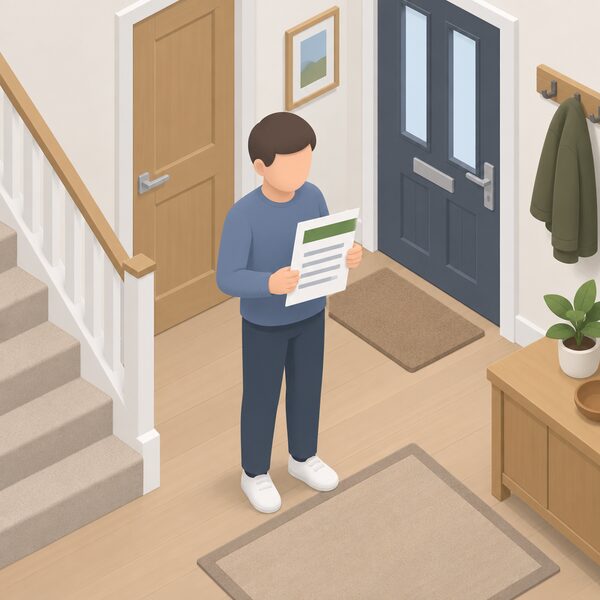
The practical benefits are specific. The scheme certificate is usable as evidence of compliance, and gov.uk states it will also show up in solicitors' searches if you come to sell your home; Electrical Safety First notes that electrical work complying with Part P is reported as part of local authority searches1. Competent person schemes have insurance-backed warranties and complaints procedures if there is a problem with the work1, and gov.uk guidance on replacements and repairs states that a scheme gives financial protection to cover the event of non-compliant work being found where the installation company has gone out of business5.
For a household building its own generation and heat, the scheme route is what turns a solar array, a heat pump, a chargepoint or a new circuit from a private arrangement into documented, saleable compliance. Solar PV, wind turbines attached or unattached to the house, electric underfloor heating, gas appliances and new window openings all have a published self-certification route through a scheme member45. Building regulations will normally apply to roof-mounted solar panels, and also to other aspects of the work such as the electrical installation45.
The dependencies that remain are worth naming. The certificate comes from a commercial scheme operator, not from the state; the warranty and complaints route behind it are that operator's, with its own terms; inspection is periodic and by sample; and membership is voluntary, so a capable firm may be outside every scheme and a registered firm may be outside scope for the particular measure being installed. Checking scope before signing, rather than the logo, is what the published guidance asks of a householder: check that the installer is a member of a scheme covering the work they will be undertaking45. Where that has not happened, complaining about an installer and insurance-backed guarantees set out the escalation.
Sources49 cited
- Use a competent person scheme, GOV.UK, 2026-09-17
- Building regulations: competent person schemes, GOV.UK, 2026-09-17
- Planning permission and building regulations compared, Planning Portal, 2026
- Difference between building regulations and planning permission, Planning Portal, 2026
- Building work: replacements and repairs to your home, GOV.UK, 2014-11-03
- Approved Document L, Volume 1: Dwellings, 2021 edition incorporating 2023 amendments, GOV.UK
- Part P frequently asked questions, The IET, 2026-09-17
- House buyer beware: illegal electrics in hundreds of homes, Electrical Safety First, 2026-09-19
- Building regulations, Planning Portal, 2026
- Competent person scheme: current schemes and how schemes are authorised, GOV.UK, 2013-04-04
- Frequently asked questions, OFTEC, 2026-09-17
- Future Homes and Buildings Standards consultation response, GOV.UK, 2026-03
- Building regulations: doors and windows, Welsh Government, 2026-09-17
- Building regulations: boilers and heating, Welsh Government, 2026-09-17
- Approved Document L Volume 1 consultation version, Welsh Government, 2026-09-17
- Building work: competent person schemes, Welsh Government, 2023-04-05
- Boilers and heating: building regulations, Planning Portal, 2026
- Approved Document L, Volume 1: Dwellings, GOV.UK, 2026
- Electric vehicle charging: building regulations, Planning Portal, 2026-09-17
- Wiring a shed: a guide for homeowners, NICEIC, 2026-09-17
- Building regulations: electrics, Welsh Government, 2026-09-17
- Part P of the Building Regulations, Electrical Safety First, 2026-09-17
- Building regulations and finding a registered electrician, Electrical Safety First, 2026-09-17
- Building regulations and electrical works, Richmond Council, 2026-06-02
- Building control application guidance notes, Bromley Council, 2026-09-17
- Electrical safety and building regulations, Cumberland Council, 2026-09-17
- Installing solar panels on your home, Brighton and Hove City Council, 2026-09-17
- Replacing windows and doors, Certass, 2018-05-03
- ECO4 Flex, South Cambridgeshire District Council, 2026-09-17
- Energy Company Obligation scheme and home energy efficiency, Leeds City Council, 2026-09-20
- Approved Document F Volume 1: Dwellings, frequently asked questions, GOV.UK, 2022-06-15
- Building regulations guidance Part J: heat producing appliances, Welsh Government, 2026-09-17
- Approved Document L2B consultation version, Welsh Government, 2020-11
- Building regulations guidance Part L1B: existing dwellings, Welsh Government, 2014-07
- Register energy devices in homes or small businesses, GOV.UK, 2021-03-31
- Quick guide to the building regulations, Welsh Government, 2021-12
- Refurbishing an existing dormer roof with insulation, Planning Portal, 2026
- Building regulations Passivhaus equivalent, stage 2, Scottish Government, 2026-09-17
- Building Standards Technical Handbook, Domestic, April 2026, Scottish Government, 2026-03
- Exempted buildings, services, fittings and equipment, Scottish Government, 2020-12-02
- Water efficiency, Scottish Government, 2022-06-01
- Stove guidance for householders, Building Control Northern Ireland, 2015-11
- Green Homes Wales loan standard terms and conditions, Development Bank of Wales, 2026-09-17
- When you need building regulations approval, Planning Portal, 2026
- Solar photovoltaics and planning in conservation areas, West Suffolk Council, 2026-09-17
- Wind turbines: building regulations, Planning Portal, 2026
- Building regulations approval for underfloor heating, Planning Portal, 2026
- Boilers and heating smart search, Planning Portal, 2026
- Rules around fitting a log burner, Planning Portal, 2026-09-17
 Competent Person SchemesIf a tradesperson says they can sign off their own work, how do you know they are genuinely registered?
 Using an Installer in WalesExplains how installer registration, competent person schemes and building control notification apply in Wales and where Welsh rules diverge.
 Using an Installer in EnglandHow do you check an installer is registered to sign off their own work, and what happens if they are not?
 Installer QualificationsWhat training and qualifications should a heat pump installer actually have?
 Checking an InstallerBefore you sign anything, how do you know your installer is genuine?
 The Full Installers GuideHow do you find an installer you can trust, and what should you check before signing anything?